
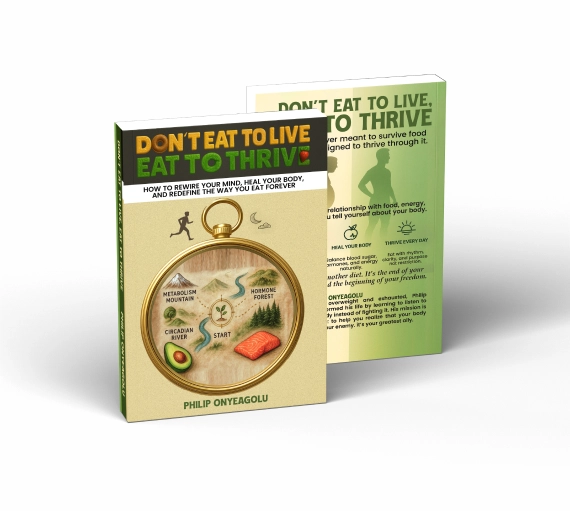
Don’t Eat to Live, Eat to Thrive

Don’t Eat to Live, Eat to Thrive

How to Rewire Your Mind, Heal Your Body, and Redefine the Way You Eat Forever

Don’t Eat to Live, Eat to Thrive by Philip Onyeagolu is an invitation to step out of survival mode and into a way of living that feels grounded, energized, and sustainable. This book challenges the belief that health is earned through restriction, guilt, or relentless discipline. Instead, it reframes wellbeing as a biological conversation, one where the body responds not to force, but to alignment.

Written with clarity and compassion, this Eat to Thrive health book guides readers toward understanding how daily choices influence energy, focus, hunger, and long-term vitality. Rather than offering rigid rules or temporary fixes, it provides a clear direction rooted in how the body naturally functions when properly supported. The result is not just physical change, but a renewed sense of trust in one’s own biology.

As a work of modern wellness nonfiction, the book bridges science with lived experience, making complex concepts accessible without oversimplifying them. Readers are encouraged to move away from punishment-based habits and toward nourishment that supports resilience, balance, and clarity.

At its core, Don’t Eat to Live Eat to Thrive book is about redefining health as something you live with daily, not something you constantly chase. It is a starting point for lasting change that feels intuitive, empowering, and deeply human.

For decades, diet culture has taught people to view food as something to control, fear, or earn. Calories are counted, bodies are judged, and progress is measured by deprivation rather than wellbeing. This holistic wellness book moves in the opposite direction, asking a more meaningful question: what happens when the body is supported instead of punished?

Rather than isolating weight, food, or exercise as separate problems, the book presents health as an interconnected system. Energy, digestion, mood, sleep, and motivation are shown to be deeply linked, each influencing the other in subtle but powerful ways. When one area is ignored, the system struggles. When the whole is addressed, healing becomes possible.

This perspective allows readers to experience true change without the cycle of guilt and relapse that defines most health plans. As a health and wellness transformation book, it focuses on restoring balance through understanding rather than restriction. The emphasis is not on short-term results, but on building habits that align with how the body naturally works.

By treating nourishment, movement, and recovery as parts of a single equation, the book supports whole-body health book principles that last. The result is a calmer, more sustainable relationship with food and with oneself, rooted in awareness instead of control.

Many people believe a slowing metabolism is a personal failure, something caused by age, lack of effort, or not trying hard enough. This section reframes that belief by explaining how the body adapts to stress, under-fueling, and constant pressure. As a metabolism health guide, the book shows that metabolic slowdown is not a flaw, but a protective response.

Instead of pushing the body harder through extreme plans, the focus shifts toward restoring balance. Readers learn how consistent nourishment, proper recovery, and reduced stress can signal safety to the body, allowing it to function efficiently again. This approach removes the need for endless restriction and replaces it with strategic support.

Unlike traditional weight-loss narratives, this sustainable weight loss book does not chase quick results. It emphasizes steady progress that respects the body’s internal systems, helping weight change occur as a natural outcome of improved metabolic health rather than constant control.

By teaching readers how to restore metabolism naturally, the book empowers them to move away from cycles of burnout and regain trust in their body’s ability to regulate itself. The result is not just physical change, but renewed energy, mental clarity, and a sense of stability that lasts beyond any temporary plan.

Eating is never just a physical act. Emotions, stress levels, habits, and past experiences all shape how and why we reach for food. This mind body nutrition guide explores the often-overlooked connection between emotional states and eating patterns, helping readers understand that cravings are not a lack of control, but meaningful signals.

Rather than framing emotional eating as a failure, the book approaches it with compassion and curiosity. Readers are guided to recognize patterns such as stress-driven snacking, fatigue-related cravings, and using food for comfort during emotional overwhelm. Through this lens, healing becomes possible without shame. As an emotional eating recovery book, it encourages awareness and responsiveness instead of suppression.

The role of stress is also examined in depth, revealing how chronic pressure disrupts appetite signals, energy levels, and mood regulation. By addressing this relationship directly, the book functions as a stress and nutrition health book, showing how calming the nervous system can naturally rebalance hunger and satisfaction.

When emotional health and physical nourishment are treated as interconnected, food becomes supportive rather than controlling. This section helps readers rebuild a relationship with eating that is grounded, intentional, and aligned with both body and mind.

Confusion around nutrition often comes from conflicting advice, rigid rules, and fear-based messaging. This section brings clarity by stripping away extremes and focusing on how the body actually responds to nourishment. As a non-diet nutrition book, it removes moral judgment from food and replaces it with understanding.

Rather than labeling foods as “good” or “bad,” the book explains how balance, timing, and quality influence energy, digestion, and long-term health. Readers are encouraged to listen to biological feedback instead of external rules. This approach allows nutrition to feel supportive rather than restrictive, restoring confidence in everyday choices.

Grounded in research but written in accessible language, the book stands as a science-based wellness book that translates complex physiology into practical guidance. The emphasis is on consistency and sustainability, not perfection. Small, repeatable actions are shown to have a greater impact than dramatic but short-lived changes.

By offering a clear framework for nutrition without dieting book principles, this section helps readers step away from cycles of deprivation and rebound. Food becomes a tool for stability and clarity rather than stress, allowing health improvements to unfold naturally over time without the pressure of constant self-control.

True health is not created in short bursts of motivation. It is built through daily patterns that support the body over time. This section positions the book as a lifestyle medicine book, showing how small, intentional choices compound into meaningful, lasting change. Health is presented not as a goal to reach, but as a state to maintain.

Rather than focusing solely on symptoms or quick interventions, the book emphasizes prevention, restoration, and resilience. Readers learn how habits related to sleep, movement, stress management, and nourishment work together to protect long-term wellbeing. This approach supports healing at the root level, reducing the need for constant correction later.

As a long-term health and vitality book, the emphasis is on sustainability. The strategies shared are realistic, adaptable, and designed to fit into real lives, not idealized routines. By respecting the body’s natural rhythms and recovery needs, vitality becomes something that grows steadily instead of fluctuating.

Through the lens of a preventive health guide, the book encourages readers to take ownership of their wellbeing before imbalance turns into illness. It reframes health as an ongoing relationship with the body, one built on awareness, consistency, and respect rather than urgency or fear.

Lasting change does not come from willpower alone. It comes from having a clear structure that supports consistent action without overwhelm. This section presents the book as a wellness reset guide, offering readers a practical framework they can return to whenever life feels off balance.

Rather than prescribing rigid routines, the blueprint adapts to individual lifestyles. It helps readers identify which daily habits support energy and which quietly drain it. By focusing on alignment instead of intensity, the book encourages steady progress that feels manageable and empowering rather than exhausting.

As a healthy lifestyle transformation book, it shows how sustainable living is built through small, repeatable choices that respect the body’s needs. Readers are guided to simplify their approach to health, replacing complexity with clarity and pressure with direction.

This structure also supports long-term consistency, positioning the book as a health book for sustainable living. It emphasizes integration over perfection, allowing health practices to evolve naturally alongside changing seasons of life. The result is a sense of stability and confidence, where wellbeing becomes part of everyday living rather than a constant project to fix.

Don’t Eat to Live, Eat to Thrive by Philip Onyeagolu

Available now on Amazon and major platforms.

🔗 For Amazon: Click here

Philip Onyeagolu writes from a place of clarity, purpose, and deep respect for the human body’s intelligence. His work reflects a belief that health is not something to be forced, but something to be restored through understanding and consistency. Through his writing, he invites readers to reconnect with their biology rather than fight against it.

As the voice behind this wellness mindset transformation book, Philip brings together science, lived experience, and practical insight in a way that feels grounded and accessible. His approach avoids extremes and instead focuses on helping readers recognize patterns, make informed choices, and build habits that support long-term wellbeing.

What sets his work apart is its emphasis on direction rather than discipline. This modern health transformation book does not promise shortcuts or dramatic fixes. Instead, it offers a steady path toward clarity, balance, and vitality, guided by respect for how the body naturally functions.

Positioned firmly as a nonfiction wellness guide, Philip’s work speaks to readers who are ready to move beyond confusion and reclaim trust in themselves. Behind the pages is an author committed to helping people shift from merely getting through life to living with intention, resilience, and renewed energy.

For future updates, insights and upcoming releases, follow Philip Onyeagolu on his official social media pages:

🔗 Personal Facebook Profile: Click here

🔗 Eat to Thrive Facebook Page: Click here