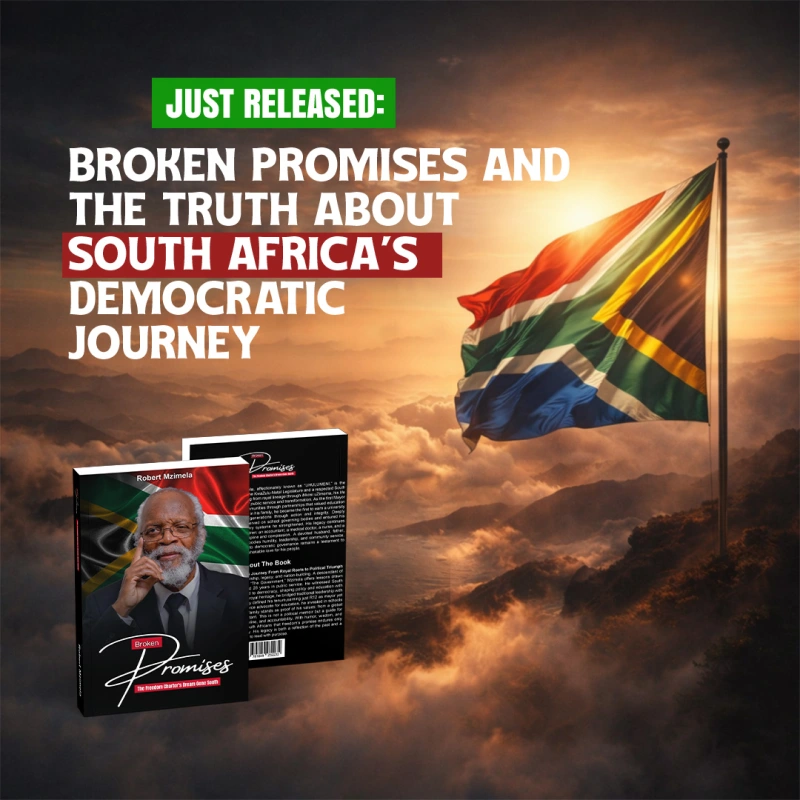
Muntuwenkosi Robert Mzimela does not approach this reckoning from distance or ideology. He writes from within the journey itself, from the long arc between apartheid and democracy, between promise and practice. His perspective is not fueled by outrage, but by responsibility. He does not dismiss the Freedom Charter as naive. He treats it as what it was always meant to be: a blueprint whose realization depends on leadership, sacrifice, and civic integrity across generations.
This is why Broken Promises matters now. Not because it revisits history, but because it interrogates what has been done with it. At a time when political discourse often trades in slogans rather than solutions, this work restores something essential, moral seriousness. It invites South Africans to move beyond inherited narratives and ask what kind of country they are actively building.
Democracy is not sustained by memory alone. It is sustained by choices. This book is a call to examine those choices, honestly, responsibly, and without fear.
What gives Broken Promises its authority is not theory, but experience. Muntuwenkosi Robert Mzimela does not write as a distant observer of South Africa’s democratic experiment. He writes as someone who stood inside it, shaping policy, guiding institutions, and witnessing the weight of leadership from within the machinery of government itself.
With nearly eight decades of life behind him and close to three decades of public service, Mzimela’s perspective is forged in responsibility rather than rhetoric. He lived through apartheid, through the exhilaration of 1994, and through the complex realities that followed. His journey is one of continuity, bridging traditional leadership with democratic governance, heritage with reform, and authority with accountability. As a descendant of iNkosi uZimeme and a senior figure in KwaZulu governance, his life embodies a rare convergence of cultural legacy and modern statecraft.
This is not the voice of a politician defending a record, nor that of a commentator critiquing from the sidelines. It is the voice of a builder, of schools, institutions, and community frameworks designed to outlast individual office or recognition. Mzimela did not measure leadership by personal advancement. He measured it by impact. He governed the same schools his own children attended. He served without privilege, without spectacle, and without the trappings that often define political power. In an era increasingly marked by entitlement and self-interest, his example stands apart.
Throughout Broken Promises, that lived credibility matters. When he speaks of democracy, it is not as an abstraction. When he speaks of governance, it is not as ideology. It is as a practitioner who understands how policy becomes consequence, how decisions ripple into communities, and how leadership, when rooted in service, can shape generations.
This is what distinguishes Mzimela’s work. He does not claim moral authority. He has earned it. And in a national conversation too often dominated by noise, his voice carries something rarer: weight.
At its core, Broken Promises is not an exercise in nostalgia, nor is it a lament for a past that cannot be recovered. It is a reckoning. Muntuwenkosi Robert Mzimela takes the ideals of the Freedom Charter seriously enough to ask why so many of them remain unrealised in the daily lives of ordinary South Africans. His message is neither partisan nor abstract. It is rooted in consequence.
The book moves through the pillars that once defined the promise of democracy and measures them against lived reality. Employment was meant to restore dignity through opportunity, yet mass unemployment has instead become a defining condition of the present. Education was envisioned as a pathway to equality and empowerment, but deep disparities in access and quality continue to shape who advances and who is left behind. Land reform was meant to correct historical dispossession, yet decades later it remains one of the most unresolved and emotionally charged questions in the country. Healthcare, social justice, freedom of expression, and the integrity of democratic institutions are all examined through the same lens: what was pledged, and what has been delivered.
Mzimela does not reduce these issues to slogans or party positions. He approaches them as a statesman who understands how policy decisions become social realities. Corruption, mismanagement, and political recycling are not treated as distant scandals, but as forces that erode trust, hollow out institutions, and weaken the moral foundation of governance itself. For him, the greatest danger is not disagreement, it is indifference. A democracy, he argues, does not fail overnight. It frays when accountability becomes optional and responsibility is deferred.
Yet Broken Promises is not written in bitterness. It is written in conviction. The Freedom Charter is not dismissed as idealism, but upheld as a blueprint that still demands action. Each generation, Mzimela insists, inherits not only the benefits of democracy, but the duty to protect its integrity. Voting is not a favour granted by leaders; it is a responsibility carried by citizens. Leadership is not a reward for loyalty; it is a burden of service.
In confronting what has gone wrong, this book does something rare. It refuses both despair and denial. It challenges South Africans to look honestly at the distance between promise and practice, not to abandon the democratic vision, but to reclaim it with courage, discipline, and moral clarity.
What sets Broken Promises apart is not only what it critiques, but the standard it quietly restores. Throughout the book, Muntuwenkosi Robert Mzimela returns to a principle that has grown increasingly rare in public life: leadership is not a position of advantage, but a commitment to serve.
His own life stands as evidence of that belief. He did not govern from distance or exemption. The schools he helped oversee were the same schools his children attended. The policies he supported were lived, not abstract. He did not build status for himself, but institutions meant to outlast his tenure. In a political culture often defined by personal enrichment and symbolic authority, Mzimela’s record tells a different story, one rooted in duty, restraint, and long-term impact.
Broken Promises challenges a generation of leaders who have come to treat democracy as entitlement rather than responsibility. Mzimela writes without spectacle about a form of leadership measured not by visibility, but by consequence. He speaks of governance in terms of what remains after office ends: communities strengthened or neglected, systems sustained or eroded, futures protected or compromised. His reflections carry the weight of someone who understands that the true cost of leadership is borne not by those who hold power, but by those who live under its outcomes.
This is not moral posturing. It is lived accountability. When Mzimela examines corruption, recycled leadership, or institutional decay, he does so not as a distant critic, but as someone who knows how easily purpose can be replaced by convenience. He does not condemn democracy itself. He condemns the abandonment of its ethical foundation. For him, the crisis is not simply political, it is moral.
In this sense, Broken Promises is as much about character as it is about policy. It asks what kind of leaders a nation chooses to elevate, and what kind of leadership its citizens are willing to accept. Mzimela reminds readers that democracy does not collapse only through force. It weakens when service is replaced by self-interest, when stewardship gives way to entitlement, and when power forgets the people it exists to serve.
This section of the book does not merely critique leadership. It redefines it, quietly, firmly, and without apology.
If Broken Promises is anchored in history, its purpose is directed toward the future. Muntuwenkosi Robert Mzimela does not write for applause from his peers or validation from the past. He writes for those who will inherit the consequences of today’s choices, young South Africans, students, community builders, and citizens who will shape what the nation becomes next.
Throughout the book, a quiet urgency runs beneath the analysis: democracy is not something a generation receives and preserves by default. It is something that must be renewed, defended, and rebuilt with intention. The Freedom Charter was never meant to be a commemorative document. It was a living commitment, one that each generation must either advance or allow to erode. Mzimela speaks directly to those coming of age in a country marked by both extraordinary promise and deep frustration. His message is not one of blame. It is one of responsibility.
He challenges young readers to reject political apathy disguised as realism. To understand that a vote is not a gift from leaders, but a civic duty that carries weight only when paired with awareness, integrity, and engagement. To recognize that rights without accountability hollow out democracy, and that freedom without stewardship becomes fragile. This is not a call to inherit anger, but to inherit purpose.
In this way, Broken Promises becomes a bridge between generations. It does not ask the youth to abandon the ideals of the past, nor to accept its failures as destiny. It asks them to build on what was envisioned, to learn from what was mishandled, and to carry forward a deeper understanding of what leadership, citizenship, and nationhood demand. Mzimela does not romanticize struggle, but he does honor responsibility. He reminds readers that progress is never automatic. It is constructed through discipline, ethical courage, and collective effort.
For those searching for direction in a political landscape often clouded by noise, this book offers something rare: a moral compass. It insists that the future of South Africa is not sealed by history, nor guaranteed by democracy alone. It rests, ultimately, in the hands of those willing to demand better and to become better in the process.
Broken Promises is not written to provoke outrage, nor to offer easy answers to complex national questions. It does something far more demanding. It asks readers to think, to measure, and to take ownership of the society they inhabit. Muntuwenkosi Robert Mzimela does not present himself as a saviour of democracy. He presents himself as a witness to its possibilities, and to its failures when responsibility is neglected.
This book is not a memoir of self-congratulation. It is not a partisan manifesto. And it is not a retreat into nostalgia for a past that cannot be restored. Instead, it is a blueprint for accountable citizenship. It insists that democracy is not sustained by symbolism or slogans, but by ethical leadership, informed participation, and a collective willingness to confront uncomfortable truths.
At every turn, Mzimela returns to one enduring idea: nations are shaped less by what they promise than by what they practice. The Freedom Charter, in his view, was never an abstract dream. It was a practical framework for dignity, equality, justice, and shared responsibility. When those values are ignored, distorted, or traded for convenience, the result is not merely political disappointment, it is moral erosion.
Yet the tone of Broken Promises is not despairing. It is disciplined. It does not ask readers to abandon faith in democracy, but to take it seriously enough to defend its foundations. The book reminds us that progress is not inherited. It is built. It is protected. It is renewed through conscious effort, generation after generation.
In this sense, Broken Promises is both a warning and an invitation. A warning against complacency in the face of injustice, corruption, and inequality. And an invitation to re-engage with the principles that once defined the nation’s moral direction. It challenges readers to see democracy not as a destination reached in 1994, but as a responsibility that must be carried forward with integrity, courage, and purpose.
Broken Promises: The Freedom Charter’s Dream Gone South by Muntuwenkosi Robert Mzimela is now available to readers worldwide. This is a work intended not only for political scholars or historians, but for students, educators, community leaders, and citizens who seek to understand what true public service looks like, and why it matters now more than ever.
The book speaks to those who care about South Africa’s future, who believe that democracy is not defined by celebration alone, but by the everyday decisions that shape opportunity, dignity, and justice. It is written for young leaders finding their voice, for communities grappling with inherited challenges, and for readers who want more than commentary, they want perspective grounded in experience.
Broken Promises: The Freedom Charter’s Dream Gone South by Muntuwenkosi Robert Mzimela
Now available worldwide
🔗 For Amazon: Click here
This is not simply the release of a book. It is the continuation of a conversation about leadership, accountability, and the responsibility of building a nation worthy of its founding ideals.
Follow Muntuwenkosi Robert Mzimela for future releases, insights, and official announcements.
🔗 For Facebook: Click here