Krzysztof Sliwa

Krzysztof Sliwa – A Scholar Preserving the Living Voice of Spain’s Golden Age

Krzysztof Sliwa author stands as a rare and disciplined figure in contemporary letters, bringing together historical rigor, poetic sensitivity, and scholarly devotion to the literary traditions of early modern Spain. As a Krzysztof Sliwa poet, his work is shaped not by imitation but by deep engagement with source texts, classical forms, and the cultural frameworks that gave rise to some of the most enduring poetry in Western history. His contribution to Krzysztof Sliwa poetry reflects years of academic study and immersion in the intellectual climate of Renaissance and Baroque Spain.

Positioned as a literary academic author, Sliwa approaches poetry not merely as aesthetic expression but as a living historical document. His work bridges the gap between textual preservation and interpretive clarity, allowing readers to encounter poetry as it was written, understood, and valued within its original cultural moment. As a European literary poet, he operates within a continental tradition that respects continuity, discipline, and literary inheritance rather than rupture or trend.
Sliwa’s scholarship situates him among those committed to safeguarding classical literary memory while making it accessible to modern readers and students. His voice carries the authority of a researcher and the restraint of a humanist, grounding poetic expression in philology, history, and cultural identity. Through his careful editorial and poetic work, he reinforces poetry as an enduring intellectual pursuit rather than a fleeting artistic gesture, ensuring that the Spanish Golden Age continues to speak with clarity, dignity, and scholarly integrity.

The Siglo de Oro poetry tradition stands as one of the most influential literary movements in European history, shaping not only the evolution of poetic form but also the intellectual identity of Spain during the sixteenth and seventeenth centuries. Golden Age literature poetry emerged at a moment when political power, religious reflection, and artistic ambition converged, producing works that balanced technical mastery with philosophical depth. Poetry became a vehicle through which questions of faith, honor, love, and human limitation were explored with extraordinary precision.

At its core, Spanish cultural poetry from this period reflects a society negotiating transformation. The expansion of empire, encounters with new worlds, and internal spiritual reform all found expression through verse. This body of work is inseparable from poetry and cultural identity, as poets used language to articulate both collective values and personal introspection. The enduring relevance of these texts lies in their ability to speak across centuries without losing historical specificity.

Equally important is the role of historical Spanish poetry as a record of intellectual continuity. Rather than isolated artistic achievements, these poems form part of a broader literary ecosystem grounded in classical learning, humanism, and theological inquiry. The refinement of meter, imagery, and rhetorical discipline within Golden Age verse established standards that continue to inform literary study today. Understanding this period is essential not only for appreciating its beauty but for recognizing how poetry functions as a cultural foundation rather than a decorative art.

The vision behind this anthology reflects the discipline of a poetry scholar author committed to restoring depth and context to the study of Spanish literary history. Rather than assembling a selective or aesthetic-driven collection, this work is structured to serve as a foundational academic resource, one that re-centers poetry within its historical, cultural, and intellectual frameworks. Each inclusion is guided by scholarly relevance rather than popularity, ensuring the integrity of the canon remains intact.

As an academic poet Spanish literature specialist, the editor approaches the material with methodological care, balancing textual accuracy with interpretive restraint. The anthology is designed to support rigorous study, making it particularly valuable for those engaged in scholarly poetry Spanish studies at both undergraduate and postgraduate levels. By organizing works chronologically and contextualizing authors through concise biographical and historical framing, the collection facilitates a clearer understanding of poetic evolution across stylistic periods.

The book’s function as a university level poetry book is evident in its pedagogical intent. It addresses long-standing gaps within academic curricula by reintroducing texts that have been overlooked or marginalized despite their literary significance. For researchers and students alike, this volume operates as a reference point, encouraging further inquiry and critical engagement. Through careful curation and academic discipline, the anthology affirms poetry not as an isolated art form but as a sustained intellectual tradition deserving of continued scholarly attention.

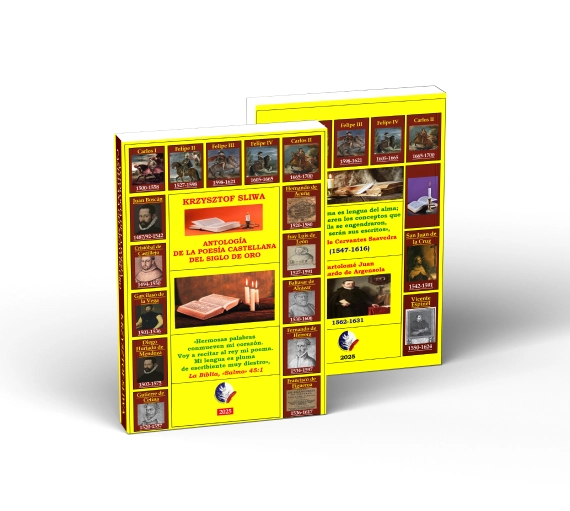
El Siglo de Oro Poesía book stands as a carefully constructed scholarly work that brings together the poetic foundations of Spain’s most influential literary period. Conceived as more than a simple collection, this volume functions as a comprehensive El Siglo de Oro poetry collection designed to preserve, contextualize, and reintroduce essential texts within the canon of early modern literature. Its structure reflects academic precision, presenting poetry within a clear historical and chronological framework.

As a Spanish Golden Age poetry book, the anthology spans the full breadth of poetic production from the late fifteenth to the seventeenth century, capturing the evolution of form, language, and intellectual intent. The inclusion of biographical introductions and historical framing allows readers to approach each work with a deeper understanding of its cultural and philosophical origins. This makes the volume especially valuable as an academic poetry book Spanish literature, suited for formal study as well as independent research.

The anthology also functions as a Spanish poetry anthology with pedagogical clarity. It restores visibility to texts that have gradually disappeared from modern curricula while maintaining fidelity to original language and literary discipline. Through its careful selection and scholarly organization, the book affirms the enduring relevance of Golden Age poetry, presenting it not as a relic of the past but as a living body of work essential to understanding the intellectual and artistic foundations of Spanish literary history.

Now available on all major platforms.

🔗 For Amazon: Click here

Complementing Antología de la Prosa Castellana del Siglo de Oro, Krzysztof Sliwa’s El Siglo de Oro – Poesía offers a parallel exploration of Spain’s Golden Age through its poetic tradition. Conceived as a monumental scholarly anthology, this volume brings together the poetic foundations that shaped the intellectual and artistic life of early modern Spain. Rather than functioning as an isolated collection, it serves as a natural counterpart to the prose anthology, completing a broader literary portrait of the period.

The poetry anthology spans from the late fifteenth to the seventeenth century, tracing the evolution of poetic form, language, and aesthetic intent across the Siglo de Oro. Its academic structure mirrors that of the prose volume, presenting texts within a clear historical and chronological framework. Biographical introductions and historical context guide readers toward a deeper understanding of each poet’s cultural and philosophical environment.

Together, the prose and poetry anthologies form a unified scholarly foundation for the study of Spanish Golden Age literature. While Antología de la Prosa Castellana del Siglo de Oro foregrounds narrative, historiography, and intellectual discourse, El Siglo de Oro – Poesía restores poetic expression to its rightful place within the literary canon, reinforcing the period’s enduring relevance for academic study and literary scholarship.

Now available on all major platforms.

🔗 For Amazon: Click here

Antología del Teatro Castellano del Siglo de Oro is a rigorously curated scholarly volume that brings together the dramatic foundations of Spain’s most influential theatrical period. Conceived as more than a simple compilation, the book functions as a comprehensive academic anthology designed to preserve, contextualize, and critically present the essential works of Spanish Golden Age theatre. Its structure reflects methodological precision, organizing dramatic texts within a clear historical and chronological framework that allows readers to follow the evolution of theatrical form from the Renaissance through the Baroque.

The anthology spans the full breadth of dramatic production from the sixteenth and seventeenth centuries, capturing the development of theatrical language, structure, and thematic depth that defined the Siglo de Oro. Each author and work is introduced through concise biographical and historical context, enabling readers to engage with the plays in relation to their cultural, political, and intellectual environments. This approach makes the volume particularly valuable for academic study, advanced research, and university-level instruction.

At the same time, the book fulfills an essential restorative function by reintroducing dramatists and works that have been marginalized or overlooked in modern curricula. Through careful selection and scholarly organization, the anthology affirms Spanish Golden Age theatre as a living literary tradition central to the history of European drama.

Now available on all major platforms.

🔗 For Amazon: Click here

One of the defining strengths of this anthology lies in its careful representation of classical Spanish poetry through a diverse range of voices that shaped the literary conscience of the Golden Age. Rather than privileging a single school or style, the collection brings together poets whose works reflect the complexity and intellectual breadth of the period. Each author included contributes to a broader understanding of Spanish literary poetry as both an artistic and cultural practice.

The anthology traces the development of poetic expression from early Renaissance clarity to later Baroque complexity, allowing readers to observe how form, language, and thematic focus evolved over time. The influence of major stylistic figures is evident throughout, particularly in poetry influenced by Góngora and Quevedo, where linguistic innovation and conceptual depth redefine the limits of poetic expression. These works demonstrate how poetic mastery became a means of intellectual distinction rather than ornamentation.

Equally important is the attention given to structure and technique. By presenting works that exemplify the range of Spanish poetic forms, the volume functions as a Spanish poetic forms book, offering insight into sonnets, canciones, liras, and other classical structures. This approach supports detailed literary examination and reinforces the anthology’s value as a resource for literary poetry analysis. Through its balanced selection, the collection preserves not only individual poems but the intellectual ecosystem that sustained one of Europe’s most influential poetic traditions.

A defining dimension of this anthology is its engagement with poetry as a space where spiritual inquiry and intellectual discipline converge. Many of the works included form part of a broader philosophical poetry collection, in which poets grapple with questions of existence, morality, suffering, and transcendence. These poems do not merely express emotion; they articulate structured reflection shaped by theology, classical philosophy, and Renaissance humanism.

The presence of mysticism and ethical contemplation positions the volume firmly within the tradition of the humanistic poetry book. Poets of the Golden Age viewed verse as a means of pursuing truth, whether through religious devotion, moral introspection, or metaphysical exploration. This approach underscores how poetry rooted in Spanish history served as both artistic expression and intellectual exercise, grounded in the cultural and spiritual realities of its time.

The anthology also highlights how poetic form became a vehicle for disciplined thought. The balance between reason and emotion reflects the work of the classical humanities poet, whose training demanded mastery of rhetoric, philosophy, and linguistic precision. In this context, poetry functioned as a mode of inquiry rather than ornament. By preserving these works within their philosophical and theological frameworks, the collection invites readers to engage with poetry as a serious intellectual tradition. It demonstrates how verse once occupied a central role in shaping moral consciousness and cultural dialogue, reaffirming its relevance within both historical and contemporary literary study.

Beyond its literary significance, this anthology functions as a structured resource for formal study and critical engagement. Designed with clarity and scholarly discipline, it speaks directly to readers seeking depth rather than summary. As an academic writer poetry resource, the volume supports sustained analysis by presenting texts in a way that encourages close reading, contextual understanding, and interpretive rigor.

The collection holds particular value for those engaged in literary poetry academic study, where primary texts must be accompanied by reliable historical framing. Its organization allows educators and students to trace stylistic development across periods while maintaining focus on individual poetic voices. In this way, the anthology serves as a bridge between textual preservation and academic usability.

For scholars working within European traditions, the book also reinforces the relevance of a scholarly poet Europe perspective, situating Spanish Golden Age poetry within a wider continental intellectual context. The careful selection of authors and forms reflects the expertise of a Golden Age literature specialist, ensuring that the material presented aligns with established academic standards rather than selective modern taste.

As part of Spanish poetry studies, the volume offers a dependable foundation for coursework, research projects, and comparative literary analysis. Its structure supports both introductory exploration and advanced scholarship, making it suitable for university classrooms as well as independent research. By restoring rigor and accessibility to Golden Age poetry, the anthology affirms its place within serious literary education.

At the heart of this anthology lies a deep respect for form as an intellectual discipline rather than a decorative choice. The poets represented exemplify the rigor expected of a classical poetry author, for whom structure, meter, and rhetorical balance were essential to poetic meaning. Their work reflects an era in which poetic craft was inseparable from education, philosophy, and cultural responsibility.

As a body of work shaped by the tradition of the classical literature poet, the anthology demonstrates how verse functioned within a codified system of artistic standards. Poetic expression was governed by inherited rules that demanded precision, restraint, and mastery of language. These principles are evident throughout the collection, particularly in the sustained use of established meters and carefully controlled imagery.

The volume also highlights the endurance of classical poetry traditions Spain, revealing how poets adapted inherited forms to address contemporary concerns without abandoning discipline. This balance between innovation and continuity reinforces the anthology’s role as a record of literary poetry Spanish heritage. Each poem participates in a lineage that values refinement over excess and clarity over obscurity.

By presenting poetry within its formal context, the anthology affirms the relevance of the poet of historical literature, whose work gains meaning through dialogue with past models. The collection ultimately demonstrates that form itself is a historical argument, one that preserves intellectual continuity across generations of Spanish literary culture.

While firmly grounded in historical scholarship, this anthology also participates in a contemporary reawakening of classical literary values. It contributes to a broader poetic revival of Golden Age literature by restoring texts that speak with intellectual clarity to modern readers. Rather than treating these works as static artifacts, the collection frames them as living expressions of cultural memory and artistic discipline.

The volume illustrates how poetry inspired by Siglo de Oro traditions continues to resonate beyond its original historical moment. Themes of honor, faith, love, and moral struggle retain relevance because they are articulated through enduring forms and carefully reasoned expression. This continuity allows the anthology to serve not only as a historical record but also as a model for renewed engagement with classical aesthetics.

Through its scholarly framing, the book offers a clear poetic interpretation of Golden Age literature that resists simplification. Each poem is positioned within its original intellectual environment while remaining open to contemporary analysis. In doing so, the collection functions as a heritage poetry collection, preserving literary identity while inviting renewed scholarly dialogue.

The anthology also demonstrates how classicism in modern poetry can coexist with critical inquiry. By presenting disciplined poetic forms without dilution, the work challenges modern assumptions about accessibility and relevance. It reasserts that classical literature, when presented with scholarly care, remains capable of informing present-day thought and literary practice.

Krzysztof Sliwa – Where the Legacy Continues

The contribution of Krzysztof Sliwa poet reaches beyond the boundaries of a single publication, positioning him firmly within the ongoing intellectual stewardship of Spanish literary history. As a Spanish literature poet working at the intersection of scholarship and preservation, his role is not merely to present texts but to sustain the continuity of a tradition that shaped European thought for centuries. His work reflects a commitment to literary responsibility rather than personal acclaim.

Within the broader field of literary poet Spanish studies, this anthology reinforces the importance of disciplined engagement with primary sources. By restoring coherence to a fragmented canon, the book affirms the relevance of historical poetry in modern academic discourse. It stands as a testament to the enduring necessity of authors who treat literature as a cultural inheritance rather than a consumable product.

As an author of Spanish poetry collections, Sliwa demonstrates how scholarly dedication can coexist with poetic sensitivity. His editorial choices reflect long-term academic vision, ensuring that texts remain accessible without sacrificing intellectual rigor. This positions him securely as a Krzysztof Sliwa published poet whose work contributes to institutional memory and scholarly continuity.

Through the author of El Siglo de Oro Poesía, the legacy of the Golden Age does not conclude but continues in dialogue with new generations of readers, students, and researchers. The anthology stands as both a culmination and an invitation, to study, preserve, and carry forward the intellectual achievements of Spain’s literary past.