
Table Of Content
- What Is an Imprint? Definitions & Clarity
- Publisher vs Division vs Imprint
- Why Do Publishers Have Imprints?
- Can Indie Authors Create an Imprint?
- Major Publisher Imprints (The Big Five)
- Other Meanings of Imprint (Outside Publishing)
- Why Knowing About Imprints Matters (Authors & Readers)
- Frequently Asked Questions About Imprints
- Conclusion
The next time you pick up a book, tilt it slightly and look at the bottom of the spine. Alongside the title and author, you’ll see a small name or logo. It might read Penguin Random House or Simon & Schuster, but more often it will say Picador, Knopf, Riverhead, or Little, Brown. These are not the publishers themselves; they’re known as imprints.
Authors who want to understand publishing more deeply can also explore our guide on how to write a children’s book to see how publishing expectations differ across categories.
So, what is a book imprint? In publishing, it’s the trade name a company uses when releasing a title. An imprint functions like a brand within a larger publishing house, giving books their own identity. While the imprint definition outside of books refers to any mark or impression, in publishing it has a specific meaning: the label you see printed on the spine and title page of a book.
The meaning of imprint goes beyond a simple logo. It signals to readers the kind of experience they might expect, literary, commercial, academic, or genre-specific. For authors, understanding imprints is vital. Knowing which one aligns with their work can influence how their book is marketed and where it reaches its audience.
What Is an Imprint? Definitions & Clarity
People often wonder, what does imprint mean? Outside publishing, an imprint is any mark or lasting impression, like a stamp on paper or a memory that sticks. Inside publishing, the imprints definition is the trade name a publisher uses to release books, shown on the spine and title page.
A related question is, what do imprinted mean? In plain English, imprinted means marked or stamped with a design, logo, or idea. A tote bag can be imprinted with a company logo. A reader can feel imprinted by a powerful story, meaning it left a deep impression.
You may also hear, what does imprinting mean? Imprinting is the process of making that mark or lasting impression. In psychology and biology, it describes how early experiences shape attachment and behavior. In branding it is how a label or message becomes memorable.
For clarity in this guide, we use imprint in its publishing sense. Think of it as a brand identity under a larger publishing house. The definition of imprinting in our context is the act of applying or building that brand impression across covers, copy, and marketing so readers recognize it quickly. Knowing these meanings helps writers and readers talk about labels precisely.
Publisher vs Division vs Imprint
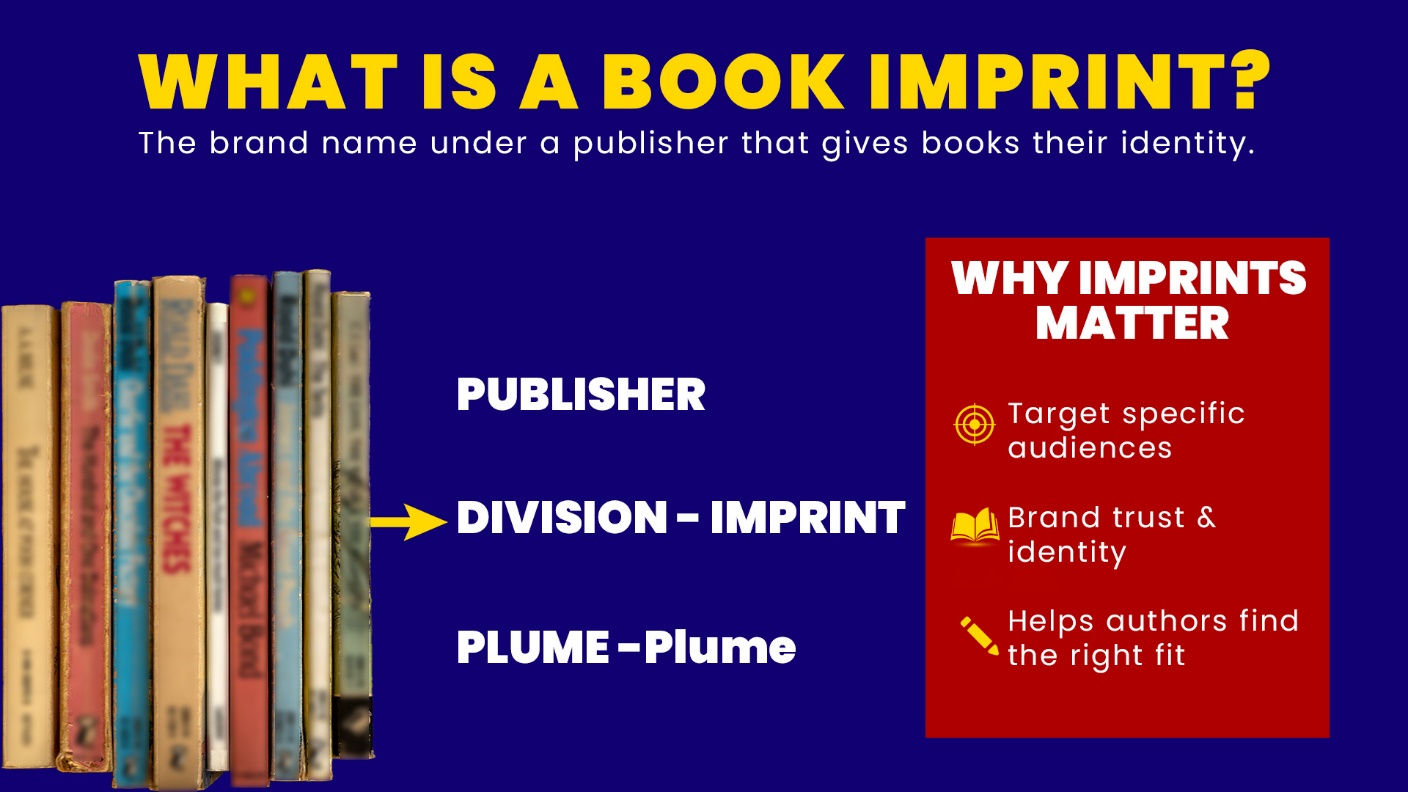
People often ask what is the imprint of a book and what is an imprint in publishing. The answer sits in the basic hierarchy. At the top is the publisher, the company that funds, owns rights, and oversees production. Many big houses are split into divisions that manage broad categories like adult or children’s books. Inside each division sits the imprint, the brand name under which books are released and marketed.
Think of it like this:
Publisher → Division → Imprint
Example: Penguin Random House → Penguin Publishing Group → Plume
Sometimes an imprint manages a sub-brand of its own:
Publisher → Division → Imprint → Imprint
Example: HarperCollins → Adult Division → William Morrow → Avon
If you ever wonder what an imprint in publishing looks like in practice, scan the spine and title page. You will see the imprint logo and name, not always the parent publisher. For readers, this signals style and curation. For authors, it signals a team with a clear editorial focus and audience. So an imprint is not a separate company. It is a focused label that helps the publisher group and grow books with a shared identity.
Why Do Publishers Have Imprints?
Once you understand the structure, the next question becomes: why do publishers have imprints? The answer lies in branding, specialization, and reach. A single publishing house can release thousands of books each year, but not all of them target the same audience. Creating imprints allows a company to divide its catalogue by genre, theme, or reader type.
For example, one imprint may focus on literary fiction, another on romance, and a third on business or nonfiction. This way, each imprint builds its own reputation. Readers learn to trust those names because they consistently deliver the style of books they enjoy. In this sense, what does imprint mean in publishing is not only a logo but also a promise of quality and consistency.
It’s also important to ask, is a small press the same as an imprint? Not quite. A small press is an independent publisher that operates as its own company, while an imprint is always tied to a larger publishing house. So while both publish books, the difference is in structure and independence.
For authors, aligning with the right imprint can open doors to niche audiences, stronger marketing, and a clear professional identity in the market.
Can Indie Authors Create an Imprint?
Many new writers wonder, can indie authors set up a publishing imprint? The answer is yes, and it can make a big difference in how professional their book looks. An imprint gives an author the appearance of being published under a distinct brand instead of just their own name.
So, what is a publishing imprint in this context? It’s the trade name you choose for your self-publishing work. Instead of listing your book as published by yourself, you create a label for example, Blue Sky Press or Golden Path Books. This makes your title look polished and can help you stand out when approaching bookstores, libraries, or readers who may be skeptical of self-published books.
Some also ask, what does an imprint mean in publishing for independent authors? It means control. You select the name, purchase your ISBNs under it, and brand all your work consistently. Over time, your imprint becomes associated with a particular genre or quality.
Setting up an imprint does not require becoming a large company. For most indie writers, it’s simply a matter of choosing a professional name, registering it if needed, and using it on the copyright page, title page, and book spine.
Major Publisher Imprints (The Big Five)
To really see how imprints work, it helps to look at the “Big Five” publishers. Each one owns dozens of imprints, each with its own focus and audience. This breakdown shows how divisions and imprints are organized and helps answer questions like what’s an imprint in publishing and what is book imprint in practice.
Penguin Random House
- Division: Knopf Doubleday Publishing Group → Imprints: Knopf, Doubleday, Vintage, Anchor, Pantheon.
- Division: Penguin Publishing Group → Imprints: Viking, Plume, Penguin Classics, Riverhead, Dutton.
HarperCollins
- Division: General Books → Imprints: Harper, Ecco, Avon, Amistad, Harper Business
- Division: Harlequin → Imprints: HQN Books, Carina Press, Love Inspired, Park Row Books
Simon & Schuster
- Division: Adult Publishing → Imprints: Scribner, Atria, Gallery, Threshold, Howard
- Division: Children’s → Imprints: Aladdin, Atheneum, Paula Wiseman Books
Hachette Book Group
- Division: Little, Brown → Imprints: Back Bay Books, Mulholland Books, Voracious
- Division: Perseus → Imprints: Avalon Travel, Basic Books, PublicAffairs
Macmillan
- Division: Adult Trade → Imprints: Farrar, Straus & Giroux, St. Martin’s Press, Henry Holt, Flatiron, Picador
- Division: Children’s → Imprints: Feiwel & Friends, First Second, Roaring Brook Press
Other Meanings of Imprint (Outside Publishing)
So far, we’ve looked at imprints in the book world. But many people also ask broader questions like what does imprint mean in everyday life or what does imprint on someone mean. The truth is, the word stretches far beyond publishing.
In psychology, what does imprinting mean usually refers to early learning or attachment. For example, baby birds imprint on the first moving figure they see, often their mother. This biological process explains how does imprinting work in nature: a quick, lasting bond formed during a critical period. In human terms, it can describe how early experiences leave lasting marks on memory and behavior.
In general English, what does it mean to imprint is to make a deep or permanent mark. A powerful book can imprint on a reader’s heart. A brand can imprint its logo on merchandise. Something imprinted is marked in a way that lasts.
By understanding these wider meanings, we see why the publishing industry borrowed the term. Just as memories or impressions can leave marks on our lives, an imprint in publishing leaves a brand identity on every book it releases.
Why Knowing About Imprints Matters (Authors & Readers)
For writers and readers, it’s not just trivia to ask what is an imprint in publishing or what does imprint mean in publishing, the answers shape how books are created, sold, and discovered.
For authors, choosing the right imprint can define their career. Understanding imprints also helps authors see how financial opportunities vary across publishing paths, something we explained in detail in our guide on how much money authors make. Each one carries its own reputation: some are known for bold literary voices, others for commercial bestsellers, and others for niche nonfiction. Knowing what is a book imprint allows authors to target the imprints that align with their style, making submissions stronger and more strategic.
For readers, recognizing an imprint helps guide choices. Someone who loves Tor Publishing Group knows they’ll find quality science fiction. A reader who enjoys Vintage Books trusts it for classics and modern literary fiction. This is why learning what’s an imprint in publishing can enrich the reading experience.
On a bigger scale, imprints protect brand identity. They let large houses speak to different audiences without blurring their message. That’s why publishers spend decades building the reputations of their imprints because for both readers and authors, those names have come to mean trust, consistency, and a particular type of storytelling.
Frequently Asked Question
-
Imprinted define: What does it mean?
The phrase imprinted define refers to the explanation of the word imprinted. Simply put, imprinted means something that has been marked, stamped, or permanently shaped by an image, idea, or brand.
-
Imprinting define: How is it different?
Imprinting define usually relates to the process of making a mark. In publishing, imprinting can mean attaching a book to a label. In psychology or biology, it refers to creating a lasting impression during the early stages of development.
-
What is imprint publishing?
Imprint publishing is the practice of releasing books under an imprint name rather than only the parent publisher’s name. This makes the book appear under a specific brand or division.
-
What do imprint mean in simple terms?
The question what do imprint mean is often asked by readers. In plain English, an imprint means a mark or a label. In publishing, it is the trade name used to identify a book’s brand.
-
What is a publisher’s imprint?
A publisher’s imprint is the brand name owned and controlled by a publishing house. For example, Penguin Classics is an imprint of Penguin Random House.
-
What does imprint stand for?
Sometimes people ask what does imprint without finishing the question. The answer is that imprint refers to a mark or brand, especially in the publishing world.
-
What is for imprint?
The phrase what is for imprint usually appears in forms or templates. It means the space provided to list the publishing imprint or company name that appears on a book.
-
What is imprinted?
Imprinted explains the state of being marked or stamped. A book can be imprinted with a publishing label, and a person can feel imprinted by an idea or experience that leaves a strong impression.
Conclusion
At the heart of it, the word imprint carries many shades of meaning. People often ask, what does imprint mean? At its core, it’s a mark, a lasting impression, or a brand identity. In the world of books, it goes one step further. When we ask, what is a book imprint, we’re really asking about the label that sits under a publisher and gives each book its identity.
The imprint definition in publishing is simple: the name printed on the spine and title page that represents a division of a larger house. But behind that name is a legacy of curation, marketing, and storytelling. The meaning of imprint is more than a logo, it is the reputation, audience, and promise that readers and authors come to trust.
So, whether you’re a reader browsing shelves or a writer submitting manuscripts, knowing what do imprints mean helps you see the bigger picture of the book world. Imprints shape trends, highlight voices, and make it easier to find the kind of stories you love. They leave their mark on every title, just like an impression that lasts long after the page is turned.
