
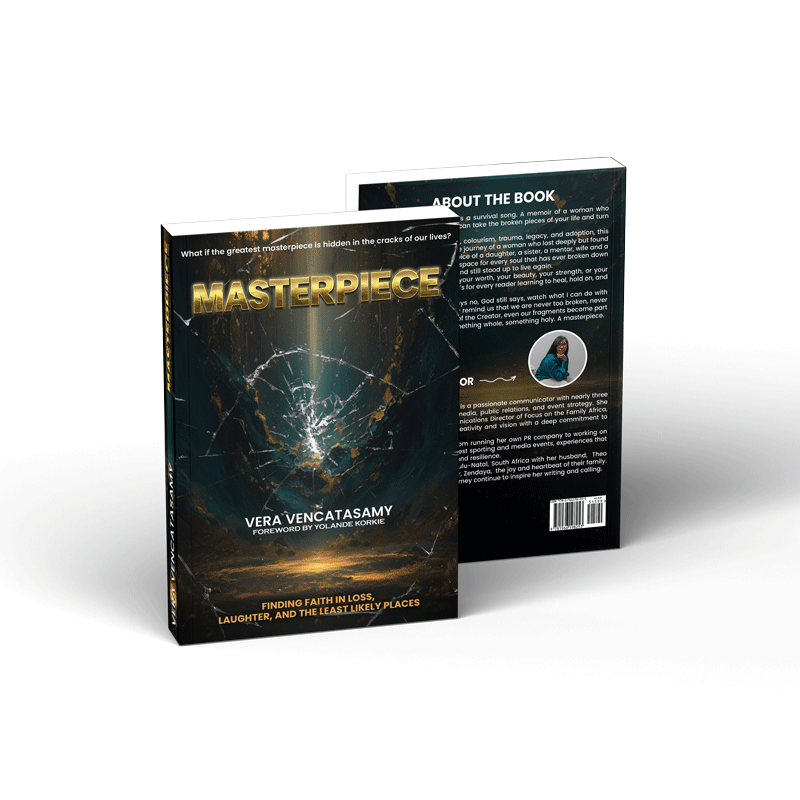
Masterpiece

Masterpiece: Finding Faith in Loss, Laughter and the Least Likely Places

Masterpiece book is not written from a place of polished certainty or spiritual distance. It rises instead from lived experience, where faith is shaped in real time by loss, grief, and the quiet resilience required to keep going when answers do not come easily. In Masterpiece by Vera Ceceila Vencatasamy, the reader is invited into a deeply personal journey that does not shy away from pain, yet refuses to let pain have the final word.

This Christian memoir Masterpiece unfolds through moments that are raw, reflective, and profoundly human. Childhood memories, generational history, trauma, laughter, and faith collide on the same canvas, revealing a story that is as tender as it is courageous. The narrative does not present faith as a destination already reached, but as a path walked honestly, sometimes with confidence and sometimes with trembling hands.

At the heart of this book is a powerful truth: brokenness does not disqualify a life from beauty or purpose. Scripture reminds us, “For we are God’s masterpiece. He has created us anew in Christ Jesus” (Ephesians 2:10). This verse becomes more than a reference point; it becomes a lived reality throughout the pages of this memoir. Each chapter reflects the quiet work of restoration happening beneath the surface, where faith grows not in spite of suffering, but often because of it.

Rather than offering easy answers, Masterpiece holds space for complexity. It speaks to readers who have known grief, questioned God, or wondered whether healing is still possible. In doing so, it reframes the idea of strength, not as the absence of cracks, but as the grace that fills them.

This is a faith based memoir book that refuses to sanitize the realities of loss or the long road toward healing. The story unfolds as a deeply personal Christian testimony book, grounded in lived experience rather than abstract theology. Faith, here, is not theoretical. It is tested, questioned, and ultimately refined through life’s most difficult seasons.

As an inspirational Christian memoir, Masterpiece speaks to readers navigating grief, identity, trauma, and spiritual uncertainty. The narrative moves through moments of childhood pain, generational legacy, cultural challenges, and profound personal loss, revealing how faith can remain present even when it feels fragile. Rather than portraying belief as unwavering certainty, the book honors the kind of faith that wrestles, doubts, and still chooses to hope.

Scripture weaves naturally through the story, not as decoration, but as anchor. Verses appear where they have carried the author through darkness, reminding the reader that God’s presence is often most tangible in moments of surrender. “The Lord is close to the brokenhearted and saves those who are crushed in spirit” (Psalm 34:18). This promise echoes throughout the memoir, not as a slogan, but as a lived truth slowly unfolding over time.

What makes this memoir distinctive is its emotional honesty. Healing is not rushed. Pain is not minimized. Faith is allowed to be quiet, strained, and real. In presenting testimony this way, Masterpiece becomes more than a personal story. It becomes a companion for readers who are learning that restoration is rarely instant, but always possible.

At its core, Masterpiece is a memoir about faith and loss, written without softening the realities of grief. Loss in these pages is not distant or symbolic; it is immediate, formative, and life-altering. The narrative acknowledges that grief does not arrive politely or leave on schedule. It interrupts childhood, reshapes identity, and leaves questions that linger far longer than comfort allows.

As a memoir about grief and faith, the book explores what happens when belief collides with heartbreak. Prayer does not always bring immediate relief. Scripture does not always silence sorrow. Instead, faith becomes something quieter and more enduring. It becomes the decision to remain present, even when answers feel absent. The writing honors the confusion that often follows loss, especially when it occurs early in life and alters the way safety, love, and trust are understood.

This is a Christian memoir for difficult seasons, not because it offers quick encouragement, but because it validates the weight of pain many carry silently. The story recognizes that faith does not eliminate grief; it walks alongside it. Scripture reminds us, “Blessed are those who mourn, for they shall be comforted” (Matthew 5:4). In Masterpiece, comfort does not come as erasure of sorrow, but as the slow assurance that God remains near, even when life feels unbearably fractured.

Healing in Masterpiece is not portrayed as instant or complete. It is layered, nonlinear, and deeply personal. This healing through faith book acknowledges that restoration often happens quietly, through reflection, memory, and the courage to face what has been buried. The journey toward wholeness is shown as something lived, not achieved.

As a book about spiritual healing, the memoir reveals how faith sustains even when emotional wounds remain tender. Healing is not defined as forgetting the past, but as learning to live truthfully with it. The narrative allows space for anger, silence, doubt, and eventual reconciliation with God, self, and memory. Faith does not demand perfection; it invites honesty.

Throughout the story, healing is framed as partnership rather than performance. Scripture becomes a source of steady reassurance rather than pressure. “He heals the brokenhearted and binds up their wounds” (Psalm 147:3) reflects the heart of this memoir, where healing is gradual and deeply sacred.

Ultimately, Masterpiece stands as a memoir of healing and hope, reminding readers that restoration does not erase pain but gives it meaning. The process is slow, often unseen, yet profoundly transformative. In honoring that process, the book offers readers permission to heal at their own pace, trusting that faith continues to work even in the unseen spaces.

At its heart, Masterpiece speaks powerfully as a Christian book for women, not because it offers formulas for strength, but because it tells the truth about becoming whole in a world that often defines worth too narrowly. Through experiences shaped by culture, colorism, family expectations, and loss, the memoir explores how identity is formed long before we realize we are carrying questions about our value.

Womanhood in these pages is complex and deeply human. It is shaped by what is spoken over us and what is withheld, by love received and love lost. Faith becomes a mirror through which identity is slowly restored, not by denying pain, but by acknowledging it honestly. The story affirms that dignity is not earned through perfection or approval, but received through grace.

As an inspirational faith book, Masterpiece gently challenges the lies many women internalize about beauty, strength, and belonging. Scripture reminds us, “You are precious and honored in my sight, and I love you” (Isaiah 43:4). This truth becomes a quiet refrain throughout the narrative, reinforcing that faith does not demand shrinking or silence. It invites women to stand fully present in who they are becoming, even when the journey has been marked by struggle.

Rather than presenting belief as something static or effortless, Masterpiece unfolds as a faith journey memoir, shaped by seasons of certainty and seasons of deep questioning. Faith here is not portrayed as the absence of doubt, but as the courage to keep showing up when doubt is present. Prayer becomes conversation rather than performance, and belief is refined through lived experience.

This story resonates as inspirational Christian reading because it allows faith to be human. Anger toward God, silence in prayer, and moments of spiritual exhaustion are not edited out. Instead, they are honored as part of a journey that continues to move forward, even when clarity feels distant. Scripture is not used to rush healing, but to anchor it. “Lord, I believe; help my unbelief” (Mark 9:24) captures the tension that runs honestly through these chapters.

Ultimately, Masterpiece stands as a Christian encouragement book for readers who are learning that faith does not always look strong from the outside. Sometimes it looks like endurance. Sometimes it looks like whispering a prayer with no words left. And sometimes it looks like simply staying. The memoir affirms that God remains present in all of it, shaping faith not through certainty, but through faithfulness.

Although deeply personal, Masterpiece carries the reach and resonance of a Christian memoir worldwide. The experiences shared in these pages move beyond geography, culture, or background, touching universal themes of grief, resilience, identity, and faith. Loss, longing, and hope are not bound by borders, and the memoir understands this intuitively.

As an inspirational memoir global readers can connect with, the story speaks to anyone who has wrestled with unanswered questions or carried silent pain. The narrative does not rely on cultural shorthand or assumptions. Instead, it invites readers into moments that feel familiar regardless of where they come from: the ache of loss, the struggle to believe again, and the slow rebuilding of trust in God and self.

This is also a faith memoir international readers can approach without feeling excluded by doctrine or distance. Faith is presented as lived experience rather than instruction, allowing readers from different walks of life to engage honestly. Scripture appears as comfort, not constraint, reinforcing the truth that God’s presence is not confined to place, language, or tradition. In this way, Masterpiece becomes a shared space where personal testimony meets collective human experience.

Positioned for a wide audience, Masterpiece now stands as a Christian book available worldwide, offering readers access to a story shaped by faith, endurance, and grace. Its global reach reflects the universality of its message: that healing is possible, even when the journey is long and uncertain.

As a Christian book published worldwide, the memoir enters the broader faith-based publishing space with quiet authority. It does not seek attention through spectacle, but through sincerity. The story’s power lies in its honesty, inviting readers to engage not as spectators, but as companions walking alongside the author’s journey.

This faith based book global release reflects a growing desire among readers for narratives that feel real, grounded, and spiritually authentic. Masterpiece offers that authenticity by honoring both the cracks and the beauty formed within them. The memoir affirms that faith does not require perfection or certainty to be meaningful. Instead, it flourishes in truth, humility, and perseverance, making its message relevant wherever readers may find themselves.

Masterpiece arrives as an inspirational Christian book release for readers who are not looking for surface-level encouragement, but for something honest and sustaining. This is a story for those who have carried grief quietly, who have prayed without words, and who have wondered whether faith still has room for their questions. It does not demand agreement or certainty from the reader. It simply offers companionship.

As a Christian book launch blog, this moment marks more than the arrival of a new title. It marks the sharing of a testimony that understands life as layered and unfinished. The memoir invites readers to reflect on their own stories, not with pressure to resolve them, but with permission to acknowledge what has shaped them. Pain is not presented as something to rush past, but as something that can be held with care and meaning.

For readers seeking depth, this book offers a steady presence rather than spectacle. It becomes a reminder that healing does not require forgetting and faith does not require perfection. In this way, Masterpiece speaks gently but firmly to those navigating transition, loss, or renewal. It stands as a Christian book order online readers may choose not just to read, but to return to, finding reassurance in its honesty and grace.

🔗 For amazon: Click here

At the center of this memoir stands Vera Ceceila Vencatasamy author, whose voice carries both vulnerability and quiet strength. Her writing is shaped not by distance from pain, but by proximity to it. Each chapter reflects a life lived attentively, where faith has been tested, refined, and ultimately deepened through experience.

As a Christian author Vera Ceceila Vencatasamy writes with humility rather than declaration. Her story does not place her above the reader, but beside them. She writes as someone who has walked through loss, questioned God, and continued forward with courage shaped by grace. The memoir reflects a commitment to truth, allowing faith to appear in its most human form.

As the author of Masterpiece book, Vera offers more than a personal narrative. She offers testimony that honors complexity, resilience, and spiritual endurance. Her voice invites reflection rather than persuasion, reminding readers that even lives marked by cracks can hold extraordinary meaning. In sharing her story, she leaves behind not certainty, but hope rooted in honesty, faith, and the belief that God is still at work in every unfinished chapter.

For future updates and upcoming release follow Vera on her official social media pages.

🔗 For Facebook Profile: Click here

🔗 For Instagram Profile: Click here