The Lifeguard Game Plan

The Lifeguard Game Plan

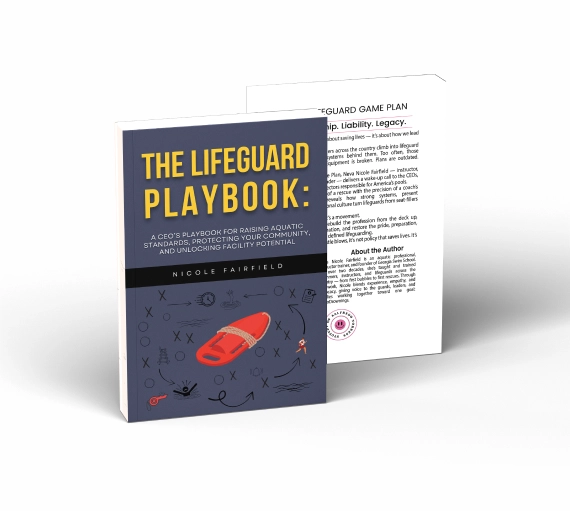
A CEO’s Playbook for Raising Aquatic Standards, Protecting Your Community, and Unlocking Facility Potential

Most city managers, CEOs, and recreation directors inherit aquatic facilities without ever being trained to lead them. Yet few assets carry more visibility, liability, and operational complexity than a public pool. The Lifeguard Game Plan book addresses that gap directly, positioning aquatics where it belongs, at the leadership table.

This is not a manual about whistles and rescue techniques. It is a strategic framework for decision-makers who approve budgets, shape policy, and oversee teams responsible for public safety. From staffing structures to training cadence, from deck culture to executive oversight, the book translates pool operations into language senior leaders understand.

At its core, this is a business leadership book for recreation directors who recognize that safety is not accidental. It is built. Structured. Funded. Reinforced.

Aquatic facilities are often treated as seasonal amenities. In reality, they are high-risk, high-impact community assets that demand executive-level clarity. When leadership understands the systems behind the stand, facilities move from reactive to proactive.

This playbook exists to raise the floor, so the guards beneath it can rise higher.

In Nicole Fairfield The Lifeguard Game Plan, the message is direct: leadership decisions upstream determine safety outcomes downstream. Aquatic oversight is not a middle-management issue. It is an executive responsibility.

Pools operate at the intersection of public visibility and public risk. They require policy discipline, operational systems, and consistent supervision. Yet many organizations approach them casually, assuming certification alone equals compliance. It does not.

This is where the book distinguishes itself as a lifeguard leadership book grounded in real-world execution. It bridges the gap between executive leadership and the realities of the pool deck, offering clear direction for those who oversee but may not come from an aquatics background.

For municipalities and organizations alike, it also stands as a practical public sector management book, reminding leaders that accountability cannot be delegated away. When systems are unclear, when rotations are unstructured, when training lacks consistency, exposure increases.

Aquatic safety is not about reacting to incidents. It is about designing environments where incidents are less likely to occur.

Leadership sets that standard. Or fails to.

Most facilities believe they are protected because their guards are certified. Certification, however, is the starting point, not the system. This is where the leadership gap quietly forms.

As a lifeguard leadership book, The Lifeguard Game Plan challenges the assumption that credentials equal readiness. Certification teaches individual skills. Leadership builds team execution. Without structured supervision, consistent in-service training, and visible management presence, even well-certified guards can underperform in high-pressure moments.

This is why the book also functions as an aquatic facility management book, translating operational blind spots into executive-level clarity. Guards do not fail in isolation. They operate inside systems designed, funded, and monitored by leadership. When those systems lack structure, unclear rotation policies, inconsistent supervision, reactive decision-making, risk multiplies.

The difference between a controlled emergency response and chaos is rarely talent. It is preparation. It is rhythm. It is leadership on deck long before a whistle blows.

Facilities that close unexpectedly, lose community trust, or face preventable incidents often share one common thread: the absence of structured leadership oversight.

Aquatic environments do not collapse because of one bad day. They erode when leaders underestimate what it truly takes to run them well.

Risk in aquatics is not theoretical. It is operational, visible, and often preventable. What distinguishes high-performing facilities from vulnerable ones is not luck, it is structured accountability.

As an aquatic risk management book, this playbook reframes liability as a leadership responsibility rather than a legal afterthought. Every aquatic department should operate with a clearly written and rehearsed Emergency Action Plan for pools, supported by regular drills and executive oversight. A laminated document on the wall is not protection. Practiced execution is.

Incidents rarely occur because no one cared. They occur because systems were assumed to be strong without being verified. Fatigue was overlooked. Rotations were inconsistent. Equipment checks were irregular. Supervision was stretched thin.

Accountability begins long before an emergency. It lives in the hiring timeline, the training cadence, the maintenance schedule, and the culture leaders model. When upstream decisions lack discipline, downstream consequences surface quickly, often publicly.

This book does not dwell on fear. It focuses on responsibility. Liability exposure decreases when leadership understands operational details well enough to ask better questions.

In aquatics, accountability is not optional. It is embedded in every shift, every guard, and every executive decision made above the deck.

Aquatic safety is not sustained by individual heroics. It is sustained by structure. Facilities that operate smoothly do so because their aquatic department operational systems are intentional, documented, and consistently reinforced.

At the center of those systems are structured lifeguard in-service training systems that move beyond initial certification. Weekly drills, scenario rehearsals, and post-incident reviews build muscle memory long before pressure arrives. When guards train as a unit, they respond as a unit. That coordination does not happen by accident.

Equally critical are clearly defined pool deck supervision standards. Leadership presence on deck is not micromanagement. It is performance protection. Managers who observe rotations, monitor fatigue, check glare conditions, and verify equipment readiness are actively reducing risk. They are also reinforcing culture.

Strong systems create predictability. Guards know when rotations happen. They know how relief works. They understand escalation protocols. They operate inside clarity rather than uncertainty.

When systems are loose, stress rises. When systems are tight, confidence rises.

Operational structure does not restrict teams. It stabilizes them. And in high-liability environments like aquatic facilities, stability is the difference between reactive scrambling and coordinated execution.

One of the most common misconceptions in aquatics is that preparation begins when summer approaches. In reality, effective facilities operate on disciplined year-round planning for seasonal pools.

This is where the book aligns closely with principles found in a strong public sector management book. Municipal leadership requires backward planning, budget forecasting, staffing pipelines, equipment audits, and maintenance scheduling long before gates open. When leaders treat aquatics as a three-month program, they unintentionally compress preparation into crisis mode.

Year-round planning protects more than safety. It protects revenue, community trust, and operational reputation. Hiring timelines should begin in winter. Certifications should be completed in early spring. Marketing for programs should launch before public demand spikes. Maintenance projects should be resolved before opening week, not during it.

This approach reflects disciplined municipal leadership development book principles: systems first, season second. Facilities that follow this model enter summer executing rather than scrambling.

Waiting until June to address staffing gaps or equipment failures is not strategic leadership. It is operational gambling.

Aquatics may be seasonal in visibility. It is not seasonal in responsibility.

For decades, many facilities have treated pools as unavoidable expenses rather than strategic assets. The truth is simpler: water alone does not generate revenue. Leadership does. That is why this book dedicates significant attention to aquatic facility revenue generation strategies that shift pools from passive cost centers to active performance hubs.

A well-run facility understands that programming drives sustainability. Swim lessons, certification courses, contracted team rentals, and hosted events convert empty water into measurable value. This is foundational thinking in any serious recreation management book. When pool schedules are audited hour by hour, leaders often discover long stretches of “dead water” where payroll continues but revenue does not.

The transformation requires ownership. Someone must manage partnerships, build contracts, promote programming, and align staffing with demand. Facilities that succeed do not simply open their gates; they orchestrate activity.

This approach also mirrors principles found in a strong sports facility management book. Stadiums are rarely profitable because of the field alone. They thrive because of events, scheduling strategy, and layered experiences. Aquatic facilities operate under the same logic.

When leaders treat the pool as a stage rather than a seasonal amenity, community engagement rises, revenue stabilizes, and the facility becomes an asset that strengthens the broader department rather than draining it.

Improving aquatic performance does not require excessive bureaucracy. It requires clarity. Facilities achieve operational excellence in aquatics when systems are simple, repeatable, and consistently modeled by leadership.

The foundation begins with accountability. Strong leadership accountability in recreation departments means executives do more than approve budgets. They verify execution. They walk decks. They ask structured questions about rotations, emergency rehearsals, equipment readiness, and supervision coverage. Oversight becomes active rather than symbolic.

Equally important is deliberate culture building in aquatic teams. Culture is not motivational signage or occasional recognition. It is the lived rhythm of the deck. Guards who rotate predictably, train regularly, and receive visible coaching operate with greater focus and confidence. Fatigue decreases. Response precision improves. Retention increases.

Standards do not overwhelm teams; inconsistency does. When expectations shift daily or leadership disappears for weeks, stress rises. When systems remain steady, guards feel supported rather than exposed.

Raising standards is not about adding complexity. It is about removing ambiguity. Clear rotations. Practiced responses. Visible leadership. Reliable equipment. Consistent feedback.

When structure stabilizes performance, guards are freed to concentrate on vigilance rather than uncertainty. That is how safety becomes sustainable rather than situational.

The Leadership Playbook for Decision-Makers

This book is not written for guards on the stand. It is written for the leaders who shape the stand from above. The Lifeguard Game Plan functions as a true CEO playbook for aquatics, guiding executives through the operational realities that most never see but are fully responsible for.

It serves as one of the best leadership book for aquatic directors seeking clarity in environments where risk, staffing, budgeting, and public trust intersect daily. Directors often inherit facilities without a roadmap. They inherit pools mid-season. They inherit teams mid-cycle. They inherit problems already forming. This book provides structure where assumptions once lived.

It also stands confidently as an executive leadership book for facility managers, bridging policy and performance. The guidance inside does not overwhelm leaders with technical jargon. Instead, it clarifies the fundamentals: rotations must protect vigilance, in-service must be consistent, liability must be anticipated, culture must be intentional, and planning must begin months before gates open.

Leadership in aquatics is not about controlling every detail. It is about understanding enough detail to ask better questions.

When executives understand what happens on deck, they stop reacting to crises and begin preventing them. That shift transforms aquatics from fragile to formidable.

🔗 For Amazon: Click here

Nicole Fairfield brings more than theory to these pages. With over two decades in aquatics, she writes from lived experience, from pool decks, staff meetings, crisis moments, and system rebuilds. Nicole Fairfield understands both the teenage guard on the stand and the executive in the office, and she writes to connect them.

Her perspective elevates this work beyond operational advice. It reads like a professional development book for directors who want to lead responsibly in high-risk environments. But it also reflects the discipline of a business leadership nonfiction book, grounding its message in accountability, systems, and structured execution.

Her passion for water safety is not abstract. It is personal. A childhood near-drowning experience shaped her lifelong commitment to preventing avoidable tragedy. That lived perspective gives weight to every chapter. She does not write to criticize leaders. She writes to equip them.

Nicole Fairfield challenges executives to walk the deck, verify the systems, and invest in the people who protect their communities daily. She reframes aquatics as more than a program. It is a leadership test.

Behind these pages is not just an author. It is a practitioner who has seen what works, what fails, and what changes when leadership finally shows up.

For the latest book releases, exclusive discounts, and updates, follow Nicole Fairfield:

🔗For Facebook: Click here

🔗 For an Exclusive Preview & review: Click here