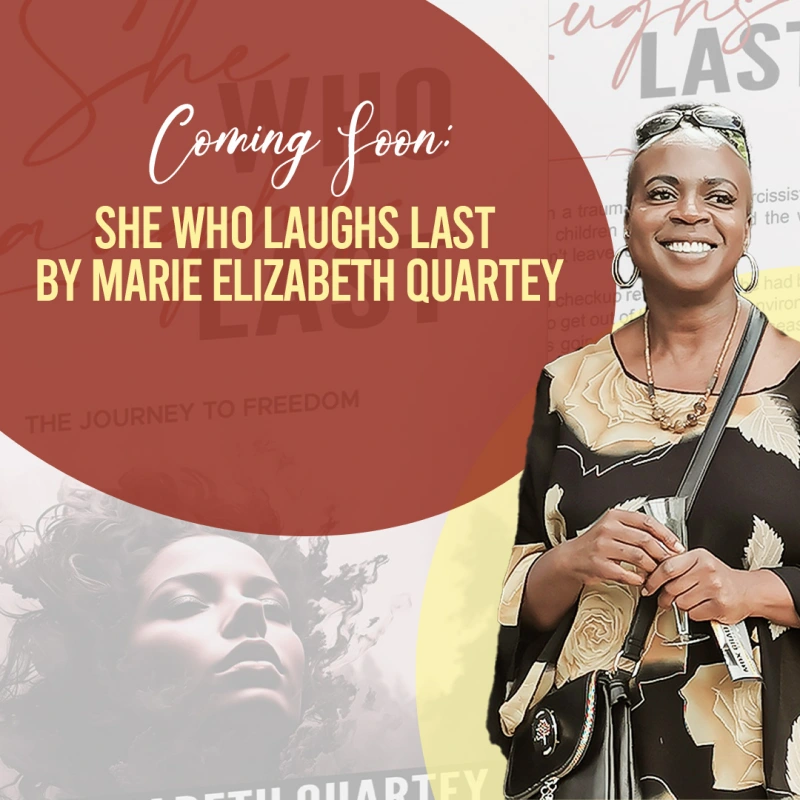
Rather than presenting trauma as spectacle, Marie offers a deeply human narrative rooted in emotional truth. This emotional abuse recovery book is not about blame or bitterness. It is about naming what was endured and honoring the strength it took to endure it. As an abuse survival story book, it gives voice to women who have lived in quiet endurance and reminds them that their experience is real, valid, and worthy of being told.
Some books inform. Others testify. She Who Laughs Last belongs to the latter. This is not a story shaped for comfort or crafted for approval. It is a declaration of truth from a woman who refused to let her suffering remain unnamed. She Who Laughs Last book stands as both witness and reckoning, offering readers not a filtered narrative, but an honest account of what it means to survive, confront, and reclaim a life.
At the center of this work is the voice of Marie Elizabeth Quartey author, whose presence on the page is grounded, courageous, and unflinchingly real. Her writing does not dramatize pain, nor does it soften its edges. Instead, it invites readers into the emotional reality of a woman who endured, questioned, and ultimately chose herself. The result is a story shaped not by victimhood, but by awakening.
What distinguishes this memoir is its refusal to define healing as a single moment or outcome. It is a memoir of resilience and freedom, charting the slow, often invisible process of rebuilding after years of emotional erosion. In doing so, it becomes more than personal testimony. It offers solidarity to those who recognize fragments of their own lives within its pages.
As an inspirational memoir for women, the book does not offer perfection or easy answers. It offers truth, dignity, and the quiet reassurance that survival can evolve into strength. Marie’s story is not about what was taken from her, but about what she chose to reclaim.
Emotional captivity does not arrive suddenly. It forms gradually, through patterns of control that distort reality, weaken boundaries, and convince a person that endurance is the same as strength. For Marie, the path toward freedom began not with escape, but with recognition. Her story speaks directly to the long, painful process of breaking free from emotional abuse, where survival requires first seeing what has been normalized for too long.
Life within a narcissistic marriage reshapes identity in ways that are difficult to explain from the outside. In Marie’s experience, love became conditional, autonomy became dangerous, and silence became protection. Yet within that suffocation, awareness began to grow. Her journey reflects what so many endure in life after narcissistic marriage, when the body may be free, but the mind is still untangling years of emotional entrapment.
This section of her story carries the weight of a trauma healing memoir, not because it documents pain for its own sake, but because it names the psychological mechanisms that keep survivors bound to those who harm them. Gaslighting, emotional dependency, and fear are examined not as personal weakness, but as learned survival responses.
By confronting these patterns directly, Marie’s narrative becomes a powerful testament to overcoming psychological abuse. Her transformation is not sudden or cinematic. It is deliberate, difficult, and deeply human. Through clarity and courage, she begins the work of reclaiming her mind, her voice, and her right to exist beyond control.
For many survivors, the moment of awakening does not arrive gently. It interrupts life without warning, forcing clarity where denial once existed. For Marie, that moment came with a diagnosis that would change everything. Her journey through illness became more than a medical battle. It became a turning point that transformed her from endurance to action, shaping what would later become a breast cancer survivor memoir rooted not only in recovery, but in awakening.
Confronting her mortality stripped away fear that had once felt permanent. The body that had carried years of emotional burden now demanded truth, rest, and self-preservation. In the face of illness, Marie was forced to examine the life she had been living and the cost of remaining where her spirit could not breathe. What might have been a moment of collapse instead became the beginning of clarity.
This chapter of her story reflects the heart of an emotional trauma and healing story, where suffering does not define the future, but reshapes it. Illness revealed what silence had concealed. It made visible the weight she had carried for others at the expense of herself. Through vulnerability, Marie discovered strength that had long been buried beneath survival.
Her transformation speaks to the deeper meaning behind a strength after adversity book. This is not about triumph over circumstances alone, but about choosing life, dignity, and self-worth when the body itself demands change. What followed was not just physical recovery, but the first true step in a profound healing journey after abuse, where freedom became not only possible, but necessary.
Freedom does not end with leaving. For many survivors, the greater battle begins afterward, in the quiet work of remembering who they were before fear rewrote their identity. For Marie, healing meant more than distance from harm. It meant restoring the parts of herself that had been diminished through years of emotional erosion. At the core of her transformation is a powerful memoir about reclaiming self-worth, where survival gives way to self-recognition.
In choosing herself, Marie also chose a different future for her children. Motherhood became both motivation and mirror, reflecting what strength could look like when rooted in love rather than endurance. Her story stands as a testament to women finding freedom after abuse, not through anger or vengeance, but through clarity, boundaries, and compassion. It is a reminder that rebuilding is not an act of forgetting, but of becoming.
This phase of her journey carries the emotional depth of a motherhood and survival memoir, where resilience is not performative, but lived in daily choices that prioritize safety, dignity, and emotional presence. Marie does not frame healing as perfection. She presents it as a process, shaped by patience, setbacks, and quiet victories.
What emerges is not simply recovery, but transformation. Her story embodies the essence of abuse recovery and transformation, showing how a life once defined by limitation can be reshaped by intention. Through courage, reflection, and an unwavering commitment to self-respect, Marie reclaims not just her future, but her identity.
There are stories that remain personal, and then there are stories that become collective. Marie’s journey belongs to the latter. In a world where many women endure in silence, her voice offers both recognition and release. She Who Laughs Last stands firmly as a women empowerment memoir, not because it presents an idealized version of strength, but because it honors the reality of survival and the courage required to choose something better.
For countless readers, this book will feel like seeing their own unspoken experiences finally acknowledged. It joins a growing body of empowering survivor stories that validate what so many have endured behind closed doors. Marie does not speak from theory. She speaks from life. Her words reach into the quiet spaces where fear once lived and replace it with understanding, clarity, and hope.
This memoir also contributes to an urgent conversation about recovery and visibility. As a domestic abuse recovery book, it sheds light on the long-term emotional consequences of psychological harm, while offering a path forward grounded in self-awareness and dignity. It refuses to simplify pain or rush healing, instead honoring the complexity of rebuilding after trauma.
In doing so, Marie’s story becomes part of a broader movement toward emotional truth and accountability. It carries the purpose of a mental health awareness memoir, reminding readers that survival is not weakness, that healing is not linear, and that no one should ever have to walk the journey alone.
Marie’s journey does not end in survival. It moves beyond endurance into meaning, dignity, and self-definition. Her story stands as an inspirational true life story not because it avoids pain, but because it refuses to be shaped by it. What emerges is not a narrative of loss, but one of awakening, where healing becomes an act of personal sovereignty.
This memoir is anchored in the quiet bravery required to rebuild a life after emotional devastation. In doing so, it embodies the heart of a courage and resilience memoir, showing how strength can exist without spectacle. Marie does not present herself as untouched by trauma. She presents herself as transformed by the decision to live honestly, freely, and without apology.
Rather than closing the door on the past, her story reframes it as a beginning. The life she builds afterward reflects the power of renewal found in a memoir about starting over, where identity is reclaimed not through reinvention alone, but through truth, boundaries, and self-respect. Each step forward is shaped by clarity, not fear.
Ultimately, Marie’s journey stands as a true story of freedom and healing, one that does not seek to inspire through perfection, but through authenticity. It reminds readers that liberation is not an abstract idea. It is a lived experience, earned through courage, sustained by self-belief, and defined by the choice to rise.
She Who Laughs Last is written for women who have survived in silence and are ready to reclaim their voice. As an inspirational memoir for women, it speaks to those who recognize fragments of their own lives in Marie’s journey and are seeking understanding rather than judgment.
This story also stands for those who are only beginning to question what they have endured. As a survivor empowerment book launch, it offers validation to readers who have lived within emotional control and are searching for clarity, safety, and self-trust.
For anyone navigating the long aftermath of harm, the book serves as an emotional abuse recovery book grounded in compassion rather than instruction. It is especially meaningful for readers who are walking the path of healing after narcissistic abuse, offering not formulas, but the reassurance that freedom is possible, and that they are not alone in their becoming.
She Who Laughs Last: The Journey to Freedom is not a conclusion. It is a beginning. Marie Elizabeth Quartey’s story stands as quiet proof that survival can evolve into clarity, and that healing, though never simple, is always possible when truth is chosen over fear.
As this memoir prepares for release, it arrives not as a promise of easy answers, but as an offering of dignity, courage, and emotional honesty. It is a book for those who have endured, for those who are rebuilding, and for those who believe that even after the deepest wounds, life can still be reclaimed.
Coming Soon
Available in paperback and hardcover