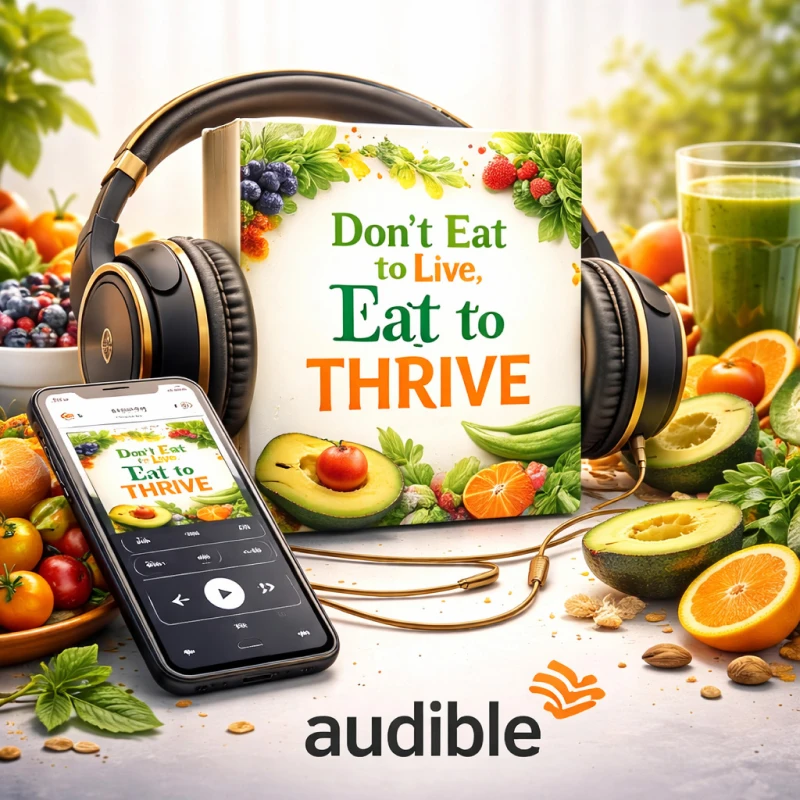
As a new Audible release wellness title, the audiobook enters a space where listeners increasingly seek education over intensity and long-term wellbeing over instant results. Whether discovered by readers already familiar with the book or by new audiences exploring health through audio for the first time, this release positions Don’t Eat to Live, Eat to Thrive as a listening experience built for modern life. It is not a program to follow for a few weeks, but a framework designed to support lasting alignment between mind, body, and daily habits.
Why This Audiobook Matters Right Now
The release of Don’t Eat to Live, Eat to Thrive in audio arrives at a moment when the wellness conversation is shifting. More than ever, people are questioning systems built on restriction, willpower, and short-term results. Listeners are no longer looking for another diet, another rigid plan, or another cycle of motivation followed by burnout. Instead, they are seeking understanding: how the body actually works, why energy crashes, why cravings persist, and why so many “healthy” routines fail to create lasting change. This is where a new Audible release wellness title like this one becomes culturally relevant, not just commercially visible.
As a wellness guide audiobook 2026, the audiobook responds to a growing demand for health education that respects biology, rhythm, and recovery rather than forcing discipline. While many audio health titles focus on tactics or surface-level behavior change, this release addresses the deeper systems that shape hunger, mood, focus, metabolism, and long-term vitality. It speaks to listeners who want clarity without complexity, structure without rigidity, and progress without punishment. In an era where burnout and information overload dominate wellness culture, the audiobook offers something rare: a calm, coherent framework that can be absorbed gradually and applied sustainably.
Within Audible’s expanding health category, the book’s arrival also reflects why it is increasingly being recognized among the best wellness audiobooks Audible listeners turn to for substance rather than trends. As an Audible health audiobook 2026, it aligns with a new generation of listeners who prefer learning through guided explanation rather than quick-fix promises. For those exploring a health transformation audiobook not as a temporary program but as a long-term shift in how they fuel, move, and restore their bodies, this release meets the moment. It does not ask listeners to fight themselves. It invites them to finally understand themselves.
What Listeners Will Actually Learn
At the heart of Don’t Eat to Live, Eat to Thrive is a promise that goes far beyond motivation. This is not an audiobook that tells listeners what to cut out, restrict, or discipline themselves into following. Instead, it explains why the body behaves the way it does and how lasting change begins by working with biology rather than against it. As a health transformation audiobook, it guides listeners through the internal systems that shape hunger, energy, mood, focus, sleep, and long-term wellbeing, offering insight that is both practical and grounded in real physiological processes.
Throughout the audio experience, listeners are introduced to a framework that clarifies why metabolism slows, why cravings feel overpowering, why fatigue persists even with “healthy” habits, and why willpower alone never creates sustainable results. This understanding is what positions the audiobook as a true Audible nutrition audiobook, not simply a collection of tips. The focus is not on surface-level behaviors, but on the deeper biological patterns that govern how the body responds to nourishment, stress, rhythm, and recovery.
Rather than promoting dieting or short-term programs, the book presents a model of sustainable change rooted in how the body naturally rebalances when given the right conditions. In this way, it also functions as a sustainable health audiobook, offering listeners a way to rebuild their relationship with food, energy, and movement without pressure or guilt. Whether the goal is weight change, improved focus, better sleep, or simply feeling like oneself again, the audiobook equips listeners with a clear biological roadmap instead of another set of rules.
What makes this learning experience distinct is its tone. The audiobook does not speak in extremes or promises of rapid transformation. It speaks in understanding. By explaining the internal mechanics of hunger, motivation, and recovery, it empowers listeners to see their bodies not as obstacles, but as systems that can be supported, reset, and realigned through informed daily choices.
At the core of Don’t Eat to Live, Eat to Thrive is a structured framework Philip Onyeagolu calls the Thrive Blueprint, a model designed to help listeners move from survival into sustainable vitality. In audio form, this system becomes not just something to read about, but something to absorb, reflect on, and integrate into everyday life. As the Eat to Thrive audiobook Philip Onyeagolu presents it, the blueprint is built around restoring balance to the biological systems that govern energy, hunger, recovery, focus, and long-term health.
Rather than isolating food as the sole driver of wellbeing, the blueprint explains how nourishment, movement, recovery, and daily rhythm work together to shape the body’s internal environment. Listeners are guided through how each pillar influences metabolism, hormonal balance, and nervous system stability, creating a clear picture of why fragmented wellness efforts so often fail. This is why the audiobook stands apart as a biological wellness audiobook, one that treats the body as an integrated system rather than a problem to be fixed in pieces.
Through the audio experience, complex concepts are translated into accessible understanding. The blueprint shows how small, informed shifts in fueling, movement, stress management, and rest can activate the body’s natural ability to repair, rebalance, and regenerate. In doing so, it reframes health not as something to be forced, but as something that emerges when biology is supported rather than overridden. This approach also makes the audiobook especially relevant for listeners searching for an audiobook for energy and focus, as it connects mental clarity directly to physical rhythm and metabolic stability.
What gives the Thrive Blueprint its lasting value is its realism. It does not rely on rigid plans or extreme routines. Instead, it offers a system that adapts to real life, allowing listeners to build consistency without perfection. By presenting wellness as a process of alignment rather than control, the audiobook equips its audience with a structure they can return to again and again, making it not just informative, but genuinely transformative.
Don’t Eat to Live, Eat to Thrive in audio is designed for listeners who are done with chasing short-term fixes and ready for something that actually fits into real life. It speaks to those who have tried “doing everything right” and still feel exhausted, unfocused, or disconnected from their bodies. As an audiobook for healthy living, it meets people where they are, not with rules, but with understanding, offering a path that is grounded in biology rather than willpower.
This audiobook is for the listener who wakes up tired despite “healthy habits,” who feels trapped in cycles of cravings, energy crashes, or inconsistent results. It is for those who want to improve their relationship with food without falling back into restriction or guilt. In that sense, it also stands out as an audiobook for food relationship healing, reframing nourishment as support rather than control. Instead of telling listeners what to eliminate, it helps them understand what their bodies are asking for and why.
It is equally relevant for people seeking a more integrated approach to wellbeing, one that connects physical health with mental clarity, emotional stability, and long-term resilience. Whether the goal is weight change, improved focus, better sleep, or simply feeling like oneself again, the audiobook offers a framework that adapts to different lifestyles rather than demanding a single rigid path. This is what makes it resonate as an Audible lifestyle transformation book: not because it promises dramatic overnight change, but because it supports meaningful, sustainable progress through awareness and alignment.
Ultimately, this audiobook is for anyone who is tired of surviving their health journey and ready to build something that lasts. It invites listeners to stop fighting their biology and start working with it, creating a version of wellness that feels realistic, compassionate, and genuinely livable.
The power of Don’t Eat to Live, Eat to Thrive in audio lies not only in what is being taught, but in how it is delivered. Hearing the framework unfold allows listeners to absorb its ideas at a pace that feels reflective rather than rushed. Concepts around biology, rhythm, nourishment, and recovery are not presented as rigid instructions, but as guided understanding, making the audiobook especially effective for those who prefer to learn through listening rather than reading.
The narration supports this experience with a tone that is steady, clear, and grounded, reinforcing the book’s core philosophy of calm, sustainable change. Rather than dramatic emphasis or high-pressure delivery, the voice guiding listeners through the material mirrors the book’s message: progress does not come from force, but from alignment. This approach makes the audiobook feel less like a program to follow and more like a conversation that unfolds alongside everyday life, whether during a commute, a walk, or a quiet moment of reflection.
As an Audible health narration Erin Honeycutt performance, the audiobook maintains a balance between clarity and warmth, ensuring that complex ideas remain accessible without being simplified. The narration allows listeners to engage deeply with the material without feeling overwhelmed, creating an experience that supports both understanding and emotional connection. For many, this format becomes a way to revisit key insights repeatedly, letting the principles of biological balance, energy restoration, and sustainable habit-building settle in over time.
In this way, the audiobook does more than convey information. It creates space for listeners to think differently about their health, their bodies, and their daily choices, transforming the listening experience into a tool for long-term awareness rather than a one-time download.
With its release on Audible, Don’t Eat to Live, Eat to Thrive enters a new phase of accessibility for listeners ready to approach health through understanding rather than intensity. As an Audible health audiobook 2026, the audio edition makes Philip Onyeagolu’s framework available to a global audience seeking sustainable, biology-led wellbeing that can be integrated into real life. Whether discovered by long-time readers or first-time listeners, the audiobook offers a way to engage with the material that is reflective, practical, and designed for everyday rhythms.
For those ready to hear Don’t Eat to Live Eat to Thrive, the listening experience delivers more than information. It provides a guided path toward clarity around metabolism, energy, nourishment, recovery, and long-term balance, without the pressure of rigid systems or short-term goals. This is not a promise of instant results, but an invitation into a process of awareness that supports lasting alignment between body and lifestyle. In a market crowded with fast solutions, the audiobook stands apart as a resource built for those who value depth, education, and sustainable change.
As an Audible new release by Philip Onyeagolu, the audiobook reinforces the book’s central message: thriving is not achieved through control, restriction, or constant effort, but through understanding how the body is designed to function and how daily choices can support that design. Listeners are encouraged to move beyond survival patterns and into a more balanced relationship with food, movement, rest, and self-awareness.
Don’t Eat to Live, Eat to Thrive by Philip Onyeagolu
Now available on Audible, Amazon, and major global audiobook platforms.
🔗 For Audible: Click here