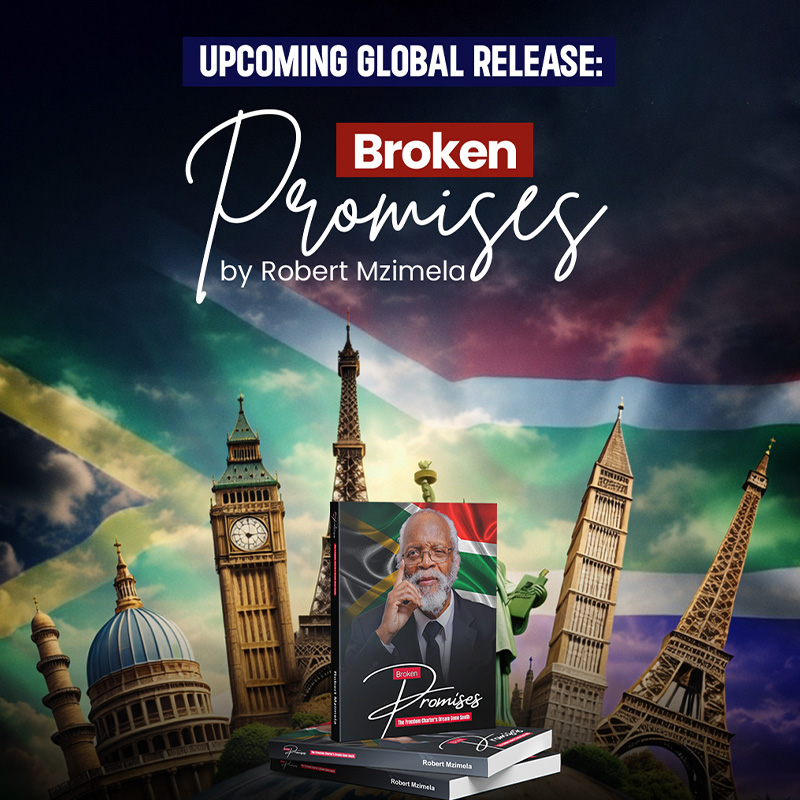
Central to this analysis is the idea that democracy is not sustained by elections alone. Broken Promises Freedom Charter themes are revisited not as slogans, but as benchmarks for governance. Mzimela’s work situates South Africa’s transition within broader patterns of South Africa democracy analysis, where liberation movements become governing parties and moral authority is tested by power.
As an African political history book, the narrative extends beyond individual leadership failures to examine systemic decay, policy inconsistency, and the erosion of public trust. Rather than condemning democracy itself, the book asks harder questions about how governance choices, once detached from accountability, undermine even the most hopeful transitions.
In doing so, Broken Promises establishes itself as a sober intervention in contemporary political discourse, one that invites readers to reassess not only where South Africa has been, but where its democracy is heading.
Democratic systems do not collapse overnight. They weaken gradually, through repeated compromises, unchecked authority, and the quiet normalization of dysfunction. In South Africa’s case, the crisis examined in Broken Promises is not rooted in the absence of democratic structures, but in how those structures have been managed. The book presents a rigorous governance failure South Africa analysis, tracing how accountability eroded while power consolidated.
Institutions that were designed to protect citizens increasingly serve political survival. Oversight bodies exist, inquiries are launched, and reports are published, yet consequences rarely follow. This pattern has created a dangerous disconnect between governance and public trust. Within this framework, Broken Promises functions as a political corruption South Africa book, documenting how corruption became systemic rather than exceptional. When misconduct is met with redeployment instead of removal, democratic legitimacy weakens from within.
The work situates this decline within broader South Africa democracy analysis, arguing that corruption does not merely waste public funds, but reshapes behavior across the state. Service delivery stalls, merit is replaced by loyalty, and governance becomes performative rather than functional. Citizens are left navigating a system where promises persist, but outcomes do not.
Importantly, the book avoids the simplicity of villain-centric narratives. Instead, it exposes how prolonged tolerance of ethical breaches recalibrates expectations. What once would have provoked national outrage becomes routine. Over time, this erosion produces voter fatigue, disengagement, and cynicism, conditions that are lethal to any democracy.
By extending the discussion beyond national borders, Broken Promises also speaks to readers engaged in South Africa political analysis USA discourse, where democratic backsliding and institutional strain are increasingly familiar concerns. The South African experience, as presented here, becomes a case study within global democracy books USA, illustrating how liberation credentials cannot substitute for sustained ethical governance.
This section underscores a central warning of the book: when democratic systems fail to discipline power, they invite instability. Trust, once lost, is not easily restored, and without trust, democracy exists only in form, not in function.
Economic justice was one of the most powerful promises embedded in South Africa’s democratic transition. The Freedom Charter envisioned a society where opportunity was shared, work was protected, and dignity extended beyond political rights into everyday life. Yet, decades later, the economic realities explored in Broken Promises reveal a widening gap between promise and practice. The book positions itself clearly as a South Africa economic inequality book, documenting how policy missteps and governance paralysis have entrenched hardship rather than relieved it.
Unemployment emerges not as a temporary setback, but as a structural crisis. Despite repeated national strategies and political commitments, joblessness continues to rise, particularly among youth and skilled graduates. The analysis in Broken Promises connects this failure to inconsistent economic planning, weak support for the informal sector, and labour systems that protect incumbency while excluding new entrants. Within this framework, inequality is not accidental; it is produced and sustained by governance choices.
By examining these patterns, the book contributes meaningfully to the discourse of African governance and democracy book literature, where economic outcomes are increasingly recognized as the true test of democratic credibility. Political freedom without economic mobility, the argument suggests, creates frustration rather than fulfilment. Citizens are left formally free, yet materially constrained.
Importantly, the work situates South Africa’s experience within contemporary African politics book conversations, where post-liberation states grapple with similar challenges of elite concentration, stalled reform, and public disillusionment. The issues raised resonate beyond national borders, making the book relevant to scholars and readers engaged in global African studies book discussions.
For international audiences, particularly those following African political nonfiction UK and African politics nonfiction USA markets, Broken Promises offers a grounded case study of how economic exclusion can destabilize democratic faith. It reinforces a sobering reality: when democracy fails to deliver materially, its moral authority erodes, and with it, the trust required to sustain the system itself.
Few issues in South Africa carry the emotional, political, and historical weight of land. In Broken Promises, land reform is not treated as a rhetorical talking point, but as a defining measure of whether democratic justice has meaning beyond legislation. The book stands firmly as a Freedom Charter critique book, revisiting land not as a symbolic promise, but as an unfulfilled obligation that continues to shape inequality and social tension.
The analysis situates land reform within the broader legacy of dispossession, tracing how colonial and apartheid-era policies severed communities from economic independence, cultural identity, and food security. As a post-colonial Africa politics book, Broken Promises argues that unresolved land injustice is not merely a historical grievance but an active contributor to present-day instability. The failure to implement sustainable reform has left rural communities trapped between expectation and neglect, while agricultural productivity remains vulnerable to politicized decision-making.
Rather than endorsing radical slogans or reactionary fear, the book advances a sober examination of consequences. It interrogates the debate around expropriation without compensation through evidence, regional comparison, and lived governance experience. The lesson is clear: reform without planning risks repeating the very harms it seeks to correct. Land redistribution, if divorced from training, capital access, and productivity safeguards, becomes symbolic rather than transformative. In this sense, Broken Promises positions itself as a political reform Africa book, advocating realism over populism.
The book’s relevance extends well beyond national borders. For European audiences engaging with South African history book Germany, African politics book Germany English, and political nonfiction Germany English, the land debate becomes a case study in how post-liberation states wrestle with moral redress while navigating economic survival. South Africa’s struggle illustrates a universal dilemma: justice delayed breeds resentment, but justice mishandled breeds collapse.
Ultimately, this section underscores one of the book’s most sobering conclusions. Land reform is not only about ownership. It is about food security, governance capacity, and whether democracy can deliver restitution without destroying the systems that sustain life itself.
While Broken Promises is grounded in South Africa’s lived political reality, its relevance extends far beyond national borders. Democracies across the world are facing similar pressures, declining trust in institutions, widening inequality, and growing frustration with political elites. In this context, the book emerges as a global release political nonfiction book, offering insight not only into South Africa’s challenges, but into the fragile nature of democratic systems everywhere.
South Africa’s transition was once celebrated as a global model of reconciliation and peaceful reform. Today, its struggles serve as a cautionary example of how democracy can falter when accountability weakens and economic justice stalls. Through this lens, Broken Promises functions as an international African history book, situating South Africa within a broader narrative of post-liberation states grappling with unmet expectations and governance fatigue. The themes explored resonate deeply within global democracy and governance book conversations, where democratic erosion is no longer confined to emerging states.
For international readers, particularly those engaging with South African democracy book Canada, global politics books Canada, and democracy and governance books Denmark, the book offers a grounded, experience-driven analysis rather than abstract theory. It challenges readers to confront uncomfortable questions about leadership, reform, and civic responsibility in democratic societies. Likewise, audiences interested in African history books Sweden English and global political nonfiction Sweden will find the South African case both specific and universally instructive.
Ultimately, Broken Promises argues that democracy is not self-sustaining. It requires vigilance, ethical leadership, and a willingness to confront failure honestly. By documenting where promises were broken and why, the book does more than critique the past. It issues a warning for the future. Democracies do not collapse only through force. They unravel when citizens lose faith that the system still serves them.
In that sense, Broken Promises is not merely a national reflection. It is a global reminder that freedom, once achieved, must still be protected, renewed, and earned.
Broken Promises: The Freedom Charter’s Dream Gone South by Robert Mzimela
Upcoming Global Release.
Follow Robert Mzimela for updates as Broken Promises prepares for international publication and global readership.
🔗 For Facebook: Click here