

Published on August 5, 2026
You’re scrolling through Goodreads or BookTok when a review catches your eye: “Five stars! Don’t worry, it has an HEA.” Another reader comments, “This one ends with an HFN instead.” If you’ve ever paused and wondered what those abbreviations actually mean, you’re not alone.
Understanding the HEA meaning is one of the easiest ways to navigate the romance genre with confidence. These short terms appear everywhere, from book reviews and recommendation lists to online reading communities, and they tell readers what kind of emotional ending to expect. For many romance fans, knowing the HEA meaning in books isn’t considered a spoiler. Instead, it’s a helpful guide for choosing stories that match their reading preferences.
Whether you’re new to romance novels or simply curious about the language readers use online, learning the HEA meaning can help you better understand discussions surrounding your favorite books. In this guide, you’ll discover what HEA really means, how it differs from HFN, and why these endings have become such an important part of modern romance fiction and reader expectations.
What Is the HEA Meaning in Books?
At its simplest, the HEA meaning is Happily Ever After. In the world of romance fiction, it refers to an ending where the main romantic couple finishes the story together in a stable, committed, and optimistic relationship. While every novel reaches that destination differently, the defining feature is that readers are left believing the couple’s future is secure.
Unlike many other genres, romance has long been built around the promise of emotional satisfaction. Readers expect obstacles, conflict, and moments that test the relationship, but they also expect those struggles to lead somewhere meaningful. That’s why the HEA meaning in books has become more than just another abbreviation; it’s a signal that the novel fulfills one of the genre’s most cherished conventions.
What Does Happily Ever After Really Mean?
Many people assume a happily-ever-after ending always includes a wedding, children, or a perfect future. In reality, that’s not what defines an HEA.
An HEA can take many forms depending on the story being told. One novel may end with the couple moving in together, while another concludes with a marriage proposal or simply a heartfelt commitment to face the future side by side. The details may differ, but the HEA meaning remains the same: readers finish the story believing the relationship is built to last.
This emotional reassurance is one of the reasons romance has such a loyal audience. Rather than promising a flawless future, an HEA promises hope, commitment, and the sense that the characters have earned their happiness after overcoming the obstacles in their way.
Why Readers Value HEA Endings
Unlike many genres that rely on unpredictable finales, romance readers often enjoy knowing they’ll be rewarded with an emotionally satisfying conclusion. That’s why reviewers frequently mention the ending type; it helps readers choose books that fit their preferences without spoiling the journey itself.
The HEA meaning has become a familiar part of online book discussions because it signals the kind of experience readers can expect. Whether the story involves second chances, enemies-to-lovers, or friends-to-lovers, the ending assures readers that the emotional investment pays off.
Is Every HEA the Same?
Not at all. While every HEA ends on a hopeful note, the path to that ending can look completely different. A contemporary romance may focus on rebuilding trust, while a historical or fantasy romance might weave love into larger personal or world-changing conflicts.
That variety keeps the genre fresh while still delivering the satisfying romance book endings readers have come to love. Although every story is unique, the feeling an HEA leaves behind is remarkably consistent: hope, happiness, and confidence that love has prevailed.
HEA vs HFN: What’s the Difference?
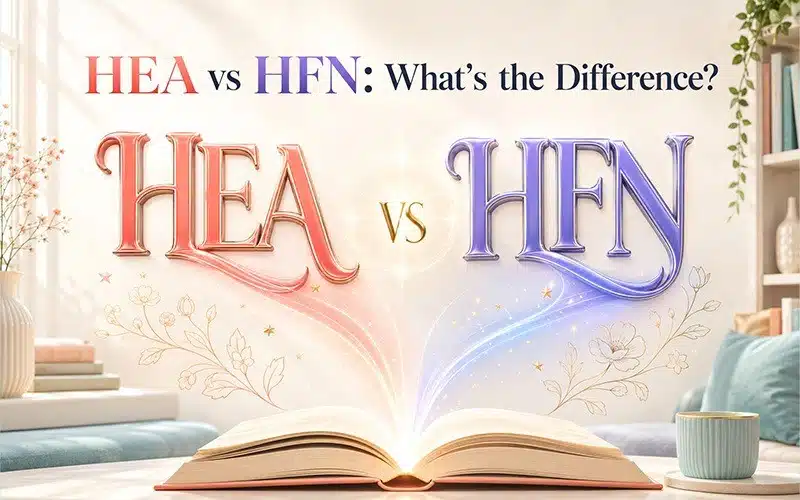
While the HEA meaning is familiar to many romance readers, you’ll also come across another common abbreviation: HFN, or Happy For Now. Understanding the HFN meaning makes it much easier to interpret book reviews and recommendations.
An HFN ends on a positive note, but it doesn’t promise that the couple’s future is completely settled. Instead, the characters have resolved the story’s main conflict and chosen to move forward together, leaving room for their relationship to continue growing after the final page.
When comparing HEA vs HFN, the biggest difference is certainty. An HEA gives readers confidence that the couple has found lasting happiness and a stable future together. An HFN offers optimism as well, but it focuses more on the present, suggesting that the relationship is just beginning its next chapter rather than declaring a lifelong happily ever after.
Neither ending is better than the other. Some readers prefer the complete closure of an HEA, while others enjoy the realism and open-ended nature of an HFN. Knowing the HFN meaning and understanding HEA vs HFN simply helps readers choose stories that match the kind of emotional experience they’re looking for.
Why Romance Book Endings Matter to Readers
If you’ve ever looked through online reviews before buying a romance novel, you’ve probably noticed readers mentioning whether a book has an HEA or an HFN. To someone outside the romance community, that might seem like an unnecessary detail. After all, doesn’t knowing the ending spoil the story?
Not necessarily.
For many readers, the destination isn’t the surprise; the journey is. The excitement comes from watching two characters meet, grow, overcome challenges, and earn their relationship. Knowing the ending offers reassurance rather than revealing every twist along the way.
That’s why discussions about the HEA meaning have become such a familiar part of romance book recommendations. Readers aren’t simply asking how a story ends; they’re asking what kind of emotional experience they’re signing up for.
Reader Expectations Shape the Romance Genre
Every literary genre comes with its own expectations. Mystery readers hope to solve a puzzle. Fantasy fans expect immersive worlds and unforgettable adventures. Romance readers, however, often look for an emotionally rewarding relationship that leaves them feeling satisfied.
Because of these expectations, romance book endings play a much bigger role than they do in many other genres. A well-written romance isn’t judged solely by its ending, but the conclusion should feel earned after everything the characters have experienced together.
This is also why you’ll frequently see reviewers mention the HEA meaning in books without considering it a spoiler. Instead, they view it as useful information that helps fellow readers choose stories they’ll genuinely enjoy.
Different Readers Want Different Endings
One of the reasons romance continues to be one of the world’s most popular genres is its variety. While many readers actively search for stories with an HEA, others appreciate books that leave a little uncertainty or promise further character growth.
Someone looking for comfort after a stressful week may specifically choose a novel with a traditional happily-ever-after. Another reader might prefer a more realistic ending that reflects relationships as ongoing journeys rather than neatly wrapped conclusions.
Neither preference is right or wrong. Understanding the HEA meaning simply gives readers another way to find books that fit their mood and expectations.
Why These Terms Matter Beyond Romance
Although HEA and HFN originated within romance publishing, they’re now part of everyday conversations across BookTok, Goodreads, online book clubs, podcasts, and social media communities.
Readers use these abbreviations to recommend books, organize reading lists, and discuss favorite stories without revealing major plot details. They also help new readers feel more confident exploring unfamiliar authors or subgenres.
Whether you’re picking up your very first romance novel or you’ve been reading them for years, understanding the HEA meaning makes it easier to navigate recommendations and appreciate why these endings have become such an important part of modern reading culture.
The growing popularity of terms like HEA and HFN reflects how reading culture continues to evolve, and publications such as America Publishers Author Spotlight regularly explore similar literary topics that help readers navigate today’s book community.
Frequently Asked Question
-
What is the HEA meaning in books?
The HEA meaning stands for Happily Ever After. In romance fiction, it refers to an ending where the main couple resolves their central conflict and finishes the story in a committed, optimistic relationship, giving readers a satisfying emotional conclusion.
-
What is the HFN meaning?
The HFN meaning is Happy For Now. Unlike an HEA, it doesn’t guarantee a permanent happily-ever-after. Instead, it shows the couple ending the story in a positive place while leaving room for their relationship to continue growing beyond the final chapter.
-
Are HEA endings required in romance books?
Traditional romance novels are generally expected to include either an HEA or an HFN because readers look for emotionally satisfying romance book endings. While some love stories outside the romance genre may end tragically or ambiguously, books marketed as romance usually follow these conventions to meet reader expectations.
Conclusion
At first glance, HEA and HFN may seem like simple abbreviations, but they represent much more than a particular type of ending. They reflect reader expectations, genre traditions, and the emotional payoff that makes romance novels so memorable.
Understanding the HEA meaning helps you recognize why so many readers value stories that end with hope, commitment, and lasting happiness. At the same time, learning about HEA vs HFN makes it easier to choose books that match the kind of reading experience you’re looking for, whether you prefer complete closure or a hopeful beginning.
As romance continues to grow across BookTok, Goodreads, and countless online reading communities, these terms are likely to remain part of everyday book conversations. The more familiar you become with them, the easier it becomes to discover stories you’ll genuinely enjoy and confidently choose romances that match your reading preferences.
