
Table Of Content
Published on October 06, 2026
Wordle gets noticeably more interesting when the obvious vowel-heavy guesses stop working. You may have a few letters confirmed, several ruled out, and a row of blank squares that somehow still refuses to reveal the answer. That is often when unusual letter combinations become worth considering. Five-letter words with exactly three consonants can create some of those trickier situations, especially when the consonants appear side by side.
The good news is that you do not have to treat these words as completely random. Once you understand how consonants can be arranged in a five-letter word, certain combinations become much easier to recognize. A difficult-looking opening can start to make sense when you spot a familiar cluster or realize that one of your missing letters is probably a vowel.
This guide explores five-letter words containing exactly three consonants, with particular attention to words that contain consonant clusters without exceeding that total. Along the way, you will find useful word examples, common patterns, and practical ways to use them when solving Wordle. Whether you are trying to recover from a string of gray tiles or simply want to expand your guessing strategy, understanding these patterns can give you another way to approach the board.
The examples below include five-letter words with exactly three consonants and two vowels, including words where all three consonants appear consecutively. They are organized by recognizable letter combinations so that you can quickly scan for a pattern that matches the clues on your board. Wordle’s accepted guesses and daily solutions may differ, so check a word against the game’s current list before relying on it as a possible answer.
What Are 5 Letter Words With Three Consonants?
Before jumping into a word list, it helps to distinguish between five-letter words containing exactly three consonants overall and words containing three consonants consecutively. These are related but different patterns. In this guide, a consonant is any letter that is not one of the standard vowels A, E, I, O, or U.
A five-letter word with exactly three consonants contains two vowels and three consonants. Those consonants may appear together or be separated by vowels. For example, scree contains S, C, R, E, and E, giving it exactly three consonants and two vowels. Similarly, sprue contains S, P, R, U, and E, also giving it exactly three consonants.
Consonants vs. Consonant Clusters
A simple way to think about the difference is to look at the letters as a sequence.
A pattern such as CCCVV contains three consecutive consonants at the beginning and two vowels afterward. It therefore has exactly three consonants overall. A pattern such as CVCVC also contains exactly three consonants, but they are separated by vowels.
Both arrangements can be relevant when solving a five-letter puzzle. The important distinction is that a word with three consecutive consonants does not automatically have exactly three consonants overall. The remaining two positions must both contain vowels for the word to meet this guide’s definition.
Some five-letter words with consonant clusters can look particularly unusual because English often places vowels between consonants. The broader idea of repeated consonant sounds is also explored through 100 Consonance Examples with Sound Patterns Explained, which offers a useful look at how consonant patterns work in language. When several consonants appear together, the word can seem harder to recognize at first glance. However, familiar combinations can make these structures much easier to spot.
Common examples of consonant combinations in English include scr, spr, and str. Once you begin recognizing combinations like these, a row of unknown tiles may not seem quite so intimidating.
Why the Number of Consonants Matters
Knowing how many consonants a word may contain can also help narrow your choices. Suppose your guesses have already eliminated several common vowels. Instead of continuing to throw unrelated words at the puzzle, you can start looking at the remaining spaces as a pattern.
This is especially helpful when exploring consonant cluster words. A cluster can immediately suggest several possible letter arrangements, while the confirmed letters and tile colors help determine which arrangement actually fits.
It is also worth remembering that not every five-letter word containing exactly three consonants has three consonants together. Keeping that distinction in mind prevents you from overlooking perfectly useful possibilities simply because they do not begin with an obvious cluster.
Why Three-Consonant Patterns Can Be Tricky in Wordle
Three-consonant patterns can be challenging because they are less immediately noticeable than familiar vowel-consonant combinations. When players see several consonants together, the word may look unfamiliar even if the individual letters and their order are perfectly natural in English.
Wordle adds another layer of difficulty because you are not given a definition or a category to work from. You are working almost entirely from letter placement and elimination. A green tile tells you exactly where a letter belongs, a yellow tile confirms that the letter exists somewhere else, and a gray tile removes a possibility. Every guess gradually changes the pattern.
This makes difficult Wordle puzzles less about knowing obscure vocabulary and more about recognizing what the available clues are telling you.
Clusters Can Hide in Plain Sight
Imagine that you have discovered that the first three positions may contain three consecutive consonants. At first, that can feel restrictive. But a cluster such as str, spr, or scr immediately gives you a much smaller group of possibilities to investigate.
The same principle works in reverse. If your guesses have established a vowel in the middle of the word, you can look at the consonants surrounding it rather than trying to invent an entire word from scratch.
That is one reason difficult five-letter puzzles can become easier once you stop thinking about individual words and start thinking about their structures. Instead of asking, “What word could this possibly be?” ask, “What combinations can fit these five positions?”
Use the Vowels You Have Left
Vowels can be especially valuable when a word contains several consonants. If common vowels such as A, E, and I have already been ruled out, the remaining possibilities become more limited. Even when the answer does not contain three consonants consecutively, knowing which vowels remain can help reveal the shape of the word.
This is where Wordle word patterns become useful. A pattern is not necessarily a complete answer; it is a framework that helps you organize the clues you already have.
Think in Letter Groups, Not Just Individual Letters
Another useful habit is to look for groups of letters that naturally occur together. English spelling contains recurring combinations, so a difficult-looking arrangement may become much more recognizable once you identify one of those groups.
For players searching for 5 letter words with three consonants, this approach can turn a seemingly impossible board into a smaller set of possibilities. You are no longer testing every five-letter word you can remember. You are testing words that fit the structure revealed by your clues.
The key is to use clusters as a starting point rather than forcing them into every puzzle. If the evidence on your board does not support a three-consonant sequence, move on. Good Wordle solving is about adapting the pattern to the clues, not adapting the clues to a pattern.
5 Letter Words With Three Consonants Together for Wordle
When a Wordle pattern starts filling up with consonants, the word can suddenly look much harder than it really is. The trick is to stop treating each letter as an isolated clue and start looking for combinations that commonly occur together.
The following examples contain exactly three consonants and two vowels, with all three consonants appearing consecutively. They illustrate recognizable letter combinations that may help you interpret clues on your board. However, a word’s spelling does not guarantee that it is accepted as a guess or included among Wordle’s possible daily solutions.
Words With SCR
The SCR combination is one of the recognizable three-consonant sequences in English. Finding a five-letter word that begins with SCR and contains exactly three consonants overall is more restrictive because the remaining two letters must both be vowels.
One example is:
- scree
In scree, S, C, and R form the opening consonant cluster, while the two E letters complete the word. This makes it a clear example of a five-letter word with exactly three consonants.
For Wordle, the important point is not to assume that this word must be the answer. Instead, use the cluster as a framework and let your green, yellow, and gray tiles determine which possibilities remain.
Words With SPL
SPL is a recognizable three-consonant cluster in English. However, finding a familiar five-letter word beginning with SPL that contains exactly three consonants overall is restrictive because the remaining two letters must both be vowels.
Rather than include words that fall outside this definition, focus on the letter patterns revealed by your Wordle board. The exact positions of the vowels and consonants will help determine whether a three-consonant opening is possible.
Words With SPR
The SPR sequence can also produce challenging-looking combinations. Once you recognize the first three consonants, the remaining two positions must contain vowels if the word is to have exactly three consonants overall.
A qualifying example is:
- sprue
In sprue, S, P, and R appear consecutively at the beginning, followed by U and E. The word therefore contains exactly three consonants and two vowels.
If your Wordle board already suggests an S, P, or R, keep an eye on their positions. A yellow S does not necessarily mean the word begins with S, while a green S can immediately make a beginning cluster more plausible.
Words With STR
The STR combination is another useful pattern to recognize. Many familiar five-letter words beginning with STR contain more than three consonants overall, so they do not fit this guide’s exact requirement.
One qualifying example is:
- stria
In stria, S, T, and R form the opening cluster, while I and A are the two vowels. This makes it an example of a five-letter word with exactly three consonants overall.
When a puzzle gives you S, T, and R as possible letters, seeing them as a group can be more productive than testing them randomly in separate positions. If the placement clues support the sequence, you have a smaller structure to investigate.
Words With Three Consonants That Are Not Together
Not every example of five-letter words with three consonants contains a consecutive cluster. This is an important distinction when using a word list for Wordle.
Consider patterns such as CVCVC or CVCCV. Both can contain exactly three consonants and two vowels, although the consonants are arranged differently. They may not look as dramatic as a beginning cluster such as STR or SPR, but they can still produce difficult guesses.
For example, crane contains C, R, and N as its three consonants, with A and E as its vowels. The consonants are not all together, although C and R form a pair at the beginning.
Similarly, stare contains S, T, and R as its three consonants, with A and E as the vowels. The word has a consonant pair at the beginning, followed by a vowel and another consonant.
These examples show how a word can contain exactly three consonants without placing all three consecutively. If your guesses have already revealed several vowels, this type of structure may actually be easier to identify than a dense cluster.
The lesson is simple: do not limit your search to words that visually resemble a dense consonant cluster. The clues determine the structure.
A Quick Way to Narrow the List
When you have several consonants confirmed, try arranging them according to their possible positions. Then ask three questions:
- Which letters are definitely in the word?
- Which positions have already been eliminated?
- Which vowels can still fit between the consonants?
That process can turn a large collection of difficult five-letter words into a much smaller group of realistic possibilities.
It is also worth checking whether a consonant is repeated, because three consonant positions do not necessarily mean three different consonant letters. A word containing three different consonants behaves differently from one where the same consonant appears twice. Repeated letters can easily be overlooked when you are concentrating on the more unusual part of the pattern.
The goal is not to memorize every word on this list. It is to recognize the structures behind them.
How to Use Consonant Clusters to Solve Wordle
Knowing a few clusters is helpful, but recognizing one does not automatically solve a puzzle. The real advantage comes from combining the cluster with the information you have already collected. Players can also benefit from exploring 5 Letter Words With No Repeating Letters for Word Games and Vocabulary, especially when they want to broaden their options without relying on repeated letters.
Start With the Confirmed Letters
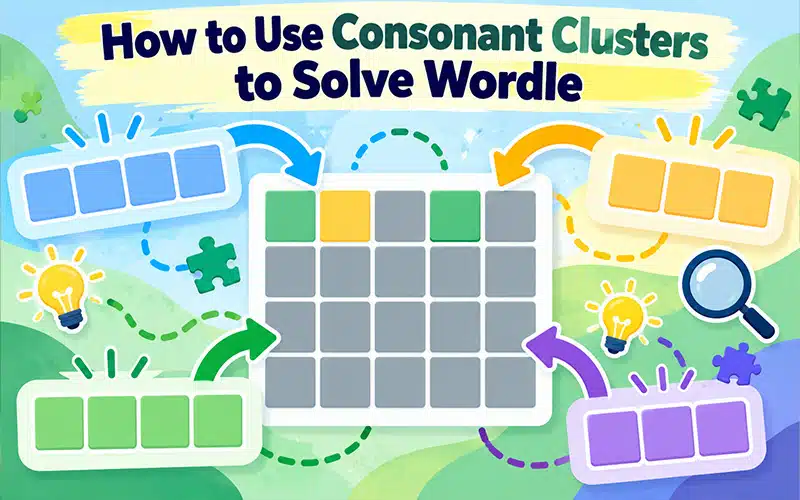
Begin with the green tiles. These give you the strongest information because both the letter and its position are confirmed.
Suppose you have a pattern such as:
S _ R _ _
That does not tell you exactly which word you need, but it gives you a framework. If P has also appeared as a yellow letter, you might start considering whether an SPR combination is possible.
This is where Wordle word patterns become practical rather than theoretical. You are using the pattern to organize the clues instead of guessing blindly.
Separate Yellow Letters From Gray Letters
Yellow letters belong somewhere in the word but are in the wrong position. Gray letters, assuming they have not been affected by a repeated-letter situation, are generally eliminated.
This distinction becomes especially important with clusters. If you know S and R belong in the word but cannot occupy certain positions, you can test whether a combination such as SCR, SPR, or STR still fits.
Do not move every yellow letter around randomly. Think about where that letter could naturally occur within the word structure.
Look for the Vowel Gap
Three consonants together can look intimidating, but vowels can give you a useful anchor. If you have already identified one vowel, place it mentally into the remaining spaces and see which structures become possible.
For example, a five-letter word with exactly three consonants and two vowels may follow a pattern such as:
CCCVV
or
CVCVC
In the first pattern, all three consonants appear consecutively, followed by two vowels. In the second, the consonants are separated by vowels. Both patterns contain exactly three consonants overall.
You do not need to know the exact answer yet. You only need to determine which structures are still compatible with your clues.
Test the Pattern, Not Just the Word
One of the biggest mistakes players make when solving difficult Wordle puzzles is becoming attached to a single possible answer too early.
If you notice STR, for example, do not immediately decide that the answer has to begin with STR. Check whether the confirmed positions actually support it. If they do not, discard that possibility and investigate another structure.
This keeps your guesses flexible and prevents one interesting cluster from taking over your entire search.
Use Unconfirmed Guesses Strategically
Sometimes your next guess should be chosen to gather information rather than to solve the puzzle immediately.
If you have several possible consonants but do not know which vowel belongs in the word, a useful guess can test multiple letters at once. Even if that guess is not the answer, the resulting tiles may reveal whether your suspected cluster is worth pursuing.
That is especially valuable when dealing with consonant cluster words, because identifying one correct sequence can eliminate a large number of alternatives at once.
Know When to Abandon the Cluster
A cluster is a clue, not a rule.
If the board does not support three consonants occurring together, do not force the pattern simply because you started the puzzle looking for it. A word can contain three consonants without placing them consecutively, and sometimes the answer will use a completely different arrangement.
Good solving means adjusting your theory whenever new information appears.

Common Wordle Patterns to Watch For
Wordle becomes easier to approach when you begin recognizing recurring structures instead of trying to remember thousands of individual words. Five-letter words can be represented with C for consonant and V for vowel, creating simple patterns that help organize your guesses.
CVCVC
This pattern alternates consonants and vowels:
C-V-C-V-C
It contains exactly three consonants and two vowels. It can be useful when your guesses reveal several vowels but no consecutive consonants.
CCVCV
Here, two consonants appear together at the beginning:
C-C-V-C-V
This pattern contains three consonants and two vowels, with the first two consonants forming a pair. A known vowel can then help determine what follows.
CCCVV
This pattern places all three consonants together at the beginning:
C-C-C-V-V
It contains exactly three consonants and two vowels. A word such as sprue illustrates this arrangement, making it useful to consider when the board supports a three-consonant opening.
Watch for Repeated Consonants
Not every difficult pattern contains three different consonants. Repetition can make a word harder to identify because a letter that has already appeared may need to appear again.
If your board suggests that a consonant is present but the possible positions seem exhausted, consider whether the word could contain that letter twice. This can open up possibilities that an otherwise strict pattern search would miss.
Let the Board Change the Pattern
The most useful Wordle word patterns are flexible. Start with the structure suggested by your clues, but update it after every guess.
A pattern that looks consonant-heavy after one guess might look completely different after the next. That is not a setback; it is new information.
The same principle applies when looking for 5 letter words with three consonants. The purpose of pattern recognition is to reduce uncertainty, not to lock you into one arrangement. The more clues you collect, the narrower the structure should become, while keeping the total at exactly three consonants and two vowels.
A Final Word on Three-Consonant Wordle Patterns
Five-letter words with exactly three consonants can make a Wordle puzzle look intimidating, but they become easier to approach once the letters are viewed as patterns rather than isolated clues. Recognizing combinations such as SCR, SPR, and STR can help narrow down possibilities, while vowels, letter positions, and eliminated letters provide the information needed to test those possibilities.
The important thing is not to memorize every word. Instead, use these patterns to understand different letter arrangements, while keeping the exact consonant count in mind. A five-letter word with exactly three consonants contains two vowels, whether the consonants appear consecutively or are separated by vowels.
Readers exploring word-based guides on sites such as America Publishers Author Spotlight can use this kind of pattern-focused approach to expand their vocabulary while also developing more deliberate solving habits. The more familiar these structures become, the less mysterious a difficult five-letter combination can seem.
Frequently Asked Question
-
What are five-letter words with three consonants?
Five-letter words with exactly three consonants contain three consonants and two vowels among their five letters. Examples include crane, scree, sprue, and stria. The consonants may appear together or be separated by vowels.
-
What are some five-letter words with consonant clusters?
Examples containing exactly three consonants include scree, sprue, and stria. These words contain the clusters SCR, SPR, and STR, respectively, with the remaining two letters being vowels.
-
Are consonant clusters useful for Wordle?
Yes. Recognizing consonant clusters can help narrow possible combinations when several consonants have been confirmed, particularly when their positions suggest that they may occur together.
-
What makes some Wordle words difficult to guess?
Some difficult Wordle puzzles use unfamiliar letter combinations, unusual consonant arrangements, repeated letters, or less obvious vowel placements. Recognizing common structures can make these patterns easier to work through.
-
How can I solve difficult five-letter words?
Start with the letters and positions confirmed by the board, eliminate letters that cannot fit, and consider possible five-letter answers only after narrowing the pattern. Avoid committing to one possibility too early.
-
How do Wordle word patterns help with guessing?
Wordle word patterns give you a framework for organizing known letters. Instead of searching through every possible word, you can identify whether the remaining spaces are more likely to contain vowels, individual consonants, or a consonant cluster.