
Table Of Content
- Why Do Some English Words Sound the Same but Mean Different Things?
- Understanding Homophones: The Secret Behind Similar Sounds and Different Meanings
- 50 Words That Sound the Same but Have Different Meanings: Complete List With Examples
- How to Remember Words That Sound the Same but Have Different Meanings
- Why Learning Homophones Improves Your English Writing and Communication
- How Words With Similar Sounds Continue to Shape the English Language
- Conclusion
- FAQs
Published on September 24, 2026
Have you ever written a sentence and suddenly stopped because two words sounded exactly the same, but you were unsure which one was correct? English is full of these moments. A word can sound familiar when spoken, yet its meaning can completely change depending on its spelling and context. These are known as words that sound the same but have different meanings, and they are one of the most interesting parts of the English language.
For example, “buy” and “by” sound the same, yet “buy” refers to purchasing something while “by” can indicate location, time, or other relationships. The pronunciation is identical, but the meanings are completely different. These small differences can create confusion for learners, writers, and even fluent speakers.
Language is not only about sounds. It is about understanding the story behind those sounds. The same pronunciation can represent different ideas, objects, actions, or emotions. Learning these differences helps people communicate more clearly and avoid mistakes in writing.
Many learners search for words that sound alike but have different meanings because these confusing pairs appear everywhere: in conversations, books, emails, exams, and professional communication. Understanding them does not require memorizing complicated rules. Instead, it requires recognizing patterns and seeing how each word works inside a sentence.
From everyday examples like “there,” “their,” and “they’re” to pairs that appear in formal writing, these words show how flexible and surprising English can be. This guide explores 50 common examples, explains why they create confusion, and provides practical examples to make them easier to remember.
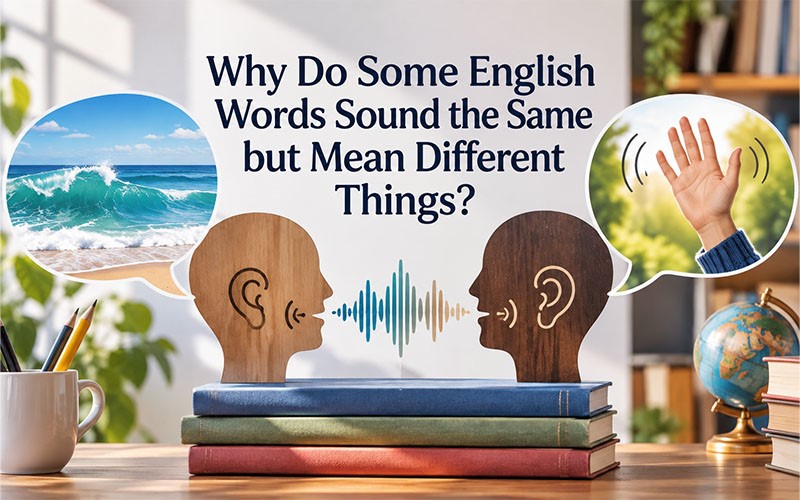
Why Do Some English Words Sound the Same but Mean Different Things?
English pronunciation can sometimes hide important differences. Two words may sound identical when spoken aloud, yet they may have different spellings, origins, and meanings. These words often create challenges because our brains naturally connect sounds with meanings. When the sound stays the same, it can be easy to assume the meaning is also the same.
The reason these differences exist is connected to the history of the English language. English has developed through influences from many languages, including Latin, French, Germanic languages, and Old Norse. Over centuries, different words entered English with similar pronunciations but retained their own meanings and spellings.
For example, the words “flower” and “flour” sound exactly alike. One refers to a part of a plant, while the other is an ingredient used in baking. Without seeing the word written down or understanding the context, it is impossible to know which meaning is intended.
These words with the same pronunciation but different meanings are called homophones. They demonstrate why English spelling and pronunciation do not always follow predictable patterns. A listener needs context to understand the intended meaning, while a writer needs correct spelling to communicate the message clearly.
These challenges are especially common among English learners because many languages have more consistent relationships between letters and sounds. English, however, contains many exceptions, silent letters, and historical spellings that make certain words difficult to predict.
Recognizing these patterns can make reading and writing easier. Instead of viewing them as random mistakes waiting to happen, learners can approach them as useful language connections. Once people understand the differences between these pairs, they become much easier to identify and use correctly.
Understanding Homophones: The Secret Behind Similar Sounds and Different Meanings
The term “homophone” comes from Greek-derived elements: “homo-,” meaning same, and “-phone,” referring to sound. Together, the word describes terms that share the same pronunciation but have different meanings or spellings.
Homophones are everywhere in English. Some are simple and appear in everyday conversations, while others are more challenging because they look completely different on paper. For example, “to,” “too,” and “two” all sound the same, but each serves a different purpose. “To” often shows direction, “too” means also or excessively, and “two” represents a number.
Understanding homophones is important because spoken English does not always reveal the spelling behind a word. A sentence like “I can hear you from here” contains two words with identical pronunciation but completely different meanings. The first refers to listening, while the second refers to a place.
Exploring homophones examples helps learners recognize these differences in real situations rather than memorizing isolated definitions. Seeing the words inside complete sentences creates a stronger connection between pronunciation, spelling, and meaning.
Some people confuse homophones with other word categories. Homographs are words that share the same spelling but may have different meanings or pronunciations. Homophones are words that share the same pronunciation but have different meanings, while homographs share the same spelling and may have different meanings or pronunciations. The term homonym is sometimes used broadly for words that share a form but have different meanings. Homophones specifically focus on words that sound the same but have different meanings.
A useful way to learn from an English homophones list is to study small groups at a time. Instead of trying to memorize hundreds of words immediately, learners can focus on common pairs, create example sentences, and practice using them naturally. Similar to how homophones create connections between sound and meaning, writers also use different language techniques to add rhythm, emotion, and depth to their writing. Exploring poetic devices can help readers understand how carefully chosen words influence the way a message is received.
These words may seem confusing at first, but they also reveal the creativity of English. They show how pronunciation, history, and meaning interact to create a language that continues to evolve. Once learners understand the patterns behind homophones, many common writing mistakes become easier to avoid.

50 Words That Sound the Same but Have Different Meanings: Complete List with Examples
Learning English becomes easier when confusing words are placed into real situations. Many mistakes happen because people recognize the sound of a word but do not immediately connect it with the correct spelling or meaning. The following examples show how pronunciation can stay the same while the idea behind the word changes completely.
These words that sound the same but have different meanings appear in everyday conversations, professional writing, and academic work. Understanding them helps readers improve accuracy and confidence when using English.
- Aisle / Isle
Aisle means a passage between rows of seats or shelves.
Example:
“She walked down the aisle to find the cereal.”
Isle means an island, especially a small one.
Example:
“They spent their vacation on a remote isle.”
- Principal / Principle
Principal can mean a person in charge of a school or an amount of money.
Example:
“The school principal welcomed the new students.”
Principle means a fundamental rule, belief, or idea.
Example:
“Honesty is an important principle.”
- Allowed / Aloud
Allowed means given permission.
Example:
“Students are allowed to use the library.”
Aloud means spoken with the voice rather than silently.
Example:
“She read the story aloud.”
- Bare / Bear
Bare means uncovered or without something.
Example:
“He walked across the floor with bare feet.”
Bear can refer to an animal or the act of carrying something.
Example:
“The forest is home to many bears.”
- Brake / Break
Brake is a device used to slow or stop a vehicle.
Example:
“She pressed the brake before the turn.”
Break means to damage, separate, or pause.
Example:
“Let’s take a short break after this chapter.”
- Buy / By / Bye
Buy means to purchase something.
Example:
“I want to buy a new notebook.”
By can indicate location, time, means, or the person who performs an action.
Example:
“The book was written by an award-winning author.”
Bye is a casual way of saying goodbye.
Example:
“She waved and said bye.”
- Capital / Capitol
Capital can mean a city where a government is located, money used for investment, or an uppercase letter.
Example:
“Paris is the capital of France.”
Capitol refers to a building where lawmakers meet, especially in the United States.
Example:
“The representatives gathered at the state capitol.”
- Cell / Sell
Cell can mean a small unit in biology or a small compartment.
Example:
“The scientist examined the cell under a microscope.”
Sell means to exchange something for money.
Example:
“They decided to sell their old furniture.”
- Complement / Compliment
Complement means something that completes or improves another thing.
Example:
“The colors complement each other.”
Compliment means praise or a positive comment.
Example:
“She received a compliment about her presentation.”
- Course / Coarse
Course can mean a path, direction, or class of study.
Example:
“He enrolled in a writing course.”
Coarse means rough or not smooth.
Example:
“The fabric feels coarse.”
- Deer / Dear
Deer is a wild animal.
Example:
“A deer crossed the road.”
Dear can describe someone loved, valued, or regarded with affection.
Example:
“She wrote a letter to her dear friend.”
- Flour / Flower
Flour is a powder used for baking.
Example:
“The recipe requires two cups of flour.”
Flower is the blossom of a plant.
Example:
“The garden is filled with beautiful flowers.”
- Hear / Here
Hear means to receive sound through your ears.
Example:
“I can hear music from the next room.”
Here refers to a place or position.
Example:
“Please sit here.”
- Knight / Night
Knight refers to a historical warrior.
Example:
“The story follows a brave knight.”
Night refers to the period of darkness.
Example:
“The stars were visible during the night.”
- Mail / Male
Mail refers to letters and packages sent through a postal system.
Example:
“I received an important letter in the mail.”
Male refers to a person or animal of the male sex.
Example:
“The study included both male and female participants.”
- Peace / Piece
Peace means calm, freedom from conflict, or harmony.
Example:
“The agreement helped bring peace to the region.”
Piece means a part of something.
Example:
“She ate a piece of cake.”
- Plain / Plane
Plain means simple, clear, or a flat area of land.
Example:
“She chose a plain white shirt.”
Plane refers to an aircraft.
Example:
“The plane landed safely.”
- Right / Write
Right means correct or a direction opposite to left.
Example:
“You chose the right answer.”
Write means to create words using letters.
Example:
“I need to write an email.”
- Sea / See
Sea refers to a large body of salt water.
Example:
“They spent the afternoon near the sea.”
See means to look at or notice something.
Example:
“I can see the mountains.”
- Sight / Site / Cite
Sight refers to the ability to see or something viewed.
Example:
“The sunset was a beautiful sight.”
Site means a location or place.
Example:
“The company selected a new construction site.”
Cite means to mention or reference a source.
Example:
“Researchers must cite reliable sources.”
- Son / Sun
Son means a male child.
Example:
“They celebrated their son’s birthday.”
Sun is the star at the center of our solar system.
Example:
“The sun rises in the east.”
- Steal / Steel
Steal means to take something without permission.
Example:
“Someone tried to steal the valuable painting.”
Steel is a strong metal.
Example:
“The bridge was built using steel.”
- Tale / Tail
Tale means a story.
Example:
“She shared an interesting tale from her childhood.”
Tail refers to the back part of an animal’s body.
Example:
“The dog wagged its tail.”
- Weather / Whether
Weather describes conditions such as rain, wind, or temperature.
Example:
“The weather changed quickly.”
Whether introduces alternatives, choices, or possibilities.
Example:
“I am unsure whether I should go.”
- Whole / Hole
Whole means complete or entire.
Example:
“She read the whole book.”
Hole means an opening or empty space.
Example:
“There is a hole in the wall.”
- Ad / Add
Ad is a short form of advertisement.
Example:
“I saw an interesting ad for a new book.”
Add means to put something together with something else.
Example:
“Please add another example to the list.”
- Ate / Eight
Ate is the past tense of “eat.”
Example:
“She ate breakfast before leaving.”
Eight is the number that comes after seven.
Example:
“There are eight students in the group.”
- Band / Banned
Band can refer to a group of musicians or a strip used to hold things together.
Example:
“The band performed three songs.”
Banned means officially prohibited or not allowed.
Example:
“The school banned phones during the exam.”
- Be / Bee
Be is a form of the verb “to be.”
Example:
“Please be careful on the stairs.”
Bee is a flying insect that produces honey.
Example:
“A bee landed on the flower.”
- Board / Bored
Board can refer to a flat piece of wood or a group that manages an organization.
Example:
“The carpenter cut a wooden board.”
Bored describes the feeling of having little interest or excitement.
Example:
“The students were bored during the long lecture.”
- Cent / Scent / Sent
Cent is a monetary unit equal to one hundredth of a dollar in the United States.
Example:
“The coin is worth one cent.”
Scent means a smell or fragrance.
Example:
“The flowers filled the room with a sweet scent.”
Sent is the past tense of “send.”
Example:
“She sent me an email yesterday.”
- Die / Dye
Die means to stop living.
Example:
“Plants may die without enough water.”
Dye is a substance used to change the color of something.
Example:
“She used blue dye to color the fabric.”
- Eye / I
Eye is the organ used for seeing.
Example:
“He injured his eye while playing sports.”
I is the pronoun used by a speaker to refer to themselves.
Example:
“I enjoy reading in the evening.”
- Fair / Fare
Fair can mean reasonable, just, or treating people equally.
Example:
“The teacher gave everyone a fair opportunity.”
Fare can mean the price paid for a journey.
Example:
“The bus fare increased this year.”
- Flew / Flu / Flue
Flew is the past tense of “fly.”
Example:
“The bird flew over the garden.”
Flu is a common illness caused by influenza viruses.
Example:
“She stayed home because she had the flu.”
Flue is a passage that allows smoke or gases to escape from a chimney or other structure.
Example:
“The chimney has a blocked flue.”
- For / Four / Fore
For is a preposition commonly used to indicate purpose, benefit, or duration.
Example:
“This gift is for my sister.”
Four is the number that comes after three.
Example:
“We waited for four hours.”
Fore is a word used as a warning that something is coming, especially in golf.
Example:
“The golfer shouted ‘Fore!’ when the ball went toward the spectators.”
- Genes / Jeans
Genes are units of heredity that carry information in living organisms.
Example:
“Genes can influence many physical characteristics.”
Jeans are trousers made from denim.
Example:
“He wore blue jeans to the concert.”
- Groan / Grown
Groan means to make a low sound because of pain, discomfort, or frustration.
Example:
“He let out a groan when he saw the amount of homework.”
Grown is the past participle of “grow” and can describe something that has developed or reached maturity.
Example:
“The children have grown quickly.”
- Heal / Heel
Heal means to become healthy again after an injury or illness.
Example:
“The cut should heal within a few days.”
Heel is the back part of a foot or shoe.
Example:
“She hurt her heel while running.”
- Hour / Our
Hour is a period of sixty minutes.
Example:
“The meeting lasted an hour.”
Our is a possessive word used to show that something belongs to or is connected with us.
Example:
“Our class starts at nine.”
- Knew / New
Knew is the past tense of “know.”
Example:
“I knew the answer immediately.”
New means recently made, discovered, purchased, or introduced.
Example:
“She bought a new notebook.”
- Lead / Led
Lead (pronounced “leed”) means to guide or direct someone.
Example:
“She will lead the team to victory.”
Lead (pronounced “led”) is a heavy metal.
Example:
“The old pipes contained lead.”
Led (pronounced “led”) is the past tense of “lead.”
Example:
“She led the team to victory.”
- Made / Maid
Made is the past tense of “make.”
Example:
“He made dinner for his family.”
Maid traditionally refers to a woman employed to clean or care for a home.
Example:
“The hotel maid cleaned the room.”
- Meat / Meet
Meat refers to the flesh of animals used as food.
Example:
“They served meat with vegetables.”
Meet means to come together or encounter someone.
Example:
“We will meet at the library.”
- Passed / Past
Passed is the past tense of “pass” and can mean moved beyond something or succeeded in a test.
Example:
“She passed the final exam.”
Past refers to a time before the present.
Example:
“We learned about events from the past.”
- Pause / Paws
Pause means to stop temporarily.
Example:
“Please pause the video for a moment.”
Paws are the feet of certain animals, especially those with claws or pads.
Example:
“The cat cleaned its paws.”
- Rain / Reign / Rein
Rain is water that falls from clouds.
Example:
“The heavy rain flooded the streets.”
Reign refers to the period during which a monarch rules.
Example:
“The king’s reign lasted for thirty years.”
Rein is a long, narrow strap used to control a horse.
Example:
“The rider gently pulled the rein.”
- Role / Roll
Role means the function or part someone has in a situation, organization, or performance.
Example:
“She played the lead role in the school play.”
Roll can mean to move by turning over and over or to form something into a rounded shape.
Example:
“The ball began to roll down the hill.”
- Sole / Soul
Sole can refer to the bottom part of a foot or shoe.
Example:
“The sole of his shoe was worn out.”
Soul can refer to the spiritual or emotional part of a person.
Example:
“The music touched her soul.”
- Weak / Week
Weak means lacking physical strength, power, or effectiveness.
Example:
“He felt weak after being sick.”
Week is a period of seven days.
Example:
“She will return next week.”
The 50 examples above represent only a portion of the many homophones found in English. Some pairs are easy to recognize, while others require careful attention to context. Building familiarity with these patterns is one of the most effective ways to improve vocabulary and avoid common writing mistakes.
How to Remember Words That Sound the Same but Have Different Meanings
Memorizing confusing word pairs can feel difficult at first, especially when pronunciation provides no clue about the correct spelling. However, learning strategies based on context are often more effective than simply repeating definitions.
One useful method is to create personal sentences for each word. For example, instead of memorizing that “flour” relates to baking, connect it with a sentence about making bread or cooking a favorite recipe. The stronger the personal connection, the easier it becomes to remember the difference.
Reading regularly is another powerful technique. Books, articles, and well-written websites expose readers to vocabulary in natural situations. Over time, the surrounding words help the brain identify the correct meaning automatically.
Keeping a small collection of confusing words in English can also help. Whenever a similar-sounding pair creates uncertainty, write it down with an example sentence. Reviewing these examples regularly turns mistakes into learning opportunities.
Another helpful approach is focusing on spelling patterns. Many words with the same pronunciation but different meanings have completely different letter combinations. Paying attention to these visual differences improves both writing accuracy and reading comprehension.
Language learning is not about remembering every word instantly. It is about repeated exposure, practice, and understanding how words function in real communication.

Why Learning Homophones Improves Your English Writing and Communication
Clear communication depends on more than knowing vocabulary. Choosing the correct word allows readers to understand the intended message without confusion. This is especially important in professional writing, education, publishing, and online communication.
A single spelling mistake can sometimes change the meaning of an entire sentence. For example, using “there” instead of “their” may make a sentence look incorrect even if the writer understands the idea. Learning homophones reduces these small errors and helps writers present their thoughts more confidently.
Accurate word choices are also closely connected to a writer’s overall style and expression. Understanding elements such as tone words can help writers communicate emotions, attitudes, and meanings more effectively.
Studying an English homophones list can also improve reading skills because readers become more aware of context. Instead of focusing only on pronunciation, they begin examining how words function within sentences.
For students, professionals, and anyone improving their English, understanding homophones examples provides practical knowledge that can be used every day. These words are not just language challenges; they are opportunities to understand how flexible and detailed English can be.
How Words with Similar Sounds Continue to Shape the English Language
The complexity of English is part of what makes it such an interesting language to learn. Words that sound the same but have different meanings show that pronunciation alone is not always enough to understand a message. Context, spelling, and usage all work together to reveal what a speaker or writer truly means.
For learners, recognizing these patterns can transform confusing moments into opportunities for improvement. Instead of seeing these words as difficult exceptions, they can become familiar language connections that strengthen vocabulary and communication skills.
Many of these examples appear in everyday conversations, books, articles, and professional writing. Building awareness of words that sound the same but have different meanings helps readers become more confident when choosing the correct spelling and using words effectively.
Resources that focus on books, authors, and written communication, such as America Publishers Author Spotlight, also reflect the importance of language accuracy and the role words play in creating meaningful stories and content.
Conclusion
Words that sound the same but have different meanings are a small but important part of learning English. Homophones such as “flour” and “flower,” “right” and “write,” and “peace” and “piece” demonstrate how pronunciation can remain the same while spelling and meaning change completely. Understanding these differences can make everyday writing clearer and help learners avoid common mistakes.
The most effective way to learn homophones is through context. Rather than memorizing definitions in isolation, readers can study each word in a complete sentence and pay attention to how its meaning changes depending on the situation. Regular reading, writing practice, and reviewing commonly confused words can gradually make these distinctions easier to recognize.
The 50 examples in this guide provide a practical starting point for building familiarity with common English homophones. As learners encounter more words that sound the same but have different meanings, they can begin to recognize the correct spelling more naturally and communicate with greater confidence.
English contains many unusual connections between pronunciation, spelling, and meaning. Learning homophones may seem like a small part of language study, but developing this awareness can contribute to more accurate, confident, and effective English writing.
Frequently Asked Question
-
What are words that sound the same but have different meanings called?
Words that sound the same but have different meanings are called homophones. These words usually have different spellings and meanings but share the same pronunciation.
For example, “sea” and “see” sound identical, but “sea” refers to a body of water while “see” describes the act of looking. These words with the same pronunciation but different meanings can sometimes confuse writers because spoken language does not reveal spelling differences.
Understanding the context of a sentence helps identify the correct word.
-
What is the difference between homophones and homonyms?
Homophones focus specifically on words that have the same pronunciation but different meanings and often different spellings. Homonyms are a broader category that includes words sharing the same spelling or sound but having different meanings.
For example, “right” can mean correct or a direction, while “write” refers to creating text. These are examples of words that sound alike but have different meanings because their pronunciation is the same, but their meanings are different.
-
Why are homophones difficult to learn in English?
Homophones can be challenging because English pronunciation does not always clearly show spelling differences. Many words developed through different languages and historical changes, creating similar sounds with unrelated meanings.
Learning confusing words in English becomes easier when learners study examples in complete sentences rather than memorizing definitions alone.
-
What are some common homophone examples?
Some common homophone examples include:
- To, too, two
- There, their, they’re
- Hear, here
- Flour, flower
- Buy, by, bye
- Right, write
Creating an English homophones list and practicing these words regularly can help learners recognize their differences and use them correctly.
-
How can I avoid confusing words in English writing?
The best way to avoid mistakes is to focus on meaning and context instead of pronunciation alone. Reading regularly, practicing vocabulary, and checking unfamiliar words can improve accuracy.
Using words that sound the same but have different meanings in personal example sentences is also an effective way to remember their correct usage.
-
Where can I find a useful list of English homophones?
An English homophones list can be created by collecting common homophones and studying them with examples. Learning words with the same pronunciation but different meanings through real sentences helps readers understand when and where each word should be used.
With regular practice, these words become easier to recognize and apply correctly in everyday communication.