
Published on August 21, 2026
Someone calls a miserly neighbor “a real Scrooge.” A journalist describes a political scandal as “Pandora’s box.” A character chasing an impossible goal meets “his white whale.” Each phrase says far more than its few words suggest because it quietly points toward another story.
That is the power of allusion. Instead of stopping to explain greed, unleashed trouble, or destructive obsession, a writer can draw upon an idea the audience may already recognize. The reference creates an instant connection between the present moment and a familiar book, myth, historical event, religious account, film, or cultural figure.
However, recognizing allusion examples is not always easy. Some have become so common that people use them without knowing their origins, while others remain hidden unless a reader understands the source. The expression “Achilles’ heel,” for instance, comes from Greek mythology, but it now appears naturally in conversations about personal weaknesses, business risks, and even sports.
This guide brings together 100 memorable examples of allusion and explains the meaning behind each one. It includes classical references, modern pop-culture connections, and well-known allusion examples in literature that reveal how authors build meaning across texts. By exploring both subtle references and famous allusion examples, readers can learn to identify this device, while writers can discover how to use it with greater purpose and originality.
Affiliate Disclosure: As an Amazon Associate I earn from qualifying purchases. at no additional cost to you.
What Is an Allusion, and How Does It Work?
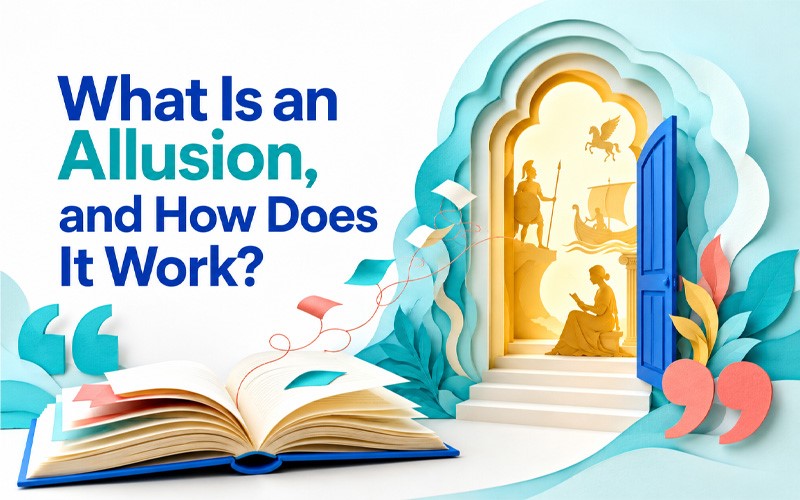
An allusion is a brief reference to a recognizable person, character, place, event, story, work of art, or cultural idea. The writer does not usually explain the entire source. Instead, the reference invites the audience to make the connection.
Consider the sentence:
Opening that old case became a Pandora’s box for the detective.
The sentence does not retell the Greek myth of Pandora, who opened a forbidden container and released suffering into the world. It assumes that the name carries enough meaning on its own. Once readers recognize the source, they understand that investigating the case has released numerous problems that can no longer be contained.
This is what makes allusion so economical. It compresses a much larger story into a name, image, or phrase. Through carefully chosen examples of allusion, a writer can suggest ambition, betrayal, innocence, danger, sacrifice, or transformation without explaining those ideas at length.
An allusion works on two levels. The first is the literal situation taking place in the current text. The second is the earlier story or idea being recalled. Meaning develops through the relationship between those two levels.
If a novelist describes a powerful executive as “sitting on his own Mount Olympus,” the literal image is an executive in an office. The additional meaning comes from Mount Olympus, the home of the Greek gods. The reference may suggest that the executive considers himself superior, untouchable, or godlike. Depending on the surrounding tone, it could communicate admiration, criticism, or humor.
Allusion should not be confused with “illusion.” An allusion is a reference, while an illusion is a false appearance or misleading perception. The words sound similar but describe entirely different ideas.
Allusion can also resemble several other literary techniques, although each works differently:
| Literary device | How it works | Simple example |
| Allusion | Refers to an outside story, figure, event, or work | “He finally met his Waterloo.” |
| Metaphor | Directly describes one thing as another | “The classroom was a zoo.” |
| Symbolism | Gives an object or image a broader meaning | A broken chain represents freedom. |
| Quotation | Repeats another source’s exact words | A character recites a line from a poem. |
| Foreshadowing | Hints at something that will happen later | Dark clouds gather before a tragedy. |
A single line can contain more than one device. An allusion might also function metaphorically or symbolically. What makes it an allusion is its dependence on a source beyond the immediate text.
Most importantly, an allusion succeeds only when it adds something meaningful. A reference that merely displays the writer’s knowledge may feel forced. A strong one rewards readers for making the connection while still providing enough context for others to understand the basic idea.
The Five Main Types of Allusion
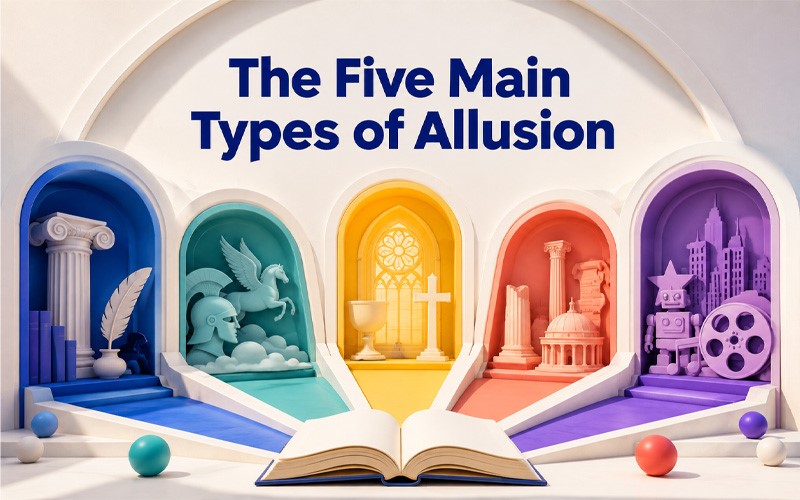
Allusions can come from almost any shared source, from ancient myths to yesterday’s viral television episode. However, most references fall into five broad categories. Understanding these categories makes allusion examples in literature and everyday communication much easier to recognize.
- Literary Allusions
A literary allusion refers to another novel, poem, play, short story, or recognized fictional character. Calling a romantic young man “Romeo,” for example, recalls Shakespeare’s Romeo and Juliet. Describing an obsessive pursuit as someone’s “white whale” points to Captain Ahab’s destructive hunt in Herman Melville’s Moby-Dick.
These references allow one text to communicate with another. Many literary allusion examples do more than borrow a familiar name; they invite readers to compare characters, conflicts, or themes across different works.
- Mythological Allusions
Mythological allusions draw upon stories about gods, heroes, monsters, and legendary journeys. Greek and Roman mythology supplies many familiar expressions, including “Achilles’ heel,” “the Midas touch,” “a Herculean task,” and “Pandora’s box.”
Other traditions also provide rich sources of allusion. Writers may reference the Norse god Thor to suggest strength, the trickster Anansi from West African and Caribbean storytelling to suggest wit, or the phoenix found across ancient traditions to represent renewal. Using mythology from different cultures can broaden a text, but accuracy and respect for the original tradition remain essential.
- Biblical and Religious Allusions
Religious allusions refer to sacred texts, spiritual figures, teachings, or widely recognized religious stories. “David and Goliath” describes a struggle in which a seemingly weaker opponent faces a powerful rival. A “Good Samaritan” is someone who helps a person in need, while a “Judas” represents betrayal.
Although biblical references are common in English-language writing, religious allusion is not limited to the Bible. Authors can draw upon Islamic history, Hindu epics, Buddhist teachings, Jewish tradition, and other faiths. The meaning should come from the specific source rather than treating distinct beliefs as interchangeable.
- Historical Allusions
Historical allusions recall real people, places, conflicts, discoveries, or events. Saying that someone has “met their Waterloo” refers to Napoleon Bonaparte’s final defeat. Calling a betrayal “a Benedict Arnold moment” invokes the American military officer remembered for changing sides during the Revolutionary War.
These references give present situations historical weight. They can also shape how an audience judges a person or event, so writers should consider whether the comparison is accurate rather than choosing a dramatic name simply because it sounds impressive.
- Cultural and Pop-Culture Allusions
Pop-culture allusions point toward films, television, music, celebrities, sports, advertising, comics, or other widely shared entertainment. Calling a complicated choice “a red-pill-or-blue-pill moment” recalls The Matrix. Describing a gifted investigator as “Sherlock” combines literary and popular-cultural associations because the character is familiar through both books and screen adaptations.
Some of today’s most famous allusion examples come from popular culture because audiences recognize them immediately. Yet these references can date more quickly than those rooted in older stories. A fashionable reference may feel fresh today and become confusing a decade later. Effective writers therefore consider not only whether an allusion is clever, but also whether their intended readers are likely to understand it.
100 Memorable Allusions from Literature, History, Myth and Culture
The best way to understand this literary device is to see it working in different contexts. The following examples of allusion are divided by source, allowing you to compare references drawn from books, mythology, religion, history, entertainment, and everyday speech.
Each entry identifies the original reference and explains the meaning it can create. Some of these are familiar allusion examples in literature, while others appear in conversation, journalism, advertising, speeches, and films. Together, these literary allusion examples and cultural references demonstrate how a few carefully chosen words can carry the weight of an entire story.
Literary Allusions
Literary allusions connect one piece of writing to another. A character’s name, a recognizable setting, or even a brief phrase can encourage readers to recall an earlier work and apply its meaning to a new situation.
- “He is such a Romeo.”
This reference to Shakespeare’s Romeo and Juliet describes someone intensely romantic, although it may also suggest impulsive love. - “She became the Cinderella of the company.”
Cinderella’s transformation from an overlooked servant to a princess represents an unexpected rise in fortune or social position. - “The old landlord was a complete Scrooge.”
Ebenezer Scrooge from Charles Dickens’s A Christmas Carol has become a shorthand description for someone miserly, cold, or ungenerous. - “That promotion became his white whale.”
Captain Ahab’s obsessive pursuit in Moby-Dick represents a goal that consumes someone, possibly at the expense of everything else. - “Big Brother is watching the office.”
George Orwell’s 1984 gives this reference its association with constant surveillance, government control, and the loss of privacy. - “Do not go full Don Quixote over this issue.”
The idealistic hero of Miguel de Cervantes’s novel represents someone pursuing a noble but unrealistic mission. - “She followed the White Rabbit into the mystery.”
The White Rabbit in Lewis Carroll’s Alice’s Adventures in Wonderland represents an invitation into an unfamiliar or increasingly strange world. - “His indecision was worthy of Hamlet.”
Shakespeare’s Hamlet is famous for questioning, delaying, and overthinking, making his name an effective reference for paralyzing uncertainty. - “Their neighborhood felt like the Capitol.”
The wealthy Capitol in Suzanne Collins’s The Hunger Games can represent privilege, excess, spectacle, and indifference to suffering elsewhere. - “The invention became a Frankenstein’s monster its creator could no longer control.”
Mary Shelley’s novel makes this a reference to something created with good intentions but producing dangerous and uncontrollable consequences. - “He waited for Gatsby’s green light.”
The green light in F. Scott Fitzgerald’s The Great Gatsby represents longing, ambition, and a future that remains painfully out of reach. - “The investigation entered a real Catch-22.”
Joseph Heller’s Catch-22 provides the name for a contradictory situation in which every available solution is blocked by the rules of the problem. - “Her perfect community had a Stepford quality.”
The Stepford Wives by Ira Levin gives this reference an unsettling association with artificial perfection, conformity, and suppressed individuality. - “He was the Jekyll and Hyde of the newsroom.”
Robert Louis Stevenson’s characters represent two sharply opposing sides of the same personality. - “The abandoned garden became her own Secret Garden.”
Frances Hodgson Burnett’s novel allows this reference to suggest healing, privacy, discovery, and personal renewal. - “She faced the trial with Atticus Finch beside her.”
The principled lawyer in Harper Lee’s To Kill a Mockingbird represents moral courage and a willingness to defend justice despite public opposition. - “Their summer was pure Tom Sawyer.”
Mark Twain’s adventurous character evokes youthful mischief, freedom, cleverness, and a resistance to adult rules. - “The children entered a Lord of the Flies situation.”
William Golding’s novel provides a darker comparison for the collapse of order and the emergence of cruelty within an isolated group. - “The accusation became an invisible scarlet letter she was forced to carry.”
Nathaniel Hawthorne’s The Scarlet Letter makes this a reference to public shame, social judgment, and lasting stigma.
- “He seemed to have made a Dorian Gray bargain with time.”
Oscar Wilde’s The Picture of Dorian Gray makes this a reference to someone who maintains a youthful or respectable appearance while concealing moral corruption, troubling secrets, or the consequences of their choices.
- “Her memory worked like Proust’s madeleine.”
In Marcel Proust’s In Search of Lost Time, the taste of a madeleine triggers an involuntary flood of memory.
- “The expedition became a modern Odyssey.”
Homer’s Odyssey lends its name to any long, difficult journey filled with challenges, discoveries, and changes.
- “The committee kept waiting for Godot.”
Samuel Beckett’s Waiting for Godot makes this a reference to prolonged, seemingly pointless waiting for something that may never arrive.
- “His supposedly perfect society began to resemble the world of Brave New World.”
Aldous Huxley’s novel makes this a warning about comfort, conformity, and technological control being purchased at the cost of freedom.
- “She felt trapped inside the yellow wallpaper.”
Charlotte Perkins Gilman’s story allows the image to suggest confinement, psychological distress, and a struggle to escape oppressive control.
These allusion examples in literature show that the original source does not have to be explained at length. A name such as Scrooge or Gatsby can bring a complete pattern of behavior, emotion, and consequence into a new story.
Mythological Allusions
Mythological references remain among the most recognizable allusions in English. Although Greek and Roman myths appear frequently, mythology from many cultures gives writers a vast collection of heroes, tricksters, monsters, gods, and transformations.
- “Public speaking was his Achilles’ heel.”
Achilles was nearly invulnerable except for his heel, making the phrase a reference to an otherwise strong person’s critical weakness.
- “The investigation opened Pandora’s box.”
Pandora released suffering into the world by opening a forbidden container. The expression describes an action that creates numerous unforeseen problems. - “She seems to have the Midas touch with every investment.”
King Midas could turn whatever he touched into gold. Today, the reference describes a person’s exceptional ability to make ventures successful or profitable.
- “Cleaning the archive was a Herculean task.”
Hercules completed twelve seemingly impossible labors. A Herculean task therefore requires extraordinary strength, patience, or effort.
- “His rapid rise became an Icarus story.”
Icarus flew too close to the sun after ignoring his father’s warning. His fall represents reckless ambition, overconfidence, and disregard for limits. - “She rose from the failure like a phoenix.”
The phoenix is a legendary bird reborn from its ashes, making it a lasting symbol of renewal after destruction or defeat. - “Rumors became the Hydra of the campaign.”
When one of the Hydra’s heads was cut off, more appeared. The creature represents a problem that multiplies whenever someone tries to solve it. - “Music remained his only muse.”
The Muses of Greek mythology inspired art, poetry, music, and learning. A muse is now any person or force that stimulates creativity. - “The new manager arrived like Athena in the boardroom.”
Athena, the Greek goddess of wisdom and strategic warfare, can represent intelligence, discipline, and carefully planned action. - “He carried the department on his shoulders like Atlas.”
Atlas was condemned to hold up the heavens. The comparison describes someone carrying an enormous responsibility or burden. - “The celebrity seemed like a modern Narcissus, constantly admiring his own image.”
Narcissus fell in love with his own reflection. Referring to someone as a modern Narcissus suggests extreme vanity or self-absorption and recalls the origin of the word “narcissism.” - “The tempting offer was a siren song.”
In Greek mythology, the Sirens lured sailors toward destruction with their beautiful voices. A siren song is an irresistible but dangerous attraction. - “She brought Promethean energy to the invention.”
Prometheus gave fire to humanity and was punished for it. His name can represent innovation, rebellion, sacrifice, or knowledge given at great personal cost. - “The project became a Sisyphean routine.”
Sisyphus was condemned to push a rock uphill only for it to roll down repeatedly. The reference describes endless, futile labor.
- “The explanation worked like Ariadne’s thread.”
Ariadne gave Theseus a thread to find his way out of the Minotaur’s labyrinth. It represents guidance through a complicated problem.
- “The deal was a Trojan horse.”
Greek soldiers entered Troy by hiding inside a wooden horse. The phrase describes a threat concealed within something that appears harmless or beneficial.
- “He moved through the court like Loki.”
The Norse trickster Loki is associated with deception, disruption, shifting loyalties, and unpredictable behavior.
- “Her stories carried the cleverness of Anansi.”
Anansi, the spider trickster from West African and Caribbean traditions, represents wit, storytelling, survival, and victory through intelligence.
- “The discovery became their El Dorado.”
El Dorado developed from the legend of a gilded ruler into the imagined location of immense riches. It now represents fabulous wealth or an elusive goal pursued at enormous risk.
- “The athlete seemed to have Thor’s strength.”
Thor, the Norse god associated with thunder, courage, and physical power, makes the comparison suggest exceptional strength.
Biblical and Religious Allusions
Religious references often carry moral, emotional, and spiritual associations. Their meaning depends on the particular story being recalled, so writers should understand the source rather than using sacred material carelessly.
- “The small charity faced a David-and-Goliath battle.”
The biblical David defeated the giant Goliath, making this a reference to an underdog confronting a much stronger opponent.
- “The stranger became our Good Samaritan.”
The parable of the Good Samaritan makes the term a description of someone who helps another person without prejudice or expectation of reward. - “The garden looked like Eden.”
The Garden of Eden represents paradise, natural beauty, innocence, and a peaceful state before loss or wrongdoing.
- “The betrayal felt like a Judas kiss.”
Judas identified Jesus with a kiss before his arrest. The image represents betrayal disguised as friendship or affection.
- “She had the patience of Job.”
Job endured severe suffering while his faith was tested. The phrase describes remarkable patience during prolonged hardship. - “His return was treated like that of the prodigal son.”
In Jesus’s parable, a wasteful son returns home and is welcomed by his father. The reference suggests repentance, forgiveness, and restoration. - “The new rules were written in stone.”
The expression recalls the tablets bearing the Ten Commandments and describes rules considered permanent or impossible to change. - “The speech became a voice in the wilderness.”
This biblical phrase describes someone expressing an important warning or truth that few people are willing to hear. - “The family needed the wisdom of Solomon.”
King Solomon is remembered for wisdom and fair judgment. The reference describes the insight required to resolve a difficult dispute. - “The international meeting became a Tower of Babel.”
The biblical Tower of Babel story associates the reference with confused communication, divided languages, and the breakdown of mutual understanding. - “The decision became her road-to-Damascus moment.”
Saul’s transformative experience on the road to Damascus represents a sudden and profound change in belief or direction. - “He faced his own forty days in the wilderness.”
Jesus’s forty days of fasting and temptation in the wilderness make this a reference to isolation, testing, discipline, and spiritual preparation. - “The rescue arrived like manna from heaven.”
Manna sustained the Israelites in the desert. The phrase now describes unexpected help received at exactly the right moment. - “He washed his hands of the decision.”
Pontius Pilate’s symbolic washing of his hands before Jesus’s crucifixion represents an attempt to deny responsibility.
- “Their tiny contribution was a widow’s mite.”
The biblical widow gave two small coins despite her poverty. The reference describes a modest gift made with exceptional generosity or sacrifice.
Historical Allusions
Historical allusions use the past as a lens for the present. The comparison can be powerful, but only when the new situation genuinely shares something meaningful with the original event or person.
- “The election became his Waterloo.”
Napoleon’s defeat at Waterloo ended his rule. The name now represents a final or decisive defeat.
- “Do not cross the Rubicon unless you are ready.”
Julius Caesar’s crossing of the Rubicon committed him to conflict. The phrase describes taking an irreversible step.
- “The captain faced a mutiny worthy of the Bounty.”
The famous mutiny aboard HMS Bounty makes this a reference to organized rebellion against a leader.
- “The software failure was the company’s Titanic.”
The sinking of the supposedly unsinkable ship represents catastrophe, misplaced confidence, and ignored warnings.
- “They need a Marshall Plan for the school system.”
The post-war program designed to rebuild European economies represents an ambitious and coordinated recovery effort.
- “Her quiet refusal to accept injustice echoed the courage of Rosa Parks.”
Rosa Parks’s refusal to surrender her bus seat became a defining symbol of principled resistance to racial injustice and segregation.
- “The debate turned into another Boston Tea Party.”
The colonial protest against British taxation represents organized defiance of authority or an unpopular policy. - “The mistake created a Watergate-sized crisis.”
The Watergate scandal led to President Richard Nixon’s resignation. Its name now suggests political corruption and attempted concealment.
- “He behaved like Nero while the company burned.”
The legend that Nero played music while Rome burned has come to represent a leader remaining careless, distracted, or self-indulgent during a crisis. The story is a traditional allusion rather than a verified historical account.
- “The research team found its Rosetta Stone.”
The Rosetta Stone helped scholars decipher Egyptian hieroglyphs. The term describes a discovery that unlocks previously inaccessible knowledge. - “The new restrictions created an economic Iron Curtain between the two regions.”
Winston Churchill popularized the term “Iron Curtain” to describe the political and ideological division between Soviet-controlled Eastern Europe and the West. The allusion now suggests a severe barrier separating countries, regions, or systems. - “The announcement produced a moon-landing moment.”
The 1969 Apollo 11 landing represents a historic achievement once considered nearly impossible. - “The scientist was treated like a modern Galileo.”
Galileo’s conflict with established authority makes his name a reference to someone whose evidence challenges accepted beliefs. - “His former partner became the office’s Benedict Arnold.”
Benedict Arnold’s defection during the American Revolution made his name synonymous with betrayal in American culture. - “The peaceful protest had echoes of the Salt March.”
Mahatma Gandhi’s 1930 march against British salt laws represents disciplined nonviolent resistance to unjust authority.
Cultural and Pop-Culture Allusions
The following famous allusion examples draw from films, television, comics, music, and familiar public figures. They often feel immediate, although their effectiveness depends heavily on the audience.
- “She entered the interview in full Wonder Woman mode.”
The superhero represents courage, confidence, power, and readiness to confront a difficult challenge. - “He chose the red pill.”
In The Matrix, the red pill offers painful truth while the blue pill preserves comforting illusion. The reference represents choosing reality over ignorance. - “The office turned into the Wild West.”
Popular depictions of the American frontier make this a description of a lawless environment with little control or accountability. - “May the Force be with the new team.”
The Force in Star Wars represents an unseen spiritual energy, while the familiar phrase offers encouragement or good fortune. - “She had a Sherlock moment.”
Sherlock Holmes represents extraordinary observation and deduction, whether readers know him from Arthur Conan Doyle’s stories or screen adaptations. - “Do not make me your Yoda.”
The wise Jedi master from Star Wars represents a patient mentor who guides someone through a difficult journey. - “The celebration looked like one of Gatsby’s parties.”
Fitzgerald’s novel associates Gatsby with spectacular parties, wealth, performance, and the loneliness hidden beneath outward glamour. - “He became the Superman of the emergency room.”
Superman represents exceptional strength, heroism, endurance, and the ability to rescue others. - “The plan required an Ocean’s Eleven team.”
The heist film suggests a group of specialists combining their different talents to execute an elaborate plan. - “The internet detectives went full Scooby-Doo.”
Scooby-Doo represents a group investigating strange events and revealing the ordinary truth behind an apparent mystery. - “Her wardrobe had entered its Barbie era.”
Barbie can suggest highly styled femininity, bright color, reinvention, or an idealized identity, depending on context. - “The family gathering became an episode of Succession.”
The television drama makes the comparison suggest wealth, rivalry, manipulation, and conflict over power. - “He pulled a Rocky and kept getting up.”
Rocky Balboa represents endurance, discipline, and the refusal to surrender when facing a stronger opponent. - “The children thought the wardrobe might lead to Narnia.”
S. Lewis’s fictional world represents an unexpected passage from ordinary life into wonder and adventure.
- “It felt like Groundhog Day at the office.”
The film Groundhog Day makes this a reference to an experience repeating so predictably that escape seems impossible.
Allusions Used in Everyday Language
Some references become so familiar that their literary, historical, or mythological origins nearly disappear. These final ten examples of allusion show how old stories continue to shape ordinary speech.
- “That topic is forbidden fruit.”
The expression recalls the forbidden tree in Eden and describes something made more tempting because it is prohibited.
- “Do not be a Grinch.”
The title character from Dr. Seuss’s story represents someone who resents or attempts to spoil other people’s happiness.
- “This paperwork is my kryptonite.”
Kryptonite weakens Superman, so the term describes something that leaves an otherwise capable person unusually powerless.
- “She is the Einstein of our department.”
Albert Einstein’s name has become an everyday reference to exceptional intelligence or scientific brilliance.
- “He thinks he is Casanova.”
Giacomo Casanova’s reputation makes his surname a common description for a charming and persistent seducer.
- “A sword of Damocles hung over the negotiations.”
In the ancient story, Damocles sits beneath a sword suspended by a single hair. The image represents danger continually threatening someone in a powerful or fortunate position.
- “Accepting the offer became her Sophie’s choice.”
William Styron’s novel makes this a reference to an agonizing decision between unbearable alternatives. Because the original context involves profound trauma, the expression should not be used for trivial choices. - “The new policy felt distinctly Orwellian.”
George Orwell’s writing gives “Orwellian” its associations with surveillance, manipulated language, propaganda, and authoritarian control.
- “The new leader imagined himself as King Arthur gathering the Knights of the Round Table.”
The legends of King Arthur and the Knights of the Round Table make this an allusion to bringing trusted equals together around a shared mission.
- “After years abroad, he returned like Rip Van Winkle.”
Washington Irving’s character awakens after a twenty-year sleep to find his world transformed. The reference describes someone returning after a long absence and feeling displaced by change.
Taken together, these literary allusion examples reveal how widely references travel. A phrase may begin in an ancient myth or classic novel, enter public conversation, and eventually become so familiar that its original story is almost invisible.
How to Identify and Analyze an Allusion
Finding an allusion is only the first step. Strong literary analysis must explain why the writer selected that particular reference and what it contributes to the new context.
When reading, watch for a name, location, object, phrase, or event that seems unusually specific. Capitalized names such as Eden, Waterloo, Gatsby, or Olympus can be obvious clues, but some allusions appear through imagery or altered wording rather than direct naming.
A useful method involves five questions:
- What appears to be referenced?
Identify the word, image, character, event, or phrase that seems connected to an outside source. - Where does the reference come from?
Find the original book, myth, historical event, religious account, film, or cultural tradition. - What does the original source represent?
Consider the source’s central qualities, conflicts, themes, and consequences. - How does it connect to the present context?
Determine what the current character, situation, or idea shares with the source. - What does the connection add?
Decide whether the reference creates humor, criticism, emotional depth, foreshadowing, irony, or thematic meaning.
Suppose a novel describes an ambitious politician as “flying toward the sun.” A reader familiar with Icarus may recognize a warning. The character is not literally flying, but his rapid ascent, confidence, and refusal to recognize limits resemble the myth. The reference may therefore foreshadow a fall caused by pride.
A weak analysis would simply state, “This is an allusion to Icarus.” A stronger interpretation explains the effect: “By recalling Icarus, the author presents the politician’s ambition as dangerously excessive and suggests that his success may contain the cause of his downfall.”
Context remains essential. Calling someone “Romeo” could praise romantic devotion, mock excessive flirting, or warn of reckless love. The source stays the same, but tone changes its purpose. This is why analyzing allusion examples in literature requires more than recognizing a famous name.
Readers should also allow for uncertainty. An apparent connection may be coincidental, especially when it relies only on a broad theme. Convincing analysis uses textual evidence, considers the author’s likely sources, and avoids claiming certainty when the connection is merely possible. Studying famous allusion examples can sharpen recognition, but careful readers still judge every reference within its own context.
Further Reading
Want to explore allusions in greater depth? The Oxford Dictionary of Allusions provides a useful reference for understanding literary, historical, mythological, and cultural references.
How Writers Can Use Allusions Effectively
Allusion gives writers access to a vast cultural memory, but a recognizable reference is not automatically a good one. The strongest choices feel natural within the voice, subject, and world of the writing.
Begin with the audience. A reference to Icarus may work for a broad readership because the story is widely known. A passing reference to a minor character from an obscure novel may leave most readers confused. Obscurity is not always a problem, specialist fiction can reward a knowledgeable audience, but the surrounding sentence should still provide enough context to preserve the basic meaning.
Writers should also ask what the reference accomplishes. Does it reveal character? Strengthen a theme? Create humor? Add irony? Foreshadow a consequence? If removing it changes nothing, it may be decorative rather than meaningful.
Consider these two sentences:
- “Maya was like Cinderella.”
- “By midnight, the applause was over, the borrowed dress was returned, and Maya was once again invisible.”
The first names the reference but does little with it. The second adapts Cinderella’s temporary transformation to create a more emotionally specific idea. Effective literary allusion examples do not simply point backwards; they make the older story perform new work.
Accuracy matters as well. Frankenstein is the scientist, not the unnamed creature. Pandora opened a jar in the earliest Greek account, although later traditions commonly call it a box. Getting the source wrong can weaken the writer’s credibility unless the mistake is deliberate and meaningful.
A few practical rules can help:
- Choose a reference your intended audience can reasonably understand.
- Give readers enough context to follow the sentence without a lengthy explanation.
- Use the source to deepen meaning rather than decorate the prose.
- Avoid stacking several references into one sentence.
- Check the original story instead of relying entirely on popular memory.
- Treat sacred and culturally specific sources with care.
- Remember that contemporary references may age quickly.
- Look beyond the most overused figures when a fresher comparison would be clearer.
Writers can also transform an allusion rather than merely repeat it. A modern character might reject the role of Cinderella, survive an Icarus-like fall, or refuse to wait for Prince Charming. Such reversals create surprise because readers recognize the expected pattern and then see it challenged.
The most effective examples of allusion feel like invitations, not tests. Readers who recognize the source receive an additional layer of meaning, while those who do not should still understand the immediate scene. When that balance is achieved, an allusion becomes more than a clever reference: it becomes a bridge between stories, cultures, and generations.
For readers interested in exploring more literary techniques, storytelling concepts, and writing insights, America Publishers Author Spotlight shares educational resources designed to make literature more accessible and engaging.
Frequently Asked Question
-
What is a simple example of an allusion?
“She has the patience of Job” is a simple allusion. It refers to the biblical figure Job, who endured extreme suffering while his faith was tested. The sentence uses that familiar story to describe someone who remains patient through prolonged difficulty.
-
What are the five main types of allusion?
The five main types are literary, mythological, religious, historical, and cultural or pop-cultural allusion. Some references fit more than one category. Sherlock Holmes, for example, began as a literary character but is also widely recognized through film and television.
-
What is the difference between allusion and illusion?
An allusion is a reference to another person, story, event, place, or cultural idea. An illusion is a false or misleading appearance. Calling a difficult task “Herculean” is an allusion, while a magician making an object appear to disappear creates an illusion.
-
How can you identify allusion examples in literature?
Look for unusually specific names, phrases, objects, places, or events that may point beyond the immediate story. Then identify the original source and compare its meaning with the present context. The connection should add something useful, such as irony, symbolism, foreshadowing, criticism, or emotional depth.
-
Why do authors use allusions?
Authors use allusions to communicate complex ideas efficiently, develop characters, establish mood, strengthen themes, or connect their work with an earlier tradition. Studying literary allusion examples shows how a short reference can create meaning that would otherwise require several paragraphs to explain.
-
Can an allusion refer to a film or popular culture?
Yes. Allusions can refer to films, television programs, songs, superheroes, celebrities, sports, and other recognizable parts of popular culture. Many famous allusion examples, including “choosing the red pill,” “having a Rocky moment,” and “using Kryptonite,” come from modern entertainment rather than classical literature.
Conclusion
Allusion proves that a writer does not need many words to communicate a large idea. A single reference to Icarus can warn against reckless ambition, while the name Scrooge can reveal a character’s attitude toward money before a full description begins. The most effective examples of allusion work because they connect new experiences with stories audiences already know.
Learning from literary allusion examples can make readers more attentive to the hidden conversations taking place between books. At the same time, recognizing myths, historical events, religious narratives, and famous allusion examples from popular culture can deepen our understanding of everything from novels to everyday speech.
For writers, the goal is not to fit in as many references as possible. It is to choose one that adds meaning, suits the audience, and rewards recognition. Used thoughtfully, allusion turns shared cultural memory into a powerful storytelling tool.
