
Table Of Content
Published on July 30 2026
Symbolism examples can turn a simple object into the most unforgettable part of a story. A locked door can hold a secret, a storm can mirror a character’s fear, and a distant green light can come to represent an entire dream.
That is the quiet power of symbolism. It gives books an emotional layer beyond the plot, allowing readers to feel what characters cannot always say directly. From ancient myths and classic poetry to modern novels, symbols make stories more vivid, personal, and open to interpretation.
This guide brings together clear symbolism examples in literature, poetry, and famous stories, with practical explanations of what each object, color, image, or action may represent.
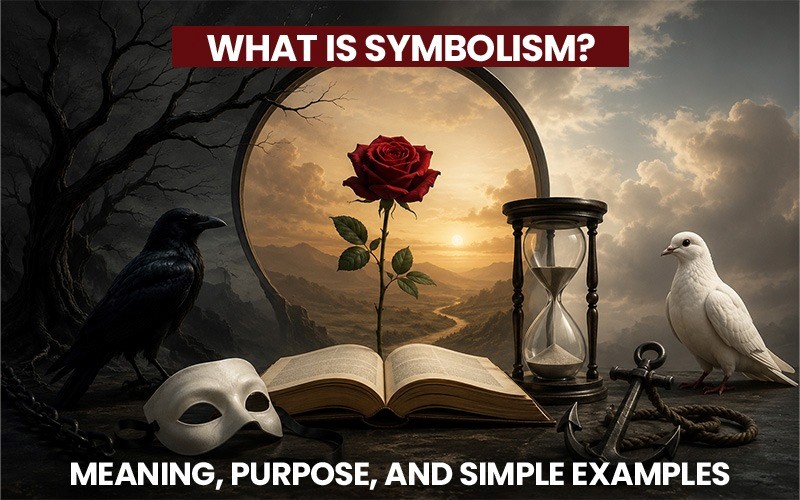
What Is Symbolism? Meaning, Purpose, and Simple Examples
Exploring symbolism meaning and examples can help readers move beyond the surface of a story and notice the ideas beneath it. Symbolism is the use of a person, object, setting, color, action, or image to suggest an idea beyond its literal meaning. Put simply, it allows one thing to stand for something else.
For example, a rose is still a flower. But in a love story, it may also represent affection, romance, desire, or a relationship that is beginning to bloom. A broken mirror may be just a broken mirror, or it may suggest a fractured identity, lost confidence, or an uncomfortable truth.
When people search for symbolism meaning and examples, they are usually looking for this deeper layer. The key is context. A color, animal, or object does not have one fixed meaning in every story. A white dress might symbolize innocence in one novel and social pressure or grief in another. The writer’s choices, the plot, and the emotions surrounding the image all shape its meaning.
Here are a few simple symbolism examples:
- A candle can symbolize hope, guidance, memory, or life.
- A chain can symbolize confinement, duty, oppression, or an unbreakable bond.
- A road can symbolize a journey, a major choice, or the direction of someone’s life.
- A window can symbolize possibility, distance, freedom, or a new perspective.
- A mask can symbolize secrecy, deception, protection, or the gap between a person’s public and private self.
The best symbols do not feel randomly placed. They appear at important moments, return throughout the work, or connect closely to a character’s struggle. Rather than announcing the theme, they let the reader feel it.
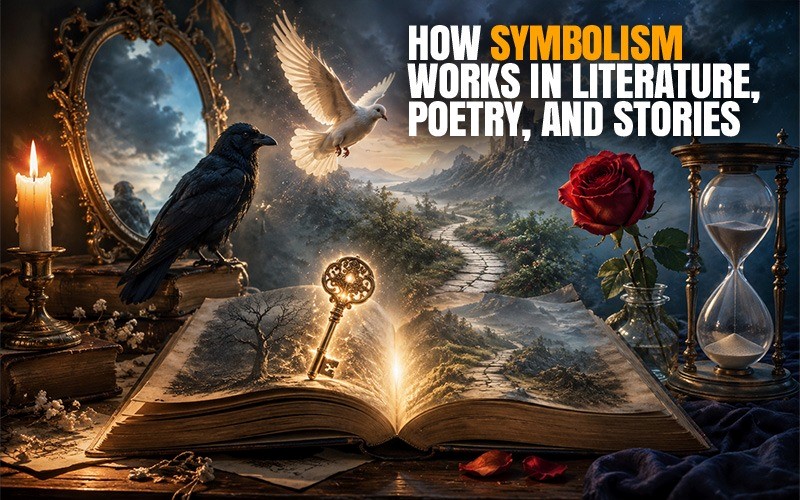
How Symbolism Works in Literature, Poetry, and Stories
In strong writing, symbolism often works quietly. A writer may repeat an image, place it at a turning point, or contrast it with another detail to create an emotional effect. Readers begin to sense that the image matters, even before they can fully explain why. Symbolism in fiction is especially effective when it reveals an emotion or theme that characters cannot easily express in words.
For instance, in Macbeth, blood becomes tied to guilt, violence, and the consequences of ambition. In F. Scott Fitzgerald’s The Great Gatsby, the green light is connected to Gatsby’s longing for Daisy and the future he cannot quite reach. These famous symbolism examples in literature are effective because they grow naturally from the characters and their conflicts.
Symbols can take many forms:
- Objects: keys, letters, photographs, clocks, mirrors, and doors
- Nature: rivers, trees, birds, seasons, fire, and storms
- Colors: red, white, black, green, gold, and blue
- Settings: houses, cities, forests, oceans, and empty rooms
- Actions: traveling, falling, crossing a bridge, planting a seed, or breaking an object
In poetry, a symbol may do a great deal of work in just a few lines. A bird might suggest freedom, while a darkening sky may create a sense of uncertainty or approaching loss. These symbolism examples in poetry are often especially powerful because poems rely on condensed language and carefully chosen images.
It is also worth remembering that symbolism is not a puzzle with only one correct answer. Robert Frost’s “The Road Not Taken,” for example, is often read as a poem about individual choice. Yet its two roads can also suggest uncertainty, regret, and the stories people later tell themselves about the decisions they made. The symbol gains power because it invites thought.
This is why symbolism in fiction matters so much. It gives readers room to participate in the story. A symbol can reveal a theme, deepen a character, build atmosphere, or make an ending stay with us long after the final page.
100 Symbolism Examples in Literature, Poetry, and Famous Stories
Below are 100 symbolism examples to help you recognize how writers use ordinary images to express larger ideas. Meanings can change depending on cultural context and the individual work, but these are common interpretations. The following examples of symbolism show how writers use familiar images to express complex emotions, themes, and conflicts.
Nature and weather
- A storm often symbolizes conflict, emotional turmoil, danger, or a major change.
- Rain can suggest sadness, cleansing, renewal, or suppressed emotion.
- Sunlight often symbolizes optimism, vitality, openness, or the return of happiness after a difficult period.
- Darkness may symbolize the unknown, fear, confusion, or a world in which moral certainty has disappeared.
- A river can represent the passage of time, life’s movement, change, or a boundary to cross.
- The ocean often suggests the unknown, emotional depth, freedom, or overwhelming power.
- A mountain can symbolize challenge, spiritual growth, isolation, or an achievement still ahead.
- A forest may represent the unconscious mind, danger, transformation, or a place outside ordinary rules.
- A desert can suggest loneliness, spiritual testing, emotional emptiness, or survival.
- A rainbow often represents hope after hardship, peace, promise, or renewal.
Seasons and the cycle of life
- Spring often symbolizes rebirth, youth, hope, romance, or fresh opportunity.
- Summer can represent abundance, confidence, joy, maturity, or a high point in life.
- Autumn may symbolize change, aging, reflection, beauty, or the beginning of an ending.
- Winter often suggests death, isolation, hardship, stillness, or emotional distance.
- Falling leaves can represent loss, mortality, transition, or letting go.
- A seed may symbolize potential, faith, a new idea, or the beginning of transformation.
- A flowering tree often represents growth, beauty, family, renewal, or a flourishing relationship.
- A withered flower can suggest fading love, disappointment, loss of innocence, or neglected hope.
- Dawn symbolizes a new chapter, awakening, possibility, or relief after a difficult time.
- Sunset may represent closure, aging, peace, beauty, or the end of a stage in life.
Animals and creatures
- A dove traditionally represents peace, hope, love, innocence, or spiritual comfort.
- A raven can suggest death, prophecy, memory, loneliness, or an unsettling message.
- A butterfly often symbolizes transformation, freedom, fragility, or personal growth.
- A snake may represent temptation, danger, hidden knowledge, betrayal, or rebirth.
- A wolf can symbolize instinct, loyalty, wilderness, threat, or a character’s untamed side.
- A bird in flight commonly represents freedom, escape, ambition, or the human spirit.
- A caged bird may symbolize restriction, silenced identity, oppression, or a desire to break free.
- A spider can suggest patience, creativity, manipulation, entrapment, or fate.
- A horse often represents strength, freedom, passion, journey, or uncontrolled energy.
- A moth may symbolize attraction to danger, vulnerability, obsession, or self-destruction.
Colors and visual images
- Red can symbolize love, passion, anger, danger, blood, or sacrifice.
- White may represent innocence, peace, purity, emptiness, or mourning in some cultures.
- Black often suggests grief, secrecy, death, fear, sophistication, or the unknown.
- Green can symbolize nature, envy, growth, wealth, hope, or an unattainable dream.
- Blue may represent calm, sadness, loyalty, distance, spirituality, or reflection.
- Gold can suggest wealth, success, beauty, power, or something valuable but corrupting.
- Purple often represents royalty, ambition, mystery, luxury, or spiritual authority.
- Gray may symbolize uncertainty, emotional numbness, aging, or a world without clear answers.
- A shadow can symbolize a repressed memory, hidden guilt, an unwanted past, or the part of oneself that remains unacknowledged.
- A bright light can symbolize revelation, a moment of understanding, or the exposure of something previously hidden.
Everyday objects
- A key may symbolize access, knowledge, trust, freedom, or the answer to a mystery.
- A locked door can represent secrecy, exclusion, fear, opportunity, or a truth not yet revealed.
- A mirror can symbolize self-examination, identity, truth, or the difference between how a person sees themselves and how others see them.
- A broken mirror may symbolize a shattered self-image, fractured relationships, or the collapse of an illusion.
- A clock can symbolize time, mortality, pressure, routine, or the inability to stop change.
- A candle may symbolize remembrance, prayer, fragile hope, or a life that continues despite darkness.
- A lamp can symbolize learning, guidance, and the deliberate search for clarity or wisdom.
- A photograph can represent memory, loss, family history, longing, or the gap between past and present.
- A letter often symbolizes truth, connection, confession, news, or a message from the past.
- A book may represent knowledge, escape, hidden history, imagination, or a character’s inner life.
Journeys, barriers, and places
- A road can symbolize the long, unfolding course of a life, with its movement, uncertainty, and changing direction.
- A crossroads often represents a difficult decision, moral conflict, or a turning point.
- A bridge may symbolize connection, transition, reconciliation, or the movement from one stage of life to another.
- A train can represent progress, destiny, departure, industrial change, or time moving forward.
- A ship often suggests a journey, exploration, risk, freedom, or survival against powerful forces.
- A house can symbolize family, identity, safety, memory, or a character’s mental state.
- An empty house may represent abandonment, loneliness, loss, or a past that refuses to disappear.
- A window can suggest possibility, observation, separation, hope, or a view of another life.
- A staircase often represents progress, ambition, descent, revelation, or movement between different states of mind.
- A maze may symbolize confusion, a difficult search, psychological struggle, or a journey toward self-knowledge.
Symbols in famous literature
- The green light in The Great Gatsby represents Gatsby’s longing for Daisy, his hope for the future, and the elusive American Dream.
- The eyes of Doctor T. J. Eckleburg in The Great Gatsby suggest an unsettling, impersonal gaze over a morally empty society and are often read as a symbol of lost spiritual values.
- The conch shell in Lord of the Flies represents order, democratic authority, and civilized discussion.
- The beast in Lord of the Flies symbolizes the fear and violence the boys carry within themselves.
- The scarlet letter in The Scarlet Letter represents shame, social judgment, identity, and Hester’s changing strength.
- The mockingbird in To Kill a Mockingbird symbolizes innocence and the harm caused by cruelty toward the innocent.
- The green girdle in Sir Gawain and the Green Knight represents self-preservation, fear of death, human weakness, and the tension between honor and survival.
- The ring in The Lord of the Rings symbolizes power, temptation, corruption, and the burden of responsibility.
- The wardrobe in The Lion, the Witch and the Wardrobe represents a threshold between ordinary life and a transformative, magical world.
- Big Brother in Nineteen Eighty-Four symbolizes the Party’s omnipresent surveillance, authoritarian control, and the destruction of personal freedom.
Symbolism examples in poetry and drama
- The two roads in Robert Frost’s “The Road Not Taken” symbolize a moment of decision and the uncertain meaning people later attach to the choices they make.
- Fire in Frost’s “Fire and Ice” is linked with desire, intensity, and destructive passion.
- Ice in Frost’s “Fire and Ice” suggests hatred, coldness, detachment, and emotional destruction.
- The raven in Edgar Allan Poe’s “The Raven” symbolizes grief, haunting memory, and the speaker’s inability to move beyond loss.
- In William Carlos Williams’ “The Red Wheelbarrow,” the wheelbarrow is often read as an image that honors ordinary labor, practical dependence, and overlooked everyday beauty rather than carrying one fixed symbolic meaning.
- In William Blake’s “The Sick Rose” the rose can symbolize love, innocence, or beauty, while the invisible worm suggests a hidden force, such as secrecy, corruption, betrayal, or disease that destroys it.
- The tiger in Blake’s “The Tyger” represents fierce beauty, creation, terror, and the mystery of existence.
- Blood in Shakespeare’s Macbeth symbolizes guilt, violence, and the lasting psychological cost of ambition.
- Sleep in Macbeth represents innocence, peace, and the rest that guilt has taken away.
- The handkerchief in Shakespeare’s Othello symbolizes love, trust, and marital fidelity, while its misuse fuels the jealousy and manipulation that destroy Othello and Desdemona’s marriage.
Food, clothing, and personal items
- An apple may symbolize temptation, knowledge, desire, choice, or forbidden experience.
- Bread often represents survival, comfort, community, generosity, or basic human need.
- A feast can symbolize celebration, abundance, power, belonging, or excess.
- An empty plate may suggest poverty, neglect, grief, hunger, or emotional absence.
- A crown often represents power, leadership, burden, legitimacy, or dangerous ambition.
- A mask can symbolize deception, hidden identity, social performance, or self-protection.
- A wedding dress may represent love, social expectation, innocence, transformation, or a role imposed on someone.
- A uniform can symbolize duty, belonging, authority, conformity, or loss of individuality.
- A necklace or locket often represents memory, love, inheritance, secrecy, or a connection to the past.
- A suitcase can suggest departure, emotional baggage, independence, escape, or an uncertain future.
Abstract and recurring symbols
- A broken chain usually symbolizes liberation, the end of oppression, or freedom from control.
- A wall may represent division, emotional distance, protection, prejudice, or a barrier between people.
- A wound or scar can symbolize trauma, survival, memory, sacrifice, or a past that still shapes the present.
- A dream often represents desire, fear, prophecy, hidden truth, or the unconscious mind.
- A ghost may symbolize unresolved grief, guilt, history, trauma, or something society refuses to confront.
- A crown of thorns can represent suffering, sacrifice, cruelty, and spiritual endurance.
- A cracked crown may symbolize unstable authority, the burden of leadership, inherited power, or the failure of ambition.
- A ladder can represent ambition, spiritual ascent, social mobility, or the risk of falling.
- A fallen statue may symbolize the collapse of power, forgotten ideals, or the temporary nature of human achievement.
- A phoenix represents rebirth, resilience, survival, and the ability to begin again after destruction.
How to Identify Symbolism When Reading
Spotting symbolism becomes easier once you begin paying attention to what a writer repeats, emphasizes, or places at a meaningful moment. You do not need to search for a hidden message in every sentence. Instead, look for details that seem to carry more emotional weight than their literal role in the story.
Here are a few simple ways to recognize symbolism examples as you read:
- Notice repetition. If a particular object, color, animal, or setting keeps appearing, it is probably important. A recurring bird, a locked room, or a particular song may be connected to the story’s central theme.
- Look at key moments. Symbols often appear during major decisions, emotional turning points, or the ending. If a character gives away a necklace before leaving home, the necklace may represent more than jewelry.
- Ask what the detail makes you feel. A storm may create fear before anything dangerous happens. A candle in a dark room may make the scene feel hopeful. The emotional response can point toward the symbol’s deeper role.
- Connect the image to the character. In many symbolism examples in literature, a symbol reflects a character’s hopes, fears, guilt, or change. A character who cannot throw away an old photograph may be holding on to a past they cannot accept.
- Think about contrast. Writers often use symbols in opposition. Light and darkness, open doors and locked doors, or spring and winter can highlight conflict between hope and despair, freedom and restriction, or life and loss.
- Keep the story’s context in mind. A snake, a rose, or the color red can mean different things in different works. The surrounding plot, setting, and culture matter more than a universal definition.
Looking for symbolism in fiction can also help readers understand why a seemingly small object becomes important by the end of a story. The best symbolism examples usually feel connected to the story rather than added for decoration. If an image keeps returning and seems linked to the characters or theme, it is worth considering what else it might represent.
Why Symbolism Matters in Fiction and Creative Writing
Symbolism gives writers a way to make a story feel deeper without slowing it down with long explanations. Instead of stating that a character feels trapped, a writer might show them standing beside a locked gate or watching a bird struggle inside a cage. The image allows the reader to feel the emotion for themselves.
This is one reason symbolism in fiction is so effective. It adds layers to a novel, short story, or poem. A reader may understand the plot on a first read, then notice new connections in the symbols when returning to the work later.
For writers, symbolism can help to:
- Reinforce the central theme without repeatedly stating it
- Create a stronger emotional atmosphere
- Reveal a character’s inner conflict
- Make settings and objects feel more memorable
- Connect the beginning and ending of a story in a satisfying way
The strongest symbols are usually simple. They do not need to be complicated to be meaningful. A garden can represent growth. A cracked wall can reflect a broken relationship. A journey home can become a symbol of healing, belonging, or self-acceptance.
When used with purpose, symbolism examples turn familiar details into moments that readers remember. That is why symbolism remains important across poetry, classic novels, and contemporary fiction, helping writers create scenes and ideas that stay with readers.
For readers interested in the craft behind meaningful storytelling, America Publishers Author Spotlight shares author-focused content that explores books, writing, and the details that make stories resonate.
Frequently Asked Question
-
What are some common symbolism examples?
Common symbolism examples include a dove for peace, a rose for love, a road for life choices, a key for access or knowledge, and a storm for conflict or emotional turmoil. Their exact meaning depends on how the writer uses them in the story. The meanings of these symbols can change depending on the characters, setting, and message of the work.
-
What is the difference between symbolism and metaphor?
A metaphor directly compares one thing to another, often by saying that one thing is another. Symbolism is broader: it uses an object, image, character, or event to represent a deeper idea throughout a work. Both can add meaning, but symbolism often develops across an entire story or poem.
-
What are symbolism examples in literature?
Well-known symbolism examples in literature include the green light in The Great Gatsby, the conch shell in Lord of the Flies, the mockingbird in To Kill a Mockingbird, and the ring in The Lord of the Rings. Each object supports larger themes within its story.
-
What are symbolism examples in poetry?
Some powerful symbolism examples in poetry include the roads in Robert Frost’s The Road Not Taken, the raven in Edgar Allan Poe’s The Raven, and the tiger in William Blake’s The Tyger. Poetry often uses symbols to express large emotions and ideas in very few words.
-
What does symbolism mean in fiction?
In fiction, symbolism refers to the way writers use objects, settings, colors, or actions to suggest ideas beyond their literal meaning. A falling leaf may represent change, while a locked door may represent secrecy or restriction.
Conclusion
Symbols invite readers to see familiar things in a new way. A road can become a choice, a mirror can become a question of identity, and a storm can reveal an emotion a character cannot say aloud.
The most effective symbolism examples are not forced or overly explained. They grow from the story, the characters, and the world around them. Whether you are reading a famous novel, studying a poem, or writing your own story, learning to notice symbols can make every page more meaningful.
