David L. Powell III

Introduction to David L. Powell III

David L. Powell III is an award-winning author and poet whose creative work moves across fiction, poetry, psychological horror, spirituality, and philosophical reflection. His writing explores the complicated dimensions of identity, love, pain, faith, morality, and the experiences that influence how people understand themselves and the world around them. As a filmmaker and multidisciplinary storyteller, he brings several creative perspectives to these subjects, allowing his work to move between intimate personal reflections and stories shaped by fear, mystery, and difficult questions about belief.

The range of David L. Powell III’s books offers readers different ways to approach his storytelling. A family confronting unsettling changes, a teenager questioning humanity’s ancient history, and a fictional killer wrestling with religious conviction each provide a distinct entry point into his creative world. His poetry and more personal writing explore other dimensions of vulnerability, relationships, and self-discovery.

This author journey considers the person behind these varied works, examining the creative perspective that connects them and the influences that inform his approach. For readers discovering Powell for the first time, his bibliography offers an opportunity to explore how one storyteller can work across genres while returning to questions about human nature, personal conviction, and the experiences that shape a life.

The Creative Perspective Behind His Writing

Understanding David L. Powell III’s author journey begins with the subjects that repeatedly draw his attention. Identity, love, pain, faith, and morality provide a foundation for his creative work. These themes leave room for very different stories, from reflections on personal vulnerability to unsettling fictional accounts in which characters must confront the consequences of their beliefs.

Powell’s interest in the human experience also helps explain the breadth of his writing. His poetry and affirmational work make space for relationships, emotional honesty, and self-reflection, while his fiction ventures into darker territory. Psychological horror allows him to examine fear and disturbing behavior; speculative fiction gives him room to question familiar explanations of humanity’s past. Spirituality and morality introduce further tensions, particularly when characters must decide what to believe or how to interpret what they encounter.

Across these forms, Powell approaches storytelling with an interest in the thoughts and motivations beneath people’s outward actions. What a person believes, what they conceal, and what they experience can all influence the choices they make. His characters and subjects offer different ways to consider these tensions without requiring every story to reach the same conclusion.

Powell has described his creative outlook in a straightforward statement: “I don’t believe a writer has to fit neatly into one box.” That perspective captures the freedom behind his multidisciplinary approach. Rather than allowing one genre to define his entire body of work, he moves between forms according to the stories and ideas he wants to explore.

For readers examining David L. Powell III’s biography and creative development, this openness is an important part of the picture. His work can be intimate or unsettling, reflective or speculative. The connecting thread is his continued interest in the questions people carry about themselves, their convictions, and their place in the world.

How Filmmaking Shapes His Written Stories

David L. Powell III’s work as a filmmaker adds another dimension to his identity as an author and poet. His background includes directing, writing, producing, and cinematography, disciplines that involve shaping a story through images, atmosphere, pacing, and carefully chosen details. These creative roles offer a useful context for understanding his approach to written storytelling.

Film and literature use different tools, but both can guide an audience through a character’s experience. A shift in atmosphere can introduce unease; a withheld detail can encourage questions; and a carefully constructed scene can reveal information gradually. Powell’s filmmaking background provides a visual perspective through which to consider the settings, encounters, and dramatic situations found in his fiction.

That perspective is particularly relevant to supernatural horror and speculative storytelling. In The Whisperer, unexplained bruises, sleepwalking, and whispers gradually disturb an already grieving family. In Jesus Showed Me Allah, Powell’s personal exploration of scripture leads to questions about faith and the connections between religious traditions. Both works explore belief and the gradual expansion of understanding through different approaches.

His broader creative work also includes screenplays, contributions to television and film, and ghostwriting, as noted in his official biography. These activities form part of a career that extends beyond a single medium.

For Powell, writing and filmmaking offer different ways to bring stories to life. Together, they help frame the work of a multidisciplinary storyteller whose interests extend across genres, while leaving room for each book to develop its own voice, questions, and imaginative world.

The books selected for this David L. Powell III author profile offer four distinct views of his storytelling. Supernatural horror, speculative fiction, psychologically dark fiction, and spiritual reflection give him different ways to examine fear, belief, human behavior, and uncertainty. Each title establishes its own premise while contributing to a broader understanding of the questions that interest him as a writer.

The Whisperer: When Grief Opens the Door to Fear

In The Whisperer, fourteen-year-old Jake begins noticing disturbing changes in his younger brother, Joey, following a death in the family. Nightmares and sleepwalking give way to unexplained bruises and whispers, transforming an already painful period into something increasingly sinister. As Jake tries to understand what is happening, the story draws him beyond the boundaries of the faith he has always known and toward an ancient warning about an evil that can influence a person without possessing them.

The premise gives Powell a way to bring supernatural horror into a familiar setting: a family coping with loss. Grief leaves Jake and Joey vulnerable, while the unexplained changes surrounding Joey create uncertainty about what the family is facing. The horror develops through the tension between ordinary emotional suffering and the possibility of something far more dangerous.

For readers interested in The Whisperer supernatural horror, the story offers an unsettling combination of family vulnerability, whispers, and spiritual unease. It also demonstrates Powell’s interest in the relationship between belief and fear. When familiar explanations stop making sense, Jake must confront questions that reach beyond what he can readily understand.

The novel’s family-centered premise provides an accessible entry point into Powell’s darker fiction, where the frightening element extends beyond an unexplained event to the people forced to confront it.

πŸ”— For Amazon | The Whisperer: Click here

πŸ”— For The Whisperer | Official Book Page: Click here

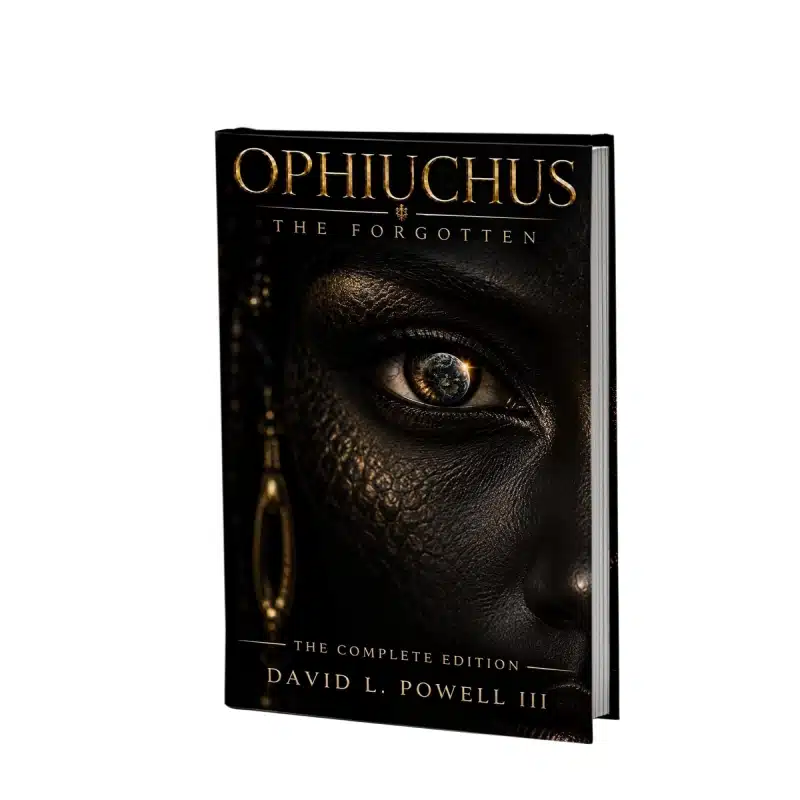
In Ophiuchus: The Forgotten, teenager Ezekiel encounters beings unlike anything he has known before and receives an extraordinary opportunity: he may ask three questions. Their answers open a path into forgotten history, Mars, humanity’s origins, and the ancient stories that have influenced civilization’s understanding of the world.

The novel’s central premise invites readers to reconsider how people interpret what they cannot explain. The beings humanity once understood through the language of gods, angels, and miracles are presented through a fictional reinterpretation of ancient beliefs. At the center of these revelations is Ophiuchus, a figure described as a brilliant scientist who was once one of thirteen and later became associated with the serpent, the adversary, and the fallen one.

Powell uses speculative fiction to build a world in which familiar accounts of the past take on unfamiliar meanings. Ezekiel’s questions become a narrative device for exploring how knowledge changes when the explanations people inherit are challenged.

For readers interested in Ophiuchus: The Forgotten speculative fiction, the appeal lies in the intersection of mythology, cosmic history, and questions about humanity’s origins. The story creates space for Powell’s imaginative engagement with belief and interpretation, while keeping the reader focused on Ezekiel’s encounter and the implications of what he learns.

This book illustrates a different side of Powell’s storytelling. Where The Whisperer brings fear into a family’s private world, The Forgotten expands its questions to humanity’s collective understanding of its own history.

πŸ”— For Amazon | Ophiuchus: The Forgotten: Click here

πŸ”— For Ophiuchus: The Forgotten | Official Book Page: Click here

Set in 1980s Philadelphia, Blood & Scripture: Memoirs of the Philadelphia Slasher presents the imagined journal of Derrick, a killer who interprets his violence through a deeply distorted religious framework. As his confessions unfold, fragments of scripture, journal entries, poetry, and the voices of forgotten victims contribute to a disturbing portrait of a man who believes his actions have a divine justification.

The book draws inspiration from true unsolved murders, but Derrick’s confessional narrative is fictional. Its premise allows Powell to explore the difference between a person’s moral convictions and the actions those convictions are used to defend. Derrick’s understanding of salvation places religious language alongside cruelty, creating a troubling conflict between the idea of righteousness and the reality of violence.

This tension makes Blood & Scripture a distinct entry in Powell’s body of work. The narrative examines the ways people can manipulate belief to justify their behavior, raising questions about responsibility, judgment, and the possibility of redemption. It also asks readers to consider the distance between claiming moral authority and acting with genuine moral accountability.

For readers drawn to psychological fiction, dark character studies, and stories involving faith and morality, the book offers a challenging premise. Its fictional journal format brings readers close to Derrick’s stated reasoning without requiring them to accept his interpretation of his actions.

Through this unsettling character, Powell explores how belief can become entangled with obsession and how the pursuit of personal justification can obscure the consequences of one’s choices.

πŸ”— For Amazon | Blood & Scripture: Memoirs of the Philadelphia Slasher: Click here

πŸ”— For Blood & Scripture: Memoirs of the Philadelphia Slasher | Official Book Page: Click here

In Jesus Showed Me Allah, Powell explores faith and spirituality through a search for understanding that began with Jesus and led him to a deeper understanding of Allah. The work considers connections between religious traditions and presents questioning, learning, and looking beyond familiar boundaries as part of a person’s spiritual journey.

The book approaches faith as something that can be explored through thoughtful inquiry. Powell’s attention to scripture and religious understanding opens space for questions about the beliefs people inherit and the possibilities they encounter when they look beyond familiar traditions. The emphasis is on learning and reflection, allowing readers to consider how questioning can become part of spiritual growth and a personal search for understanding.

Powell’s exploration of Christianity and Islam offers a different setting for his recurring interest in belief and interpretation. The questions concern religious understanding, the connections between traditions, and the role of scripture in a personal search for God.

Readers interested in Jesus Showed Me Allah may appreciate its focus on faith, spiritual reflection, and the connections between religious traditions. The work invites consideration of how studying familiar teachings can lead to new questions and a wider perspective, making it a starting point for readers drawn to religious inquiry and personal journeys of understanding.

Alongside The Forgotten, this work demonstrates how Powell approaches questions of belief through different forms. One uses speculative fiction to reconsider inherited stories, while the other explores scripture and religious traditions through personal reflection and spiritual inquiry.

πŸ”— For Amazon | Jesus Showed Me Allah: Click here

The four books differ in setting, genre, and subject matter, yet they share an interest in how people respond when their understanding of the world is tested. Across David L. Powell III’s fiction, characters encounter experiences that unsettle familiar explanations. What follows depends on what they believe, what they fear, and how they interpret the information before them.

In The Whisperer, grief and supernatural uncertainty bring a family into contact with fears that challenge its existing sense of security. In Ophiuchus: The Forgotten, Ezekiel’s questions open a fictional reimagining of humanity’s past, inviting consideration of how inherited stories shape collective understanding. Jesus Showed Me Allah shifts the emphasis toward spiritual inquiry, exploring how questioning and learning can deepen a person’s understanding of faith. Meanwhile, Blood & Scripture examines a darker moral problem: the ability of an individual to use religious conviction to rationalize harmful choices.

Belief takes different forms in these narratives. It can offer a framework for understanding an unfamiliar experience, become the source of uncertainty, or be manipulated to excuse behavior. Fear can expose vulnerability, while spiritual inquiry can encourage reflection on inherited beliefs. These ideas connect Powell’s supernatural horror, speculative fiction, psychological storytelling, and spiritual reflection without making the books interchangeable.

His wider interests in identity, relationships, spirituality, and personal reflection add another dimension to this creative perspective. Across different forms, Powell returns to questions about what people value and how their experiences influence the decisions they make.

This is part of what makes his multidisciplinary approach worth exploring. Rather than being defined by a single genre, his work creates several routes into the complicated relationship between human experience and personal conviction.

Recognition forms another part of David L. Powell III’s creative journey. His supplied author materials identify honors across poetry, nonfiction, and broader artistic and literary work, reflecting the range of forms represented in his creative identity. For a multidisciplinary storyteller who moves between poetry, fiction, filmmaking, and personal reflection, this recognition provides additional context for understanding his work and the different creative spaces in which he participates.

His literary awards and recognitions include:

  • 2025 Persons of the Year – Artist/Poet
  • Christlit Book Award – 2025
  • Nautilus Book Award
  • Free the Verse Poetry Contest
  • Lightscatter Press Poetry Contest
  • Positive Impact Book Award
  • NHA Literary Award
  • William Shakespeare Award – Non-Fiction
  • The BookFest Award – Non-Fiction

These recognitions span different award names and literary contexts. They form part of Powell’s public creative profile alongside his work as an author, poet, and filmmaker. Each recognition should be understood on its own terms, without assuming that every award corresponds to a particular book or that all represent the same category of achievement.

For readers discovering David L. Powell III’s author profile, the list adds another dimension to the picture emerging from his bibliography. His creative interests are not confined to one literary form, and his work encompasses subjects ranging from personal vulnerability and relationships to psychological darkness, spirituality, and speculative ideas about humanity.

The recognition section also complements the broader story of his creative development. Powell’s writing and filmmaking represent different ways of approaching storytelling, while his poetry and fiction allow him to explore distinct emotional and imaginative territories. Together, these elements help introduce the breadth of his work without reducing his creative identity to a list of achievements.

Ultimately, awards provide one part of an author’s public record. The books themselves offer readers the opportunity to encounter Powell’s ideas, consider the questions his stories raise, and decide which aspects of his creative world they wish to explore further.

Readers approaching David L. Powell III’s books can begin with the genres and questions that interest them most. His range makes it possible to enter his work through several different paths, whether that means exploring a supernatural mystery, considering an imaginative reinterpretation of ancient beliefs, or examining the relationship between personal conviction and moral responsibility.

Readers drawn to supernatural horror may want to begin with The Whisperer, where family grief and unsettling changes in a young boy’s behavior gradually introduce a more sinister mystery. Those interested in speculative fiction and humanity’s origins may find Ophiuchus: The Forgotten a useful starting point, particularly if they enjoy stories that imagine alternative explanations for familiar historical and mythological narratives.

Jesus Showed Me Allah offers an entry into Powell’s spiritual writing, centering on faith, scripture, and the connections between religious traditions. Readers interested in psychological darkness and questions of faith and morality may instead gravitate toward Blood & Scripture: Memoirs of the Philadelphia Slasher, whose fictional journal format explores a killer’s distorted understanding of salvation and judgment.

These books offer different introductions to Powell’s imagination, so readers need not approach them through a single genre or presumed reading preference. His poetry and more reflective work, including Love, Pain, and Affirmations, provide another perspective on his interests in relationships, vulnerability, and personal reflection.

For those wishing to learn more, Powell’s official author biography and book listings provide the appropriate starting points for exploring his wider bibliography and creative activities. Readers can also visit his official website, DLP3 VisionWork, to seek out his work and learn more about his creative identity.

Exploring the books individually offers a fuller sense of the range behind his name. Each title approaches its subject differently, while together they introduce a storyteller interested in the ways people understand themselves, their beliefs, and the world around them.


America Publishers Welcomes David L. Powell III

America Publishers Author Spotlight welcomes David L. Powell III, an author and poet whose work moves across genres while returning to the complexities of the human experience. His creative identity brings together fiction, poetry, filmmaking, and personal reflection, offering readers several ways to discover the ideas and questions that shape his storytelling.

Through this feature, we invite readers to look beyond individual titles and explore the storyteller connecting them. From the unsettling family-centered horror of The Whisperer to the speculative world of Ophiuchus: The Forgotten, the spiritual reflection of Jesus Showed Me Allah and the psychological tensions of Blood & Scripture: Memoirs of the Philadelphia Slasher, Powell’s selected works demonstrate the breadth of his creative interests.

His approach to storytelling leaves room for different forms, subjects, and perspectives. Readers can follow whichever path speaks to their interests, whether they are drawn to imaginative fiction, difficult moral questions, or more personal reflections on identity and relationships.

We are pleased to feature David L. Powell III through America Publishers Author Spotlight and encourage readers to continue exploring his work through his official website and book listings. His creative journey offers a reminder of the many ways a storyteller can approach the written word, bringing different experiences and ideas into conversation through literature.

Discover more about David L. Powell III and his work through his official author channels.

πŸ”— For Official Website: Click here

πŸ”— For Author Biography: Click here

πŸ”— For Amazon Author Page: Click here

πŸ”— For IMDb Profile: Click here