The Swank Legacy

The Swank Legacy a History Uncovered

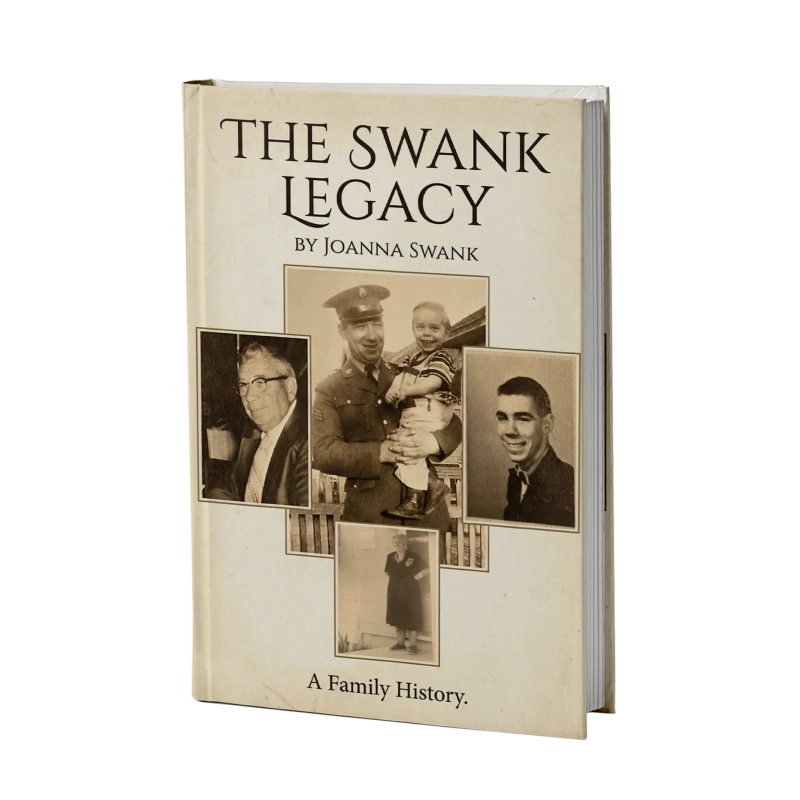
A family’s history can survive in fragments: names passed between generations, stories retold, and questions that remain unanswered long after the people involved are gone. In her forthcoming book, The Swank Legacy by Joanna Swank brings those fragments into focus through an exploration of her paternal grandfather’s family.

At its heart are Philip and Blanche, their children, and the circumstances that broke their family apart. Their story moves through debt, separation, orphanhood, and lives that followed dramatically different paths. It also reaches a disturbing chapter in Elmira, New York: the “Eternal Triangle Murders” of Election Night 1934, the event that first drew Joanna into the research behind the book.

Developed through nearly 15 years of investigation into her family’s past, The Swank Legacy explores the complicated relationship between family folklore and historical truth. With publication coming soon, the book invites readers to discover a history in which a notorious crime forms part of a much larger human story, one shaped by devotion, devastating loss, and the determination to begin again.

Before the separations and the scandal, there was a family bound by devotion. Philip and his wife, Blanche, stand at the beginning of a narrative that traces how financial hardship and tragedy can alter the course of several generations.

Their place in The Swank Legacy gives the history its emotional foundation. The children whose lives eventually diverged first belonged to the same household. Understanding that shared beginning matters: it gives weight to everything that followed, particularly the loss of family connections that might otherwise have continued throughout their lives.

Debt becomes a significant force in this account, forming part of the circumstances surrounding the family’s fracture. Its consequences extend beyond the immediate struggle of two parents. The story follows the effects into their children’s lives, where the loss of a home and separation from one another created a different future for each of them.

This is where the Swank family history begins to raise questions that reach beyond one surname. What happens to a family’s identity when its members can no longer remain together? How does a child carry the memory of a shared home into an unfamiliar life?

Philip and Blanche’s story provides the starting point for those reflections. Their importance rests both in their own experiences and in the lives that unfolded after their children were removed from their care. The family’s early devotion makes its eventual fragmentation especially poignant, establishing the personal stakes behind the history Joanna has spent years uncovering.

The removal of Philip and Blanche’s children from their care is an important part of The Swank Legacy. What begins as a shared family story branches into separate journeys through orphanhood and hardship, with many of those paths never crossing again.

For siblings, a common childhood can provide a continuing point of connection. Here, separation disrupts that possibility. The children move into lives shaped by different circumstances, carrying a shared origin into futures they could no longer experience together.

That divergence gives the book one of its most compelling subjects. A family history often follows a line of descent, connecting one generation to the next. Joanna’s account also follows the branches that grew apart. It asks readers to consider the people who can become distant within their own family’s story, even while remaining essential to its understanding.

The children’s journeys bring the consequences of the family’s fracture into sharper view. Their experiences move the narrative beyond the circumstances that caused the separation and toward the question of what came afterward. Each life becomes part of the larger history, even when those paths never crossed again.

For readers drawn to stories of family separation and survival, this aspect of the book offers a reason to look closely at individual lives within a collective tragedy. Sharing a surname or an early home does not mean sharing the same fate.

The distance between these siblings also gives the idea of a “legacy” a difficult emotional dimension. An inheritance can include broken connections and unanswered questions alongside the memories a family preserves. Following those separate paths becomes a way of acknowledging how much of a family’s past lies beyond the story any one descendant knows.

The event that set Joanna’s project in motion was the “Eternal Triangle Murders” of Election Night 1934 in Elmira, New York. This episode anchors a pivotal part of the book and introduces the crime that scandalized the town.

The name itself provokes curiosity. Yet within The Swank Legacy, the murders belong to a history that had already been shaped by financial strain, fractured relationships, and children growing up apart. Approaching the event through that family context gives readers a broader frame in which to consider it.

A notorious crime can become the defining detail attached to a family’s name. Over time, the scandal may be remembered more readily than the lives surrounding it. Joanna’s exploration creates room to look beyond that single point of notoriety and consider how the event fits into the experiences of the Swanks.

The distinction matters to the book’s appeal. Readers may first be drawn by the mystery surrounding Elmira in 1934, but the family narrative gives them other questions to follow. Who were the people whose lives became entangled in this history? What preceded the tragedy? What remained for those who survived?

For Joanna, the murders became the starting point of a research commitment lasting nearly 15 years. That sustained attention connects a public scandal with a descendant’s effort to understand her family’s past.

As an upcoming book, The Swank Legacy invites readers to approach this troubling chapter with an interest in both the historical event and its human consequences. The crime draws attention; the lives around it give the search its enduring purpose.

Family stories change as they pass from one generation to another. Some details remain vivid, while others fade or acquire a different meaning with each retelling. For descendants trying to understand what happened, a familiar account can become the beginning of a much longer search.

That relationship between family folklore and historical truth is central to The Swank Legacy. Joanna’s research brings her into the complicated history of her paternal grandfather’s family, where inherited stories meet the task of understanding the people and events behind them.

Nearly 15 years devoted to this project reflects the scale of that personal commitment. The connection is close enough to carry emotional significance, yet the history reaches into lives and circumstances far removed from her own experience. Writing about that past means encountering family members as individuals whose experiences extend beyond their place in a family tree.

For readers, this creates an opportunity to consider how their own understanding of family history takes shape. Which stories are repeated most often? Whose experiences receive less attention? What questions emerge when a familiar account is examined more closely?

The Swank Legacy by Joanna Swank places those reflections within a specific family’s experience. Its movement between folklore and history gives the book an appeal that extends beyond the Swank name, particularly for readers interested in how personal histories are recovered and understood.

Alongside its account of separation and tragedy, The Swank Legacy carries a thread of determination: one survivor’s resolve to build a future from the ashes of the past.

That prospect gives the narrative a forward direction. The consequences of loss remain part of the family’s history, while the effort to continue living introduces another dimension to what that history contains. Survival becomes a question of what a person can make of the years that follow.

The book’s premise invites readers to consider legacy in those terms. What passes between generations may include the effects of hardship, the absence of relatives, or questions about choices made long ago. It may also include the determination that allowed someone to establish a future despite those circumstances.

Readers interested in multigenerational family histories may find particular resonance here. The story follows the relationship between a family’s shared beginnings and the different lives that emerged from its fracture, giving both loss and persistence a place in the account.

As anticipation builds for Joanna Swank’s book, this balance offers a compelling reason to follow its release. The history encompasses a scandal that drew public attention and the quieter, deeply personal struggle to carry on afterward.

With the official release of The Swank Legacy scheduled for November 11, 2026, Joanna Swank continues to connect with readers through her literary work and the growing community surrounding Ask About My Books.

Readers will also have an opportunity to join Joanna for a special Black Friday online discussion on Friday, November 27, 2026, at 11:00 a.m. EST. The event, titled Anyone Can Be a Novelist Discussion, will highlight another aspect of her literary work and offer readers an opportunity to engage with her as an author.

Those interested in following Joanna’s latest announcements, literary activities, and Black Friday event updates can join her official Ask About My Books Facebook Group.

Readers can also explore The Swank Legacy and find ordering information through her official website, Ask About My Books.

Stay connected with Joanna Swank through her Facebook community for updates on her books, upcoming discussions, and special literary activities.

Born and raised in Lindenwold, New Jersey, Joanna Swank now lives in Conway, South Carolina. Writing has long provided an outlet for her ideas, and her work encompasses several creative interests under different author names.

With The Swank Legacy, that creative commitment meets a deeply personal subject. Her paternal grandfather’s family became the focus of nearly 15 years of research, beginning with her interest in the “Eternal Triangle Murders” and developing into an exploration of the wider Swank family history.

Her connection to the people at the center of the book gives the project a distinct purpose. Philip, Blanche, and their children belong to the history she has inherited. Bringing their experiences together is an effort to understand the family’s fractured past and the lives that continued beyond it.

With The Swank Legacy readers can look forward to discovering how Joanna brings these strands of folklore, tragedy, separation, and survival into one historical family narrative.

Visit AskAboutMyBooks.com and follow Joanna Swank for release announcements, book updates, and opportunities to connect with the author.

🔗 The Swank Legacy: Click here

🔗 Visit the Official Website: Click here

🔗 Joanna Swank’s Facebook: Click here

🔗 Ask About My Books Facebook Page: Click here

🔗 Ask About My Books Instagram Page: Click here