
Published on July 30, 2026
Imagery examples are the reason some sentences stay with us long after we finish reading them. A story can tell us that a house is old, but it becomes far more memorable when we hear its floorboards groan beneath a character’s feet, smell dust trapped behind heavy curtains, and feel the cold brass handle turn in their hand.
That is the power of imagery. It takes readers beyond the page and places them inside the moment. Suddenly, they are not simply being told that a kitchen feels welcoming or a storm feels dangerous; they can sense the warmth of the room, hear the rain against the glass, and feel the tension building in the air.
The best imagery examples do more than help readers picture a scene. They create mood, reveal character, and give ordinary moments emotional weight. An uncollected glove on a train platform can suggest loss. The smell of rain on dry pavement can bring back a memory. A flickering hallway light can make readers uneasy before anything frightening has even happened.
In this guide, you will find 100 original imagery examples, learn how each type works, and see how writers use sensory language in fiction, poetry, and everyday creative writing. Whether you are studying a novel, analyzing a poem, or trying to make your own scenes feel more alive, these imagery examples will give you practical ideas to use immediately.
By the end, you will know how to choose details that make readers pause, imagine, and feel, without overloading every sentence with description.
What Is Imagery? Meaning and Examples
Imagery is descriptive language that appeals to the reader’s senses and creates a vivid mental experience. It is often associated with sight, but strong imagery can also make us hear, smell, taste, touch, move, or feel something internally. At its core, sensory imagery examples show how carefully chosen words can make readers feel as though they are inside the moment rather than simply reading about it.
For example, compare these two sentences:
- The bakery smelled good.
- Warm cinnamon rolled from the bakery door and clung to the cold morning air.
The second sentence gives the reader a sensory experience. Rather than simply saying that the bakery is pleasant, it lets us imagine the scent, temperature, and moment. That is what makes imagery memorable.
When people search for imagery meaning and examples, they are usually looking for more than decorative language. Imagery helps a writer create mood, deepen a setting, reveal emotion, and draw readers closer to a character’s point of view. A nervous child may notice the sharp click of a classroom clock; a hungry traveler may focus on the smell of grilled food drifting through a station. The details a character notices can tell us a great deal about them.
It is also useful to know that imagery and figurative language are connected, but they are not exactly the same thing. A metaphor, simile, or personification can create imagery, yet imagery can be direct as well. “Rain tapped against the window” is vivid sensory description without needing a comparison.
The strongest imagery examples are specific. Instead of writing “a beautiful garden,” a writer might describe “purple foxgloves bowing under the weight of rain.” Specific details help readers build the scene in their own minds.
You will find imagery examples in literature across every genre, from mystery and romance to literary fiction and fantasy. The same is true of poetry, where a single sharp image can carry an entire feeling or idea.
Seven Common Types of Imagery
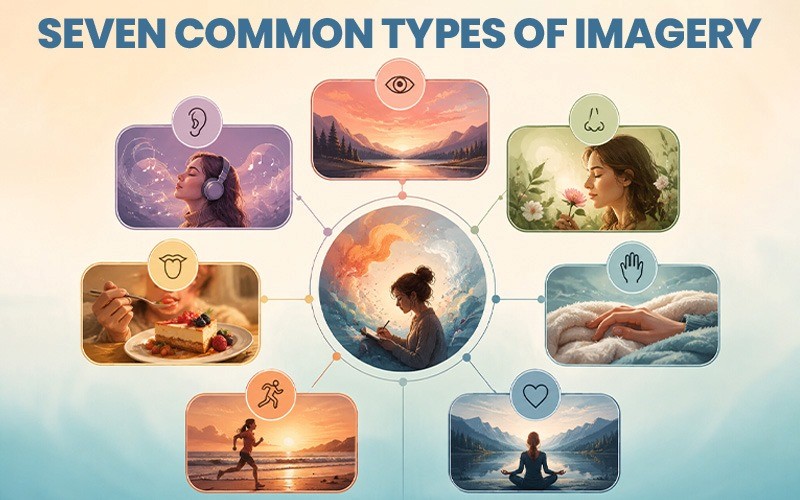
Most writers first learn about the five senses: sight, sound, smell, taste, and touch. In creative writing, two additional categories are also especially useful: movement and internal sensation. Together, they give writers seven powerful ways to make a scene feel real. These categories give writers a practical way to build sensory imagery examples that feel clear, purposeful, and emotionally engaging.
- Visual imagery
Visual imagery describes what readers can see: color, light, shape, distance, expression, or movement.
Example: The last strip of sunset burned orange behind the black line of trees.
This creates a clear visual contrast and suggests a dramatic mood without explaining it directly.
- Auditory imagery
Auditory imagery appeals to the sense of sound. It may include voices, music, silence, weather, machines, or small background noises.
Example: Rain drummed on the metal roof while the kettle began to whistle.
Sound can make a scene feel cozy, tense, lonely, or chaotic. Many sensory imagery examples use sound because it brings a setting to life quickly.
- Olfactory imagery
Olfactory imagery describes scent. Smell is closely connected to memory, so it can be especially powerful when writing emotional scenes.
Example: The hallway smelled of lemon polish and old paperbacks.
A few precise smells can establish a place faster than a long paragraph of description.
- Gustatory imagery
Gustatory imagery relates to taste. It is useful in food writing, of course, but it can also reveal culture, memory, comfort, or discomfort.
Example: The tea was bitter at first, then softened with honey at the back of her throat.
These imagery examples show that taste can describe both a physical sensation and a character’s emotional response.
- Tactile imagery
Tactile imagery focuses on touch: texture, temperature, pressure, pain, and physical contact.
Example: The wool scarf scratched his neck as the wind pushed through the station.
Touch-based description helps readers feel present inside a character’s body.
- Kinesthetic imagery
Kinesthetic imagery conveys movement, motion, or physical action.
Example: The cyclist leaned into the corner, tires skimming over loose gravel.
This type is particularly effective in action scenes, sports writing, and moments of urgency. It gives prose momentum.
- Organic imagery
Organic imagery describes internal sensations, such as hunger, nausea, exhaustion, fear, relief, or a racing heartbeat.
Example: A knot tightened beneath her ribs when the phone began to ring.
Organic details are excellent for showing emotion rather than merely stating it. This is why imagery examples in poetry often use physical sensations to express feelings that may be difficult to explain directly.
100 Imagery Examples for Writers
Below are 100 original imagery examples organized by sensory type. Notice how each one relies on a concrete detail instead of a broad statement.
Visual imagery examples
- Morning light spilled across the kitchen tiles in pale gold squares.
- A red kite trembled above the crowded beach.
- Snow gathered along the dark lashes of the pine trees.
- The city windows flickered awake one by one.
- Her yellow umbrella moved through the gray crowd like a small sun.
- A silver trail of moonlight crossed the still lake.
- Cracked paint peeled from the porch in curled white strips.
- The empty football field shone green after the rain.
- Smoke rose in thin blue ribbons from the distant chimneys.
- His hands were stained purple from picking blackberries.
- The hallway narrowed into a strip of shadow.
- A row of candles softened the room with unsteady light.
- The old map was creased at the corners and faded near the sea.
- Pink blossoms drifted across the pavement like confetti.
- The train disappeared into the tunnel, taking its bright windows with it.
Auditory imagery examples
- The screen door slapped shut behind her.
- Leaves whispered against the bedroom window.
- The violin note hung in the room after the musician stopped playing.
- Gravel crunched beneath his boots.
- A baby laughed somewhere beyond the garden wall.
- The clock ticked loudly in the silent waiting room.
- Thunder rolled over the hills like a heavy cart.
- The café hummed with low conversation and clinking cups.
- Waves hissed and folded over themselves along the shore.
- The elevator groaned before opening its doors.
- A dog barked twice, then went quiet.
- The radio crackled through the storm.
- Her keys chimed in the dark as she searched for the lock.
- The crowd erupted when the ball crossed the line for the final goal.
- Ice cracked sharply across the frozen pond.
Olfactory imagery examples
- The garage smelled of engine oil and wet cardboard.
- Fresh bread filled the room with a buttery scent.
- The first rain lifted the dusty scent of the road.
- Lavender drifted from the open bedroom window.
- The bonfire left smoke tangled in his jacket.
- The sea air smelled sharp with salt and seaweed.
- Coffee and orange peel lingered in the small café.
- The attic smelled of cedar, dust, and forgotten winters.
- The sharp smell of garlic filled the apartment as it sizzled in the pan.
- The hospital corridor carried the clean sting of disinfectant.
- Her coat held the faint perfume of roses.
- The greenhouse smelled of wet leaves and crushed tomato vines.
- The market smelled of ripe peaches and crushed mint.
- The abandoned room carried a sour smell of mold and rainwater.
Gustatory imagery examples
- The soup tasted of pepper, tomato, and too much salt.
- Lemon juice left a bright, sour taste on her tongue.
- The chocolate melted slowly, rich and warm on her tongue.
- The lemonade was sweet enough to make his teeth ache.
- A smoky flavor clung to the grilled corn.
- The mint tea left a cool, clean taste in her dry throat.
- The apple was crisp, tart, and cold from the fridge.
- Bitter medicine coated his tongue long after he swallowed.
- The birthday cake tasted of vanilla, strawberries, and buttercream.
- Salt from the sea left a briny taste on her lips.
- The chili burned at the back of his mouth.
- The coffee was dark, strong, and slightly nutty.
- Honey softened the sharp edge of the ginger.
- The stale cookie crumbled into a dry, dusty sweetness.
Tactile imagery examples
- The marble step was cold through the thin soles of her shoes.
- Sand slipped between his fingers like warm sugar.
- The worn leather chair gave slightly beneath her weight.
- The icy wind stung his cheeks as he crossed the bridge.
- The cat’s fur brushed softly against her ankle.
- The handle was slick with rain.
- A rough wool blanket scratched his arms.
- Steam dampened her skin as she leaned over the bathroom sink.
- The sun warmed the back of his neck.
- Her palms were sticky from the melting ice cream.
- A thorn pricked his hand as he pushed through the hedge.
- The velvet curtain felt cool and heavy in her hand.
- Mud sucked at their boots with every step.
- The metal railing burned hot beneath his fingers.
Kinesthetic imagery examples
- The runner drove forward, arms cutting through the rain.
- The boat rocked gently against the dock.
- Curtains lifted and fell with the evening breeze.
- The child spun across the kitchen until she lost her balance.
- A flock of birds burst from the field at once.
- The horse reared, then landed hard on the wet ground.
- His backpack swung against his shoulder as he hurried home.
- The branches bent and snapped in the wind.
- The dancer glided across the stage without looking down.
- The wave curled, rose, and crashed over the rocks.
- She stumbled back when the door flew open.
- The train jolted forward, throwing everyone slightly off balance.
- Smoke twisted through the air above the fire.
- The flag strained against its pole in the storm.
Organic imagery examples
- His stomach tightened when he saw the missed calls.
- Relief softened the tightness in her chest.
- Grief sat heavily in his chest.
- Her heartbeat thudded in her ears before the speech.
- Sleep pulled at her eyelids during the long drive.
- Nausea rose in his throat as the elevator climbed higher.
- A sudden chill ran down her spine.
- Hunger gnawed at her stomach as the smell of dinner drifted from the kitchen.
- Her legs felt unsteady after the race.
- Excitement fizzed beneath his skin.
- The bright lights made his head ache.
- A sharp panic closed around her lungs.
- Warm relief spread through him when the message arrived.
- Exhaustion made every step feel heavier than the last.
Imagery Examples in Literature and Poetry
Writers have used imagery for centuries to make stories, characters, and emotions feel immediate. A close look at imagery meaning and examples shows that great imagery examples in literature often do more than describe a place; they reveal tension, set the mood, or hint at a deeper theme.
In Gothic fiction, for example, a decaying house may be described through broken windows, damp walls, stale air, and shadows gathering in unused rooms. Those details do not simply tell readers that the setting is frightening. They make the unease feel present. In a romance novel, a rain-soaked train platform, a forgotten scarf, or two cups of coffee growing cold can quietly suggest longing or separation.
When analyzing imagery examples in literature, ask yourself three questions:
- What sense is the writer appealing to?
- What mood does the image create?
- What does the detail suggest beyond its literal meaning?
Thinking about imagery meaning and examples in this way helps readers move beyond simply spotting description and begin understanding why a writer selected a particular detail.
A storm may represent danger, uncertainty, or emotional conflict. A bright garden may suggest hope, freedom, childhood, or renewal. Context matters, which is why the same image can mean different things in different stories.
Imagery examples in poetry are often more concentrated. A poem has less space to explain an idea, so an image must carry more weight. A poet may use a single image—a cracked mirror, a bird lifting from a wire, frost on a window—to explore memory, loneliness, love, grief, or change.
Consider how these original lines work:
The moon lay broken in the puddles after rain.
This visual image suggests reflection, fragmentation, and perhaps a damaged emotional state. The writer does not need to explain every meaning. The reader is invited to feel and interpret the image.
The most effective imagery examples in poetry often leave room for that kind of participation. They give readers something concrete to hold onto while allowing the emotional meaning to unfold naturally.
How to Use Imagery in Creative Writing
Strong imagery should feel like part of the story, not like decoration added afterward. The goal is not to describe everything in great detail. The goal is to choose the detail that matters most in that moment. For writers learning imagery meaning and examples, this is the key idea: choose details that strengthen the moment instead of adding description for its own sake.
Here are five practical ways to use imagery in your own writing.
- Write through your character’s senses
Different characters notice different things. A chef may notice the burnt edge of a sauce, while a nervous guest notices the silence around the dinner table. This makes your imagery examples feel personal rather than generic.
- Choose precise details
Instead of saying, “The room was messy,” show the reader what kind of mess it is:
Receipts covered the table, and one sock hung from the lampshade.
Specific details create clearer images and often reveal character at the same time.
- Match imagery to the mood
A sunny day can feel joyful, uncomfortable, or even threatening depending on the scene. If a character has received bad news, the brightness might feel harsh rather than hopeful.
Sensory imagery examples work best when they support the emotional tone. In a suspense scene, use a flickering light, a loose gate banging in the wind, or the cold metal of a locked door. In a peaceful scene, you might use warm bread, soft grass, birdsong, or sunlight on water.
- Do not use every sense at once
You do not need sight, sound, smell, taste, and touch in every paragraph. Too many details can slow the scene down. Choose one or two strong sensory details and let them do the work.
- Revise with a sensory check
After drafting a scene, ask: What can my character see, hear, smell, touch, taste, or feel internally? Then add only the details that sharpen the reader’s experience.
The best imagery examples make readers forget they are reading words on a page. For a moment, they are standing in the room, hearing the sound, or feeling the emotion alongside the character. For more approachable writing guides, literary techniques, and resources for authors, explore the articles at America Publishers Author Spotlight. It is a useful place to keep building your understanding of storytelling, language, and the craft of writing.
Frequently Asked Question
-
What is imagery in simple words?
Imagery is language that helps readers experience a scene through the senses. It can describe what someone sees, hears, smells, tastes, touches, or feels inside their body.
-
What are the seven types of imagery?
The seven common types are visual, auditory, olfactory, gustatory, tactile, kinesthetic, and organic imagery. The first five relate to the traditional senses, while kinesthetic imagery focuses on movement and organic imagery describes internal sensations.
-
What are some imagery examples in literature?
Common imagery examples in literature include a dark forest described through tangled branches and damp earth, a busy city shown through flashing lights and car horns, or a lonely room defined by cold air and a ticking clock. These details can build mood and reveal meaning.
-
How is imagery used in poetry?
Imagery examples in poetry use vivid sensory details to express an idea or emotion in a compact, memorable way. A poet might describe falling leaves, an empty chair, or a distant train to suggest loss, change, memory, or longing.
-
What is the difference between imagery and figurative language?
Imagery creates a sensory experience for the reader. Figurative language includes techniques such as metaphor, simile, personification, and hyperbole. Figurative language can create imagery, but not all imagery needs to be figurative.
-
How can I add stronger imagery to my creative writing?
Start by identifying the most important feeling in the scene. Then choose specific sensory details that support it. Instead of saying a character is afraid, show a dry mouth, shaking hands, a racing heartbeat, or a hallway that suddenly feels too quiet.
Conclusion
Imagery gives writing texture, emotion, and life. It turns an ordinary statement into a moment readers can see, hear, smell, taste, touch, or feel. Instead of telling readers that a character is nervous, a writer can show trembling hands, a dry throat, or the sharp sound of a clock in a quiet room. Instead of calling a setting beautiful, a writer can let sunlight move across a lake, describe wildflowers bending in the breeze, or show the glow of windows at dusk.
That is why imagery matters. It helps readers enter the world of the story rather than observe it from a distance. It can make a scene warmer, darker, stranger, funnier, or more emotionally powerful without overexplaining what readers should feel. The clearest lesson from imagery meaning and examples is that powerful writing does not need to explain every emotion; it can let one carefully chosen detail speak for itself.
Use these imagery examples as inspiration, but always shape your descriptions around your characters, setting, and message. The most memorable details are not always the biggest or most dramatic ones. Sometimes, a wet coat hanging by the door, the smell of toast in a quiet kitchen, or a forgotten voice message can say more than a long paragraph of explanation.
As you revise your work, look for places where a reader may need a stronger connection to the scene. Ask yourself what your character can notice through the senses. What does the air smell like? What sound is present in the background? Is the room too cold, too bright, too still, or too crowded? A few thoughtful answers can transform plain writing into something readers can experience.
One precise image can be more powerful than a paragraph filled with vague adjectives. With practice, sensory detail will become a natural part of your writing process, helping your stories, poems, and scenes stay vivid in the reader’s mind long after the final line.
