
Published on August 24, 2026
You rush outside because you are late, only to discover that your car will not start. Frustrating? Absolutely. Ironic? Not necessarily. Now imagine that you are a mechanic whose car breaks down on the way to teach a vehicle-maintenance class. That contrast between what should reasonably happen and what actually happens creates irony.
Some irony examples make us laugh, while others leave us uncomfortable, surprised, or heartbroken. Authors use irony to conceal meaning beneath dialogue, filmmakers use it to build suspense, and ordinary life produces moments that feel almost too perfectly contradictory to be accidental.
The trouble is that people often label every strange coincidence or unfortunate event as ironic. Genuine examples of irony involve a meaningful conflict between appearance and reality, knowledge and ignorance, or expectation and outcome.
In this guide, we will examine irony in books, films, conversations, workplaces, relationships, and familiar daily situations. By the end, you will not only recognize irony—you may begin noticing it everywhere.
Affiliate Disclosure: As an Amazon Associate I earn from qualifying purchases. at no additional cost to you.
What Is Irony and Why Is It So Easily Misunderstood?
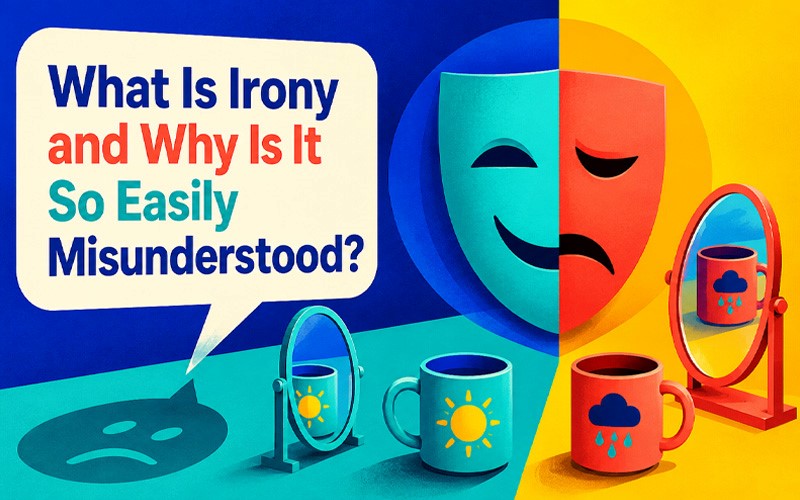
Irony occurs when there is a meaningful difference between what is said and what is meant, what people expect and what happens, or what a character understands and what the audience already knows. That contrast is the essential ingredient. Without it, an event may be unfortunate, surprising, or coincidental, but it is not automatically ironic.
Most irony examples belong to one of three principal categories:
Verbal Irony
Verbal irony occurs when someone says something but intends a different, often opposite, meaning. If a student receives an enormous homework assignment and says, “Well, this should be a relaxing evening,” the words clearly conflict with the student’s real feelings.
Sarcasm can be verbally ironic, but the terms are not interchangeable. Sarcasm is usually intended to mock, criticize, or express irritation. Verbal irony can be playful, gentle, affectionate, or even tragic without attacking anyone.
Situational Irony
Situational irony happens when an outcome meaningfully contradicts a reasonable expectation. A fire station catching fire is a familiar example because a place associated with preventing fires becomes the victim of one.
The unexpected result must have a recognizable connection to the original expectation. Losing an umbrella is inconvenient. A company that manufactures “unbreakable” umbrellas having its launch canceled because every sample breaks in the rain is ironic.
Dramatic Irony
Dramatic irony occurs when readers or viewers possess information that one or more characters do not. We may know that a character is entering a trap while that character believes the situation is completely safe. This difference in knowledge can create comedy, fear, suspense, or tragedy.
These distinctions explain why different irony examples affect us in different ways. Verbal irony asks us to interpret hidden meaning. Situational irony overturns our assumptions. Dramatic irony makes us wait while a character slowly moves toward a truth we already understand.
When assessing possible examples of irony, ask one question: What was reasonably expected, and how did the meaning or outcome contradict that expectation? If there is no meaningful contrast, you may simply be looking at bad luck or coincidence.
100 Irony Examples from Books, Movies, and Everyday Life
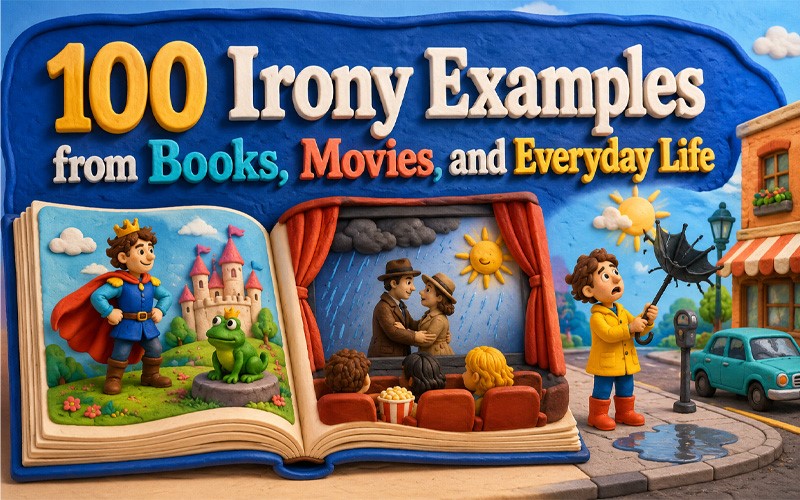
The following irony examples show how one literary device can create humor in one situation and tragedy in another. Some depend on a reversed outcome, some on hidden meaning, and others on information deliberately withheld from a character.
These examples of irony are grouped by setting, but many stories contain more than one type. A novel can combine dramatic and situational irony, just as a movie character can use verbal irony while walking toward an outcome the audience already anticipates.
35 Irony Examples in Literature
These irony examples in literature range from ancient tragedies to modern novels and children’s stories. A brief explanation accompanies each selection so that the contradiction—and not merely the plot event—is clear.
- Oedipus Rex by Sophocles: Oedipus vows to find the man responsible for the previous king’s death, unaware that he is hunting himself. The audience’s knowledge makes this dramatic irony.
- Romeo and Juliet by William Shakespeare: Romeo believes Juliet is dead, although the audience knows she has taken a sleeping potion. His incomplete knowledge turns a plan for reunion into tragedy.
- Macbeth by William Shakespeare: King Duncan considers Macbeth’s castle a welcoming place, while the audience knows his hosts are planning his murder.
- Julius Caesar by William Shakespeare: Mark Antony repeatedly describes Brutus as honorable while constructing a speech that exposes the betrayal behind Caesar’s assassination.
- Othello by William Shakespeare: Othello trusts Iago as an honest friend, but the audience knows that Iago is manipulating him.
- Hamlet by William Shakespeare: Hamlet stages a play that recreates his father’s suspected murder while Claudius watches, unaware that the performance is designed to expose his guilt.
- The Gift of the Magi by O. Henry: Della sells her hair to buy Jim a watch chain, while Jim sells his watch to buy her decorative combs. Their sacrifices make both gifts temporarily useless.
- The Story of an Hour by Kate Chopin: Louise experiences freedom after hearing that her husband has died, only for him to return alive. Her reaction to that reversal creates the story’s final irony.
- The Cask of Amontillado by Edgar Allan Poe: Fortunato follows Montresor into a cellar expecting rare wine, while the reader gradually understands that he is being led to his death.
- The Tell-Tale Heart by Edgar Allan Poe: The narrator insists that he is sane, but his obsessive language and irrational behavior reveal the opposite.
- Animal Farm by George Orwell: The animals overthrow humans to escape oppression, yet the pigs eventually become indistinguishable from the rulers they replaced.
- 1984 by George Orwell: Government ministries perform functions that contradict their names. The Ministry of Truth alters facts, while the Ministry of Love oversees punishment.
- Fahrenheit 451 by Ray Bradbury: Firefighters are traditionally expected to extinguish fires, but in this society, their role is to burn books.
- Pride and Prejudice by Jane Austen: Elizabeth prides herself on understanding people, yet her prejudice causes her to misjudge both Darcy and Wickham.
- The Importance of Being Earnest by Oscar Wilde: Jack invents a troublesome brother named Ernest, only to discover that Ernest is connected to his real identity in a way he never expected.
- The Lottery by Shirley Jackson: The pleasant village gathering initially resembles a celebration, but its true purpose is a brutal ritual.
- A Modest Proposal by Jonathan Swift: Swift calmly presents a horrifying “solution” to poverty to expose society’s cruel treatment of impoverished people.
- The Wonderful Wizard of Oz by L. Frank Baum: Dorothy’s companions travel in search of qualities they already demonstrate throughout the journey.
- The Necklace by Guy de Maupassant: Mathilde spends years replacing an expensive necklace she lost, only to learn that the original was imitation jewelry.
- The Open Window by Saki: Framton believes he has witnessed a supernatural return, while the reader discovers that he has fallen for a child’s invented story.
- The Monkey’s Paw by W. W. Jacobs: A family receives the money it wishes for, but it arrives as compensation for their son’s death.
- The Rime of the Ancient Mariner by Samuel Taylor Coleridge: Sailors are surrounded by water but have none they can safely drink, creating a cruel reversal of apparent abundance.
- Lord of the Flies by William Golding: Boys attempt to create an orderly society away from adults, but their community descends into the violence associated with the world they left.
- The Scarlet Letter by Nathaniel Hawthorne: The community publicly condemns Hester while respecting Dimmesdale, whose hidden involvement makes him equally responsible.
- The Crucible by Arthur Miller: A court claiming to protect morality punishes truthful people while rewarding convincing lies.
- Great Expectations by Charles Dickens: Pip assumes Miss Havisham is financing his rise and preparing him for Estella, but his true benefactor is the convict he once helped.
- Jane Eyre by Charlotte Brontë: Jane believes she can marry Rochester freely, while he conceals the existing marriage that makes their wedding impossible.
- Frankenstein by Mary Shelley: Victor pursues scientific mastery over life but becomes powerless against the consequences of his own creation.
- The Hobbit by J. R. R. Tolkien: Bilbo is initially treated as the least capable member of the expedition, yet his intelligence repeatedly saves the group.
- Harry Potter and the Philosopher’s Stone by J. K. Rowling: Harry suspects Snape of pursuing the Stone, while the seemingly harmless Quirrell is the actual threat.
- The Hunger Games by Suzanne Collins: The Capitol presents the Games as honor and entertainment, although they are designed to terrify and control the districts.
- The Most Dangerous Game by Richard Connell: Rainsford initially dismisses concern for hunted animals, but he is later forced to experience the terror of becoming someone else’s prey.
- The Handmaid’s Tale by Margaret Atwood: A regime claiming to preserve morality and family destroys personal freedom and separates families.
- Catch-22 by Joseph Heller: A pilot can be removed from combat if he is insane, but asking to be removed demonstrates enough rational concern to prove that he is sane.
- The Celebrated Jumping Frog of Calaveras County by Mark Twain: Jim Smiley confidently expects his specially trained frog to win, unaware that a stranger has secretly filled it with quail shot. The frog that seems certain to win cannot jump, creating situational irony through Smiley’s unexpected defeat.
The strongest irony examples in literature do more than provide surprise endings. They expose pride, injustice, misunderstanding, self-deception, and the dangerous distance between intention and consequence.
30 Irony Examples in Movies
Spoiler notice: The following entries reveal important plot details.
Many memorable irony examples in movies work because viewers can see trouble approaching before the characters can. Others save their contradiction for a final revelation that changes the meaning of everything that came before it.
- The Truman Show: Truman believes he is living an ordinary private life, while everyone around him knows that his entire world is a television production.
- The Sixth Sense: Malcolm helps a child who sees dead people without realizing that he is one of the dead people the child can see.
- Titanic: A ship promoted as practically unsinkable sinks during its first voyage.
- Jurassic Park: A park designed to demonstrate human control over nature becomes proof that nature cannot be controlled so easily.
- Jaws: Beachgoers enjoy the water while viewers know that a shark is nearby, creating dramatic tension through unequal knowledge.
- Psycho: Norman Bates appears to be controlled by his domineering mother, but the final revelation shows that she is dead and that Norman himself has been committing the murders. The contrast between the situation presented to the audience and its disturbing reality creates situational irony.
- Frozen: Anna assumes that an act of true love must come from romantic love, but the saving act is her sacrifice for her sister.
- Toy Story: Buzz Lightyear believes he is a real space ranger, while the audience and the other toys know he is a manufactured toy.
- Finding Nemo: Marlin tries to protect Nemo from every possible danger, yet his excessive fear contributes to the separation he dreads.
- The Incredibles: A society protected by superheroes forces them into hiding, then desperately needs their abilities when a major threat appears.
- The Lion King: Simba runs away because he believes he caused Mufasa’s death, while viewers know Scar is responsible.
- Monsters, Inc.: Monsters believe children are dangerously toxic, only to discover that children are not harmful and that their laughter produces more energy than fear.
- Home Alone: Kevin wishes for his family to disappear, but once that seemingly happens, he desperately wants them back.
- Star Wars: The Empire Strikes Back: Luke confronts Darth Vader believing him to be the enemy who betrayed and killed his father, only to discover that Vader is his father. The revelation creates irony because the man Luke seeks to defeat as his father’s killer is the father he believed he had lost.
- The Lego Movie: Emmet is considered completely ordinary and unimportant, yet he becomes the person capable of challenging an apparently unstoppable ruler.
- Iron Man: Tony Stark builds weapons for security but is nearly killed by his own technology and later devotes himself to limiting the damage it caused.
- The Prestige: Each magician becomes so committed to discovering the other’s secret that both sacrifice the lives and identities they originally hoped to protect.
- Coco: Miguel believes Ernesto de la Cruz represents family honor and artistic courage, only to discover that his celebrated hero stole another man’s work.
- WALL-E: Humans create technology to make life easier, but their dependence on it leaves them physically weak and disconnected from their own planet.
- The Wizard of Oz: Dorothy travels across Oz searching for a way home, although the power to return has been with her throughout the journey.
- Planet of the Apes: The astronaut believes he has landed on a distant world, only to learn that he has returned to a transformed Earth.
- Mulan: The army rejects women as incapable of serving, yet Mulan becomes instrumental in saving China.
- Ratatouille: A restaurant kitchen, where rats would normally be considered a serious threat, achieves culinary success because of a rat’s extraordinary talent.
- Get Out: A visit presented as a welcoming introduction to a girlfriend’s family conceals a plan to take away the guest’s body and freedom.
- Terminator 2: Judgment Day: A T-800 resembling the murderous Terminator from the first film is sent back to protect John Connor. The machine audiences expect to be the threat instead becomes the protector, creating situational irony through a complete reversal of roles.
- Mean Girls: Cady pretends to join a cruel social group to undermine it but gradually becomes what she intended to oppose.
- Inside Out: Joy tries to suppress Sadness to protect Riley, only to learn that sadness is necessary for connection, comfort, and healing.
- Zootopia: Judy sets out to challenge prejudice but discovers that she carries assumptions of her own.
- The Cabin in the Woods: The characters believe they are experiencing a spontaneous horror story, while unseen operators are deliberately controlling its familiar conventions.
- Megamind: After defeating the hero he has always opposed, Megamind discovers that victory leaves him without the identity or satisfaction he expected.
The most effective irony examples in movies invite audiences to participate. We notice the hidden danger, recognize the false assumption, or reinterpret earlier scenes once the truth appears.
35 Irony Examples in Everyday Life
Not all irony belongs to famous stories. Irony examples in everyday life can appear at school, at work, online, and even during an otherwise ordinary trip to the store.
- A fire station catches fire while its crew is responding to another emergency.
- A police station is burglarized because no one remembered to activate its security system.
- A communication expert’s presentation fails because they forgot to tell the event organizer when they would arrive.
- A gym installs an escalator so members do not have to climb the stairs to their fitness classes.
- An influencer’s post encouraging people to leave social media becomes their most-shared post of the year.
- A student skips a time-management class because they forgot to put it in their calendar.
- A teacher reminds everyone to proofread carefully, but the reminder contains several spelling errors.
- A school introduces a “quiet study hour” through an announcement so loud that nobody can concentrate.
- A university holds a seminar on reducing unnecessary meetings, and the seminar runs two hours overtime.
- An office installs productivity software that takes employees longer to update than the work it measures.
- A company celebrates “Employee Appreciation Day” by giving employees additional unpaid responsibilities.
- A manager sends an urgent email asking staff to stop sending unnecessary emails.
- A customer-service department places callers on hold while repeatedly announcing that their time is valuable.
- A technology company’s website crashes while promoting its new reliability service.
- A cybersecurity expert uses “password123” as the password for a presentation about strong digital security.
- A phone designed to keep people connected causes an argument because everyone at dinner is looking at a screen.
- A weather application launches a new “perfect accuracy” feature on the same day it completely fails to predict a major storm.
- A person buys an expensive tracking device and then loses the device before attaching it to anything.
- A printer produces a perfect diagnostic page but refuses to print the document its owner actually needs.
- A fitness-tracking company cancels its employee walking challenge because its tracking system cannot count steps correctly.
- Someone orders a book about overcoming procrastination and leaves it unopened for six months.
- A person stays awake until 2:00 a.m. watching videos about how to improve sleep.
- A minimalist purchases dozens of storage containers to organize all the items they intended to remove.
- Someone drives to the gym, circles the entrance to find the nearest parking place, and then spends an hour walking on a treadmill.
- A restaurant famous for fast service makes its customers wait unusually long for their meals, contradicting both its reputation and the customers’ expectations.
- A chef burns dinner while recording a tutorial about preventing food from burning.
- A family buys a large dining table to spend more time together but usually eats separately in front of different screens.
- A traveler packs emergency items for every imaginable situation but forgets their passport.
- A conference devoted to punctuality begins late because its keynote speaker does not arrive on time.
- A traffic-safety sign becomes difficult to read because a vehicle has crashed into it.
- A store advertises a “stress-free shopping experience” while playing loud music and rearranging every aisle.
- Someone stands in a long queue to purchase a guide about saving time.
- A campaign encouraging face-to-face communication communicates exclusively through automated online messages.
- A neighborhood association bans unattractive signs by installing a large, unattractive sign announcing the ban.
- A motivational speaker’s seminar about overcoming the fear of failure is canceled because the speaker is afraid the event will not attract enough people.
These irony examples in everyday life work because the result is connected to the expectation it overturns. A delayed flight is merely inconvenient. A conference about punctuality beginning late is ironic because its failure directly contradicts its stated purpose. Once readers understand that relationship, recognizing irony examples in everyday life becomes much easier.
Why Authors and Filmmakers Use Irony
Irony is not included simply to make a story clever. At its best, it changes how an audience understands a character, conflict, or theme. The most memorable irony examples create two versions of a moment: what the character believes is happening and what the audience understands is actually happening.
Authors use it to expose pride, hypocrisy, prejudice, and self-deception. Many irony examples in literature reveal that characters contribute to the very outcomes they are trying to prevent. Oedipus searches for a criminal without realizing he is pursuing himself, while the animals in Animal Farm defeat one oppressive system only to reproduce it under new rulers.
Filmmakers can make this contrast even more immediate by controlling what viewers see and when they see it. Dramatic irony examples in movies often place audiences one step ahead of the characters. We notice the person hiding behind a door, recognize that a trusted friend is lying, or understand the danger of an apparently harmless decision. That knowledge turns an ordinary scene into suspense.
Irony can serve several purposes:
- It creates comedy through misunderstanding or reversal.
- It builds tension by giving the audience privileged information.
- It strengthens tragedy by showing that disaster could have been avoided.
- It exposes the distance between a character’s values and actions.
- It challenges social customs, institutions, and accepted beliefs.
- It makes twists feel meaningful rather than merely surprising.
The strongest examples of irony do not exist separately from the story. They deepen its central idea and invite audiences to look beneath the obvious meaning.
Irony vs Sarcasm, Satire, Paradox, Coincidence, and Hypocrisy
Irony is frequently confused with several related ideas. They can overlap, but they are not interchangeable. Understanding the difference makes irony examples much easier to classify.
Irony vs Sarcasm
Sarcasm is usually a sharp or mocking comment. If someone arrives an hour late and you say, “Nice of you to be so punctual,” the statement is both sarcastic and verbally ironic. However, verbal irony can be gentle rather than insulting. A person looking at a mountain of laundry and saying, “This will only take a minute” may be expressing playful frustration rather than mocking anyone.
Irony vs Satire
Satire uses humor, exaggeration, and criticism to expose human or social problems. Irony is one of the techniques satire may use. In A Modest Proposal, Jonathan Swift adopts a calm, reasonable voice to present an appalling idea. The ironic language supports the larger satirical criticism.
Irony vs Paradox
A paradox appears self-contradictory but may reveal a deeper truth. Statements such as “less is more” or “the only constant is change” are paradoxical. They are not automatically ironic because they do not necessarily create a conflict between expectation and reality.
Irony vs Coincidence
Coincidence involves events occurring together unexpectedly. Meeting a childhood friend while traveling abroad is a coincidence. Meeting that friend at a conference about avoiding people from your past might feel ironic because the setting creates a meaningful contradiction.
This distinction is important when evaluating irony examples in everyday life. Rain on a picnic is bad luck. Rain interrupting a public demonstration of a supposedly perfect weather-control machine is irony.
Irony vs Hypocrisy
Hypocrisy occurs when someone’s behavior contradicts the standards they impose on others. A manager who demands punctuality but arrives late every day is hypocritical. The situation may also become ironic when that manager receives an award for excellent time management.
One event can fit more than one category, but the defining feature of irony remains a meaningful gap between expectation, appearance, language, knowledge, and reality.
Further Reading
For a deeper understanding of irony, sarcasm, and related forms of expression, Irony and Sarcasm from the MIT Press Essential Knowledge series offers a focused introduction to the subject.
How to Identify and Use Irony in Your Own Writing
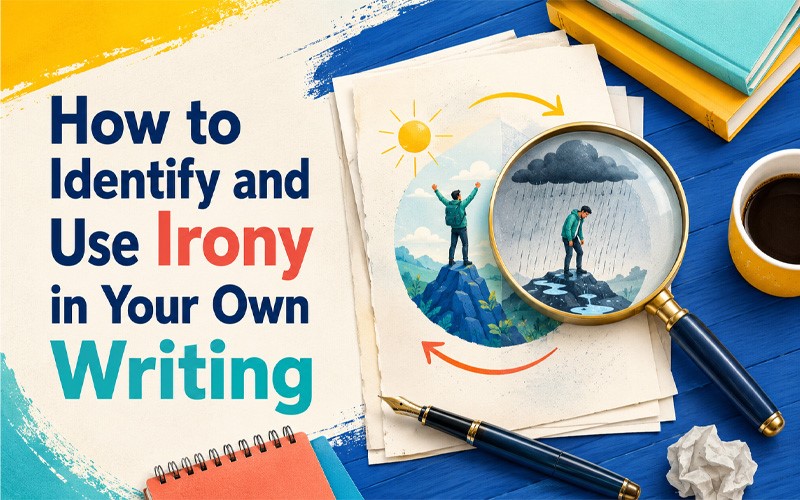
To identify irony, begin with the expectation. What does a character, reader, or ordinary person reasonably believe should happen? Then locate the contradiction. If the outcome, meaning, or available knowledge directly challenges that expectation, irony is probably present.
Use this simple test:
- Establish the expectation. What appears likely, appropriate, or true?
- Find the contrast. What is said, revealed, or experienced instead?
- Identify who knows what. Does the audience know more than the character?
- Name the type. Is it verbal, situational, or dramatic?
- Check its purpose. Does it create humor, suspense, criticism, or insight?
Writers can use the same process in reverse. First, decide what readers should expect. Next, develop an outcome that contradicts that expectation without feeling random. Plant enough clues for the reversal to make sense, but do not explain it so heavily that the discovery loses its impact.
Effective irony examples grow naturally from a character’s goals, flaws, or environment. A cautious character may cause the danger they are desperate to avoid. A dishonest character may accidentally reveal the truth. Readers may know that two enemies are secretly helping each other while neither character recognizes it.
When creating irony examples in everyday life or fiction, remember that surprise alone is not enough. The reversal should connect meaningfully to what came before. That connection is what turns an unexpected event into genuine irony.
America Publishers Author Spotlight examines the ideas, techniques, and creative choices that shape literature and storytelling. Its articles cover literary devices, writing concepts, character development, books, and the work of authors from different backgrounds. Within that wider discussion, irony offers a useful way to understand how writers build contrast, reveal hidden meaning, and guide readers toward unexpected conclusions. Studying such techniques can help readers interpret stories more thoughtfully while giving writers a clearer understanding of how language and narrative structure influence an audience.
Frequently Asked Question
-
What are some simple examples of irony?
A simple example is a fire station catching fire because the outcome contradicts the building’s purpose. Verbal irony occurs when someone walks into heavy rain and says, “What beautiful weather.” Dramatic irony appears when viewers know that a character is walking into danger while the character believes everything is safe.
-
What are the three main types of irony?
The three principal types are verbal, situational, and dramatic irony. Verbal irony involves saying something while intending a different meaning. Situational irony occurs when reality contradicts a reasonable expectation. Dramatic irony happens when an audience knows important information that a character does not.
-
What is the difference between irony and sarcasm?
Irony creates a contrast between words and meaning, expectation and outcome, or knowledge and reality. Sarcasm is a pointed form of expression usually intended to mock or criticize. A sarcastic remark can contain verbal irony, but irony does not always have a mocking tone.
-
What are some famous irony examples in literature?
Well-known irony examples in literature include Romeo believing Juliet is dead in Romeo and Juliet, Oedipus searching for the person responsible for a crime he unknowingly committed, and the exchanged gifts becoming unusable in The Gift of the Magi. Other irony examples in literature appear in Animal Farm, The Necklace, Fahrenheit 451, and The Lottery.
-
What are some popular irony examples in movies?
Popular irony examples in movies include Truman believing his manufactured world is real in The Truman Show, Buzz Lightyear believing he is a genuine space ranger in Toy Story, and Malcolm failing to realize that he is dead in The Sixth Sense. Other irony examples in movies can be found in Frozen, Jurassic Park, Coco, Zootopia, and The Wizard of Oz.
-
What are some irony examples in everyday life?
A time-management workshop starting late, a fitness coach refusing to walk across a parking lot, or a cybersecurity expert using an extremely weak password can all be ironic. Each situation contains an outcome or behavior that meaningfully contradicts what people would reasonably expect.
Conclusion
Irony makes us pause because it reveals how rarely life, language, and human intention follow a perfectly straight line. A confident character may understand the least, a carefully designed plan may create the problem it was meant to prevent, and an ordinary sentence may communicate the opposite of its literal meaning.
The irony examples explored throughout this guide demonstrate why the device remains so powerful. Verbal irony adds hidden meaning, situational irony overturns reasonable expectations, and dramatic irony allows audiences to understand a truth that characters cannot yet see.
The next time you read a novel, watch a movie, or hear someone say, “Well, that went perfectly” after a disaster, look for the contrast beneath the surface. You may discover that irony was hiding in plain sight.
