

Published on July 21, 2026
Hyperbole examples are everywhere: in the friend who says they have been waiting forever, the parent who has told you a million times, and the character whose heart feels as though it has shattered into a thousand pieces. No one expects these statements to be literal. That is exactly why they work.
Hyperbole takes an ordinary feeling and turns up the volume. A person is not simply tired; they could sleep for a year. A queue is not merely long; it stretches to the end of the universe. This exaggeration gives language personality, emotion, and a memorable image.
In this guide, you will explore hyperbole meaning and examples across everyday speech, books, dialogue, and creative writing. Whether you are studying figurative language or improving your own writing, these examples will show how dramatic exaggeration can make a simple idea more powerful.
What Is Hyperbole? Meaning, Purpose, and Quick Examples
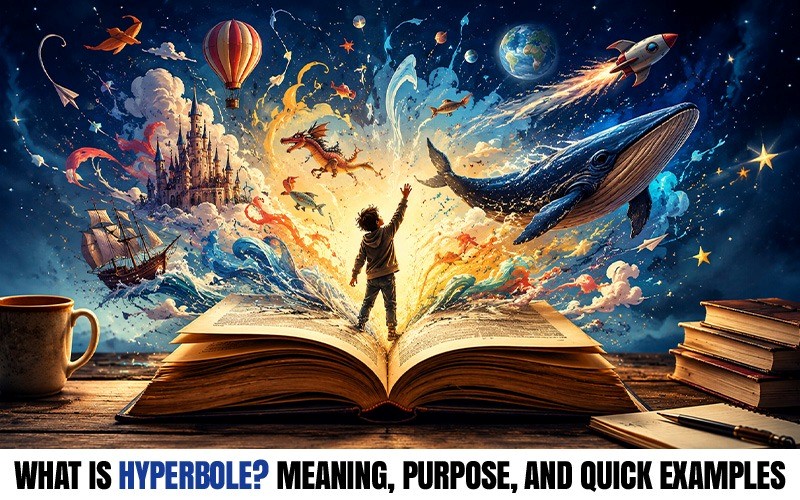
Hyperbole is a figure of speech that uses deliberate exaggeration for emphasis. It is not meant to be taken as fact. Instead, it helps a speaker or writer show how strongly they feel.
For example, when someone says, “I am starving,” they usually mean they are very hungry. When a student says, “This homework will take me a century,” they mean it feels difficult or time-consuming. The words go beyond reality, but the emotion is clear.
Here are a few quick hyperbole examples:
- “My phone battery dies every five minutes.”
- “I have a mountain of laundry to fold.”
- “That bag weighs a tonne.”
- “I could sleep for a year.”
Hyperbole can make writing funnier, more dramatic, or more revealing. It is also different from a lie: a lie is meant to deceive, while hyperbole is usually so exaggerated that readers understand the real point.
How to Spot Hyperbole in Writing and Conversation
To spot hyperbole examples, ask: Could this literally happen? If the answer is no, but the line clearly communicates a feeling, it is likely hyperbole.
Common signals include impossible amounts, extreme size, unrealistic time, or overstated emotion:
- “I have a million things to do.”
- “We waited for ages.”
- “I was dying of embarrassment.”
- “His voice could wake the dead.”
The best hyperbole examples in dialogue sound natural to the speaker and suit the emotion of the scene.

100 Hyperbole Examples in Literature, Dialogue, and Everyday Storytelling
The following hyperbole examples are grouped by situation so you can see how exaggeration changes tone. Each one says more than the literal words on the page.
Everyday Hyperbole Examples
- “I am so hungry I could eat a horse.”
Meaning: I am extremely hungry. - “This shopping bag weighs a tonne.”
Meaning: The bag is very heavy. - “I have a mountain of work to finish.”
Meaning: I have a great deal of work. - “My room is a complete disaster zone.”
Meaning: My room is very messy. - “I have been waiting forever.”
Meaning: The wait feels very long. - “That joke was so funny I nearly died laughing.”
Meaning: I laughed very hard. - “My feet are killing me.”
Meaning: My feet hurt badly. - “I am freezing to death in here.”
Meaning: I feel very cold. - “This traffic is moving at the speed of a snail.”
Meaning: The traffic is moving very slowly. - “I could sleep for a year.”
Meaning: I am extremely tired.
Hyperbole Examples in Dialogue
- “If she is five minutes late again, I will be ancient by the time she arrives.”
Meaning: The speaker is impatient about waiting. - “You have changed your outfit a hundred times.”
Meaning: You have changed clothes repeatedly. - “That film was so boring, even the popcorn looked tired.”
Meaning: The film felt dull and slow. - “Do not ask me to cook tonight. I have survived a thousand meetings.”
Meaning: The speaker has had an exhausting day. - “I am one email away from moving to a cabin in the woods.”
Meaning: The speaker feels overwhelmed. - “You could hear her sigh from the other side of the planet.”
Meaning: Her sigh was loud or dramatic. - “If my alarm goes off one more time, I may throw it into another dimension.”
Meaning: The speaker is annoyed by the alarm. - “He has been talking about that match since the beginning of time.”
Meaning: He has discussed it for a very long time. - “I am so embarrassed I could disappear through the floor.”
Meaning: I feel deeply embarrassed. - “That child has enough energy to power the whole city.”
Meaning: The child is extremely energetic.
These hyperbole examples in dialogue work because they do more than report information. They let us hear the speaker’s mood. A dramatic line can show exhaustion, affection, sarcasm, anxiety, or irritation in a few words.
Hyperbole for Hunger, Tiredness, and Time
- “I have not eaten since the Stone Age.”
Meaning: I have not eaten in a long time. - “This lesson has lasted three lifetimes.”
Meaning: The lesson feels very long. - “I could drink an ocean.”
Meaning: I am extremely thirsty. - “I have been awake for a thousand years.”
Meaning: I am very tired. - “It took me forever to find a parking space.”
Meaning: Finding parking took a long time. - “I am so tired my bones are tired.”
Meaning: I feel completely exhausted. - “That queue goes on for miles.”
Meaning: The queue is very long. - “I have aged ten years waiting for this page to load.”
Meaning: The webpage is loading slowly. - “I am starving enough to eat the table.”
Meaning: I am extremely hungry. - “It has been raining for a hundred days.”
Meaning: It feels as though it has rained for a long time.
Funny and Sarcastic Hyperbole
- “The speaker is extremely annoyed about the coffee spill,” she said as coffee spilled over her notes.
Meaning: She is being sarcastic about an annoying moment. - “My bank account is so empty that it could echo.”
Meaning: I have spent too much money. - “Redoing this spreadsheet again will take the rest of my life.”
Meaning: I am not thrilled at all. - “That haircut was so bad it needs its own warning label.”
Meaning: The haircut looks very bad. - “I have seen more excitement in a waiting room.”
Meaning: The situation is not exciting. - “This printer has personally chosen to ruin my life.”
Meaning: The printer is causing repeated problems. - “He took so long to reply that I assumed he had joined a monastery.”
Meaning: He replied very late. - “That meeting could have been an email, a text, or a thought.”
Meaning: The meeting felt unnecessary. - “I am only buying one thing,” she said, already carrying enough bags to open a shop.
Meaning: She has bought many things. - “I would need a miracle to find any motivation today.”
Meaning: I have no motivation.
Love, Friendship, and Big Feelings
- “I would cross oceans to see you smile.”
Meaning: I care for you deeply. - “My heart skipped a thousand beats.”
Meaning: I felt sudden excitement or fear. - “I missed you more than words can hold.”
Meaning: I missed you intensely. - “Her kindness could melt the coldest heart.”
Meaning: She is exceptionally kind. - “I would wait forever if it meant hearing your answer.”
Meaning: The answer matters deeply to me. - “His apology lifted a mountain from my chest.”
Meaning: The apology brought great relief. - “They laughed loudly enough to shake the house.”
Meaning: Their laughter was joyful and loud. - “My heart broke into a million pieces.”
Meaning: I felt devastated. - “You are worth more to me than all the stars in the sky.”
Meaning: You are deeply valuable to me. - “Her goodbye echoed in my mind for years.”
Meaning: The goodbye stayed with me for a long time.
Anger, Fear, and Frustration
- “I was so angry I could breathe fire.”
Meaning: I was extremely angry. - “That noise is loud enough to wake the dead.”
Meaning: The noise is extremely loud. - “My nerves were doing cartwheels.”
Meaning: I felt very anxious. - “One more interruption and I will explode.”
Meaning: I am close to losing patience. - “The thunder shook the whole world.”
Meaning: The thunder sounded powerful. - “I nearly jumped out of my skin.”
Meaning: I was badly startled. - “That deadline is going to be the end of me.”
Meaning: I feel intense pressure about the deadline. - “The suspense was unbearable.”
Meaning: Waiting felt extremely tense. - “My heart was pounding loudly enough for the whole room to hear.”
Meaning: I felt frightened or nervous. - “His glare could freeze the sun.”
Meaning: His expression was extremely cold or angry.
School, Work, and Daily Life
- “I have enough notes to write a library.”
Meaning: I have taken a lot of notes. - “This assignment will take me a hundred years to finish.”
Meaning: The assignment feels very difficult. - “My inbox multiplies every time I look away.”
Meaning: New emails arrive constantly. - “I have read this paragraph a thousand times.”
Meaning: I have reread it many times. - “That exam question was written in another language.”
Meaning: The question was very confusing. - “My to-do list is longer than the road home.”
Meaning: I have many tasks to complete. - “The office was silent enough to hear a pin drop.”
Meaning: The office was extremely quiet. - “I have been studying since the dawn of civilization.”
Meaning: I have studied for a very long time. - “The photocopier ate my entire afternoon.”
Meaning: The photocopier caused a long delay. - “That presentation took every ounce of courage I had.”
Meaning: Giving the presentation was very difficult.
Hyperbole in Storytelling
- “By midnight, the storm had swallowed the entire town.”
Meaning: The storm made the town feel completely overwhelmed. - “The old house groaned as though it had been carrying its secrets for centuries.”
Meaning: The house seems ancient and full of mystery. - “The silence between them felt loud enough to shake the room.”
Meaning: Her silence felt powerful and noticeable. - “The news hit him like a hundred doors slamming at once.”
Meaning: The news felt shocking and painful. - “He ran as if the whole world were collapsing behind him.”
Meaning: He ran with intense urgency. - “The sun was hot enough to melt the road beneath their feet.”
Meaning: The day was painfully hot. - “The walk to the stage lasted a thousand years.”
Meaning: The character feels nervous about going on stage. - “The city lights were bright enough to turn night into day.”
Meaning: The city lights looked dazzling. - “Without his promise, she would have fallen into a million pieces.”
Meaning: The promise gave her vital emotional support. - “The winter seemed determined to last forever.”
Meaning: The winter felt unusually long and bleak.
Used carefully, hyperbole in storytelling gives a scene emotional scale. It can make readers feel the weight of a character’s grief, the chaos of a storm, or the pressure of a decision without stopping the story to explain every feeling plainly.
Hyperbole Examples in Literature and Poetry
- Macbeth by William Shakespeare
In Macbeth, Macbeth wonders whether all of Neptune’s ocean could wash the blood from his hand, then imagines his hand turning the entire sea red.
Meaning: His guilt feels so enormous that even an ocean could not cleanse it. - “A Red, Red Rose” by Robert Burns
In “A Red, Red Rose,” Robert Burns promises to keep loving until the seas run dry and the rocks melt in the sun.
Meaning: The speaker presents his love as lasting beyond anything realistically possible. - “To His Coy Mistress” by Andrew Marvell
In “To His Coy Mistress,” Andrew Marvell imagines spending hundreds and even thousands of years praising different parts of his beloved.
Meaning: The impossible amount of time exaggerates the depth of the speaker’s admiration. - “I Wandered Lonely as a Cloud” by William Wordsworth
In “I Wandered Lonely as a Cloud,” William Wordsworth says he saw ten thousand daffodils at a single glance, stretching in a seemingly endless line.
Meaning: The exaggerated number captures how vast and unforgettable the scene felt to him. - “Annabel Lee” by Edgar Allan Poe
In “Annabel Lee,” the speaker claims that his love was stronger than the love of people older and wiser than the couple, and that even heaven envied them.
Meaning: The exaggeration makes their relationship feel unmatched and almost supernatural. - “Sonnet 18” by William Shakespeare
In “Sonnet 18,” Shakespeare suggests that the person he admires will live forever as long as people continue to read the poem.
Meaning: Poetry is given the impossible power to preserve someone’s beauty and memory eternally. - “The Sun Rising” by John Donne
In “The Sun Rising,” the speaker says his beloved represents every country and he represents every ruler, as though the whole world exists inside their room.
Meaning: The lovers’ importance is exaggerated until nothing outside their relationship seems to matter. - “Song: Go and Catch a Falling Star” by John Donne
In “Song: Go and Catch a Falling Star,” John Donne asks the reader to complete impossible tasks and travel for ten thousand days and nights.
Meaning: The impossible journey emphasizes how unlikely the speaker believes his search will be. - “The Raven” by Edgar Allan Poe
In “The Raven,” the narrator says he dreams dreams that no human being has ever dared to dream before.
Meaning: The exaggeration increases the mystery, fear, and emotional intensity of the moment. - “The Passionate Shepherd to His Love” by Christopher Marlowe
In “The Passionate Shepherd to His Love,” the speaker promises beds of roses, a thousand fragrant flowers, and every pleasure the countryside can offer.
Meaning: The grand promises create an idealized picture of love that is far more perfect than real life.
These literary-style hyperbole examples show why exaggeration has remained popular across poetry, drama, and fiction. It gives writers a way to make love feel endless, guilt feel unbearable, and ambition feel larger than life.
Original Creative-Writing Hyperbole Examples
- “The secret sat between them like a thundercloud too large for the sky.”
Meaning: The secret creates enormous tension. - “Her first rejection letter weighed more than every book on the shelf.”
Meaning: The rejection felt emotionally heavy. - “The café was so crowded that even the chairs seemed to be standing.”
Meaning: The café was extremely busy. - “He smiled as though he had won the moon in a raffle.”
Meaning: He was incredibly pleased. - “The silence after the argument lasted a whole season.”
Meaning: The emotional distance lasted a long time. - “Her grandmother’s kitchen could feed an entire army.”
Meaning: There was a huge amount of food. - “The baby’s cry could crack the morning open.”
Meaning: The cry was loud and piercing. - “His confidence was so fragile that one raised eyebrow could break it.”
Meaning: He was deeply insecure. - “The little dog believed it was ten feet tall.”
Meaning: The dog acted much braver and bigger than it was. - “When the final bell rang, the students flew out of the building at a hundred miles an hour.”
Meaning: The students were extremely eager to leave.
Why Writers Use Hyperbole in Storytelling
Writers use hyperbole to make emotions feel stronger and scenes more memorable. Instead of saying a character is nervous, they might say their heart is pounding hard enough to shake the room.
Hyperbole can help writers:
- Reveal personality and voice
- Add humor or sarcasm
- Make emotion feel more vivid
- Create strong images quickly
Strong hyperbole examples often reflect a character’s perspective. A teenager may feel one awkward moment has ruined their entire life, while a detective may believe every shadow in the room is watching them. The statement is not literal, but the emotion is real.
Used well, hyperbole in storytelling makes readers feel the pressure, excitement, fear, or joy of a moment.
How to Use Hyperbole Without Overdoing It
The best hyperbole examples fit the character and scene. A funny character might say they are “one spilled coffee away from disappearing into the sea,” while a sad character may feel that “the empty chair filled the whole room.”
Keep these points in mind:
- Match the exaggeration to the character’s voice.
- Use it to strengthen a real emotion.
- Make the intended meaning clear.
- Do not use dramatic exaggeration in every sentence.
For example:
Plain: “Maya was nervous before the interview.”
Hyperbolic: “Maya’s stomach had tied itself into a hundred knots before the interview.”
When considering hyperbole meaning and examples, think of exaggeration as seasoning: enough can improve a sentence, but too much can overpower it.
Frequently Asked Question
-
What are 5 common hyperbole examples?
“I could eat a horse,” “I have told you a million times,” “This bag weighs a tonne,” “I could sleep for a year,” and “I am freezing to death.”
-
What is the difference between hyperbole and exaggeration?
Hyperbole is deliberate, obvious exaggeration used for emphasis, humor, or emotion. This is the key idea behind hyperbole meaning and examples.
-
What are hyperbole examples in dialogue?
Hyperbole examples in dialogue include, “I have been waiting forever,” “This queue goes on for miles,” and “One more email and I will explode.”
-
Why do authors use hyperbole examples in literature?
Authors use hyperbole examples in literature to make feelings, characters, and dramatic moments feel larger than life.
-
How can I use hyperbole in storytelling effectively?
Use hyperbole in storytelling to highlight emotion or reveal character voice. Keep it clear, natural, and occasional so it retains its impact.
Conclusion
Hyperbole gives language energy. It helps us express hunger, exhaustion, excitement, frustration, and heartbreak in ways that feel immediate and human.
The strongest hyperbole examples do not just make a sentence bigger; they make its feeling clearer. Used in conversation, dialogue, or fiction, hyperbole proves that sometimes the most memorable way to say something is to say it a little larger than life.
For more reader-friendly insights into language, books, and storytelling, explore America Publishers Author Spotlight.