
Table Of Content
- Why Silent Letters Make Wordle Harder Than It Looks
- Useful 5 Letter Words With Silent Letters to Know for Wordle
- How to Use Silent Letters as a Wordle Strategy
- When Unusual Spelling Becomes Your Biggest Wordle Clue
- Quick Tips for Remembering Silent-Letter Wordle Words
- A Smarter Way to Approach Silent-Letter Wordle Words
- FAQs
Published on October 06, 2026
If you have ever stared at a Wordle board knowing you have seen the answer before but somehow cannot remember how to spell it, silent letters may be the reason. English has plenty of words that sound simpler than they look, and that can become especially frustrating when you have only six guesses to find a five-letter word.
That is where 5 letter words with silent letters become interesting. A word can sound perfectly familiar while hiding a letter you would never think to type. From a quiet K at the beginning of a word to a final E that changes the vowel before it, these spelling patterns can turn an ordinary-looking Wordle into a surprisingly difficult puzzle.
The good news is that you do not need to memorize an enormous dictionary to get better at spotting them. Once you recognize common patterns, you can start using them as clues rather than treating them as random spelling traps. This guide explores useful examples, explains why they are tricky, and shows how recognizing silent-letter patterns can give you another way to approach your next Wordle.
Why Silent Letters Make Wordle Harder Than It Looks
Silent letters are one of those quirks of English that seem harmless until you have to spell a word under pressure. When we speak, we naturally focus on the sounds we hear. When we play Wordle, however, we need to reconstruct the spelling behind those sounds. Understanding how sounds work in language can also make spelling patterns easier to notice. Readers interested in sound patterns in writing can explore 100 Consonance Examples with Sound Patterns Explained for more examples.
That difference matters.
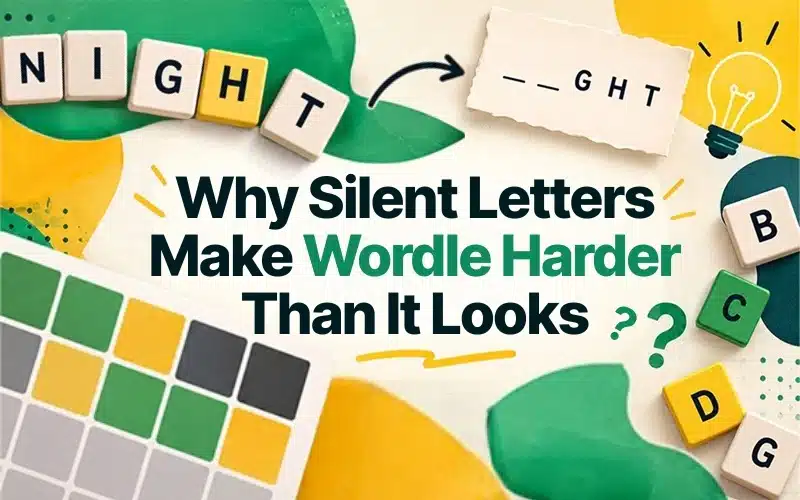
Consider a word such as KNIFE. When you say it aloud, you hear the beginning as a simple “n” sound. The K does not announce itself, yet it is essential to the spelling. The same pattern appears in KNEEL, KNOCK, and other words beginning with KN. If your brain is working from pronunciation alone, it is easy to overlook that first letter.
The same problem appears with WR words such as WRITE, WRONG, and WRIST. The W is written but does not receive its own pronounced sound. Then there are words containing GH, such as LIGHT, NIGHT, and RIGHT, where the written combination can look much more complicated than the sound suggests.
These silent letter words can therefore create a particular kind of Wordle challenge: you may know exactly what word you mean but still fail to retrieve its spelling quickly.
There is another reason they can be difficult. Wordle does not give you enough space to casually experiment with every possibility. A misplaced guess can use one of your six attempts, so recognizing familiar spelling patterns can be more useful than simply thinking about how a word sounds.
This is also why some difficult English words for Wordle are not necessarily obscure vocabulary. A player might know the meaning and pronunciation of a word perfectly well and still hesitate because its spelling contains an unexpected letter.
The trick is to start treating those unusual letters as patterns rather than surprises. Once KN, WR, GH, MB, or a final silent E becomes familiar, a word that once looked strange can become much easier to recognize.
Useful 5 Letter Words With Silent Letters to Know for Wordle
Not every silent-letter pattern works in exactly the same way, and English pronunciation can vary between words and accents. Still, several recurring spelling patterns are particularly useful to recognize when you are working through a Wordle grid.
Rather than memorizing a huge collection of unrelated answers, it helps to group words according to the letters that tend to cause trouble.
Silent K: When the Word Starts With KN
One of the easiest patterns to overlook is KN at the beginning of a word. The K is silent, so the word begins with an “n” sound even though the spelling begins with two letters.
Useful five-letter examples include:
- KNIFE
- KNEEL
- KNELT
- KNACK
- KNOCK
If you are thinking of an N sound at the beginning, do not automatically assume the word begins with N. A silent K could be hiding before it, as in KNIFE or KNOCK.
Silent W: Watch for WR
The WR combination creates another familiar spelling trap. In words such as WRITE, WRONG, and WRIST, the W is not pronounced separately.
Try these examples:
- WRITE
- WRONG
- WROTE
- WRIST
- WRECK
This pattern can be particularly useful when you are thinking of a word that begins with an R sound. Instead of assuming the spelling starts with R, consider whether a silent W belongs before it.
Silent B: The Letter You Do Not Hear
The silent B pattern is slightly different because it often appears near the end of a word. In THUMB, for example, the final B is written but not pronounced. DOUBT follows a similar pattern, with the B disappearing from the spoken word.
For Wordle players, that creates an interesting spelling-versus-sound problem. If you know the word from hearing it but are trying to reconstruct the spelling, the B may be one of the last letters that comes to mind.
Examples worth remembering include:
- THUMB
- DOUBT
These are good reminders that a letter does not have to appear at the beginning of a word to cause a spelling trap.
Silent GH: A Classic English Complication
Few letter combinations have caused English learners more confusion than GH. In several common five-letter words, the combination does not produce a distinct sound.
Consider:
- LIGHT
- NIGHT
- RIGHT
- SIGHT
- EIGHT
These words are especially interesting for Wordle because the pronunciation gives you very little help with the spelling of GH. If your clues suggest a word with an “-ite” or “-ight” ending, several possibilities may compete for attention.
This is where unusual English words can become less intimidating. Once you start recognizing recurring combinations, a strange-looking spelling is no longer completely unfamiliar.
The GU Pattern: When U Changes the Sound
The letter U can behave differently depending on the letters around it. In words such as GUIDE, GUESS, and GUILD, the U is not pronounced as a separate vowel sound. Because this pattern does not work the same way in every GU word, it is better treated as a spelling pattern rather than a simple silent-letter rule.
Some useful examples include:
- GUIDE
- GUESS
- GUILD
This category requires a little more care than a straightforward silent K or W because English spelling and pronunciation patterns are not always perfectly consistent. Still, recognizing common GU combinations can help when several letters are already confirmed.
Silent E: The Small Letter With a Big Effect
The final silent E is one of the most familiar spelling patterns in English, but familiarity does not necessarily make it easy to spot during a timed or high-pressure Wordle attempt.
Words such as these demonstrate the pattern:
- CRANE
- SLATE
- STONE
- BRIDE
- PHONE
- SHARE
- SHADE
- TRADE
- PRICE
- SMILE
Here, the final E is not simply an extra letter sitting quietly at the end. It can affect the pronunciation of the vowel earlier in the word. That makes the pattern particularly useful when your Wordle clues suggest a familiar word shape and you need to remember how the final E changes the preceding vowel’s sound.
The larger lesson is that 5 letter words with silent letters are easier to handle when you recognize the spelling family they belong to. Instead of asking yourself, “What random word could fit these boxes?” you can ask a more focused question: “Could this be a KN word, a WR word, a GH word, or a word ending in silent E?”
That small change in thinking can make a difficult board feel much more manageable.

How to Use Silent Letters as a Wordle Strategy
Knowing a few silent-letter examples is useful, but recognizing the patterns while you are actually playing is where the knowledge becomes valuable. When your guesses start narrowing the possibilities, spelling patterns can give you another route toward the answer.
Start by separating sound from spelling. If you have a word in mind because of the way it sounds, pause for a second and ask whether an unpronounced letter could be hiding somewhere in its spelling. This is particularly helpful when a familiar pronunciation seems to fit your colored tiles but the obvious spelling does not.
For example, if your clues suggest an N at the beginning, you do not necessarily have to limit yourself to words that begin with N. A word such as KNIFE begins with a written K, even though that K disappears when the word is spoken. The same idea applies when an R appears to be the first sound you hear. Words such as WRITE and WRONG remind you that a W can sit quietly before it.
Pay attention to letter combinations
Individual letters are not always the best clues. Sometimes the combination is more revealing.
Keep familiar patterns such as these in the back of your mind:
- KN at the beginning
- WR at the beginning
- GH in words such as LIGHT and NIGHT
- MB near the end, as in THUMB
- GU combinations
- A final E
You do not need to test every pattern in every game. The goal is simply to recognize when one might fit the letters you have already uncovered.
This can be especially useful with difficult English words for Wordle because the difficulty may come from spelling rather than vocabulary. A player may know the word immediately when they see it written but struggle to produce it from its pronunciation.
Use your confirmed letters strategically
Wordle gives you two particularly valuable types of information: letters that belong in the answer and letters that do not. Once you have several confirmed letters, look at the spaces around them instead of immediately trying another completely unrelated word.
Suppose your clues suggest a five-letter word ending in -IGHT. Remembering the GH pattern could make possibilities such as LIGHT, NIGHT, RIGHT, or SIGHT easier to consider.
The same principle works with less obvious patterns. If the clues suggest an R near the beginning, ask yourself whether WR could be involved. If a word seems to end with a familiar vowel sound, consider whether a silent E might complete the spelling.
Do not assume every strange-looking word is a good guess
Five-letter word lists online can be enormous. Some contain obscure dictionary entries, alternate forms, proper names, or words that may be accepted as guesses but are unlikely to be the day’s answer.
That distinction matters.
Your goal is not to memorize every entry in a word database. It is to become familiar with useful spelling patterns and common vocabulary. That makes tricky Wordle words easier to approach without turning your preparation into a vocabulary marathon.
Above all, use the information already on your board. A silent-letter pattern should help narrow your choices, not encourage you to throw random unusual words at the puzzle.

When Unusual Spelling Becomes Your Biggest Wordle Clue
There is a funny thing about English spelling: what initially looks like the biggest obstacle can eventually become one of your best clues.
When a word has an unexpected letter, players often focus on how strange it looks. But once you have encountered the same spelling pattern several times, that strangeness becomes recognizable. KN starts suggesting a certain group of words. WR suggests another. GH points toward another collection of possibilities.
That is why learning silent letter words as groups can be more useful than memorizing them individually.
Think about the difference between remembering that KNIFE contains a silent K and understanding that English has a recurring KN- spelling pattern. The first helps you remember one word. The second gives you a clue that can potentially help with several words.
The same applies to final silent E. You do not need to memorize every five-letter word ending in E. Instead, become comfortable with the fact that a final E can change the sound of the vowel before it. When your board begins to resemble a familiar pattern, that knowledge can help you generate possibilities more quickly.
Strange does not always mean obscure
Another useful distinction is between an unusual spelling and an unusual word.
A word can look strange because its spelling does not closely match its pronunciation while still being part of everyday English. KNIFE, WRITE, THUMB, and NIGHT are hardly obscure vocabulary. Their spellings simply contain historical patterns that are not obvious from the way we say them today.
For readers interested in how repeated vowel sounds shape language, 100 Assonance Examples in Poetry and Famous Writing offers another look at the relationship between letters and sound. This matters because Wordle can make familiar vocabulary feel unfamiliar. Under pressure, even an ordinary word can suddenly look wrong.
That moment is worth recognizing. If a possible answer seems familiar but its spelling feels strangely complicated, do not dismiss it immediately. Ask whether the unusual-looking letter combination is actually a pattern you have seen before.
Build recognition instead of memorization
One useful long-term approach is to build a mental collection of spelling patterns.
You might notice that several silent letter words begin with KN, several others begin with WR, and another group contains GH. Over time, those groups become easier to retrieve.
This also explains why some unusual English words become surprisingly memorable after you encounter them in a puzzle. You are not just learning a definition. You are connecting the word’s appearance, pronunciation, and letter pattern.
And that is useful beyond Wordle. Becoming more aware of spelling patterns can make unfamiliar vocabulary easier to decode when you encounter it while reading, writing, or learning new words.
Quick Tips for Remembering Silent-Letter Wordle Words
You do not need a complicated study routine to get better at recognizing spelling traps. A few simple habits can make the patterns much easier to remember.
- Learn families, not isolated words.
Instead of memorizing KNIFE on its own, connect it with other KN- words. Do the same with WR and GH patterns. - Separate pronunciation from spelling.
Say the word aloud, then deliberately spell it. Noticing the difference between what you hear and what you write can reinforce the unusual letter. - Keep a personal Wordle list.
Whenever a word catches you off guard, write it down. A short list of words that have personally fooled you is often more useful than a giant vocabulary database. - Look for patterns after each game.
If you encounter a word with a silent letter, take a moment to identify what made its spelling unusual. That extra few seconds can help the pattern stick. - Do not be afraid of tricky spellings.
Once you have seen enough tricky Wordle words, the unusual combinations start feeling less random. What once looked like a spelling trap can become a recognizable clue.

A Smarter Way to Approach Silent-Letter Wordle Words
Silent letters can make a familiar word look completely unfamiliar when it appears on a Wordle board. What matters is recognizing the patterns behind those spellings. A quiet K, an unexpected W, an unpronounced GH, or a final E can all become useful clues once the patterns start to feel familiar.
Repeated exposure can also make it easier to separate how a word sounds from how it is written. That can turn difficult English words for Wordle into something much more manageable.
More vocabulary, reading, and literary features are also available through America Publishers Author Spotlight. Ultimately, the next time a Wordle answer looks strangely familiar, it may be worth asking one simple question: Is there a letter hiding in the spelling that you cannot hear? Sometimes, that is the clue that solves the puzzle.
Frequently Asked Question
-
What are five-letter words with silent letters?
They are five-letter words containing letters that are not normally pronounced separately. Examples include KNIFE, WRITE, THUMB, LIGHT, and NIGHT.
-
What five-letter Wordle words have a silent K?
Common examples include KNIFE, KNEEL, KNELT, KNACK, and KNOCK. In each case, the K appears in writing but is not pronounced.
-
Which five-letter words have a silent W?
Words such as WRITE, WRONG, WROTE, WRIST, and WRECK contain a silent W at the beginning.
-
What five-letter words contain unpronounced GH?
Examples include LIGHT, NIGHT, RIGHT, SIGHT, and EIGHT. In these examples, the GH combination is not pronounced.
-
Can silent-letter patterns help with Wordle?
Yes. Recognizing common spelling patterns can help players consider possibilities they might otherwise overlook, particularly when pronunciation does not clearly reveal the spelling.
-
How can players remember tricky Wordle words?
Grouping words by patterns is often easier than memorizing them individually. Players can also keep a short list of words that have surprised them and review the spelling patterns behind those words.