
Published on August 26, 2026
Some sentences do more than communicate an idea; they create a sound that stays with you. Read “The evening breeze moved through the trees” aloud. The repeated long e sound in “evening,” “breeze,” and “trees” gives the sentence a gentle musical quality. That effect is called assonance.
Assonance appears when nearby words repeat the same or a similar vowel sound. Writers use it to shape rhythm, emphasize certain words, create atmosphere, and make a line more memorable. Unlike rhyme, the words do not need to share identical endings. They only need to echo one another through their vowel sounds.
The assonance examples in this guide show how the technique works across poems, novels, familiar expressions, and original sentences. You will find classic assonance examples in poetry, short passages demonstrating assonance in literature, and everyday assonance examples in sentences. Each group makes it easier to hear the repeated sound instead of simply memorizing a definition.
Whether you are analyzing a poem, teaching a class, or improving your own writing, these 100 assonance examples will help you recognize the music hidden inside ordinary language. They will also show how a small sound choice can influence the pace, emotion, and meaning of an entire line.
Affiliate Disclosure: As an Amazon Associate I earn from qualifying purchases. at no additional cost to you.
What Is Assonance and How Does It Work?
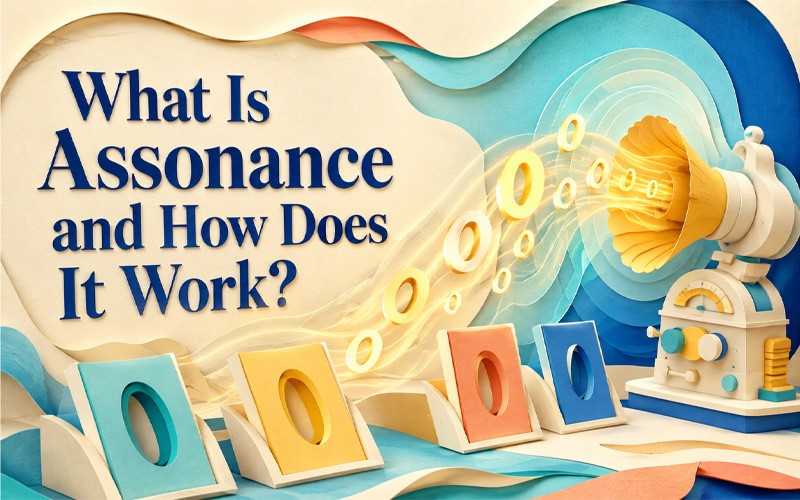
Assonance is the repetition of a vowel sound in two or more nearby words. It is sometimes described as “vowel rhyme,” although it does not require words to rhyme completely. In “The goat slowly approached the road,” the long o sound connects “goat,” “slowly,” “approached,” and “road.” Their consonants and endings differ, but their central vowel sound is similar.
The most important thing to remember is that assonance depends on pronunciation, not spelling. “Sea,” “dream,” and “believe” use different combinations of letters, yet all three contain the long e sound. Meanwhile, the same vowel letter can represent different sounds. Reading a line aloud is therefore one of the most reliable ways to identify assonance examples.
Some examples of assonance repeat a sound so clearly that readers notice it immediately. Others are subtler and work quietly beneath the meaning of a sentence. This is especially common with assonance in literature, where sound can support the mood without distracting readers from the story.
In assonance examples in poetry, repeated vowels may slow a line, quicken its movement, connect related images, or reinforce an emotion. Long vowel sounds can make a line feel spacious or flowing, while short vowel sounds may create a sharper or faster effect. However, these are tendencies rather than strict rules. Meaning, rhythm, pronunciation, and surrounding consonants all influence what readers hear.
Consider “Bright lights shine in the silent night.” The long i sound appears in “bright,” “lights,” “shine,” “silent,” and “night.” This is one of the clearest assonance examples in sentences because the shared sound can be heard across several nearby words.
Learning to recognize assonance requires more listening than memorization. The following assonance examples include famous lines and original sentences, allowing you to hear how repeated vowels function in different forms of writing.
Recommended for Beginners
Build a practical understanding of repeated sounds and learn how assonance works alongside alliteration and rhyme.

Complete List of 100 Assonance Examples
The list begins with poetry and famous writing before moving into original sentences and familiar expressions. Listen to each example rather than relying only on its spelling. Pronunciation varies between accents, so some patterns may sound slightly stronger to certain readers.
Assonance can also appear alongside rhyme, alliteration, consonance, and repetition. When two words rhyme, they naturally share a vowel sound; therefore, some examples below demonstrate both rhyme and assonance.
30 Assonance Examples in Poetry
These assonance examples in poetry demonstrate how repeated vowel sounds can strengthen rhythm, mood, imagery, and emphasis.
Recommended Reading
Explore an academic examination of assonance and related sound patterns in British poetry.
View on Amazon (ad)- “Hear the mellow wedding bells” — Edgar Allan Poe, “The Bells”
The short e sound repeats in “mellow,” “wedding,” and “bells.” - “From the jingling and the tinkling of the bells” — Edgar Allan Poe, “The Bells”
“Jingling” and “tinkling” repeat the short i sound, helping imitate the light ringing of bells. - “A host, of golden daffodils” — William Wordsworth, “I Wandered Lonely as a Cloud”
“Host” and “golden” share the long o - “The woods are lovely, dark and deep, / But I have promises to keep” — Robert Frost, “Stopping by Woods on a Snowy Evening”
“Deep” and “keep” share a long e They also form a complete rhyme. - “Tyger Tyger, burning bright” — William Blake, “The Tyger”
“Tyger” and “bright” repeat the long i - “What immortal hand or eye, / Could frame thy fearful symmetry?” — William Blake, “The Tyger”
“Eye” and “thy” share the long i - “Thou still unravish’d bride of quietness” — John Keats, “Ode on a Grecian Urn”
“Bride” and the opening syllable of “quietness” repeat the long i sound. - “Because I could not stop for Death— / He kindly stopped for me” — Emily Dickinson
“He” and “me” create a clear long-e - “Hope is the thing with feathers” — Emily Dickinson
The short i sound appears in “is,” “thing,” and “with.” - “In a kingdom by the sea” — Edgar Allan Poe, “Annabel Lee”
“In” and the first syllable of “kingdom” repeat the short i - “The fair breeze blew, the white foam flew” — Samuel Taylor Coleridge, “The Rime of the Ancient Mariner”
“Blew” and “flew” share the long oo sound and also rhyme. - “The Wedding-Guest here beat his breast” — Samuel Taylor Coleridge, “The Rime of the Ancient Mariner”
“Wedding,” “Guest,” and “breast” repeat the short e - “She walks in beauty, like the night” — Lord Byron, “She Walks in Beauty”
“Like” and “night” share the long i - “Of cloudless climes and starry skies” — Lord Byron, “She Walks in Beauty”
“Climes” and “skies” repeat the long i - “O wild West Wind, thou breath of Autumn’s being” — Percy Bysshe Shelley, “Ode to the West Wind”
“West” and “breath” share the short e - “Look on my Works, ye Mighty, and despair!” — Percy Bysshe Shelley, “Ozymandias”
“My” and “Mighty” repeat the long i - “The lone and level sands stretch far away” — Percy Bysshe Shelley, “Ozymandias”
“Level” and “stretch” share the short e - “I will arise and go now, and go to Innisfree” — W. B. Yeats, “The Lake Isle of Innisfree”
The short i sound appears in “will” and the opening syllables of “Innisfree.” - “The ship is anchor’d safe and sound, its voyage closed and done” — Walt Whitman, “O Captain! My Captain!”
“Ship,” “is,” and “its” repeat the short i
- “Had we but world enough, and time” — Andrew Marvell, “To His Coy Mistress”
“But” and the final stressed syllable of “enough” share the short u
- “He clasps the crag with crooked hands” — Alfred, Lord Tennyson, “The Eagle”
“Clasps,” “crag,” and “hands” repeat the short a
- “To strive, to seek, to find, and not to yield” — Alfred, Lord Tennyson, “Ulysses”
“Seek” and “yield” share the long e
- “And since to look at things in bloom / Fifty springs are little room” — A. E. Housman, “Loveliest of Trees”
“Since,” “things,” “fifty,” “springs,” and “little” repeat the short i
- “Rough winds do shake the darling buds of May” — William Shakespeare, Sonnet 18
“Rough” and “buds” share the short u
- “By the shores of Gitche Gumee, / By the shining Big-Sea-Water” — Henry Wadsworth Longfellow, The Song of Hiawatha
“By” and the first syllable of “shining” share the long i sound, while the second syllable of “shining” and “Big” create a subtler short-i echo.
- “’Twas brillig, and the slithy toves / Did gyre and gimble in the wabe” — Lewis Carroll, “Jabberwocky”
“Brillig,” “did,” and “gimble” contain recurring short i sounds.
- “And the silken, sad, uncertain rustling of each purple curtain” — Edgar Allan Poe, “The Raven”
“Uncertain,” “purple,” and “curtain” repeat the ur - “The splendour falls on castle walls” — Alfred, Lord Tennyson, “The Princess”
“Falls” and “walls” share the broad aw sound and also rhyme.
- “And all should cry, Beware! Beware! / His flashing eyes, his floating hair!” — Samuel Taylor Coleridge, “Kubla Khan”
“Eyes” and “cry” repeat the long i sound, while “beware” and “hair” create a second vowel echo.
- “And so, all the night-tide, I lie down by the side” — Edgar Allan Poe, “Annabel Lee”
“Night-tide,” “I,” “lie,” and “side” repeat the long i sound, creating a sustained lyrical echo.
Some poetic examples also contain rhyme or repeated words. This overlap is normal because writers frequently combine several sound devices within the same line.
20 Examples of Assonance in Famous Literature and Writing
The following examples of assonance show how repeated vowel sounds can also appear in novels, plays, short stories, and other memorable writing. Compared with poetry, assonance in literature is often more subtle.
- “It is a truth universally acknowledged” — Jane Austen, Pride and Prejudice
“Truth” and the opening syllable of “universally” share the long oo sound, creating a subtle vowel echo. - “There was no possibility of taking a walk that day” — Charlotte Brontë, Jane Eyre
“Taking” and “day” share the long a - “I heard all things in the heaven and in the earth” — Edgar Allan Poe, “The Tell-Tale Heart”
“Heard” and “earth” repeat the ur - “Is this a dagger which I see before me?” — William Shakespeare, Macbeth
“Is,” “this,” and “which” repeat the short i - “The course of true love never did run smooth” — William Shakespeare, A Midsummer Night’s Dream
“Love” and “run” share the short u - “We are such stuff as dreams are made on” — William Shakespeare, The Tempest
“We” and “dreams” repeat the long e - “Fifteen men on the dead man’s chest” — Robert Louis Stevenson, Treasure Island
“Men,” “dead,” and “chest” share the short e - “Whenever I find myself growing grim about the mouth” — Herman Melville, Moby-Dick
“I,” “find,” and the first syllable of “myself” repeat the long i - “It is a far, far better thing that I do, than I have ever done” — Charles Dickens, A Tale of Two Cities
“It,” “is,” and “thing” repeat the short i
- “To die will be an awfully big adventure” — J. M. Barrie, Peter Pan
“Will” and “big” share the short i
- “Would you tell me, please, which way I ought to go from here?” — Lewis Carroll, Alice’s Adventures in Wonderland
“Me” and “please” repeat the long e
- “There is only one thing in the world worse than being talked about” — Oscar Wilde, The Picture of Dorian Gray
“World” and “worse” share the ur
- “Cowards die many times before their deaths” — William Shakespeare, Julius Caesar
“Die” and “times” repeat the long i
- “The play’s the thing / Wherein I’ll catch the conscience of the king” — William Shakespeare, Hamlet
“Thing” and “king” repeat the short i sound and also rhyme.
- “If you prick us, do we not bleed?” — William Shakespeare, The Merchant of Venice
“We” and “bleed” share the long e
- “Full fathom five thy father lies” — William Shakespeare, The Tempest
“Five,” “thy,” and “lies” repeat the long i
- “Listen to them—the children of the night. What music they make!” — Bram Stoker, Dracula
Short i sounds recur in “listen,” “children,” and the final syllable of “music.” - “In his blue gardens men and girls came and went like moths” — F. Scott Fitzgerald, The Great Gatsby
“Men” and “went” repeat the short e
- “Tomorrow is always fresh, with no mistakes in it yet” — L. M. Montgomery, Anne of Green Gables
“With,” “in,” and “it” repeat the short i
- “Once upon a midnight dreary, while I pondered, weak and weary” — Edgar Allan Poe, “The Raven”
“Midnight” and “while” share the long i sound, creating assonance, while “dreary” and “weary” add a prominent end rhyme that reinforces the line’s melancholic musicality.
Academic Resource
Examine how assonance, alliteration, and consonance work together to create harmony and emphasis in poetry.
40 Original Assonance Examples in Sentences
The next assonance examples in sentences are original. They demonstrate individual vowel sounds without requiring any additional literary context.
Long A Sound
- The pale rain faded late in the day.
- Jane waited beside the railway gate.
- The playful crane chased waves across the lake.
- We stayed awake to watch the daylight change.
- Grace placed the cake on a silver tray.
Short A Sound
- The black cat napped beside the map.
- Sam packed apples into a canvas bag.
- A happy rabbit dashed past the cabin.
- The captain grabbed his hat and ran.
- Jack planned to camp near the sandy bank.
Long E Sound
- Green leaves leaned into the evening breeze.
- Three sleepy geese dreamed beneath the trees.
- She could see the deep sea from the peak.
- The team agreed to meet beside the stream.
- Sweet peace filled the quiet street.
Short E Sound
- Ben left ten red pens on the desk.
- The clever hen rested near the fence.
- Meg checked every step before she left.
- Fresh bread tempted the wedding guests.
- The bell echoed through the empty shed.
Long I Sound
- Bright lights shine in the silent night.
- The child smiled while flying the kite.
- Five white birds climbed into the sky.
- I tried to hide my surprise.
- The tiny firelight flickered beside the pine.
Short I Sound
- Six little fish slipped beneath the bridge.
- Tim filled the tin with mint.
- The quick wind lifted the thin curtain.
- A cricket hid in the thick grass.
- His silver whistle split the stillness.
Long O Sound
- The old boat floated slowly home.
- Rose closed the window against the cold.
- A lonely crow watched over the road.
- Joe rode home through the snow.
- Golden smoke rolled over the coast.
Short O Sound
- Tom dropped the clock beside the box.
- The fox stopped on top of the rock.
- A soft fog crossed the rocky pond.
- Tom dropped the hot box on the dock.
- The fox knocked the clock from the box.
These original assonance examples in sentences can also serve as writing models. A sentence does not need to sound like a nursery rhyme. Two or three well-positioned vowel echoes are often enough to create an audible effect.
Practice Resource
Practise using repeated vowel sounds naturally while strengthening your understanding of related sound devices.
View on Amazon (ad)10 Examples in Familiar Expressions and Everyday Language
The final examples of assonance show how naturally the technique appears in familiar expressions. Several of these phrases also contain rhyme.
- No pain, no gain. — “Pain” and “gain” repeat the long a sound and rhyme.
- The early bird catches the worm. — “Early,” “bird,” and “worm” contain closely related ur sounds in many non-rhotic English accents, although the exact pronunciation varies by region.
- Honesty is the best policy. — “Honesty” and “policy” repeat the short o sound in common American pronunciation.
- A stitch in time saves nine. — “Time” and “nine” repeat the long i sound and rhyme.
- An apple a day keeps the doctor away. — “Day” and “away” share the long a sound and rhyme.
- A friend in need is a friend indeed. — “Need” and “indeed” repeat the long e sound and rhyme.
- Keep your eyes on the prize. — “Eyes” and “prize” repeat the long i sound and rhyme.
- Go slow on the road. — “Go,” “slow,” and “road” repeat the long o
- Make hay while the sun shines. — “While” and “shines” share the long i
- Time flies when you’re having fun. — “Time” and “flies” repeat the long i sound, creating assonance without complete rhyme.
Taken together, these 100 assonance examples demonstrate how flexible the technique can be. It may dominate a poetic line, sit quietly inside a novel, or occur naturally in everyday speech. Reading each entry aloud makes the repeated vowel sounds easier to recognize and helps reveal the music hidden within written language.
Why Writers Use Assonance in Poetry and Literature
Assonance is more than a decorative technique. When used deliberately, it affects how a passage sounds, moves, and feels. The best assonance examples work so naturally that readers experience their effect before recognizing the technique.
Repeated vowel sounds can give language an internal rhythm even when no regular rhyme scheme is present. Consider the sentence, “The slow road rolled toward the coast.” The recurring long o sound creates a steady, unhurried movement. Many assonance examples in poetry use this kind of repetition to make lines flow smoothly and connect one word to the next.
Further Reading
Learn more about how repeated sounds contribute to poetic rhythm, harmony, and musicality.
View on Amazon (ad)Assonance can also help establish mood. Long o and oo sounds may make a passage feel slow, solemn, or expansive, while shorter i and e sounds can create a quicker or more restless pace. These are not fixed rules because meaning, consonants, and rhythm also shape the reader’s response.
Writers may also repeat vowel sounds to connect important words. In “The child’s bright eyes watched the night sky,” the long i sound links the child, the act of seeing, and the surrounding night. This subtle connection explains why assonance in literature may be felt without being immediately noticed.
Well-placed examples of assonance can emphasize emotion and make language more memorable. However, the technique works best when sound supports meaning instead of making the sentence feel forced.
Assonance vs. Alliteration, Consonance, and Rhyme
Assonance is often confused with other sound devices because several techniques can appear in the same sentence.
Assonance repeats vowel sounds: “The goat slowly approached the road.”
Alliteration repeats initial consonant sounds: “Wild winds whistle.”
Consonance repeats consonant sounds anywhere in nearby words: “The blank trunk sank.”
Rhyme repeats the final stressed vowel and the sounds that follow it: “Light,” “bright,” and “night.”
These categories can overlap. “The black cat sat on the mat” contains short-a assonance, while “cat,” “sat,” and “mat” also rhyme. Similarly, assonance in literature may appear alongside alliteration or consonance.
When analyzing a line, ask one simple question: Is the noticeable pattern created by a repeated vowel sound? If the answer is yes, assonance is present, even if another sound device appears beside it.
How to Find and Write Your Own Assonance
You do not need advanced knowledge of phonetics to identify assonance. Your most useful tool is your voice.
First, read the line aloud and listen for vowel sounds that echo. In “Green leaves trembled in the breeze,” the long e sound in “green,” “leaves,” and “breeze” becomes clearer when spoken.
Next, focus on pronunciation rather than spelling. “Meet,” “key,” “machine,” and “believe” use different letter combinations but can share the same long e sound. Meanwhile, the letter a sounds different in “cat,” “cake,” and “call.”
To create your own assonance examples in sentences, choose one vowel sound and list a few words containing it. For a long a sound, you might select “rain,” “pale,” “lake,” “day,” and “fade.” These could become: “The pale rain faded across the lake.”
Recommended for Practice
Develop your understanding of repeated sounds and practise creating your own examples of assonance, alliteration, and rhyme.
View on Amazon (ad)Finally, read the sentence at a normal pace. The repeated sound should be noticeable without overwhelming the meaning. Two or three natural echoes are usually more effective than filling every word with the same vowel sound.
America Publishers Author Spotlight publishes articles examining literary techniques, creative writing, books, and storytelling, placing topics such as assonance within the broader study of language and literature.
Frequently Asked Question
-
What is a simple example of assonance?
“The goat slowly walked down the road” is a simple example. The long o sound repeats in “goat,” “slowly,” and “road,” while the words themselves have different endings. This makes it assonance rather than complete rhyme.
-
What are five examples of assonance?
Here are five short examples using different vowel sounds:
- The pale rain faded away.
- Green leaves moved in the breeze.
- Bright lights filled the night.
- The old boat floated home.
- The black cat sat by the lamp.
These assonance examples demonstrate long a, long e, long i, long o, and short a sounds.
-
How can you identify assonance in a sentence?
Read the sentence aloud and listen for a vowel sound that repeats in two or more nearby words. Focus on pronunciation instead of spelling because words can share a sound even when they use different vowel letters. Highlighting the words that create the echo can make the pattern easier to see.
-
What is the difference between assonance and alliteration?
Assonance repeats vowel sounds, while alliteration repeats consonant sounds, usually at the beginning of nearby words. “Deep green leaves” uses the long e sound and is an example of assonance. “Wild winds whistle” repeats the initial w sound and is an example of alliteration. A sentence can contain both techniques at the same time.
-
Why do poets use assonance?
Poets use assonance to create musicality, shape the pace of a line, emphasize important words, and support a particular mood. Many assonance examples in poetry also help connect related images or ideas without relying on a regular rhyme scheme. The effect may be immediately noticeable or subtle enough to work beneath the poem’s meaning.
-
Can assonance appear in prose and everyday speech?
Yes. Assonance in literature appears across novels, plays, speeches, and short stories, while it also occurs in slogans, proverbs, advertising, and ordinary conversation. Phrases such as “No pain, no gain” and “Keep your eyes on the prize” use repeated vowel sounds. Writers may use the technique deliberately, but it can also occur naturally whenever nearby words share a noticeable vowel sound.
Recognizing assonance examples in everyday language is useful because it shows that the technique is not limited to formal poetry. It is part of the natural rhythm people create whenever they speak or write.
Conclusion
Assonance proves that effective writing depends not only on what words mean but also on how they sound together. By repeating vowel sounds, writers can create rhythm, reinforce emotion, connect important ideas, and make a passage more memorable. The 100 assonance examples explored in this guide show that the technique can appear in poetry, fiction, speeches, familiar expressions, and everyday conversation.
Learning to recognize assonance becomes much easier when you read a line aloud and focus on pronunciation rather than spelling. From subtle moments of assonance in literature to clear examples of assonance in original sentences, the same basic principle applies: nearby words share a noticeable vowel sound.
Use these assonance examples as references when analyzing a poem or experimenting with your own writing. You do not need to fill every sentence with repeated sounds. A few carefully chosen words are often enough to give your language greater rhythm, atmosphere, and emotional force.