
Published on July 31, 2026
A story can become more vivid in a single sound. A floorboard may creak before a character enters a dark room. Rain can pitter-patter against a window. A kettle may whistle just as an important conversation begins. These onomatopoeia examples show how sound can turn an ordinary sentence into a moment readers can almost hear.
Sound is one of the quickest ways to pull readers into a scene. Before they know exactly what a place looks like, they may hear the hum of city traffic, the crackle of a fire, or the buzz of insects in a summer garden. These details make settings feel lived-in. They also help readers connect emotionally with what is happening on the page.
Whether you are reading a poem, writing a children’s story, or building tension in a novel, sound words make scenes feel closer and more alive. The best onomatopoeia examples in poetry do more than imitate noise. They shape rhythm, mood, and emotion. A poem about a storm may use words such as rumble, whoosh, and crash to make the weather feel powerful. A quieter poem may rely on murmur, drip, or whisper to create calm, loneliness, or mystery.
In novels and short stories, onomatopoeia examples in literature can make an action sequence sharper, a setting more believable, or a quiet moment more unsettling. The click of a lock, the scrape of a chair across a floor, or the thud of footsteps upstairs can all suggest that something important is about to happen. Readers do not just understand the scene. They experience it.
This guide brings together 100 useful sound words, with simple explanations and original examples to show how they work. It also explores onomatopoeia in fiction, why it matters, and how writers can use it naturally without making a sentence feel exaggerated. By the end, you will understand what onomatopoeia means, how it works, and how sound words can strengthen your own writing.
What Is Onomatopoeia? Meaning and Examples
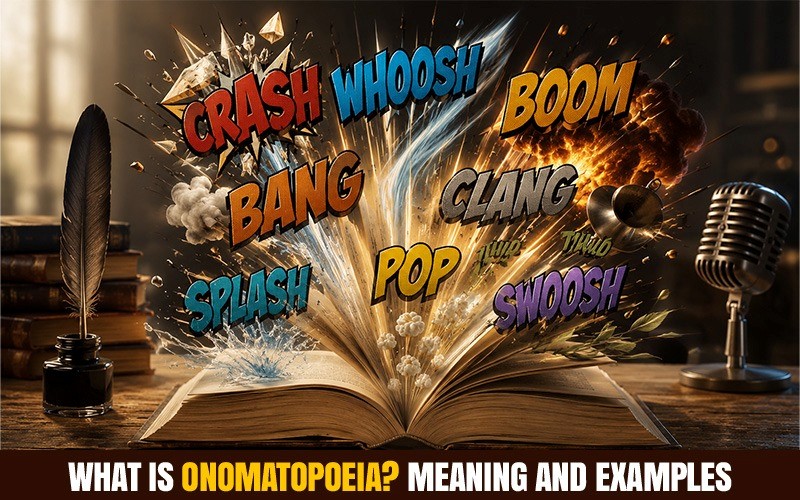
Onomatopoeia is a literary device in which a word imitates, suggests, or recreates the sound connected to it. Words such as buzz, hiss, boom, crash, and splash help readers hear what is happening rather than simply being told about it.
The word may sound complicated, but the idea is simple. Onomatopoeia turns a sound into language. When a writer uses the word sizzle, readers can imagine food cooking in a hot pan. When they read thump, they can almost feel a heavy object striking the ground. These sound words create a connection between the written page and the reader’s senses.
In simple terms, onomatopoeia turns sound into visible language. If a writer says, “The branches moved in the wind,” the image is clear. But if they write, “The branches rustled in the wind,” the sentence gains movement, texture, and sound. The reader can picture the leaves shifting and hear the breeze passing through them.
Many familiar onomatopoeia examples come from daily life. A phone can beep. A dog may bark. Bacon can sizzle in a hot pan. A heavy book might thud onto a desk. A car engine may vroom, a clock may go tick-tock, and a glass may clink during a toast. Because these sounds are familiar, they help readers enter a scene quickly.
Writers often use onomatopoeia examples in literature to create a stronger atmosphere. A drip in an empty house can feel eerie. A sudden bang may signal danger. A soft murmur can make a romantic or secretive scene feel intimate. The sound itself is simple, but its emotional effect depends on the context around it.
This is why onomatopoeia in fiction is useful in so many genres. In a thriller, the creak of a staircase may build suspense. In a fantasy adventure, a dragon may roar overhead. In a children’s book, a character may fall with a playful kerplunk. Even realistic literary fiction can use a small sound, such as a spoon that clinks against a cup, to make a moment feel personal and real.
Not every sound word has to be loud or dramatic. Gentle sounds such as flutter, whisper, hum, and tinkle can be just as effective. The goal is not to fill every paragraph with noise. It is to choose the sound that helps the reader step further into the world of the story.
100 Onomatopoeia Examples in Poetry, Fiction, and Everyday Storytelling
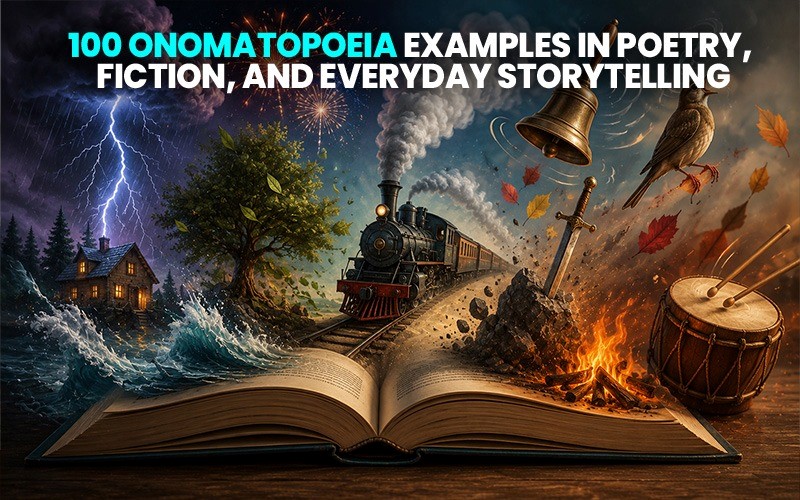
Below are 100 onomatopoeia examples grouped by the kinds of sounds they represent. Each can add energy, atmosphere, or emotional detail when used in the right moment.
Animal Sounds
- Bark: The dog began to bark at the unfamiliar car.
- Meow: A kitten’s meow came from beneath the porch.
- Moo: Cows mooed across the quiet field.
- Growl: The lion gave a low growl.
- Chirp: Birds chirped before sunrise.
- Buzz: A bee buzzed around the bright flowers.
- Hiss: The cat gave a warning hiss.
- Croak: Frogs croaked beside the pond.
- Quack: Ducks quacked as they crossed the water.
- Neigh: The horse neighed from its stable.
- Caw: A crow cawed from the bare tree branch.
- Purr: The cat began to purr beside the fire.
- Bleat: Lambs bleated in the nearby field.
- Howl: Wolves howled beneath the moon.
- Oink: The pig gave a cheerful oink at feeding time.
Nature and Weather Sounds
- Drip: Water began to drip from the leaking faucet.
- Splash: The child landed with a loud splash.
- Whoosh: The wind whooshed through the open doorway.
- Rumble: Thunder rumbled in the distance.
- Rustle: Dry leaves rustled beneath her feet.
- Patter: Rain began to patter against the roof.
- Crackle: The firewood crackled in the fireplace.
- Gurgle: Water gurgled through the broken pipe.
- Swoosh: Waves swooshed along the shoreline.
- Whistle: The wind whistled around the old house.
- Plop: A raindrop fell with a soft plop into the puddle.
- Plunk: The stone dropped into the pond with a plunk.
- Roar: The waterfall gave a constant, powerful roar.
- Fizzle: The last spark began to fizzle in the rain.
- Thwack: A branch hit the window with a sudden thwack.
These nature and weather sound words are especially useful in poetry when writers want readers to hear the landscape and sense a setting’s mood.
Human Sounds
- Giggle: The children began to giggle behind the curtain.
- Sigh: He gave a long, tired sigh.
- Cough: A sharp cough interrupted the speech.
- Sniff: She gave a quiet sniff and wiped her eyes.
- Gasp: The audience let out a collective gasp.
- Murmur: A murmur moved through the crowded room.
- Whisper: Her whisper was almost impossible to hear.
- Groan: The old man let out a painful groan as he sat down.
- Yawn: He tried to hide a wide yawn.
- Chuckle: Her grandfather responded with a warm chuckle.
- Sneeze: A loud sneeze broke the silence.
- Sob: She tried to speak through a small sob.
- Hum: He hummed while preparing dinner.
- Mumble: The boy began to mumble an apology.
- Gulp: She took a nervous gulp before answering.
Objects and Machine Sounds
- Click: The lock gave a small click before the door opened.
- Beep: The microwave gave a quick beep.
- Clang: A metal tray fell with a heavy clang.
- Clatter: Dishes clattered in the kitchen.
- Whir: The printer began to whir into life.
- Tick-tock: The clock’s tick-tock filled the silent room.
- Ding: The elevator arrived with a soft ding.
- Jingle: Keys jingled in his pocket.
- Rattle: The window began to rattle in the storm.
- Screech: Brakes screeched across the wet road.
- Honk: A car horn gave an impatient honk.
- Vroom: The motorcycle went vroom down the street.
- Chug: The old engine chugged up the hill.
- Whine: The machine gave a high, strained whine.
- Creak: The staircase creaked beneath each step.
Action and Impact Sounds
- Bang: The door slammed with a loud bang.
- Crash: A glass vase hit the floor with a crash.
- Thud: The suitcase landed with a dull thud.
- Smack: The ball hit the wall with a smack.
- Whack: The bat connected with a solid whack.
- Pop: The balloon burst with a sudden pop.
- Snap: A twig snapped under his shoe.
- Crunch: The snow crunched beneath their boots.
- Slam: The angry teenager slammed the bedroom door.
- Clunk: The heavy lid shut with a clunk.
- Zap: “Zap!” A spark jumped from the damaged wire.
- Bump: Something went bump in the hallway.
- Smash: The window broke with a violent smash.
- Kerplunk: The stone fell kerplunk into the well.
- Thump: Music thumped through the walls.
These are some of the most recognizable onomatopoeia examples in literature, particularly in mysteries, adventure stories, thrillers, comics, and children’s books.
Food and Household Sounds
- Sizzle: Onions began to sizzle in the pan.
- Slurp: He took a noisy slurp of soup.
- Munch: He munched the crisp apple loudly.
- Fizz: The drink began to fizz as it was poured.
- Burble: The sauce burbled gently in the pan.
- Clink: Glasses clinked during the toast.
- Swish: Laundry swished around in the washing machine.
- Glug: Oil glugged from the bottle over the warm bread.
- Sputter: The frying oil sputtered around the onions.
- Scrape: A spoon scraped against the bottom of the pan.
Comic-Book and Dramatic Sounds
- Pow: The comic-book hero struck with a bold “Pow!”
- Wham: “Wham!” The two cars collided at the intersection.
- Boom: An explosion shook the ground with a boom.
- Kaboom: “Kaboom!” The final firework burst in a blaze of color.
- Bam: “Bam!” The villain struck the table with his fist.
- Zoom: The racing car went zoom around the corner.
- Zing: An arrow flew past with a quick zing.
- Biff: “Biff!” The hero’s punch sent the villain stumbling backward.
- Ka-ching: “Ka-ching!” The cash register rang as the sale was completed.
- Whoop: The crowd gave a joyful whoop.
These dramatic choices show how onomatopoeia in fiction can speed up action and make a scene feel visual, immediate, and entertaining.
Quiet and Subtle Sounds
- Flap: The curtains flapped in the evening breeze.
- Tap: A soft tap came from the window.
- Psst: Someone whispered, “Psst, over here.”
- Shh: “Shh,” she said as footsteps passed the door.
- Tinkle: Wind chimes gave a light tinkle in the garden.
The most effective onomatopoeia examples are not always the loudest ones. Often, the quiet tap, psst, or tinkle is what makes a scene feel intimate, tense, or unforgettable.
Using Onomatopoeia in Fiction Without Overdoing It
Used well, onomatopoeia in fiction gives a scene movement and presence. A simple click can make a locked door feel suspicious. A scrape outside a bedroom window can create fear before the reader even knows what caused it. A crash can instantly change the pace of a peaceful chapter.
The key is to use sound words where they genuinely add something. In a fast-moving scene, direct sounds such as bang, thud, snap, and screech can make the action feel immediate. In a quieter scene, softer choices such as drip, murmur, rustle, or creak can build atmosphere more slowly.
Strong onomatopoeia examples are usually woven into a sentence instead of being added only for effect. For example:
- The hallway fell silent, except for the slow drip, drip, drip from the leaking ceiling.
The repetition gives the sound greater weight. It can make readers feel the character’s tension, discomfort, or fear while waiting.
When using onomatopoeia in fiction, consider the genre and tone of the story. A graphic novel or children’s adventure may welcome energetic words like pow, wham, and kaboom. A literary novel may use subtler sounds, allowing a hiss of rain or a clink of glass to carry emotional meaning. In suspense fiction, a single click from a dark room can often be more unsettling than a page full of loud sound effects.
Writers should also avoid repeating the same sound too often. If every door slams, every character sighs, and every object crashes, those sounds lose their impact. The best onomatopoeia examples in literature feel chosen for a particular moment, character, setting, or emotion.
How Writers Can Create Stronger Sound Effects on the Page
Great sound writing begins with attention. Listen closely to the world around you: traffic hums, kettles whistle, trees rustle, shoes scuff, and rain may tap or hammer depending on its strength. Real observation helps writers choose sounds that feel believable rather than forced.
The most effective sound words do more than name a noise. They help readers understand the moment. A clatter in a busy café can make a scene feel lively and crowded. The same clatter in an empty house at midnight can feel alarming. Context gives onomatopoeia its emotional power.
Here are a few simple ways to use sound words more effectively:
- Choose a specific sound instead of a general one. A clatter creates a different image from a clink, while a thud feels very different from a crash.
- Match the sound to the mood. A crackle may feel cozy beside a fire but threatening during a wildfire. A whisper can be romantic, secretive, or frightening depending on the scene.
- Read the sentence aloud. If the rhythm feels awkward, the sound word may not belong there. Sound words should fit naturally into the flow of the sentence.
- Let the surrounding details support the sound. A creak becomes stronger when readers know the house is old, empty, and dark.
- Avoid using the obvious sound every time. Instead of writing that a door slammed in every angry scene, consider whether it banged, clicked shut, or shuddered in its frame.
- Use silence as well as noise. A quiet room can become more tense when one small sound breaks through it, such as the tick-tock of a clock or the drip of a tap.
Writers can also use sound to reveal character. A nervous person may gulp before speaking, while someone impatient may tap their fingers against a table. A cheerful character might hum while working, whereas a frightened person may hear every snap of a twig in the dark. These details help readers understand emotion without the writer needing to explain it directly.
Understanding how onomatopoeia works also helps writers see how sound can shape pace. Short, sharp words such as bang, crack, pop, and zap can make an action scene feel fast. Longer or softer sounds such as murmur, whisper, rustle, and sizzle tend to slow the rhythm and encourage readers to linger in a moment.
The strongest onomatopoeia examples make readers hear a scene while also helping them feel its mood, tension, energy, or emotion. At America Publishers Author Spotlight, readers can find thoughtful discussions of the literary techniques that give stories their depth and character. From the rhythm of poetry to the small sounds that build atmosphere in fiction, these elements show how carefully chosen language can make a written moment feel real.
Frequently Asked Question
-
What are 10 common onomatopoeia examples?
Common onomatopoeia examples include buzz, hiss, bang, crash, splash, pop, crackle, roar, whisper, and thud. Each word imitates or suggests a sound connected to an action, object, person, animal, or setting. These simple words are useful because they make descriptions more sensory and immediate.
-
What is the difference between onomatopoeia and alliteration?
Onomatopoeia imitates or suggests an actual sound, such as buzz, hiss, or sizzle. Alliteration repeats the same beginning sound in nearby words, such as “wild winds whispered.” Writers may use both techniques together, but onomatopoeia focuses on recreating sound, while alliteration focuses on repetition and rhythm.
-
What are some onomatopoeia examples in poetry?
Popular onomatopoeia examples in poetry include rustle, murmur, crackle, pitter-patter, splash, and whisper. Poets use these sounds to create rhythm and help readers hear the world of the poem. A poem about the sea, for example, may use swoosh, crash, and roar to make waves feel more present.
-
How is onomatopoeia used in literature?
Writers use onomatopoeia examples in literature to create atmosphere, add pace to action, and descriptions more vivid. A mystery may use a creak or tap to build suspense, while a children’s story may use splash, boing, and pop to create fun and energy. Sound words can also reveal a character’s mood or make a setting feel more realistic.
-
Can onomatopoeia be used in formal writing?
Yes, but it should suit the purpose and audience. Onomatopoeia is most common in creative writing, storytelling, poetry, dialogue, comics, and advertising. In formal academic or business writing, it is usually best used sparingly unless the writing specifically discusses onomatopoeia or sound-based language.
Conclusion
Sound gives writing another layer of life. From a quiet whisper to a sudden boom, the right word can make readers pause, picture the scene, and feel closer to the action.
The best onomatopoeia examples in poetry create rhythm, atmosphere, and emotional texture. A poet may use the soft patter of rain to create calm, or the harsh crash of waves to reflect fear and conflict. In the same way, onomatopoeia in fiction can sharpen tension, deepen a setting, and make characters feel more real.
Writers do not need to fill every paragraph with sound words. One well-chosen creak in a silent hallway or one sudden smash at the height of an argument can be far more powerful than several noisy details competing for attention. The aim is always to make the sound feel earned by the scene.
When used thoughtfully, onomatopoeia examples in literature help stories stay with readers long after they finish the page. A reader may forget a description of a storm, but they may remember the rumble of thunder, the whoosh of wind, and the drip of rain from the roof.
