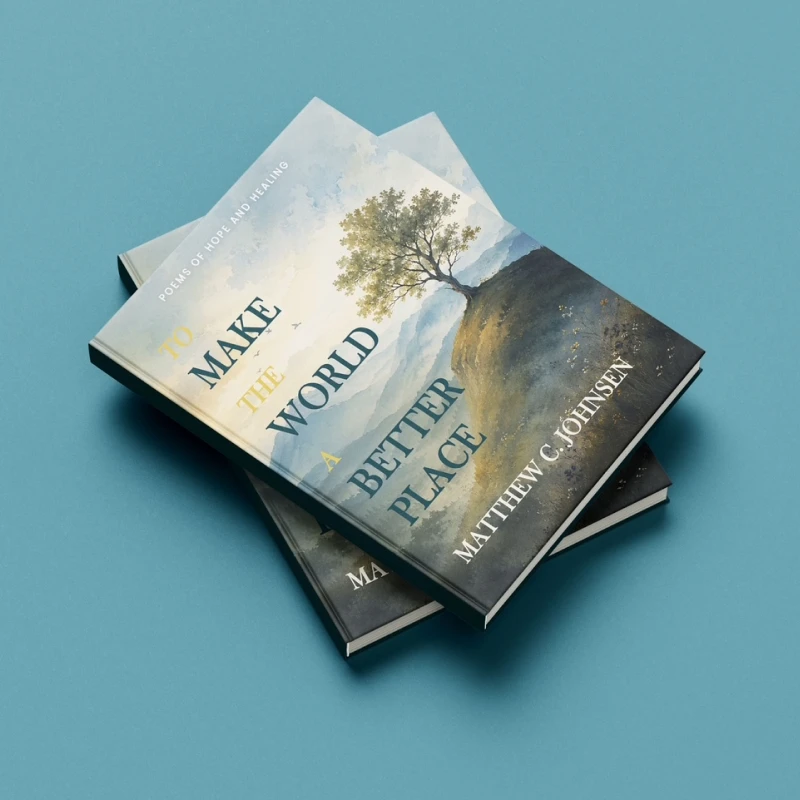
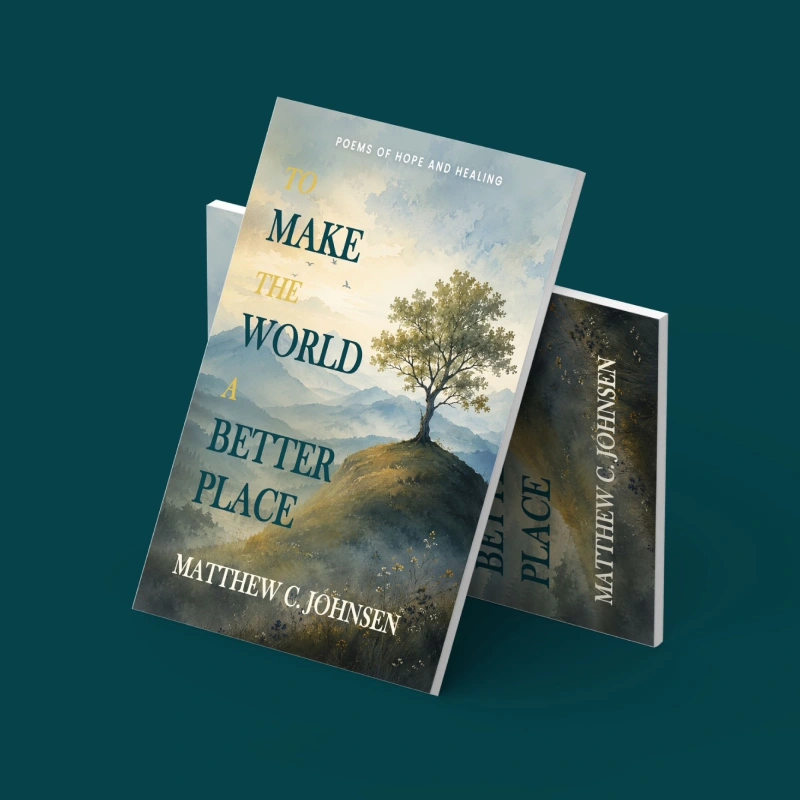
There are books that ask readers to escape the world for a while, and there are books that encourage readers to look at the world around them more carefully. Dr. Matthew C. Johnsen’s work belongs to the latter category. With a background in sociology, peacebuilding, music direction, and public engagement, Johnsen brings together interests that cross the boundaries between individual experience and wider society. His work reflects an ongoing interest in how people understand one another, participate in their communities, and respond to the world they share. This combination of social awareness, creative expression, and public engagement provides important context for understanding To Make the World a Better Place: Poems of Hope and Healing, a collection that approaches questions of hope, connection, responsibility, and change through poetry.
Dr. Matthew C. Johnsen, Ph.D., wrote To Make the World a Better Place: Poems of Hope and Healing from a perspective shaped by sociology, peacebuilding, music, and public engagement. He is Professor Emeritus of Sociology at Worcester State University, a Rotary Peace Fellow Alumnus who studied peace and conflict resolution at Chulalongkorn University in Bangkok, Thailand, and music director of the Unitarian Universalist Church of Worcester. He also co-founded Peace Choir Worcester, which sings at gatherings to promote peace and solidarity. This background helps explain the collection’s central purpose: to address issues of social consequence through an accessible creative form. Rather than keeping questions about peace, unity, equality, responsibility, and social change within academic writing alone, Johnsen uses poetry to bring them into public reflection and everyday conversation.
At its heart, To Make the World a Better Place is a contemporary poetry collection that brings together poetry, social observation, sociology, and social science. The book places ordinary experiences alongside larger concerns, moving from reflections on morning light, music, seasons, friendship, nature, faith, ageing, recovery, and everyday life toward questions of purpose, equality, justice, peace, and responsibility. The book is not limited to one subject or emotional register. Its scope allows intimate and contemplative moments to exist alongside poems concerned with society and the ways people relate to one another. The result is a social science poetry book that makes broad social ideas approachable through personal and imaginative expression instead of academic terminology.
That accessibility matters because many of the issues addressed by the collection are issues people encounter beyond classrooms, journals, and formal discussions. Questions surrounding community, inclusion, peace, equality, human connection, and responsibility can feel abstract when considered only as social concepts. Poetry can bring those questions closer to lived experience.
Through its reflections on ordinary moments and larger social concerns, the collection explores how awareness can begin with paying attention to ourselves, other people, nature, and the circumstances we share. This makes poetry addressing societal challenges a useful way to describe the collection’s broader direction without suggesting that it provides research findings or formal policy recommendations. Instead, Johnsen’s poetry creates an accessible space in which readers can consider how social realities connect with everyday choices.
The book’s underlying question is especially clear in its invitation to think about what individuals can contribute to a better future. Poetry about social change does not necessarily need to prescribe a particular solution. It can also ask readers to reconsider how they see their responsibilities and relationships.
Johnsen’s collection repeatedly returns to awareness, compassion, connection, and thoughtful action, linking personal reflection with collective life. Its engagement with current events and wider societal challenges works less as a catalogue of controversies and more as an invitation to remain attentive to the world.
In this way, poetry about current events can become poetry about the human response to a changing world: how people reflect, how they relate to one another, and how individual choices can contribute to broader conditions.