
Published on September 21, 2026
The most memorable Flashback Examples do something almost unfair: they reveal one missing moment from the past and suddenly change everything you believed about the story.
A photograph slips from a drawer. A familiar song begins to play. A character hears a name they hoped never to hear again. Within seconds, the present falls away, and you are watching the secret, loss, mistake, or promise that has been shaping the character all along. But why do some flashbacks feel powerful while others seem like interruptions?
The answer is not simply what they show, but why the story chooses that exact moment to show it.
In this guide, we will explore 100 Flashback Examples from literature, movies, television, and original scenes. These examples of flashbacks will help you recognize the technique, understand what each return to the past accomplishes, and use it without confusing your audience. Some entries reveal important plot developments, so expect occasional spoilers as we uncover how storytellers make the past matter in the present.
What Is a Flashback in Storytelling?
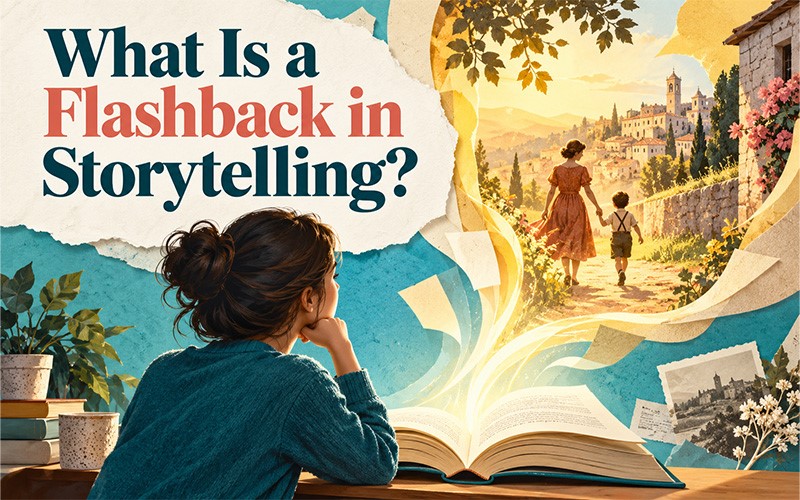
A flashback is a scene that takes the audience from the story’s current timeline to an event that happened earlier. It might last for a single paragraph, occupy an entire chapter, or unfold across several scenes before the narrative returns to the present. The literary term for this movement into the past is analepsis.
However, not every mention of an earlier event qualifies as a flashback. Backstory provides information about the past, while a memory may appear only as a passing thought. A true flashback allows readers or viewers to experience an earlier moment instead of receiving a simple summary. This distinction is especially important when examining flashback in literature, where changes in tense, narration, and viewpoint can make the timeline less obvious.
A flashback reveals something that has already happened, while foreshadowing examples point readers toward something that may happen later. Frame narratives and nonlinear plots are related techniques, but they are not automatically flashbacks. A frame narrative places one story inside another, while a nonlinear narrative presents events outside chronological order. Some stories combine all three.
The Flashback Examples in this guide will identify both the movement into the past and its narrative purpose. Comparing different Flashback Examples also reveals that length is not the defining feature. What matters is whether the story leaves its established present to revisit an earlier event. That shared movement connects the many examples of flashbacks found across books, movies, and other forms of storytelling.
Why Do Writers Use Flashbacks?
Writers rarely move backward in time without a reason. A flashback can reveal why someone fears a particular place, why two friends no longer speak, or why an ordinary object carries unexpected emotional weight. Rather than explaining those facts from a distance, the writer allows the audience to witness the defining moment.
Flashbacks can also control suspense. A story may hide part of an event and return to it only when the missing detail can challenge everything the audience believes. In other cases, the past creates dramatic irony: readers recognize a danger or connection that the character has not yet understood.
The method can change with the medium. A flashback in literature may use tense, narrative voice, or a sensory association to move through time. A flashback in movies can rely on editing, sound, color, or a visual match between past and present. Neither approach succeeds simply because it appears clever. The earlier scene must change the meaning or stakes of the current one.
As you examine the upcoming Flashback Examples, ask one question: What becomes clearer, stranger, or more urgent because the story looked backward? Later, the original flashback writing examples will turn that question into a practical test you can apply to your own scenes.
100 Flashback Examples from Books, Movies and Storytelling
The following Flashback Examples show how differently storytellers can use the past. Some reveal a single hidden moment; others reconstruct years of a character’s life. Most entries contain conventional flashbacks, while several demonstrate related forms such as framed recollection, retrospective narration, or parallel timelines. These related structures are identified explicitly and should not be mistaken for conventional flashbacks.
Rather than simply naming titles, each entry explains what the return to the past contributes. This makes the list useful for readers studying examples of flashbacks and for writers deciding whether their own stories genuinely need one.
Flashback Examples in Literature
A flashback in literature can unfold through narration, dialogue, dreams, sensory triggers, or an object connected to the past. In some novels, the main narrative is itself a recollection framed by a character speaking from a later point in life.
- The Odyssey by Homer: Odysseus recounts his earlier adventures, revealing how he became stranded far from Ithaca.
- Wuthering Heights by Emily Brontë: Nelly Dean’s recollections uncover the history behind Heathcliff and Catherine’s destructive relationship.
- Frankenstein by Mary Shelley: Victor’s account takes Robert Walton back through the creation of the creature and its consequences.
- The Great Gatsby by F. Scott Fitzgerald: Gatsby’s past with Daisy explains the dream driving his present behavior.
- Beloved by Toni Morrison: Fragmented returns to Sweet Home gradually expose trauma the characters cannot leave behind.
- Death of a Salesman by Arthur Miller: Willy Loman slips into earlier family scenes as memory and reality begin to merge.
- The Sound and the Fury by William Faulkner: Uncontrolled memories reveal the Compson family’s decline through fractured personal perspectives.
- Catch-22 by Joseph Heller: Repeated returns to earlier wartime events gradually disclose their complete meaning.
- To Kill a Mockingbird by Harper Lee: Through retrospective narration rather than isolated flashback scenes, an older Scout reconstructs the childhood events that shaped her moral awareness.
- The Catcher in the Rye by J.D. Salinger: From a later point in his life, Holden retrospectively recounts the experiences surrounding his emotional struggles, making the novel an extended framed recollection.
- Their Eyes Were Watching God by Zora Neale Hurston: Janie tells Pheoby the story of her marriages and search for independence.
- Rebecca by Daphne du Maurier: The narrator looks back on Manderley and the secrets surrounding Maxim’s first wife.
- A Separate Peace by John Knowles: Gene returns to his school years and confronts his complicated bond with Finny.
- The Kite Runner by Khaled Hosseini: Amir’s childhood memories reveal the betrayal underlying his adult guilt.
- Never Let Me Go by Kazuo Ishiguro: Kathy’s recollections slowly uncover the disturbing reality of her upbringing.
- The Remains of the Day by Kazuo Ishiguro: Stevens revisits his years of service and recognizes the emotional cost of restraint.
- Water for Elephants by Sara Gruen: An elderly Jacob remembers his turbulent life with a traveling circus.
- The Handmaid’s Tale by Margaret Atwood: Offred recalls life before Gilead, contrasting freedom with present oppression.
- The Road by Cormac McCarthy: The father’s memories preserve glimpses of the world before its destruction.
- Nineteen Eighty-Four by George Orwell: Winston’s dreams and recollections reconnect him with his mother and a lost past.
- The Things They Carried by Tim O’Brien: Recurring memories revisit Vietnam from changing emotional and narrative angles.
- The English Patient by Michael Ondaatje: Almásy’s memories return to North Africa, gradually revealing his relationship with Katharine and the decisions behind his injuries.
- Holes by Louis Sachar: Historical sections reveal how past injustice created the present-day curse and conflict.
- Harry Potter and the Half-Blood Prince by J.K. Rowling: Pensieve memories uncover Tom Riddle’s transformation into Voldemort.
- The Hunger Games by Suzanne Collins: Katniss remembers Peeta giving her bread during a desperate period in her childhood.
- Mrs Dalloway by Virginia Woolf: Clarissa’s present-day experiences repeatedly awaken memories of Bourton and Sally Seton.
- The Joy Luck Club by Amy Tan: Mothers revisit their lives in China, giving their daughters’ struggles deeper context.
- The Lovely Bones by Alice Sebold: Susie remembers moments from her life while observing her grieving family.
- The God of Small Things by Arundhati Roy: Rahel’s return to Ayemenem repeatedly takes the narrative back to the childhood events surrounding Sophie Mol’s death, gradually revealing the family tragedy.
- Great Expectations by Charles Dickens: The novel uses retrospective autobiography rather than recurring conventional flashbacks, with an older Pip narrating and reassessing his younger life.
- Jane Eyre by Charlotte Brontë: Jane tells her life story retrospectively; this sustained first-person recollection differs from a brief flashback interrupting an established present-day plot.
- David Copperfield by Charles Dickens: David’s retrospective autobiography recounts the people and hardships that formed his identity, rather than presenting the past through separate conventional flashbacks.
- Heart of Darkness by Joseph Conrad: Marlow’s framed narration transports his listeners into his earlier journey through the Congo.
- Absalom, Absalom! by William Faulkner: Competing recollections reconstruct the Sutpen family history without offering easy certainty.
- Big Little Lies by Liane Moriarty: After introducing the aftermath of trivia night, the novel moves six months backward and uses later police interviews to build suspense.
These Flashback Examples demonstrate an important point: a flashback in literature may be brief and unmistakable, or it may operate inside a larger retrospective structure. Accuracy depends on examining how the timeline is framed, not merely noticing that past events are discussed.
Flashback Examples in Movies
A flashback in movies can begin with dialogue, music, an object, a match cut, or a sudden visual disruption. Film can also distinguish the past through color, sound, aspect ratio, costume, and editing.
- Citizen Kane: Testimony from Kane’s acquaintances reconstructs his life through conflicting memories.
- Casablanca: Rick remembers his romance with Ilsa in Paris before learning why she left.
- The Godfather Part II: Parallel storylines contrast Vito Corleone’s rise with Michael’s moral decline, while the final family dinner flashback reveals how far Michael has become separated from the person he once was.
- Titanic: Elderly Rose’s recollection carries the audience back to the ship’s doomed voyage.
- Forrest Gump: Forrest narrates earlier chapters of his life to strangers at a bus stop.
- Goodfellas: Henry Hill’s narration looks back on his attraction to organized crime.
- Rashomon: Several witnesses revisit the same incident, producing incompatible versions of the truth.
- Sunset Boulevard: Joe Gillis narrates the circumstances that led to his death.
- It’s a Wonderful Life: Clarence observes George Bailey’s past to understand his present despair.
- The Bourne Identity: Fragmented memories of a failed assassination gradually help Bourne reconstruct his identity and former mission.
- Eternal Sunshine of the Spotless Mind: Joel moves through collapsing memories while trying to preserve his relationship with Clementine.
- Manchester by the Sea: Sudden scenes from Lee’s past gradually reveal the source of his grief.
- Ratatouille: One taste returns Anton Ego instantly to a comforting moment from childhood.
- Toy Story 2: Jessie’s memories explain her fear of being abandoned by another owner.
- Finding Dory: Fragmented childhood images help Dory recover information about her missing parents.
- Kung Fu Panda 2: Po’s memories reveal what happened to his family and why he was adopted.
- Batman Begins: Bruce Wayne revisits his childhood fear and the murder of his parents.
- The Lion King: Simba’s memories of his father Mufasa and the events surrounding his death shape his understanding of his past and influence his decision to return home.
- Iron Man 3: Tony’s panic attacks produce intrusive memories of the Battle of New York, connecting his present anxiety to the trauma he experienced during the alien invasion.
- Spider-Man 3: A later reconstruction of Uncle Ben’s death reveals Flint Marko’s involvement and changes Peter’s understanding of the crime.
- The Prestige: Angier and Borden’s diaries repeatedly take the audience into earlier events while each magician manipulates the other’s understanding.
- Harry Potter and the Deathly Hallows—Part 2: Snape’s memories completely reframe his loyalties and sacrifices.
- The Lord of the Rings: The Two Towers: Gandalf recounts his battle with the Balrog and subsequent return.
- Kill Bill: Volume 1: The Bride’s memories reveal the violence that began her mission for revenge.
- Reservoir Dogs: Earlier scenes expose the relationships and betrayals behind the failed robbery.
- Pulp Fiction: Adult Butch awakens from a childhood memory or dream in which Captain Koons explains the gold watch’s history, establishing why the object later matters so deeply to him.
- Memento: Its main scenes run in reverse order, while brief memory images revisit Sammy Jankis and the attack that damaged Leonard’s memory.
- The Usual Suspects: Verbal Kint’s account visualizes a past that may be deliberately fabricated.
- Fight Club: Revisited scenes expose what the narrator misunderstood about Tyler Durden.
- Slumdog Millionaire: Each question triggers an earlier experience that explains how Jamal knows the answer.
- The Social Network: Deposition testimony sends the film back through the creation of Facebook and its disputes.
- The Notebook: Noah and Allie’s earlier relationship unfolds through a story read in the present.
- The Green Mile: Elderly Paul remembers John Coffey and the events that transformed his life.
- Saving Private Ryan: The present-day cemetery sequence frames an extended narrative return to the Second World War. This is a structural flashback rather than Ryan’s literal memory, since he did not witness most of Captain Miller’s mission.
- The Grand Budapest Hotel: Nested recollections trace the hotel and its owner through several historical periods.
These examples of flashbacks also show why terminology matters. Not every flashback in movies functions as an isolated memory scene. Some films place flashbacks within testimony, while others organize most of the narrative as a retrospective account. The strongest flashback examples still share one result: the past changes how we interpret the present.
Flashback Examples in Television
Television can spread revelations across episodes or seasons, allowing an earlier event to acquire new meaning each time it returns.
- Lost: Character-centered flashbacks reveal who the survivors were before the crash.
- This Is Us: Shifting timelines connect childhood experiences with the Pearson siblings’ adult lives.
- Orange Is the New Black: Inmate flashbacks challenge first impressions by revealing lives before prison.
- Arrow: Oliver’s island experiences unfold beside the consequences he faces years later.
- Once Upon a Time: Fairy-tale histories explain the identities and conflicts hidden within Storybrooke.
- Better Call Saul: Flashbacks to Jimmy’s relationship with Chuck—including their night singing karaoke together, reveal the affection beneath their later hostility and make Jimmy’s transformation more tragic.
- Breaking Bad: Selected returns to the past reveal relationships and decisions preceding Walter’s criminal rise.
- The Handmaid’s Tale: June’s memories contrast her former family life with captivity in Gilead.
- Yellowjackets: Although its principal 1996 and adult narratives are parallel timelines rather than flashbacks, shorter flashbacks, such as Lottie’s childhood experiences, reveal trauma that predates the wilderness ordeal.
- Westworld: Dolores experiences past events as present reality, reflecting her manipulated consciousness.
- The Haunting of Hill House: Childhood scenes reveal how one traumatic night damaged the Crain siblings.
- Mad Men: Don Draper’s memories gradually expose the identity and poverty he escaped.
- Dexter: Childhood recollections explain Dexter’s trauma and Harry’s influence over his moral code.
- BoJack Horseman: Returns to BoJack’s upbringing reveal patterns of neglect behind his adult behavior.
- Stranger Things: Eleven’s recovered laboratory memories disclose her history with Dr. Brenner and the Upside Down.
Original Flashback Writing Examples
The following short scenes demonstrate everyday triggers writers can adapt without copying an existing story.
- A scent: Burnt cinnamon fills the kitchen, and Mara is twelve again, crawling through smoke as the bakery burns.
- A photograph: Eli touches the faded photograph, and the story returns to the afternoon his father introduced the mysterious stranger.
- A song: As the wedding band begins playing, Nina relives the last dance she shared with her missing sister.
- A scar: Daniel traces the mark on his arm, returning to the moment his friend pulled him from the river.
- A location: Priya enters the empty classroom, and the accusations that ended her career unfold around her again.
- An object: When Leo winds the cracked watch, he returns to his grandfather’s final unfinished warning.
- A voice: The caller repeats a familiar greeting, carrying Amira back to the conversation she tried to forget.
- A taste: One spoonful of soup returns Tomas to his childhood kitchen as his mother prepares to leave.
- A nightmare: A siren wakes the witness, and the narrative returns to the accident, revealing the face she omitted from her statement.
- An anniversary: Fireworks explode overhead, and Ben is transported back to the night his military unit was ambushed.
- A reunion: At the sight of his former teammate, Marcus relives the deliberate mistake that cost them the championship.
- A letter: As Maya reads the unfamiliar handwriting, the story returns to the night she hid a message beneath the floorboards.
- A physical reaction: The elevator stops, and Lena is eight again, trapped underground and calling for help.
- A repeated phrase: Hearing his teacher’s old warning sends the detective back to the first time the suspect told his story.
- A returned possession: Ava clasps the missing necklace, and the narrative returns to the morning her mother vanished.
Together, these flashback examples demonstrate how a small present-day trigger can open a meaningful door into the past. The original flashback writing examples also provide a useful rule: choose a trigger that belongs naturally in the current scene and connects directly to the memory being revealed.
How to Write a Flashback That Feels Natural
Before writing the past, establish what is happening now. Readers need a firm sense of the current setting, goal, or conflict so they can recognize the temporal shift. Then decide what the flashback must accomplish. If it does not alter the reader’s understanding, increase tension, or affect a decision in the present storyline, it may belong in a sentence of backstory instead.
A natural transition often begins with something concrete: a smell, sound, object, location, physical sensation, or line of dialogue. The trigger should create an emotional connection rather than behave like a mechanical signal. Writers can explore these sensory language examples to see how sight, sound, smell, taste, and touch can make a transition into the past feel immediate.
Consider this basic version:
Lena entered the hospital and remembered visiting her father there years ago.
Now compare it with one of the more immersive flashback writing examples:
The sharp smell of disinfectant stopped Lena beside the reception desk.
At sixteen, she stood beneath those same white lights, crushing the sleeve of her sweater inside her fist.
“I’m sorry,” the doctor said. “We did everything we could.”
A telephone rang at the reception desk. Lena blinked, and the hospital returned around her.
The second version gives the transition a sensory cause and enters the significant moment directly. Once inside the past, avoid explaining everything that happened before and after it. Show only the part that changes the present scene.
When returning, use another clear anchor: the same sound, an interrupted action, or someone calling the character’s name. The strongest Flashback Examples make both movements easy to follow. Good flashback writing examples do not leave readers wondering when they are. They leave readers reconsidering what the present moment means.
Common Flashback Mistakes to Avoid
The biggest mistake is using a flashback only because the author wants to explain a character’s history. Information alone is not enough. The past must create movement in the current story.
Other problems include entering the flashback before readers understand the present, interrupting an urgent scene with unrelated history, repeating facts already established, changing tense inconsistently, and staying in the past longer than the revelation requires.
Writers should also avoid obvious transitions such as “she began to remember” every time the timeline changes. A meaningful sensory or emotional connection usually feels more natural.
Finally, do not treat confusion as sophistication. Readers can enjoy uncertainty about what an event means, but they should not be accidentally confused about when it occurs. Effective Flashback Examples create discovery, tension, or emotional recognition—not unnecessary timeline repair.
America Publishers Author Spotlight regularly explores the techniques, ideas, and creative choices that shape memorable books and stories. Through accessible literary resources, the platform helps readers and writers examine storytelling with greater clarity.
Conclusion
Flashbacks are not simply pauses that explain what happened before. At their best, they create a conversation between past and present, showing how an earlier choice, relationship, loss, or discovery continues to shape the story.
The 100 flashback examples in this guide demonstrate that the technique can occupy one sentence, an entire chapter, or much of a film. Length is less important than purpose. Every return to the past should reveal something meaningful, affect the current conflict, or change how the audience understands a character. If removing the scene changes nothing, the information probably belongs in concise backstory instead.
Frequently Asked Question
-
What is a simple example of a flashback?
A woman opens an old suitcase and finds her childhood uniform. The story then shifts to her first day at school, revealing why she has avoided returning home. Simple examples of flashbacks use an understandable present-day trigger and one relevant past event.
-
What is the difference between a flashback and a memory?
A memory may be mentioned briefly through a character’s thoughts. A flashback dramatizes the earlier event as a scene, allowing the audience to experience it. The distinction can blur when a vivid memory includes action, dialogue, setting, and a clear shift in time.
-
What is the purpose of a flashback in literature?
A flashback in literature can reveal motivation, explain conflict, deepen characterization, create suspense, or change the meaning of a present event. Its purpose is not merely to provide history. The earlier scene should influence how readers understand what is happening now.
-
How is a flashback shown in movies?
A flashback in movies may be introduced through a cut, voice-over, sound bridge, altered color palette, visual match, or sensory trigger. Filmmakers do not always use obvious effects. Context, costume, setting, and character age can establish the change in time naturally.
-
Can a story begin with a flashback?
Technically, the opening scene usually establishes the story’s first active timeline. It becomes a flashback only after the narrative moves forward and identifies a later present. Some Flashback Examples therefore begin as prologues or framed recollections rather than conventional interruptions of an established timeline.
-
How do you transition into and out of a flashback?
Use a meaningful connection between the two periods, such as a sound, smell, object, image, or repeated phrase. Strong flashback writing examples also provide a clear return signal. This might be an interrupted action, a changed sound, or another character bringing the viewpoint character back to the present.