


Table Of Content
- What Is Sensory Language, and Why Does It Matter?
- 100 Sensory Language Examples for Sight, Sound, Smell, Taste, and Touch
- From Plain to Vivid: How Sensory Details Transform a Sentence
- How to Use Sensory Language Without Overwriting
- Common Sensory-Writing Mistakes and a Quick Revision Checklist
- Conclusion
- FAQs
Published on September 2, 2026
Sensory language examples can make readers hear rain striking a window, taste the bitterness of burnt coffee, or feel cold sand shifting beneath their feet, without ever leaving the page. That is the difference between simply describing a moment and allowing someone to experience it.
Consider the sentence, “The bread was fresh.” It communicates a fact, but it creates little feeling. Now compare it with this: “The crust cracked beneath the knife, releasing a warm, buttery aroma into the kitchen.” The second version gives the reader something to hear, smell, and almost taste.
Strong examples of sensory language do more than make descriptions attractive. They can turn an empty hallway into a threatening place, make a childhood kitchen feel safe, or reveal a character’s anxiety without directly naming it.
Rather than offering another predictable collection of five senses examples, this guide explores how individual details influence atmosphere, emotion, setting, and character. It includes sensory details examples from ordinary routines, natural environments, food, celebrations, memories, and suspenseful scenes.
Using sensory language in writing does not mean filling every sentence with adjectives. It means noticing the detail that matters. The sensory language examples ahead will help you choose those details and use them with purpose.
Affiliate Disclosure: As an Amazon Associate I earn from qualifying purchases at no additional cost to you.

What Is Sensory Language, and Why Does It Matter?
Sensory language uses words and phrases that appeal to sight, sound, smell, taste, and touch. Instead of merely telling readers what exists in a scene, it helps them imagine how that scene might physically feel.
For example:
General description:
The basement was unpleasant.
Sensory description:
Cold water soaked through her socks as a pipe knocked rhythmically somewhere behind the wall.
The first sentence gives the writer’s conclusion. The second provides evidence and allows readers to experience the discomfort themselves. This difference is what makes effective sensory language examples so valuable.
Sensory details can also serve several purposes at once. The smell of burnt toast may establish a kitchen setting, reveal that a character is distracted, and suggest that the morning is already going wrong. Similarly, the distant click of a lock can create tension before the reader knows who has entered the building.
Not all sensory description needs to be dramatic. Useful examples of sensory language can be as simple as sunlight warming a desk or a sweater scratching the back of someone’s neck. The importance of the detail depends on the situation.
The best five senses examples are also shaped by point of view. One character may find the pounding music at a party exhilarating, while another experiences it as pressure behind the eyes. The physical sound is the same, but their reactions reveal different personalities.
When studying sensory details examples, ask two questions: What does the character notice, and why does that particular detail matter? This prevents description from becoming a random inventory of objects.
Ultimately, sensory language in writing creates connection. Readers may not have visited the exact street, room, or landscape being described, but they understand the sting of cold air and the smell of rain on warm pavement. The following sensory language examples demonstrate how writers can build that connection through each of the five senses.
Recommended Sensory-Writing Practice
Develop stronger observation skills through 59 exercises designed to help writers create imagery using sight, sound, smell, taste, and touch.

100 Sensory Language Examples for Sight, Sound, Smell, Taste, and Touch
The following sensory language examples are divided into five categories, but real experiences rarely remain so neatly separated. A busy market may overwhelm the eyes, ears, and nose at once. A meal can involve color, aroma, flavor, texture, and even sound.
Use these examples as models rather than sentences to copy into every scene. Notice the precise verbs, concrete nouns, comparisons, and character reactions. These examples of sensory language also show that a detail can communicate mood or emotion without naming it directly.
Recommended Five Senses Guide
Learn how sight, hearing, touch, taste, and smell can make descriptions more immediate and help readers experience a scene.
View on Amazon (ad)Sight: 20 Visual Examples
Sight is often the first sense writers reach for. Visual description can establish color, shape, distance, movement, light, darkness, contrast, and scale. Strong visual details help readers understand not only what a setting contains but also where their attention should go.
These five senses examples begin with visual moments ranging from quiet domestic scenes to unsettling discoveries.
- Morning light slipped through the blinds and drew gold stripes across the floor.
- A single red mitten lay in the otherwise untouched field of snow.
- Neon signs shimmered in the puddles like broken pieces of a rainbow.
- Dust drifted through the projector beam above the silent classroom.
- Dark clouds gathered along the horizon, swallowing the last strip of blue sky.
- Her silver dress flashed each time she turned beneath the ballroom lights.
- The abandoned house leaned toward the road behind a curtain of tangled vines.
- Tiny air bubbles clung to the sides of the glass like transparent beads.
- His name appeared in thick black letters at the top of the final list.
- Beyond the train window, fields of yellow flowers blurred into one continuous ribbon.
- Candlelight trembled across the walls whenever someone opened the door.
- The bruise had deepened overnight from pale violet to stormy blue.
- Steam clouded the bathroom mirror until her reflection disappeared completely.
- A trail of muddy footprints crossed the white tiles and ended at the cellar door.
- Fireworks unfolded above the rooftops in red, green, and gold bursts.
- The moon hung low over the water, casting a silver road toward the shore.
- Shelves bowed beneath hundreds of books with faded, uneven spines.
- His smile vanished when he noticed the empty chair at the end of the table.
- Green shoots pushed through cracks in the pavement after the spring rain.
- The phone screen illuminated her face while the rest of the room remained dark.
These sensory language examples do more than identify visible objects. The red mitten creates isolation, the muddy footprints suggest a recent presence, and the empty chair carries emotional meaning. When choosing a visual detail, consider what you want the reader to notice first and what that image implies.
Sound: 20 Auditory Examples
Sound can reveal activity beyond a character’s line of sight. It can control pace, interrupt silence, signal danger, or make a familiar environment feel alive. Writers can describe volume, pitch, rhythm, repetition, distance, or the effect a noise has on the listener.
- Rain tapped against the window in a quick, restless rhythm.
- The old floorboard groaned beneath his careful step.
- Laughter spilled from the open café and followed them down the street.
- A mosquito whined beside her ear before disappearing into the darkness.
- Shopping carts rattled across the uneven supermarket parking lot.
- The kettle released a piercing whistle from the kitchen.
- Waves crashed against the rocks and withdrew with a gravelly hiss.
- Someone’s keys jingled on the other side of the locked door.
- The refrigerator hummed steadily in the otherwise silent apartment.
- Church bells rolled across the town, each note fading into the next.
- His shoes squeaked sharply on the polished hospital floor.
- Branches scraped the bedroom window whenever the wind strengthened.
- The audience erupted in cheers as the final score appeared.
- A spoon clinked against the cup while she stirred her tea.
- The puppy’s claws clicked excitedly across the wooden hallway.
- Pages fluttered in the breeze and then snapped shut.
- Thunder cracked overhead, shaking the glass in its frame.
- She lowered her voice until it was barely louder than breathing.
- The bus coughed, shuddered, and finally came to life.
- A clock ticked above the doorway, measuring every second of the wait.
These examples of sensory language demonstrate why writers do not always need to explain a mood directly. Keys outside a locked door can create suspense, while laughter drifting from a café can make a street feel welcoming. Among the most effective sensory details examples, sound often works especially well because a character may hear something before understanding its source.
Smell: 20 Olfactory Examples
Smell has a particularly strong relationship with memory and association. A familiar aroma can carry a character into an earlier moment, while an unexpected odor can warn that something is wrong. Because people respond differently to the same smell, olfactory description can also reveal personal history.
- The sharp scent of lemons rose from the freshly cleaned countertop.
- Woodsmoke drifted between the cabins and settled into their coats.
- The hallway smelled of floor polish, old paper, and damp wool.
- Warm cinnamon and melted sugar floated from the bakery doorway.
- A sour odor escaped from the refrigerator when he pulled it open.
- The first rain released an earthy smell from the dry garden.
- Her scarf carried the faint floral perfume he remembered from childhood.
- Freshly cut grass scented the air around the empty sports field.
- The chemical bite of bleach stung the back of his nose.
- Garlic and onions sizzled in the pan, filling the apartment with warmth.
- The dusty curtains smelled as though the windows had been closed for years.
- Pine needles released a clean, resinous fragrance beneath their boots.
- Salt air and drying seaweed announced the beach before it came into view.
- The acrid smell of burnt wiring crept beneath the office door.
- Peppermint rose from the mug and cleared her stuffy nose.
- The pages of the old book carried a dry, slightly sweet scent.
- Diesel fumes lingered after the delivery truck pulled away.
- The baby’s hair smelled faintly of soap and warm milk.
- Ripe peaches perfumed the market stall in the afternoon heat.
- The wool blanket held the smoky scent of last night’s campfire.
Smell should not be added simply because a scene takes place in a kitchen, forest, or marketplace. Choose an aroma that affects the observer. The scent of smoke might feel comforting beside a fireplace but alarming in a hotel corridor.
Taste: 20 Gustatory Examples
Taste descriptions can cover sweetness, sourness, bitterness, saltiness, savoriness, temperature, texture, intensity, and aftertaste. They can also show expectation. A beautiful dessert might disappoint a character, while a simple meal may offer comfort after a difficult day.
The following five senses examples demonstrate how taste can create pleasure, discomfort, surprise, and memory.
- The lemonade was so tart that her cheeks tightened after the first sip.
- Dark chocolate melted slowly, leaving a pleasant bitterness on his tongue.
- The soup tasted of roasted garlic, black pepper, and hours on the stove.
- Salt from the ocean dried on her lips as she climbed into the boat.
- The strawberry burst with sweetness when he bit through its soft flesh.
- Burnt coffee left a bitter aftertaste that no amount of sugar could hide.
- The chili spread a smoky heat across her tongue and down her throat.
- Cold watermelon tasted clean and sweet beneath the afternoon sun.
- The medicine coated his mouth with an artificial cherry flavor.
- Butter and sea salt softened the sweetness of the warm caramel.
- The unripe plum made his mouth pucker immediately.
- A hint of mint lingered after she swallowed the iced tea.
- The broth was mild at first, but ginger warmed the back of her throat.
- Powdered sugar dissolved as soon as the pastry touched her tongue.
- The sauce carried a surprising sweetness beneath its tomato tang.
- The sparkling water tasted faintly metallic from the can.
- Each bite of the pickle delivered vinegar, salt, and a crisp snap.
- The ripe mango was intensely sweet, with a slight citrus sharpness.
- Smoke from the grill flavored the edges of the roasted corn.
- The bland porridge stuck to his tongue despite the spoonful of honey.
Taste is most effective when connected to reaction. Instead of merely labeling something delicious or unpleasant, show what the flavor does: it may tighten the cheeks, warm the throat, linger on the tongue, or recall a meal from years earlier.
Touch: 20 Tactile Examples
Touch includes more than what a character feels with their hands. It covers texture, temperature, pressure, pain, moisture, weight, and physical contact. Cold air burning the skin, a crowded room pressing against the shoulders, or gravel pushing through thin shoes can all contribute to tactile description.
- The metal railing burned cold against her bare palm.
- Warm sand shifted between his toes as he walked toward the water.
- The kitten’s fur brushed her wrist like a soft feather.
- Damp fabric clung uncomfortably to the back of his neck.
- The cardboard edge scraped her finger as she opened the box.
- Heat from the oven rushed over her face when she opened the door.
- Gravel pressed through the thin soles of his shoes.
- The heavy blanket settled around her shoulders and trapped the warmth.
- A cold drop of rain slid slowly beneath his collar.
- The polished stone felt smooth and cool beneath her fingertips.
- Thorns caught at his sleeves as he pushed through the hedge.
- The wool sweater scratched the sensitive skin beneath her chin.
- Steam from the mug warmed both of her hands.
- The elevator floor vibrated beneath his shoes as it descended.
- Her wet hair slapped against her cheek in the wind.
- The backpack straps dug deeper into his shoulders with every step.
- Goosebumps rose along her arms when the cellar door opened.
- The dog’s nose pressed cold and damp against his ankle.
- Thick mud sucked at their boots and resisted every step.
- The massage loosened the tight muscles between her shoulders.
Together, these sensory language examples show that description becomes stronger when it is specific, selective, and connected to human response. The goal is not to squeeze all five senses into every paragraph. It is to choose the sensation that makes the moment clearer, more meaningful, or more emotionally convincing.
From Plain to Vivid: How Sensory Details Transform a Sentence
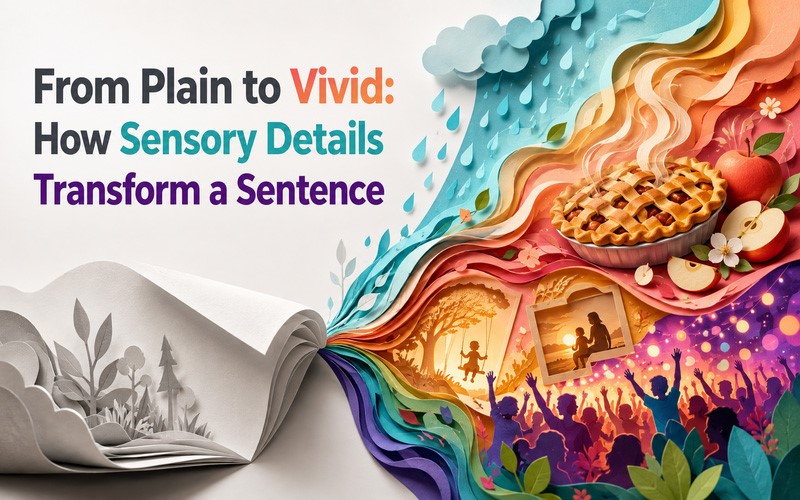
The most useful sensory language examples do not simply add more words. They replace vague conclusions with precise evidence. Compare the following sentences and notice how each revision changes the reader’s experience.
- Creating an Atmospheric Rainy Day
Plain:
It was raining heavily outside.
Sensory:
Rain hammered the metal roof, and cold drops bounced from the pavement onto her ankles.
The revised sentence combines sound, movement, temperature, and touch. Instead of being told that the rain is heavy, readers can judge its intensity themselves.
- Making Food More Appetizing
Plain:
The pie tasted delicious.
Sensory:
The buttery crust crumbled beneath her fork, releasing warm apples, cinnamon, and caramelized sugar.
Words such as delicious give an opinion but little experience. Strong sensory language examples identify the flavors, aromas, textures, and temperatures that produce that opinion.
- Building Suspense in a Room
Plain:
The room was frightening.
Sensory:
A bare bulb flickered above the stained mattress while something scratched inside the wall.
This version never uses the word frightening. The unstable light, neglected surroundings, and unexplained sound create uneasiness without announcing it.
- Bringing a Memory to Life
Plain:
The house reminded him of his childhood.
Sensory:
The hallway still smelled of furniture polish, and the loose stair clicked beneath his foot exactly as it had when he was ten.
Among the most effective examples of sensory language are details connected to memory. The familiar smell and sound make the recollection personal rather than general.
- Showing the Energy of a Crowd
Plain:
The train station was busy.
Sensory:
Suitcases rattled across the tiles as announcements crackled overhead and commuters pressed shoulder to shoulder near the platform.
These sensory details examples prove that revision is not about making every sentence poetic. It is about replacing broad labels with observable details. When using sensory language in writing, ask what a character would genuinely notice at that moment. The best sensory language examples reveal the setting while also strengthening mood, movement, or emotion.
Recommended Description Guide
Discover practical techniques for replacing vague wording with precise sensory details, stronger comparisons, and vivid descriptions.
How to Use Sensory Language Without Overwriting
Sensory description loses its power when every object receives an elaborate explanation. The goal is selection, not saturation. These techniques will help you use sensory language examples as inspiration without overcrowding your scenes.
Choose the Detail That Serves the Scene
A character escaping through a restaurant kitchen probably will not pause to admire the golden crust on a loaf of bread. They may notice the slippery floor, the heat from the ovens, or pans crashing behind them because those details affect their immediate goal.
Combine Senses Selectively
Writers do not need to include sight, sound, smell, taste, and touch in every paragraph. One or two well-chosen sensations are often enough. A useful collection of five senses examples should offer possibilities, not a checklist that must be completed in every scene.
Sensory Exercise Book for Writers
Practice combining different senses naturally while keeping descriptions focused, balanced, and relevant to the scene.
View on Amazon (ad)
Filter Description Through the Character
Two people can enter the same hospital and notice different things. A nervous patient may focus on the chemical smell and squeaking trolley wheels. A visiting child may notice the colorful drawings taped beside the reception desk. Sensory language in writing becomes more personal when it reflects the observer’s memories, fears, interests, and expectations.
Prefer Precise Nouns and Verbs
Specific language is usually stronger than a row of adjectives.
Overwritten:
The very loud, harsh, frightening thunder made a booming noise.
Stronger:
Thunder cracked above the house and shook the windowpanes.
The verb cracked and the physical reaction of the windows communicate intensity without unnecessary modifiers.
Improve Your Descriptive Writing
Learn how precise words, sensory information, metaphors, and similes can bring characters, objects, and settings to life.
View on Amazon (ad)
Connect Sensation with Emotion
Instead of naming an emotion immediately, show how the body experiences it. A nervous character’s collar may feel too tight. Relief may loosen their shoulders. Grief may make familiar food seem flavorless.
Strong sensory details examples help emotion emerge through experience. The most memorable sensory language examples therefore do more than decorate a setting: they influence how the moment feels.
Keep Comparisons Clear
Metaphors and similes can sharpen an image, but forced comparisons distract readers. Before keeping one, ask whether it makes the sensation easier to imagine. If the comparison calls more attention to the writer than the scene, simplify it.

Common Sensory-Writing Mistakes and a Quick Revision Checklist
Even accurate description can weaken a passage when it is repetitive, misplaced, or excessive. When reviewing sensory language examples in your own work, watch for the following problems.
Relying Only on Sight
Writers frequently describe colors, shapes, and facial expressions while forgetting sound, smell, taste, and touch. Sight matters, but the other senses can make a scene feel immediate and unexpected.
Listing Details Without a Purpose
A room does not need a complete inventory. Choose details that develop the atmosphere, influence an action, or reveal something about the person observing them.
Using Predictable Phrases
Descriptions such as sweet as sugar, cold as ice, and soft as silk are easy to understand, but frequent use makes the writing feel familiar. More original examples of sensory language grow from the specific situation, setting, and character.
Confusing Emotion with Sensation
Words such as sad, exciting, and terrifying name emotional judgments. They are not physical sensations by themselves. Show the trembling hand, weight in the chest, or sudden rush of warmth that accompanies the emotion.
Overloading Every Sentence
A paragraph filled with constant smells, sounds, textures, colors, and flavors can exhaust the reader. Effective sensory language in writing creates emphasis through contrast. A quiet sentence can make the next sharp sound more powerful.
Breaking the Point of View
A character cannot describe a smell from another room unless it reaches them or identify a distant object they cannot see clearly. Every sensation should remain consistent with the observer’s location and abilities.
Quick Revision Checklist
Before completing a descriptive passage, ask:
- Have I relied too heavily on sight?
- Does each detail serve the scene?
- Is the description consistent with the viewpoint?
- Can a precise verb replace several adjectives?
- Have I repeated the same sensory words?
- Would removing one detail make the strongest one stand out?
The best five senses examples teach writers to notice more, not necessarily to write more. That principle also matters during professional manuscript development. Across its author and book features, America Publishers Author Spotlight explores how writers use description, atmosphere, memory, and voice across different genres.
Recommended Revision Companion
Use a five-senses-focused writing resource to review whether every sensory detail strengthens the setting, character, or mood.
Frequently Asked Question
-
What is sensory language?
Sensory language is descriptive wording that appeals to sight, sound, smell, taste, or touch. It helps readers imagine how a setting, object, event, or physical experience might feel. Strong sensory language examples use precise details rather than broad labels such as beautiful, delicious, or uncomfortable.
-
What are the five types of sensory language?
The five main types describe visual details, sounds, smells, tastes, and physical sensations. Touch can also include temperature, pressure, pain, moisture, weight, and bodily movement.
-
What is an example of sensory language in a sentence?
“The golden cookie broke between her fingers, releasing the smell of cinnamon and melted chocolate.” The sentence combines sight, touch, and smell to make the moment easier to imagine.
-
How does sensory language improve writing?
It makes descriptions more vivid while supporting mood, characterization, setting, and emotion. Effective sensory language examples allow readers to experience the evidence instead of receiving only the writer’s conclusion.
-
Can one sentence appeal to more than one sense?
Yes. A sentence may naturally combine senses, such as the crackle, warmth, and smoky scent of a fire. However, writers should include only details that contribute to the moment. Adding every possible sensation can make a sentence feel crowded.
-
How can writers avoid overusing sensory details?
Choose the sensations that matter most to the character and scene. Remove repeated details, replace adjective-heavy phrases with precise verbs, and read the paragraph aloud. The most successful sensory language examples create a clear impression without describing every object in view.
Conclusion
Sensory language examples can transform an ordinary description into a moment readers can enter and experience. The strongest details do not simply make a passage longer. They reveal what matters by directing attention toward a particular sound, texture, flavor, scent, or image.
Writers rarely need to activate every sense at once. A single unexpected noise may create suspense, while a familiar smell may uncover a memory that pages of explanation could not communicate as naturally. The key is to select details that suit the setting, character, mood, and purpose of the scene.
Use the sensory details examples in this guide as starting points, then adapt the techniques to your own voice. Take one plain paragraph and revise it with two carefully selected sensations. When sensory language in writing feels specific and relevant, readers stop observing the scene from a distance and begin experiencing it alongside the character. That is the real value of effective sensory language examples.