

Published on June 18, 2026
Have you ever read a book and come across a word so powerful that it completely changed the way you expressed your thoughts? That’s the beauty of language. The more words you understand and confidently use, the easier it becomes to communicate, write, and connect with others. Whether you’re a student, professional, aspiring writer, or someone simply looking to speak more confidently, one of the best ways to improve your English vocabulary is through reading.
Unlike memorizing long word lists that are quickly forgotten, books introduce new words in meaningful contexts. They help readers understand not only what a word means but also how and when to use it naturally. This makes reading one of the most effective and enjoyable ways to improve your English vocabulary over time.
A stronger vocabulary can also transform your writing. When you have access to a wider range of words, you can express ideas more clearly, avoid repetition, and create content that is engaging and impactful. That’s why many successful writers, speakers, and professionals continue reading regularly to improve your English vocabulary and strengthen their communication skills.
In this guide, we’ll explore some of the best vocabulary books and English learning books that can help readers at different skill levels. From classic vocabulary-building resources to practical writing guides, these recommendations are designed to help you grow your language skills, become a more confident communicator, and discover new ways to improve your English vocabulary every day.

Why Reading Books Is the Best Way to Improve Your English Vocabulary
Many people believe that learning new words requires endless memorization, flashcards, or complicated exercises. While these methods can be helpful, they often lack one important element: context. Reading books allows you to encounter words naturally, making them easier to understand, remember, and use in real-life situations.
When you read regularly, your brain begins recognizing patterns in language. You see how words are used in different sentences, emotions, and conversations. This exposure helps improve English vocabulary far more effectively than simply studying definitions. Instead of learning isolated words, you’re learning how language works as a whole.
Another advantage of reading is variety. Different genres introduce different styles of language. Fiction improves descriptive language and creativity, while non-fiction expands academic, professional, and subject-specific vocabulary. The best English learning books often combine both approaches, helping readers build practical communication skills while developing a deeper appreciation for language.
Reading also strengthens writing skills. As you encounter well-structured sentences, engaging descriptions, and effective storytelling techniques, you naturally begin incorporating similar patterns into your own writing. This is why many educators recommend vocabulary building books not only for language learners but also for aspiring authors, bloggers, students, and business professionals.
Most importantly, reading creates a habit of lifelong learning. Every page presents an opportunity to discover a new word, phrase, or expression. Over time, this consistent exposure can significantly improve your English vocabulary, making communication feel more natural, confident, and effortless.
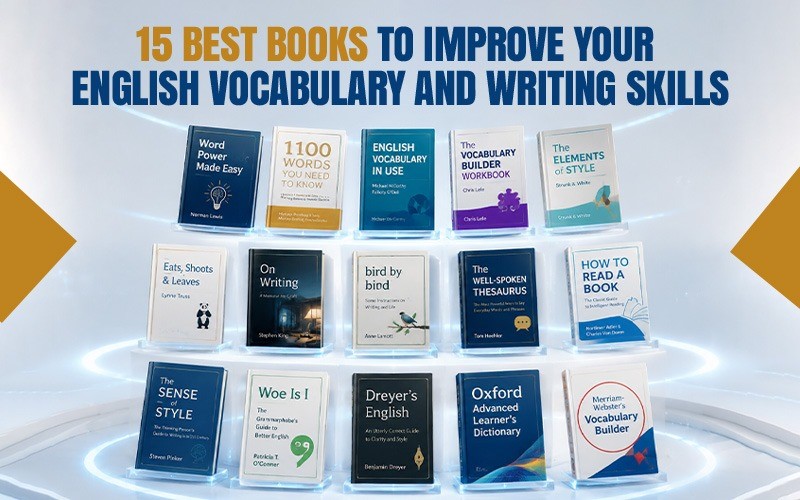
15 Best Books to Improve Your English Vocabulary and Writing Skills
Choosing the right books can make a significant difference in your language-learning journey. The following titles are widely recommended by educators, writers, and language experts because they help readers improve your English vocabulary while also strengthening reading comprehension and writing ability.
The following recommendations cover a mix of vocabulary development, writing improvement, grammar mastery, and language usage, making them valuable resources for learners at different stages of their English journey.
- Word Power Made Easy by Norman Lewis
Often considered the gold standard among vocabulary books, this classic guide focuses on word roots, prefixes, and suffixes rather than simple memorization. Readers learn how words are connected, making it easier to remember and apply new vocabulary in everyday communication.
- 1100 Words You Need to Know by Murray Bromberg and Melvin Gordon
This book introduces practical words frequently encountered in newspapers, books, and professional settings. The structured lessons and exercises make it one of the most effective vocabulary building books for learners who want consistent progress.
- English Vocabulary in Use by Michael McCarthy and Felicity O’Dell
Designed for learners at different proficiency levels, this book presents vocabulary through realistic situations and conversations. It is one of the most popular English learning books for students looking to expand their language skills naturally.
- The Vocabulary Builder Workbook by Chris Lele
Perfect for independent learners, this workbook combines explanations, exercises, and quizzes to reinforce new words. It helps readers improve your English vocabulary while developing stronger word retention.
- The Elements of Style by William Strunk Jr. and E.B. White
Although primarily a writing guide, this timeless resource teaches clarity, precision, and effective word choice. It helps writers understand how vocabulary can improve communication.
- Eats, Shoots & Leaves by Lynne Truss
This entertaining book explores punctuation and language usage in a way that is both educational and enjoyable. Readers often discover new expressions and language patterns while improving their writing skills.
- On Writing by Stephen King
Part memoir and part writing masterclass, this book offers valuable insights into word choice, storytelling, and sentence construction. It’s especially useful for aspiring writers seeking to improve English vocabulary through practical examples.
- Bird by Bird by Anne Lamott
Anne Lamott’s approachable writing style makes complex writing concepts easy to understand. Readers gain confidence in expressing ideas while expanding their understanding of language.
- The Well-Spoken Thesaurus by Tom Heehler
This book provides alternatives to commonly used words, helping readers communicate with greater precision and sophistication without sounding unnatural.
- How to Read a Book by Mortimer J. Adler and Charles Van Doren
Learning how to read effectively is just as important as learning new words. This book teaches readers how to engage deeply with texts and maximize vocabulary growth.
- The Sense of Style by Steven Pinker
Combining linguistic research with practical advice, this book helps readers understand modern writing principles and effective language usage.
- Woe Is I by Patricia T. O’Conner
Written with humor and clarity, this guide simplifies grammar and language rules, making it easier to use newly learned vocabulary correctly.
- Dreyer’s English by Benjamin Dreyer
A modern guide to writing and editing, this book helps readers develop a sharper understanding of language and style.
- Oxford Advanced Learner’s Dictionary
More than a dictionary, this resource provides examples, usage notes, collocations, and pronunciation guidance. It remains one of the most valuable English learning books for serious learners.
- Merriam-Webster’s Vocabulary Builder
This resource focuses on word origins and meanings, helping readers build long-term language skills and improve your English vocabulary through deeper understanding rather than rote memorization.
How to Create a Daily Vocabulary-Building Routine
Reading the right books is an excellent starting point, but long-term improvement comes from consistency. If your goal is to improve your English vocabulary, creating a simple daily routine can make a significant difference over time. The good news is that you don’t need hours of study each day. Even 15 to 20 minutes of focused learning can help you build stronger language skills.
Start by setting aside dedicated reading time every day. Choose from the vocabulary books or English learning books mentioned in this guide and focus on understanding words in context rather than rushing through pages. Whenever you come across an unfamiliar word, write it down along with its meaning and the sentence in which it appeared.
Many language learners find it helpful to keep a vocabulary journal. This allows you to track new words, review them regularly, and create your own example sentences. Writing new words in context is one of the most effective ways to improve your English vocabulary because it strengthens both understanding and retention.
Another useful habit is to learn a small number of words each day instead of trying to memorize dozens at once. Learning three to five new words daily may seem slow, but over a year, that can add more than a thousand words to your vocabulary.
Finally, put what you learn into practice. Use new words in emails, journal entries, social media posts, or conversations. The more often you actively use a word, the more naturally it becomes part of your vocabulary. Combined with quality vocabulary building books, a consistent routine can help transform your language skills over time.
Common Mistakes That Slow Vocabulary Growth
Many learners work hard to expand their vocabulary but unknowingly make mistakes that limit their progress. Understanding these common challenges can help you improve your English vocabulary more effectively and avoid frustration along the way.
One of the biggest mistakes is memorizing words without context. Learning a definition alone rarely helps you remember a word long term. Instead, focus on seeing how words are used in books, articles, and conversations. This is one reason why vocabulary books remain such valuable learning tools.
Another common mistake is trying to learn too many words at once. When learners overwhelm themselves with large word lists, retention often decreases. It’s far better to learn a few words thoroughly than dozens of words superficially.
Many people also neglect to use the words they learn. Reading a new word is helpful, but actively using it in writing or conversation is what truly reinforces understanding. If you want to improve your English vocabulary, make a habit of incorporating new words into your daily communication.
Some learners focus only on vocabulary while ignoring pronunciation and usage. Knowing a word’s meaning is important, but understanding when and how to use it correctly is equally valuable. The best English learning books often teach vocabulary through examples that demonstrate natural usage.
Finally, many learners fail to review what they have learned. Vocabulary growth is a long-term process that requires repetition and reinforcement. Reviewing words regularly, revisiting notes, and rereading passages from vocabulary building books can help ensure that new words remain part of your active vocabulary rather than being forgotten after a few days.
By avoiding these common mistakes and maintaining consistent reading habits, you’ll be in a much stronger position to expand your vocabulary and become a more confident communicator. For more reading and writing-focused insights, America Publishers Author Spotlight continues to share helpful resources for learners, readers, and aspiring authors.
Frequently Asked Question
-
Which book is best for improving English vocabulary?
Many learners consider Word Power Made Easy by Norman Lewis one of the best vocabulary books because it teaches word meanings through patterns and word origins rather than memorization alone. It is a great choice for anyone who wants to improve your English vocabulary with a structured approach.
-
How can reading books improve English vocabulary?
Reading exposes readers to new words in context, making them easier to understand, remember, and use naturally in everyday communication. This natural exposure helps readers improve your English vocabulary more effectively than studying isolated word lists.
-
Are vocabulary books suitable for adults?
Yes. Many vocabulary building books are specifically designed for adult learners, professionals, writers, and students who want to strengthen their language skills and communication abilities.
-
How long does it take to build a stronger vocabulary?
The timeline varies for each learner. With regular reading and practice, most people begin noticing improvements within a few weeks, while long-term growth develops over months of consistent learning.
-
Can vocabulary books improve writing skills?
Absolutely. The best English learning books teach not only new words but also how to use them effectively in sentences, helping readers write more clearly, confidently, and professionally.
Conclusion
Building a stronger vocabulary does not happen overnight, but the right books can make the journey enjoyable, practical, and deeply rewarding. Whether you are a student, professional, writer, blogger, or someone who simply wants to express ideas with more confidence, consistent reading remains one of the most powerful ways to improve your English vocabulary and strengthen your overall communication skills.
The books mentioned in this guide are not just ordinary reading materials. They are valuable learning companions that help you understand words in context, improve sentence structure, develop clearer writing habits, and build confidence in both personal and professional communication. Some focus directly on word meanings and usage, while others teach style, grammar, clarity, storytelling, and expression. Together, they create a complete path for anyone who wants to grow as a reader, writer, and communicator.
The best part is that vocabulary growth becomes easier when you make it part of your daily routine. Even reading a few pages a day can introduce you to new words, fresh sentence patterns, and better ways to explain your thoughts. Over time, these small efforts begin to shape the way you speak, write, and understand language.
So, choose a book that matches your current level, keep a notebook for new words, and practice using them in your own writing. The more consistently you read, the more naturally you will improve English vocabulary and develop a stronger command of language. Every chapter, every paragraph, and every new word brings you one step closer to becoming a more confident and expressive English user.
