
An operating room is built on trust. A patient gives up consciousness, control, and the ability to respond while placing their safety in the hands of a medical team. Monitors track vital signs, trained professionals make decisions in real time, and carefully controlled medications help guide the patient through a vulnerable state. That dependence creates an unsettling question for any hospital horror novel: what happens when the people responsible for maintaining control encounter something that medicine cannot explain? In Excruciating, that familiar act of trust becomes the doorway to a nightmare that reaches beyond the boundaries of ordinary clinical care. The premise takes one of medicine’s most controlled environments and introduces an element that cannot be managed through protocols, experience, or professional expertise. For readers drawn to operating-room suspense, that contrast establishes the foundation for a story where vulnerability is not simply part of the setting. It becomes part of the fear.
Lead Spotlight: David M. Ward

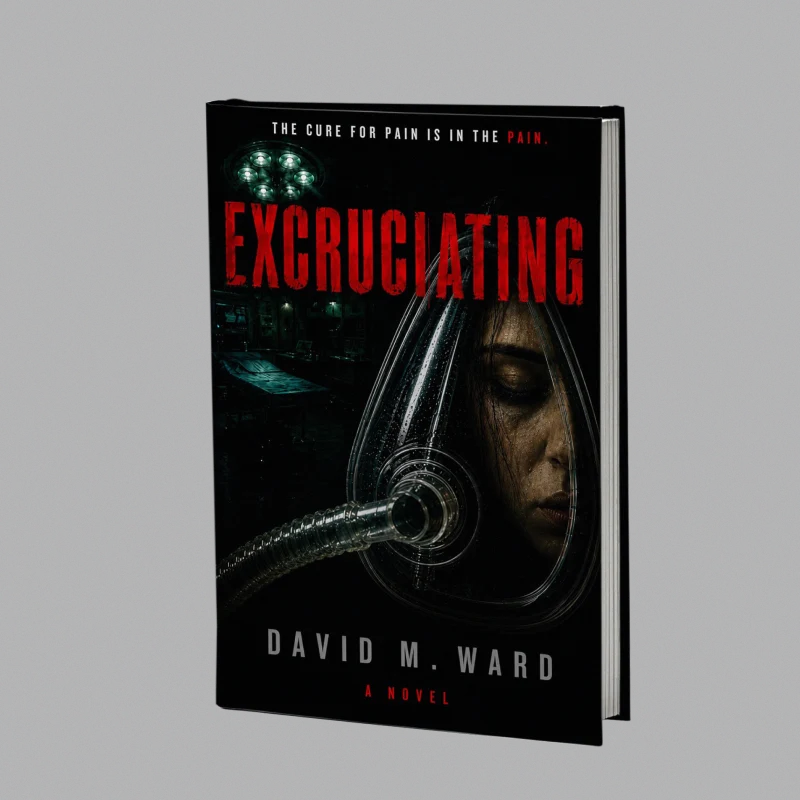
Inside Excruciating by David M. Ward: Where Medical Reality Collides With Ancient Evil
A Debut Where Medical Horror Meets Psychological Suspense
David M. Ward’s Excruciating enters the horror landscape as a debut that brings together medical horror, psychological suspense, and supernatural terror. Rather than treating the hospital as a generic backdrop, the official description positions the medical environment at the center of the story’s tension. The Excruciating book premise places a nurse anesthetist in a world where professional knowledge and personal suffering begin to collide with forces outside ordinary explanation. That combination gives the Excruciating novel a distinctive foundation: its central danger is connected not only to frightening events but also to the psychological and emotional circumstances surrounding its protagonist. As an Excruciating medical horror novel, the book occupies an unusual space between recognizable clinical reality and supernatural darkness. Readers interested in a medical horror psychological thriller can therefore approach the story through several entry points at once—hospital suspense, character-driven psychological tension, and the possibility of an ancient evil intruding into a modern medical setting. The result is a premise built around the unsettling idea that even expertise has limits.
When a Place of Healing Becomes a Place of Fear
A hospital is supposed to represent care, structure, and protection. Its routines depend on trained professionals, established procedures, constant observation, and the expectation that problems can be identified and addressed. That makes a small-town hospital an especially effective setting for a story that questions how much control people actually possess. In Excruciating, the hospital environment becomes more than the location where events happen. It is a contained world where professional pressure, personal vulnerability, secrets, and unexplained circumstances can converge. The premise turns familiar clinical spaces into sources of uncertainty without requiring the setting itself to become fantastical from the beginning. That tension is central to the appeal of a small-town hospital thriller: the surroundings remain recognizable even as the circumstances become increasingly difficult to understand. For readers interested in a supernatural hospital mystery, the contrast creates an intriguing foundation. A place designed to protect people who cannot protect themselves becomes connected to events that challenge the very systems meant to keep those people safe. The hospital’s normal function therefore becomes part of what makes the developing horror unsettling.
Meet Matthew Rix, the Nurse Anesthetist at the Center
At the center of Excruciating is Matthew Rix, a nurse anesthetist whose profession places him directly within the novel’s central tension. His work involves helping patients surrender consciousness while medical professionals assume responsibility for their safety. That role requires attention, preparation, and control, making Matthew a particularly fitting protagonist for a story built around the boundaries of consciousness and the unknown. The Matthew Rix character is introduced not simply as someone who happens to work in a hospital, but as someone whose professional understanding is closely connected to the novel’s atmosphere. He knows what it means for a patient to become unable to perceive or respond normally, and he works in an environment where maintaining control matters. Yet the premise places him in circumstances where professional knowledge may not provide all the answers he needs. This makes the nurse anesthetist thriller aspect of the book especially important. Matthew’s perspective creates a bridge between clinical reality and supernatural uncertainty, allowing the story to explore what happens when someone trained to understand altered consciousness encounters experiences that resist ordinary explanation.
Matthew Rix Is Already Carrying a Heavy Personal Burden
Matthew does not enter the story from a position of stability. The official description presents him as a man already dealing with profound personal disruption following the death of his son. His marriage is collapsing, his career has suffered serious damage, and he has developed a dependence on the medications he handles professionally. These circumstances give the Excruciating book a psychological dimension that exists alongside its supernatural premise. Matthew’s grief is not presented as a simple piece of backstory; it forms part of the vulnerability he carries into the events surrounding the hospital. His damaged relationships and professional consequences further complicate his position, creating a protagonist whose circumstances are considerably more complicated than those of a conventional hero entering a dangerous situation. That makes Excruciating an addiction and grief thriller as much as a supernatural story. Readers can expect themes involving grief, dependence, guilt, vulnerability, and the consequences of personal deterioration, while the premise leaves room for those pressures to intersect with the increasingly disturbing events around Matthew. His struggle gives the horror an intensely personal dimension before the supernatural threat fully takes shape.
The Cruel Contradiction Between Matthew’s Profession and His Struggle
One of the most striking tensions in the Excruciating premise comes from Matthew’s relationship with control. As a nurse anesthetist, he works with medications that affect consciousness and pain, and his professional responsibilities depend on using that knowledge carefully. His patients rely on him precisely because they cannot remain in control of their own awareness during procedures. Yet Matthew’s personal circumstances place his own relationship with those same medications under pressure. That contradiction creates fertile ground for a story concerned with responsibility, vulnerability, and the consequences of losing control. The premise does not require Matthew to be reduced to a simple cautionary figure. Instead, his professional expertise and personal deterioration exist beside one another, creating a morally complex horror protagonist whose knowledge cannot automatically protect him from his own circumstances. This tension also gives the story elements of medical ethics horror fiction without turning the novel into a clinical discussion. The focus remains on the character and the choices surrounding him. For readers interested in a psychological deterioration thriller, Matthew’s situation raises an unsettling question: how reliable can professional control remain when personal pain begins to undermine the person expected to maintain it?
A Murder Turns Personal Crisis Into Something More Dangerous
Matthew’s struggles take on a different significance when a brutal murder close to him rocks his small-town hospital enters the story. Until that point, his grief, damaged marriage, career problems, and dependence create an intensely personal crisis. The murder introduces an external threat and begins pushing the premise beyond the boundaries of an ordinary character study. According to the official description, the event sets off a chain of circumstances that become increasingly difficult to explain, drawing Matthew into a situation where his professional understanding is no longer enough to make sense of what is happening. This gives the hospital murder mystery element a larger purpose within the story. The crime is not simply an isolated mystery placed inside a medical setting; it becomes a turning point that connects Matthew’s already unstable world to something considerably darker. The hospital, previously associated with procedure and controlled care, becomes the center of an escalating mystery. As the situation develops, the familiar logic of medicine begins to compete with an increasingly disturbing possibility. What begins with a murder therefore opens the door to a threat that appears to belong to an entirely different order of reality.
When the Impossible Begins
The murder does more than introduce another source of danger; it begins pulling Matthew toward circumstances that his medical training cannot readily explain. The official description presents the events that follow as increasingly impossible, pushing the story beyond the boundaries of a conventional hospital thriller. For Matthew, that creates a particularly unsettling problem. His professional world is built around observation, evidence, controlled procedures, and an understanding of how the human body responds under carefully managed conditions. Yet the forces entering his life do not appear to follow those same rules. The premise of Excruciating therefore shifts from a hospital murder mystery into something much darker, with an older supernatural presence beginning to emerge behind the unexplained events. Readers looking for an ancient evil horror novel can expect the story to explore that transition without reducing the supernatural element to a simple jump scare. Importantly, the publicly available description does not establish the entity’s name, appearance, history, or specific powers, so those details remain outside what can responsibly be discussed here. What matters at this stage is the collision itself: Matthew’s medical certainty is being confronted by something he cannot easily categorize.
Grief Becomes Part of the Horror
At the emotional center of the premise is Matthew’s grief over the death of his son. That loss matters because it places the supernatural conflict against an already fractured sense of normality. Before the unexplained events begin, Matthew is dealing with a life that has already been altered by loss, damaged relationships, professional consequences, and dependence. The Excruciating book themes therefore extend beyond fear into questions about what prolonged suffering can do to a person’s sense of identity and direction. Grief can change how someone understands the future, how they respond to difficult decisions, and how they relate to the pain they carry. In Matthew’s case, the premise places those emotional pressures alongside an increasingly disturbing external threat. That combination gives the novel the qualities of an addiction and grief thriller while allowing grief to remain a character and thematic concern rather than simply a plot device. Readers can expect themes involving pain, vulnerability, guilt, and the difficult possibility of finding a way forward after devastating loss. The story’s supernatural dimension makes those questions more ominous, because Matthew is not confronting his suffering in isolation. He is facing it while the boundaries of his reality appear to be changing around him.
Addiction and the Question of Control
Matthew’s dependence on the medications he handles professionally creates another layer of tension around the idea of control. His career is based on careful decisions involving consciousness, pain, medication, and patient safety. Personally, however, he is struggling with dependence while his marriage and professional life are already deteriorating. That contrast gives Excruciating an important psychological dimension. The novel can be viewed as a psychological deterioration thriller because its protagonist is already navigating circumstances that complicate his ability to trust his own stability and judgment. At the same time, the premise does not invite a simplistic interpretation in which addiction explains everything that happens to him. The supernatural element exists alongside Matthew’s personal struggle, creating uncertainty about where one source of danger ends and another begins. This is also where the story’s potential medical ethics horror fiction dimension becomes particularly interesting. Matthew’s professional responsibilities and personal vulnerability occupy opposing sides of the same world, forcing the character into a situation where knowledge does not necessarily equal protection. The tension is not presented as medical advice or a clinical lesson. Instead, it becomes part of the character’s dramatic circumstances, reinforcing one of the book’s central questions: what happens when someone whose profession depends on control can no longer feel entirely in control of his own life?
Betrayal, Obsession and Violence
The premise of Excruciating also identifies betrayal, obsession, and violence alongside grief and addiction, broadening the story’s emotional and psychological territory. These elements suggest a narrative in which danger is not limited to an external supernatural force. Human relationships and personal choices can become sources of uncertainty too. Betrayal can undermine trust; obsession can distort priorities; violence can transform fear into irreversible consequences. Together, these themes create room for the story to explore the difference between what a person believes, what they fear, and what may actually be influencing their decisions. That is particularly significant for Matthew, whose professional and personal circumstances already place him in a vulnerable position. As the psychological supernatural thriller book premise develops, questions of guilt and responsibility can exist beside questions about supernatural manipulation without the two being neatly separated. Readers can expect the combination of grief, addiction, betrayal, and obsession to complicate the character’s attempt to understand what is happening around him. The official material establishes these as thematic elements, but it does not provide enough information to claim how each one ultimately resolves. What can be explored is the tension they create: a protagonist already struggling with personal consequences is pulled into a world where violence and unexplained forces make certainty increasingly difficult to maintain.
Science Versus Something Older
The defining distinction of Excruciating may ultimately be the collision between two systems of understanding. On one side is medicine: measurable conditions, professional expertise, established procedures, and the practical responsibility of keeping a patient safe. On the other is something described as an ancient evil, a force that exists outside the explanations Matthew has spent his career learning to trust. That makes the book particularly suited to readers interested in science versus supernatural horror, because the conflict is not simply between a hero and a monster. It is also between certainty and uncertainty. A medical professional can understand physiology, anesthesia, pain, and consciousness, but those forms of knowledge have boundaries. The novel’s premise becomes especially intriguing when those boundaries are tested by experiences that appear to resist rational explanation. This is where the medical horror psychological thriller identity of the book becomes distinctive. The horror grows from an environment where precision is expected, while the supernatural introduces something that cannot be reduced to a procedure or diagnosis. For readers who enjoy an occult medical thriller, that intersection offers a different kind of suspense: not just wondering what will happen next, but wondering whether the framework used to understand reality is still sufficient.
The Medical Reality Behind the Fiction
David M. Ward’s professional background gives the medical setting of Excruciating an especially relevant foundation. Ward is a Certified Registered Nurse Anesthetist with more than two decades of experience in operating-room and trauma-care environments, placing him professionally close to the same world occupied by Matthew Rix. That experience matters because anesthesia involves a particularly profound form of patient vulnerability. Patients surrender consciousness and depend on medical professionals to monitor them, respond to changes, and maintain their safety while they cannot actively participate in their own care. Ward’s experience provides context for the clinical environment from which the novel’s horror develops. It does not mean that the fictional events should be treated as accounts of real patients or specific experiences from his career. Instead, his background offers a credible professional foundation for the medical realism in horror fiction that distinguishes the premise. His military nursing background adds another dimension to his professional experience, having served for decades in military medicine before retiring from the U.S. Army Reserve in 2025. Yet the most relevant connection to this novel remains his extensive work around anesthesia, operating rooms, and trauma care. Those experiences help explain why the medical world surrounding Matthew can function as more than a generic backdrop.
Who Should Read Excruciating?
For readers drawn to medical horror, psychological suspense, supernatural thrillers, and dark stories about grief and addiction, Excruciating offers a premise where those elements meet inside an unsettling medical setting. The novel may particularly appeal to readers who enjoy character-driven horror, morally complicated protagonists, and stories that place ordinary professional environments against forces that defy rational explanation. David M. Ward’s debut, Excruciating, is scheduled for release on October 25, 2026, giving readers an opportunity to preorder the book ahead of its publication. Readers can preorder Excruciating on Amazon to secure a copy before release. America Publishers Author Spotlight selected Excruciating as its Lead Spotlight because the novel brings together an unusually compelling combination of medical realism, psychological vulnerability, grief, addiction, and supernatural horror. Its operating-room setting and nurse anesthetist protagonist give the story a distinctive foundation, while its darker themes create the kind of layered premise that stands out within contemporary horror. For readers looking for a medical horror novel with psychological and supernatural depth, Excruciating is one to watch ahead of its October release.
Follow David M. Ward for Further Updates
🔗 Personal Instagram: Click here
🔗 Amazon Author Page: Click here
Excruciating | Available For Pre-Order
🔗 Available For pre-order (Amazon): Click here