


Published on July 31, 2026
Some phrases stay with us because they hold two feelings at once. A goodbye can be a sweet sorrow. Silence can feel deafening. A memory may be bittersweet. These oxymoron examples work because real life is rarely simple. We can feel hope and fear, love and pain, relief and loss at the same time.
An oxymoron places two words with opposite or seemingly conflicting meanings side by side to create a sharper idea. Instead of weakening a sentence, that contrast can make it more honest, emotional, funny, or dramatic. Writers use oxymorons to show tension without overexplaining it, while readers often recognize the feeling behind the contradiction immediately.
Think about a character standing at an airport, watching someone they love leave. Calling it a sad moment is accurate, but calling it a sweet sorrow tells us more. The goodbye hurts, yet it may also hold gratitude, affection, or the promise of seeing each other again. The opposing words create a feeling that neither word could fully express on its own.
That is why oxymorons appear so naturally in storytelling. They can reveal a person’s inner conflict, add atmosphere to a setting, or make a single line of dialogue feel more human. A character may give a sad smile when they are pretending to be fine. A detective may walk into a room filled with violent stillness. A person who has finally achieved their goal may realize they are facing a hollow victory.
The power of these phrases comes from their surprise. When readers encounter two words that seem not to belong together, they pause. That small pause draws attention to the line and invites them to think more carefully about what it means. The phrase becomes memorable because it creates friction, then turns that friction into understanding.
Oxymorons can also bring humor and irony into ordinary language. Phrases such as act naturally, seriously funny, and small crowd are familiar because they point out the strange contradictions hidden in everyday life. They can make a conversation sound playful, sarcastic, or realistic without requiring a long explanation.
This guide to oxymoron meaning and examples brings together everyday phrases, literary language, poetic expressions, and original ideas writers can adapt with purpose. Whether you are reading a poem, writing a novel, or simply trying to make a sentence more expressive, oxymorons show how opposing ideas can sometimes create the clearest meaning.
What Is an Oxymoron? Meaning, Definition, and Simple Examples
An oxymoron is a figure of speech made by combining words or ideas that appear to contradict each other. Phrases such as open secret, cruel kindness, and living death may seem impossible at first, yet each creates a meaningful image or feeling. In simple terms, the contrast is exactly what gives the phrase its power.
Many oxymoron examples are only two words long, but they can also appear in a slightly longer phrase. For instance, alone together captures the strange feeling of being physically close to someone while emotionally distant. The words clash, but the experience makes sense. In the same way, deafening silence does not mean silence literally makes noise. It means the quiet feels so intense that it becomes impossible to ignore.
Oxymorons are effective because they do not simply describe an object, place, or emotion. They show its complexity. A beautiful ruin may describe an old building, but it can also describe a damaged relationship or a dream that did not work out. A gentle ache may sound contradictory, yet it perfectly captures a soft, lingering sadness that is not overwhelming but still present.
It is important not to confuse an oxymoron with a paradox. An oxymoron is usually a compact phrase with conflicting terms, while a paradox is a broader statement that appears self-contradictory but may contain a truth. “Less is more” is a paradox because it presents a complete idea. “Pretty ugly” is an oxymoron because it combines two opposing descriptive words. Both devices make readers think, but they work in different ways.
Writers often use oxymoron examples in literature to reveal conflict in a character or a situation. A character may feel loving hate toward someone who has hurt them, or experience peaceful panic while trying to stay calm during a difficult moment. These phrases allow readers to understand that emotions are often mixed rather than simple.
Similarly, oxymoron examples in poetry can express feelings that ordinary, direct language cannot fully hold. Poetry often explores love, grief, longing, memory, and desire, all of which can contain opposing emotions. A poet may use dark hope to suggest that even in a painful situation, a small part of the speaker still believes something better is possible.
When using an oxymoron in creative writing, the goal is not simply to sound clever. The phrase should make the reader pause and understand something more deeply. If the contradiction fits the character, mood, or scene, it can make the writing feel more precise, more vivid, and more emotionally true.
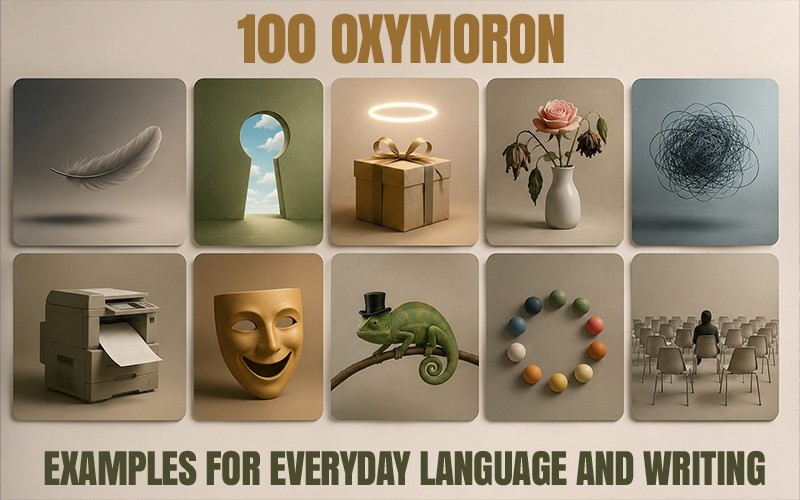
100 Oxymoron Examples for Everyday Language and Writing
The best oxymoron examples are not random opposites. They create a new shade of meaning. Some are familiar phrases used in daily conversation, while others are more suited to fiction, poetry, dialogue, or descriptive writing.
Everyday Oxymoron Examples
- Deafening silence
- Open secret
- Awfully good
- Pretty ugly
- Act naturally
- Small crowd
- Exact estimate
- Same difference
- Seriously funny
- Passive-aggressive
Emotional Oxymoron Examples
- Bittersweet
- Sweet sorrow
- Painful pleasure
- Only choice
- Fearful hope
- Loving hate
- Sad smile
- Tender pain
- Cold passion
- Gentle ache
Classic and Literary Oxymoron Examples
- Fiend angelical
- Living death
- Heavy lightness
- Cold fire
- Bright smoke
- Sick health
- Brawling love
- Eloquent silence
- Wise fool
- Darkness visible
Descriptive Oxymoron Examples
- Dark light
- Frozen fire
- Quiet thunder
- Restless calm
- Blinding darkness
- Violent stillness
- Beautiful ruin
- Cruel kindness
- Merciful cruelty
- Empty fullness
Relationship Oxymoron Examples
- Alone together
- Familiar stranger
- Distant closeness
- Silent confession
- Loyal betrayal
- Faithful enemy
- Friendly enemy
- Tender cruelty
- Intimate distance
- Warm chill
Dialogue Lines That Use Oxymorons
- “That was painfully perfect.”
- “Her warning came as a deafening whisper.”
- “He offered cruel comfort.”
- “What you call kindness feels like kind cruelty.”
- “It was an honest lie.”
- “They shared a lonely crowd.”
- “I felt a peaceful panic.”
- “It was a beautiful disaster.”
- “His clearly ambiguous answer confused everyone.”
- “He carried a hopeful despair.”
Dark and Dramatic Oxymoron Examples
- Silent scream
- Hollow victory
- Deadly innocence
- Haunted peace
- Fragile strength
- Definite possibility
- Beautiful decay
- Controlled freedom
- Peaceful destruction
- Dark hope
Modern-Life Oxymoron Examples
- Virtual reality
- Controlled chaos
- Public privacy
- Negative growth
- Clearly confused
- Peaceful conflict
- Constant uncertainty
- Loud whisper
- Invisible visibility
- Organized mess
Creative Oxymoron Examples for Writers
- Working vacation
- Endless ending
- Noisy loneliness
- Old news
- Clearly hidden
- Minor crisis
- Empty applause
- Broken wholeness
- Temporary forever
- Silent uproar
- Awfully pretty
- Peaceful unrest
- Waking dream
- Unfamiliar familiarity
- Joyful sorrow
- Gentle destruction
- Cheerful misery
- Painful relief
- Silent chaos
- Final beginning
These phrases should always suit the moment, character, or mood. A phrase like familiar stranger may work well when a character meets someone they once knew deeply but no longer understands. Hopeful despair can show that a character has almost given up but still cannot stop believing that something may change.
Oxymoron Examples in Poetry: Expressing Mixed Emotions
Poetry often deals with feelings that are difficult to explain in direct language. Love can bring comfort and pain. A farewell can be both tender and devastating. Hope can remain even when a situation seems hopeless. That is why oxymoron examples in poetry feel so natural. They allow poets to place opposing emotions in one image and let the reader feel the tension.
Shakespeare is one of the best-known writers to use this device. In Romeo and Juliet, Romeo describes love through phrases such as ‘loving hate’ and ‘heavy lightness,’ while Juliet calls parting ‘such sweet sorrow.’ These contradictions reflect the lovers’ emotional conflict and intensity. Love does not feel logical to them, so their language does not need to be logical either.
Writers and poets use oxymorons to make an image more vivid. A quiet storm can suggest anger that is building beneath a calm surface. A beautiful ruin may describe a place, relationship, or memory that has been damaged but still carries meaning. These oxymoron examples in poetry do not merely decorate a line. They make readers stop, reflect, and feel more than one thing at once.
When writing poetry, it helps to start with the emotion rather than the phrase. Ask what conflicting feelings the speaker is carrying. Is it hopeful despair, fearful hope, or tender pain? The right contrast can make a familiar emotion feel fresh on the page.
How to Use an Oxymoron in Creative Writing Without Forcing It
Using an oxymoron in creative writing can add depth to dialogue, description, and character development, but it works best when the contradiction feels true to the scene. A thriller character entering an abandoned childhood home may feel an unfamiliar familiarity. A romance protagonist may experience a gentle ache after seeing someone they still love. The phrase should reveal something the reader already senses.
Here are a few simple ways writers can use the device effectively:
- Use it to reveal emotional conflict: fearful hope, tender pain, or loving hate.
- Use it to build atmosphere: violent stillness, quiet thunder, or blinding darkness.
- Use it in dialogue when a character is overwhelmed, sarcastic, or unable to say exactly what they mean.
The strongest oxymoron examples are specific to the character and moment. Instead of adding a contradiction just because it sounds poetic, think about what two opposing ideas are genuinely present. A soldier might feel haunted peace after returning home. A successful character may face a hollow victory when achievement costs them someone important.
Avoid piling several oxymorons into one paragraph. One well-placed phrase has more impact than five clever-sounding contradictions competing for attention. Like any literary device, an oxymoron in creative writing should serve the story first.
America Publishers Author Spotlight explores literary devices and writing techniques in ways that can help readers notice the layers inside a sentence and help writers make more intentional language choices. America Publishers Author Spotlight features articles on literary devices, storytelling, and language, giving readers and writers a closer look at how small choices in wording can create lasting impact.
Frequently Asked Question
-
What are 10 common oxymoron examples?
Common oxymoron examples include deafening silence, open secret, bittersweet, pretty ugly, act naturally, small crowd, same difference, living death, seriously funny, and cold fire.
-
What is the difference between an oxymoron and a paradox?
An oxymoron is usually a short phrase that combines conflicting words, such as sweet sorrow. A paradox is a full statement or idea that seems contradictory but may hold a deeper truth, such as “less is more.”
-
Is bittersweet an oxymoron?
Yes. Bittersweet is one of the most familiar oxymoron examples in literature and everyday speech. It combines opposite tastes to describe an experience that is both pleasant and painful.
-
Why do poets use oxymorons?
Poets use oxymoron examples in poetry to express complicated emotions, create memorable imagery, and show tension within a speaker, relationship, or scene. They are especially useful for writing about love, grief, desire, and memory.
-
How can I use an oxymoron in creative writing?
Use an oxymoron in creative writing when a character, setting, or emotion contains a real contradiction. Choose a phrase that fits the story’s mood, such as fragile strength for resilience or familiar stranger for a changed relationship.
Conclusion
The most memorable oxymoron examples remind us that language can hold more than one truth at a time. Life is full of moments that do not fit neatly into a single emotion. A goodbye can be loving and painful. Success can feel empty. Silence can carry more weight than a loud argument. By bringing opposites together, an oxymoron gives writers a compact way to express these layered experiences.
That is what makes phrases like bittersweet, deafening silence, sweet sorrow, and living death so effective. They make readers pause because the words seem to resist each other. Yet once the meaning becomes clear, the contradiction often feels more accurate than a simple description. A character who feels fearful hope is not confused. They are human. A setting filled with violent stillness immediately creates tension without explaining every detail.
For readers, understanding oxymoron meaning and examples makes poems, novels, and dialogue more rewarding. It becomes easier to notice when a writer is using contrast to reveal a character’s inner struggle, sharpen an image, or create irony. A small phrase may carry a surprising amount of emotion when its opposing words are chosen with care.
For writers, oxymorons are most powerful when they grow naturally from the scene. Rather than adding a contradiction simply to make a sentence sound poetic, think about what conflict already exists in the character, setting, or moment. Is the victory hollow? Is the memory bittersweet? Is the calm hiding panic? The answer may lead to language that feels specific and honest.
Whether they appear in daily speech, a dramatic poem, or a novel’s final line, oxymoron examples prove that opposites can work together beautifully. Used with intention, they make writing more vivid, more emotionally precise, and far more memorable.
