
Published on September 9, 2026
Types of characters can determine whether a story becomes unforgettable or disappears from a reader’s mind the moment the final page is turned. A clever plot may attract attention, but it is usually the people inside that plot, with their desires, flaws, secrets, and difficult choices, who make readers care.
Think about the stories you remember most. Perhaps you admired a courageous protagonist, despised a convincing antagonist, trusted a loyal companion, or recognized part of yourself in someone who changed under pressure. Each character contributes something different, even when their role appears small.
Understanding the types of characters in literature helps readers see how these relationships create conflict, reveal personality, and move a narrative forward. For writers, it offers a practical way to build a cast in which every person has a purpose.
These character types are not rigid boxes. One person can be a protagonist, round character, and dynamic character simultaneously. This guide explores 12 essential categories through clear definitions, familiar examples, and useful writing insights.
What Are Character Types in Literature?
A character is a person, animal, creature, or personified entity that participates in a narrative. The term types of characters in literature refers to the different ways these figures can be classified according to their importance, purpose, complexity, relationships, and capacity for change.
Some labels tell us what a character does. The protagonist and antagonist, for example, occupy opposing positions in the central conflict. Other labels describe how much psychological depth a character possesses or whether that person changes during the narrative. This is the basis of distinctions such as round and flat characters or static and dynamic characters.
These classifications can overlap. Harry Potter is the protagonist of his series, but he is also round because he has fears, flaws, loyalties, and contradictions. He is dynamic because his experiences gradually alter his understanding of courage, authority, loss, and sacrifice.
It is also important not to confuse character types with character archetypes. A type usually describes narrative function or development, while an archetype represents a recurring pattern such as the Hero, Mentor, Rebel, Trickster, or Caregiver.
Learning the types of characters therefore involves more than memorizing definitions. It means understanding why each person appears, what that person contributes, and how the story would change without them. Once readers understand these types of characters, they can analyze fiction more confidently, while writers can make stronger decisions about who belongs in their stories.

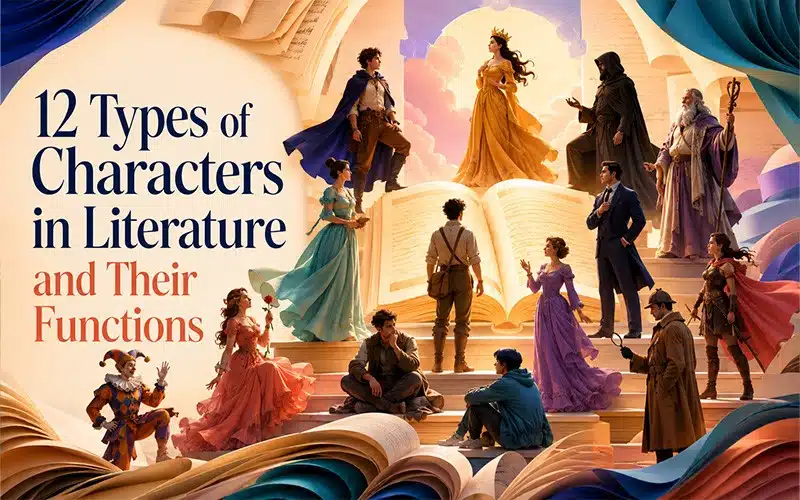
12 Types of Characters in Literature and Their Functions
The following types of characters are not mutually exclusive. A single fictional person may fit several categories because each label answers a different question. Is the character central to the plot? Does that person oppose someone else? Are they psychologically complex? Do they change?
Understanding that overlap makes the following character types much easier to recognize and use.
- Protagonist
The protagonist is the central character whose goal, struggle, or experience drives the main narrative. Readers usually follow the story through this person’s actions or emotional journey, although the protagonist is not always the narrator.
Katniss Everdeen is the protagonist of Suzanne Collins’s The Hunger Games. Her decision to volunteer for her sister places her at the center of the conflict, while her choices continue shaping the direction and consequences of the story.
A protagonist does not have to be heroic, likeable, or morally admirable. Some protagonists are selfish, unreliable, or deeply flawed. What defines them is their centrality. Their desires give the plot direction, and the consequences of their decisions give it emotional weight.
When writing a protagonist, begin with a clear desire. What does this person want, why does it matter, and what are they willing to risk to obtain it? A protagonist who merely reacts to events can feel passive. One who makes consequential decisions becomes an active force in the story.
- Antagonist
An antagonist is a character, group, or institution that obstructs the protagonist’s main objective. In some narratives, nature, society, illness, or an internal struggle serves as the broader antagonistic force. Although antagonists are frequently described as villains, the two terms are not identical.
President Snow functions as a major antagonist in The Hunger Games because he protects the oppressive system Katniss threatens. His political power, manipulation, and violence continually stand between her and the freedom she seeks.
The conflict between the protagonist and antagonist works best when both sides have understandable objectives. They do not need equal moral justification, but each should have something meaningful at stake. An antagonist who believes in their own reasoning will usually feel more convincing than someone who behaves cruelly without motivation.
An antagonist does not even have to be human. A storm, illness, social convention, government, wilderness, or destructive belief may create the central opposition. In some psychological stories, the protagonist’s own fear or guilt becomes the strongest opposing force.
The key question is not, “Who is evil?” It is, “What prevents the central character from achieving the goal?”
- Deuteragonist
The deuteragonist is the second-most important character in a narrative. This person often supports, challenges, accompanies, or emotionally anchors the protagonist, but has greater significance than an ordinary member of the supporting cast.
Samwise Gamgee in J.R.R. Tolkien’s The Lord of the Rings is a powerful example. Frodo carries the Ring and occupies the central role, but Sam’s loyalty, courage, and practical strength become essential to the journey. He does not simply stand beside Frodo. He influences whether the mission can continue at all.
A deuteragonist may be a best friend, partner, sibling, rival, or even an antagonist. The term describes narrative importance rather than a fixed relationship. In stories with dual leads, deciding who is the protagonist and who is the deuteragonist may also depend on whose central objective organizes the plot.
Writers should give this character an independent desire and emotional life. If the deuteragonist exists only to agree with the protagonist, the relationship can feel artificial. Support becomes more believable when it comes from someone who has personal fears, values, and limits.
- Tertiary Character
A tertiary character appears in a smaller capacity and performs a limited but useful narrative function. This person may deliver information, complicate one scene, represent part of the social environment, or help make the fictional world feel populated and credible.
The Apothecary in William Shakespeare’s Romeo and Juliet is a clear example. He appears briefly when Romeo purchases the poison he later uses in the tomb. Although the Apothecary receives little development or page time, his decision directly enables one of the tragedy’s most consequential events.
Limited page time does not make a tertiary character meaningless. A shopkeeper who reveals a clue, a neighbor who spreads a rumor, or a teacher who recognizes a student’s ability can influence the story without receiving a complete arc.
The challenge is proportion. Giving every minor figure an extensive history can slow the narrative, while making them completely generic can weaken the setting. A few specific details, such as an unusual habit, attitude, or way of speaking, can make a tertiary character memorable without shifting attention away from the central cast.
- Confidant or Confidante
A confidant, traditionally called a confidante when female, is a trusted character to whom another person reveals private thoughts, worries, intentions, or secrets. This relationship gives readers access to information that might otherwise remain internal.
Horatio performs this function for Hamlet in Shakespeare’s Hamlet. He listens, observes, and earns Hamlet’s trust. Because Hamlet can speak openly with him, audiences gain a clearer understanding of Hamlet’s suspicions, decisions, and emotional condition.
A confidant can also do more than listen. They may question the protagonist’s reasoning, warn against a dangerous decision, keep a secret, or eventually break that trust. These possibilities turn the relationship into part of the drama rather than a convenient method of delivering information.
Writers should avoid using a confidant solely as a passive audience for exposition. Give this person opinions, boundaries, and reasons for maintaining the relationship. A meaningful confidant may comfort the protagonist in one scene and confront them in another.
- Foil Character
A foil is someone whose contrasting qualities highlight important traits in another character. The contrast may involve personality, values, upbringing, choices, or responses to similar circumstances.
Draco Malfoy acts as a foil to Harry Potter. Both boys enter the wizarding world with inherited connections to its conflicts, but they respond differently to power, prejudice, friendship, and fear. Draco’s choices help illuminate Harry’s values, just as Harry’s actions reveal what Draco lacks or avoids.
A foil is not necessarily an enemy. Friends, siblings, romantic partners, and mentors can all serve this purpose. Nor is every foil part of the central protagonist and antagonist relationship. Opposition creates obstacles, while contrast creates understanding. A character may perform both functions, but the concepts remain different.
The most effective foils share at least one meaningful similarity. Contrast becomes more revealing when two people face comparable pressures but choose different responses. Without that common ground, they may simply seem unrelated.
- Love Interest
A love interest is a character whose romantic connection with another person affects the plot, emotional stakes, or development. This figure may become a partner, represent an unattainable desire, create conflict, or force another character to confront vulnerability.
Mr Darcy is Elizabeth Bennet’s love interest in Pride and Prejudice, but he is not merely the reward waiting at the end of her story. He has pride, responsibilities, mistaken assumptions, and an arc of his own. Their relationship matters because both characters must reconsider their initial judgements.
A weakly written love interest exists only to appear attractive, provide motivation, or validate the protagonist. A convincing one has independent priorities and can make choices that inconvenience the central character.
Romantic relationships should also influence the story in specific ways. Ask what the relationship reveals, threatens, or changes. If removing the romance makes no meaningful difference, either the character needs a stronger function or the subplot may not be necessary.
- Mentor
A mentor provides knowledge, guidance, training, or moral direction. Mentors often prepare less experienced characters for challenges they cannot yet face alone.
Haymitch Abernathy serves as a flawed mentor to Katniss and Peeta in The Hunger Games. He understands the Capitol, the audience, and the deadly performance expected from tributes. His advice is valuable, but his trauma, drinking, and abrasive behavior prevent him from becoming a simple figure of perfect wisdom.
That imperfection matters. Mentors can misunderstand situations, hide information, disappoint their students, or teach lessons that eventually need to be rejected. A mentor who always knows the correct answer may remove uncertainty from the plot.
The mentor’s job is not to complete the protagonist’s journey on their behalf. Instead, this person supplies tools, knowledge, or perspective. At some point, the central character must decide how to use what has been learned.
- Round Character
A round character possesses psychological depth, multiple traits, and believable contradictions. Readers see more than one side of the person, often discovering fears, desires, prejudices, virtues, and private vulnerabilities that complicate their first impression.
Elizabeth Bennet is a round character. She is intelligent, observant, affectionate, and independent, but she can also be proud, hasty, and overly confident in her judgement. These qualities sometimes work together and sometimes place her in conflict with herself.
Roundness is about complexity, not morality. Villains and minor figures can be round, while a heroic person can remain comparatively simple. It is also not the same as transformation. Among static and dynamic characters, either one may be psychologically layered. A round person can remain consistent from beginning to end.
Writers create roundness through meaningful contradictions rather than random traits. A brave character might fear emotional intimacy. A generous character might resent being needed. Such tensions should grow from experience, values, and circumstances.
- Flat Character
A flat character is constructed around one dominant quality, idea, or function. This person receives limited psychological development because the story does not require greater complexity.
Flat characters are sometimes treated as evidence of poor writing, but that is misleading. Not every person in a novel needs an elaborate past, an internal conflict, and a transformative arc. Overdeveloping minor figures can distract readers and weaken the narrative’s focus.
Mr Collins is often used as an example because his self-importance, social awkwardness, and obsession with status remain highly consistent. Austen gives him a clear function and makes that limited construction memorable through precise behavior and dialogue.
The difference between an effective flat character and a weak one is intention. An effective character performs a clear role and feels suited to the fictional world. A weak character appears shallow even though the story expects readers to invest deeply in them.
- Dynamic Character
A dynamic character undergoes a meaningful internal change during the story. This transformation may affect the person’s beliefs, values, priorities, emotional maturity, or understanding of themselves and others.
Ebenezer Scrooge in Charles Dickens’s A Christmas Carol is one of literature’s clearest examples. He begins as an isolated man who values money over human connection. After confronting his past, present, and possible future, he becomes generous and emotionally open.
A change in location, clothing, age, wealth, or physical ability does not automatically make a character dynamic. The transformation must reach the person’s inner outlook and influence later decisions.
Not every transformation has to be positive. A character may become bitter, corrupt, fearful, or morally compromised. What matters is that the narrative experiences leave a lasting internal effect.
When developing static and dynamic characters, writers should build change through pressure, choices, consequences, and gradual realization. A sudden reversal without sufficient preparation can feel like convenience rather than growth.
- Static Character
A static character remains fundamentally consistent throughout the narrative. Events may alter this person’s circumstances, relationships, or surroundings, but their central personality and worldview do not change significantly.
Sherlock Holmes remains largely static across many of Arthur Conan Doyle’s stories. Individual mysteries test his reasoning, place him in danger, and reveal different elements of his personality, but they do not regularly transform his essential outlook.
Static does not mean boring, simple, or inactive. A static protagonist may change the people or world around them precisely because their convictions remain firm. Likewise, a consistent supporting character can provide stability while others undergo dramatic development.
The distinction between static and dynamic characters concerns transformation, not quality. Both can be convincing when their development matches the purpose of the story.
These 12 types of characters in literature provide a flexible way to examine a fictional cast. They also clarify why the protagonist and antagonist alone cannot carry every narrative function. Stories gain depth from contrasts, confidences, guidance, romance, secondary goals, and different degrees of complexity.
Rather than forcing every person into one category, use these types of characters as overlapping lenses. One character might be a deuteragonist, confidant, foil, round character, and static character simultaneously. Recognizing those layers gives readers a richer understanding of literature and helps writers build casts that feel purposeful rather than crowded.
How Character Categories Overlap
The classifications above describe different dimensions of a fictional person. Some identify narrative importance, others explain relationships, and others measure complexity or development. That is why the same character can fit several character types without creating a contradiction.
| Classification | Question It Answers | Examples |
| Narrative role | What does the character do? | Protagonist, antagonist, mentor |
| Narrative importance | How central is the character? | Protagonist, deuteragonist, tertiary character |
| Relationship | How does the character affect someone else? | Foil, confidant, love interest |
| Complexity | How psychologically developed are they? | Round or flat |
| Development | Do they change internally? | Dynamic or static |
Ebenezer Scrooge, for example, is simultaneously a protagonist, round character, and dynamic character. Samwise Gamgee is a deuteragonist, confidant, foil, and round character whose courage becomes increasingly visible throughout the journey. Draco Malfoy sometimes functions as both an antagonist and a foil to Harry Potter.
This overlap also explains why the protagonist and antagonist should not be treated as opposites in every possible sense. Their conflict describes their relationship to the plot, not their complexity or capacity for change.
Similarly, round and dynamic are not interchangeable. Roundness describes depth, while static and dynamic characters are distinguished by whether meaningful internal transformation occurs. A layered character can remain unchanged, and a comparatively simple one can experience a clear shift in outlook.
Understanding the types of characters in literature becomes much easier once these categories are viewed as flexible lenses. These types of characters help us examine different qualities rather than forcing every fictional person into one permanent box. Viewing the types of characters this way leads to more accurate literary analysis and more purposeful character creation.
How to Choose the Right Characters for Your Story
Writers do not need to include all 12 types of characters in every story. A short story may work beautifully with three important figures, while an epic fantasy novel might require an extensive cast. The right number depends on the length, genre, central conflict, and emotional scope of the narrative.
Start with the protagonist. Identify what this person wants, why the goal matters, and what will happen if they fail. Next, determine who or what creates meaningful opposition. From there, add people who reveal another side of the protagonist, provide guidance, increase emotional pressure, or pursue goals of their own.
Before introducing someone new, apply this quick character-function test:
- What does this character want?
- How do they affect the central conflict?
- What do they reveal about another person?
- Would the story change if they were removed?
- Should they transform, or is their consistency more valuable?
If two minor characters perform the same job, consider combining them. This can give the surviving character greater depth while making the story easier to follow.
The strongest casts are not necessarily the largest. They contain people whose desires intersect, conflict, and produce consequences. Understanding the available character types helps writers make those choices deliberately. Instead of asking how many types of characters a story contains, ask whether each person creates pressure, meaning, movement, or emotional connection.

Common Mistakes When Writing Different Character Types
One common mistake is assuming that a protagonist must be morally good and an antagonist must be evil. Morality and narrative function are separate matters. A deeply flawed person can occupy the center of a story, while a reasonable opponent may stand against them for understandable reasons.
Writers also sometimes confuse complexity with change. A round character does not have to transform, and a dynamic character still needs more than one sudden decision to make their development convincing.
Other mistakes include:
- Treating a foil as nothing more than an enemy
- Giving a love interest no identity outside the romance
- Making a mentor wise, flawless, and consistently correct
- Adding minor characters who contribute no information, tension, or meaning
- Giving every supporting character the same voice or opinion
- Mistaking unexpected behavior for believable development
- Forcing every important character to complete a dramatic transformation
- Using stereotypes in place of specific personalities and motivations
When working with different types of characters, purpose should come before labels. A character should not appear simply because a story seems to need a mentor, rival, or romantic partner. That person should want something, make choices, and affect what happens next. Even a minor figure becomes valuable when their presence changes a decision, relationship, or consequence.
America Publishers Author Spotlight examines literature, authorship, publishing, and the creative decisions behind memorable books. Its educational articles are designed to make literary ideas more accessible while encouraging thoughtful discussion among readers and writers. This wider focus provides useful context for understanding how individual storytelling elements work together to shape a complete narrative.
Frequently Asked Question
-
What are the main types of characters?
The main categories include the protagonist, antagonist, deuteragonist, tertiary character, confidant, foil, love interest, mentor, round character, flat character, dynamic character, and static character. Each category describes a character’s function, importance, complexity, relationships, or development.
-
Can one character belong to several categories?
Yes. These classifications frequently overlap. A protagonist can also be round, dynamic, and someone else’s love interest. The labels examine different aspects of the same person rather than placing every character into one exclusive category.
-
What is the difference between a protagonist and antagonist?
The protagonist and antagonist occupy opposing positions in the central conflict. The protagonist pursues the story’s main objective, while the antagonist creates resistance. Neither role automatically determines whether a character is morally good or evil.
-
What is the difference between round and dynamic characters?
A round character has psychological depth, multiple traits, and believable contradictions. A dynamic character experiences meaningful internal change. A person can therefore be round but remain static, or undergo a clear transformation without being deeply complex.
-
Can a protagonist be a static character?
Yes. Some protagonists maintain their central beliefs throughout the narrative while changing the people or circumstances around them. The distinction between static and dynamic characters depends on internal transformation, not narrative importance.
-
Does every story need all 12 character categories?
No. The number and variety of characters should suit the story’s length, genre, conflict, and emotional scope. A smaller cast with clear functions is usually more effective than a crowded cast included merely to satisfy a checklist.
Conclusion
Understanding the types of characters in literature gives readers a clearer view of how stories create conflict, reveal personality, and produce emotional change. For writers, these classifications offer a practical vocabulary for building a purposeful cast.
However, the labels should guide storytelling rather than restrict it. A single person may act as a protagonist, round character, confidant, or foil at different points in a narrative. What matters most is not the number of categories a character fits, but whether their desires, choices, relationships, and consequences feel believable. When every member of the cast contributes something meaningful, the fictional world becomes more focused, convincing, and memorable.
