
Published on September 2, 2026
Conflict examples often begin with one simple question: What does a character want, and what is stopping them from getting it? A teenager wants to confess the truth but fears losing a friendship. A firefighter must reach a trapped family before the flames block the only road. One character is fighting a private battle; the other is confronting a visible danger. Both situations immediately give the reader a reason to care about what happens next.
Conflict is the pressure that turns an ordinary situation into a story. It creates uncertainty, forces difficult choices, and reveals what characters value when something important is at risk. Without meaningful opposition, even an interesting character or imaginative setting can struggle to hold the reader’s attention.
The strongest examples of conflict are not limited to arguments, battles, or obvious villains. Some unfold quietly inside a character’s mind. Internal conflict examples may involve guilt, temptation, identity, or divided loyalty, while external conflict examples can place characters against other people, society, nature, technology, fate, or supernatural forces.
Many memorable conflict examples in literature combine both forms. An external obstacle may intensify a character’s fear or self-doubt, while an unresolved inner struggle may make the outside problem harder to overcome.
In this guide, you will explore 100 conflict examples organized by type, recognizable literary cases, and practical techniques for identifying and creating struggles that move stories forward.
Affiliate Disclosure: As an Amazon Associate I earn from qualifying purchases at no additional cost to you.
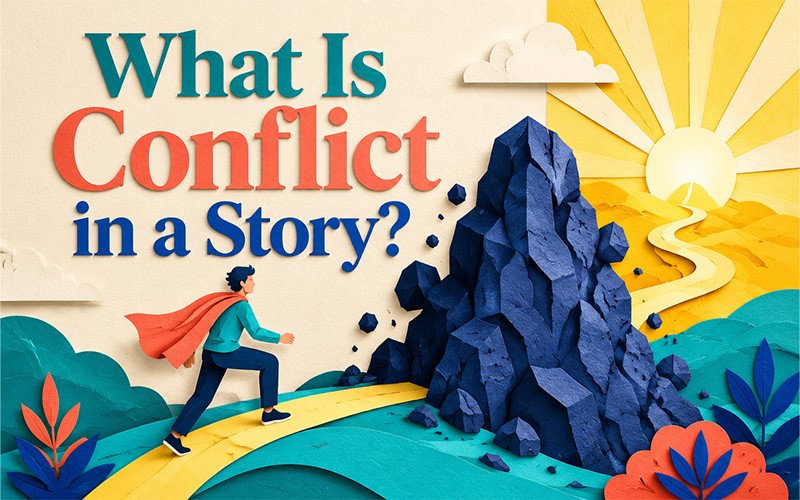
What Is Conflict in a Story?
Conflict is the struggle created when something prevents a character from achieving a goal. The character wants, needs, believes, or fears something, but another person, an outside force, or their own thoughts stand in the way. This opposition creates uncertainty: Will the character succeed, fail, compromise, or discover that the original goal was wrong?
A disagreement alone is not necessarily a meaningful story conflict. Two friends arguing over where to eat may create a brief moment of tension, but the scene becomes significant only when something valuable is at stake. Perhaps one friend is avoiding the restaurant because it holds a painful memory. Suddenly, the visible disagreement reveals a deeper emotional problem.
A useful way to understand conflict is through a simple formula:
Character + desire + obstacle + consequence = conflict
Consider these examples of conflict: a student wants to admit that they cheated but fears losing a scholarship, while a firefighter wants to reach an isolated family before a spreading wildfire cuts off the road. The first situation belongs among internal conflict examples because the decisive struggle occurs within the student. The second belongs among external conflict examples because a dangerous physical force blocks the firefighter’s goal.
Strong conflict does more than keep a plot moving. It exposes what a character values, forces difficult choices, and gives actions consequences. When the obstacle becomes more demanding, the audience begins asking questions: How far will the character go? What will they sacrifice? And who might they become under pressure?
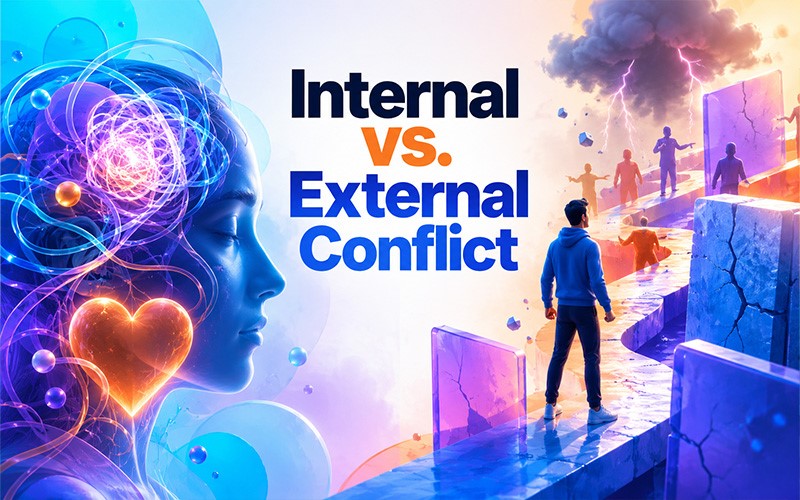
Internal vs. External Conflict: What Is the Difference?
Internal conflict happens within a character’s mind or emotions. The person may feel divided between two desires, values, responsibilities, or versions of themselves. They might love someone they cannot trust, want success but fear public attention, or know the right decision while dreading its consequences. Many internal conflict examples revolve around guilt, identity, temptation, grief, self-doubt, or competing loyalties.
External conflict comes from outside the character. An opponent, social institution, storm, machine, supernatural force, or apparently unavoidable fate interferes with the character’s goal. Common external conflict examples include a journalist challenging a corrupt government, a climber trapped by severe weather, or a family trying to escape a house controlled by malfunctioning technology.
The difference sounds straightforward, but compelling stories rarely keep the two completely separate. A character escaping a flood may also blame themselves for ignoring an evacuation warning. The flood creates the external struggle, while guilt creates the internal one. Each problem intensifies the other.
This overlap appears frequently in conflict examples in literature. In Hamlet, the prince faces people who may be responsible for his father’s death, but he also wrestles with doubt, grief, anger, and the morality of revenge. In The Hunger Games, Katniss confronts a violent political system while privately struggling with fear, responsibility, and the emotional cost of survival.
Looking closely at conflict examples in literature therefore requires more than naming an antagonist. Ask two separate questions: What outside force blocks the character, and what unresolved struggle affects the character’s response? If both answers matter, the story is using layered conflict. That combination often produces richer characters because winning the visible battle does not automatically resolve the struggle within.
Recommended Conflict Guide
Explore a wide range of obstacles, adversaries, inner struggles, and difficult choices for developing meaningful story conflict.
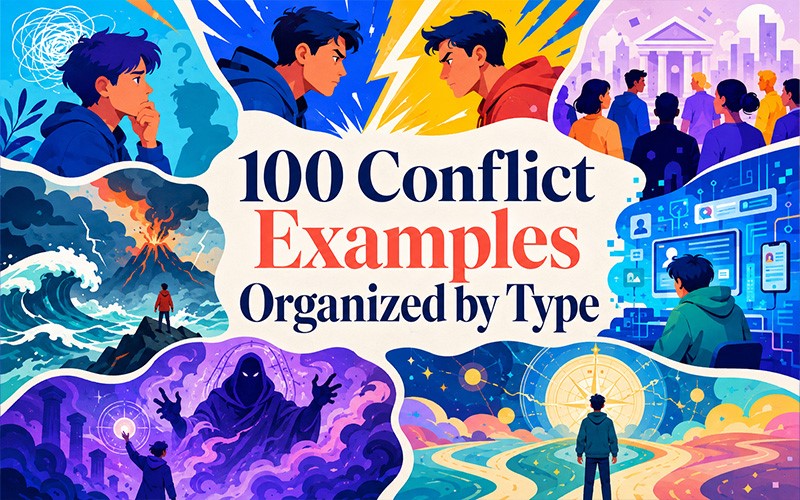
100 Conflict Examples Organized by Type
The following examples of conflict are grouped by the force opposing the character. Some could fit more than one category, especially when an outside obstacle produces an emotional struggle. As you read, notice the character’s goal, what blocks it, and what may be lost if the character fails.
Conflict Resource for Writers
Find additional conflict scenarios involving power struggles, threats, setbacks, disadvantages, and losses of control.
View on Amazon (ad)
Character vs. Self: 25 Examples
These internal conflict examples focus on private struggles involving emotions, beliefs, memories, values, and difficult choices.
- A student must decide whether to report a best friend for cheating.
- A successful lawyer wonders whether professional recognition is worth sacrificing family time.
- A recovering addict feels tempted to return to an old habit during a crisis.
- A soldier follows orders while privately questioning whether the mission is morally right.
- A teenager hides a creative passion because they fear disappointing their parents.
- A doctor struggles to remain confident after making a serious mistake.
- A bride begins questioning whether she truly wants to get married.
- A witness wants to tell the truth but fears retaliation from the accused.
- An athlete must choose between protecting an injury and competing in a championship.
- A grieving father feels guilty whenever he experiences happiness after his child’s death.
- A new manager doubts whether they deserve the promotion they received.
- A politician must choose between personal principles and the demands of the party.
- A woman considers forgiving someone who has never apologized to her.
- A musician craves recognition but becomes overwhelmed whenever people pay attention.
- A teenager changes their personality to gain acceptance from a popular group.
- A detective fears that personal anger is influencing an important investigation.
- A parent wants to protect a child but realizes that constant protection prevents independence.
- A wealthy heir considers rejecting an inheritance built through unethical business practices.
- A young adult feels divided between cultural expectations and an independent identity.
- A writer repeatedly abandons promising work because criticism feels unbearable.
- A nurse feels exhausted yet ashamed to admit that compassion has become difficult.
- A former bully wants to apologize but fears confronting the harm they caused.
- A leader must decide whether admitting uncertainty will weaken or strengthen public trust.
- A survivor struggles to accept help because independence once ensured their safety.
- A scientist discovers evidence that could disprove a theory they spent decades developing.
These internal conflict examples work because the character cannot simply defeat an opponent or escape a dangerous place. Progress requires self-recognition, sacrifice, acceptance, or a decision that changes how the character sees the world.
Character vs. Character: 15 Examples
Many external conflict examples begin when two people pursue incompatible goals, even if neither person is entirely wrong.
- Two siblings compete to inherit control of the family business.
- A detective pursues a criminal who anticipates every investigative move.
- Two journalists race to publish the same major story first.
- A tenant challenges a landlord who refuses to repair an unsafe building.
- Former friends become rivals for a leadership position at work.
- A mother and daughter disagree over a life-changing marriage proposal.
- A defense attorney faces a prosecutor convinced that the accused is guilty.
- Two explorers fight over whether to continue a dangerous expedition.
- A coach benches a talented player who refuses to support the team.
- A whistleblower confronts the executive who ordered evidence to be destroyed.
- Two neighbors clash over access to a shared water supply.
- A king’s adviser secretly works to remove him from power.
- A student challenges a teacher who applies classroom rules unfairly.
- An estranged couple fights over what future is best for their child.
- A superhero must stop a villain who was once a trusted mentor.
Character vs. Society: 15 Examples
This category often appears among conflict examples in literature because social rules can pressure characters to choose between belonging and living according to their principles.
- A journalist publishes information that an authoritarian government has censored.
- A girl demands an education in a community that forbids her from attending school.
- An employee exposes discrimination within a powerful corporation.
- A couple challenges a law that prevents them from marrying.
- A teenager rejects a tradition that determines their future occupation.
- A librarian secretly protects books that authorities have ordered destroyed.
- A factory worker organizes colleagues against dangerous working conditions.
- An artist refuses to create propaganda for the ruling government.
- A family fights eviction caused by an unfair redevelopment project.
- A student protests a school policy that targets a minority group.
- A doctor treats patients whom the state has declared undeserving of care.
- A citizen refuses to participate in a compulsory surveillance program.
- A young woman attempts to enter a profession that powerful institutions still try to keep closed to women.
- A community challenges an institution polluting its drinking water.
- A public official exposes corruption knowing the revelation may end their career.
Character vs. Nature: 10 Examples
Nature does not need malicious intent to become a powerful opponent. These situations also belong among external conflict examples because survival depends on overcoming forces outside the character’s control.
- A sailor tries to guide a damaged boat through a hurricane.
- Hikers become stranded when an avalanche blocks their route home.
- A farmer struggles to protect crops during a severe drought.
- A family searches for safety as wildfire approaches their town.
- A pilot makes an emergency landing during a violent snowstorm.
- A researcher becomes isolated when shifting polar ice cuts off the research station’s only supply route.
- A child lost in a forest must survive a freezing night.
- Villagers race to reinforce a riverbank before devastating floods arrive.
- A climber runs out of oxygen near a mountain summit.
- An injured swimmer attempts to reach shore against a dangerous current.
Character vs. Technology: 10 Examples
Modern examples of conflict increasingly involve systems that influence identity, privacy, employment, information, and control.
- A programmer discovers that an artificial intelligence system is making important decisions its designers cannot explain.
- A woman tries to prove her identity after a deepfake destroys her reputation.
- Workers resist an algorithm that dismisses employees without human review.
- A family becomes trapped inside a smart home during a system failure.
- A driver must regain control of an autonomous vehicle after its sensors malfunction.
- A journalist investigates an app secretly collecting children’s personal information.
- A patient challenges medical software that repeatedly produces an incorrect diagnosis.
- Citizens develop ways to evade surveillance drones that monitor every movement in their city.
- An astronaut repairs a damaged life-support system before the oxygen supply fails.
- A teacher confronts technology that falsely accuses students of academic dishonesty.
Character vs. the Supernatural: 10 Examples
Supernatural struggles range from frightening encounters to moral bargains. They also produce memorable conflict examples in literature, folklore, fantasy, and horror.
- A family moves into a home where a ghost repeats an unfinished warning.
- A child discovers that every wish removes someone else’s happiest memory.
- A village must break a curse passed through generations.
- A musician bargains with a mysterious figure and later regrets the price.
- A priest confronts an entity that feeds on the community’s secrets.
- A traveler unknowingly accepts hospitality from a dangerous mythical creature.
- A woman is followed by a shadow that reveals her hidden fears.
- A group of friends awakens something ancient beneath their town.
- A healer must use forbidden magic to save a dying child.
- A king fights an immortal enemy that cannot be defeated by ordinary weapons.
Character vs. Fate: 10 Examples
In these situations, characters resist a prophecy, inherited destiny, fixed future, or pattern that seems impossible to escape.
- A prince attempts to prevent a prophecy that says he will destroy his kingdom.
- A woman relives the same day while trying to stop a fatal accident.
- A child born into a royal family refuses the throne prepared for them.
- A hero tries to prevent a fortune-teller’s prediction as each part of it begins coming true.
- A man discovers that every firstborn child in his family has followed the same destructive path and tries to break the pattern.
- A warrior learns from a prophecy that victory will cost the life of someone they love.
- A traveler receives visions of a coming disaster and struggles to prevent an event no one else believes will happen.
- A family attempts to break a cycle of revenge that seems destined to continue through every generation.
- A queen attempts to change a future recorded in an ancient book.
- A scientist travels back in time but unintentionally creates the event they hoped to prevent.
Layered Conflict: 5 Examples
The final five situations combine inward and outward struggles. They demonstrate why the most convincing stories rarely rely on only one source of pressure.
- A doctor must save a rival’s life while struggling with unresolved resentment.
- A firefighter enters a collapsing building while confronting memories of a previous failed rescue.
- A whistleblower battles a corrupt company but also fears becoming isolated from loyal colleagues.
- A teenager escapes an abusive home while wondering whether leaving a younger sibling behind is unforgivable.
- A leader defends a city from invasion while privately doubting the decisions that caused the war.
Together, these situations show that conflict can be physical, psychological, social, moral, technological, or symbolic. The strongest examples of conflict do not merely delay a character’s success. They force the character to reveal what matters and decide what they are willing to risk.
Conflict in Literature and Popular Storytelling
Some of the most recognizable examples of conflict come from stories in which several struggles operate simultaneously. A character may face an obvious opponent while also wrestling with fear, guilt, ambition, or uncertainty.
Shakespeare’s Hamlet contains one of the best-known internal conflict examples. After the Ghost identifies Claudius as his father’s murderer, Hamlet believes he must pursue revenge. Yet doubt, grief, anger, and moral hesitation repeatedly complicate his actions. Claudius creates the central external danger, but much of the drama comes from Hamlet’s inability to act with certainty.
In Suzanne Collins’s The Hunger Games, Katniss Everdeen faces a government that controls citizens through fear and public violence. Her struggle against the Capitol belongs among external conflict examples, while her private concern for her family and uncertainty about whom to trust add emotional pressure.
Ernest Hemingway’s The Old Man and the Sea places Santiago against the sea, physical exhaustion, and the marlin he is determined to catch. His struggle is also connected to dignity, endurance, and his desire to restore confidence after 84 days without catching a fish.
George Orwell’s 1984 presents an individual resisting a society built upon surveillance, censorship, and control. Mary Shelley’s Frankenstein, meanwhile, develops conflict between creator and creation while exploring rejection, responsibility, loneliness, and revenge.
These conflict examples in literature remain compelling because the obstacles matter on more than one level. The external struggle gives the plot direction, while the internal struggle gives it emotional meaning. Removing either layer would leave the story less powerful.
Recommended Storytelling Guide
Understand how character goals, opposition, moral choices, and consequences work together to build a compelling story.
How to Identify and Create Strong Conflict
Whether you are analyzing a published story or developing one of your own, start by asking a simple question: What does the character want right now? A goal makes the struggle visible. Without one, even dramatic events can feel disconnected.
Next, identify the obstacle. Is another person interfering? Is society enforcing an unjust rule? Is the character facing nature, technology, fate, or a private fear? Strong conflict examples make this opposing force specific enough for readers to understand why progress is difficult.
Build Stronger Story Obstacles
Discover obstacles that challenge a character’s external goal while creating doubt, fear, guilt, or conflict within.
View on Amazon (ad)Then determine the stakes. What happens if the character fails? The consequence could be physical danger, a damaged relationship, lost freedom, public humiliation, or the collapse of a belief that has shaped the character’s identity. Bigger stakes are not automatically better; personal consequences often feel more powerful than global ones.
Use this four-question check:
- What does the character want?
- What prevents them from getting it?
- What will failure cost?
- What difficult choice must they make?
Finally, allow the pressure to change. Do not repeat the same argument or obstacle in several scenes. Reveal new information, increase the cost, remove an easy solution, or make the character choose between two meaningful outcomes. Effective conflict does not simply create noise. It tests values, exposes weaknesses, and pushes a character toward a decision that can no longer be avoided.
Create Escalating Conflict
Explore fresh complications and pressures that increase the stakes without repeating the same argument or obstacle.
View on Amazon (ad)
America Publishers Author Spotlight shares educational resources on storytelling, literature, books, and the people behind them. Through its website, readers can explore ideas that deepen their understanding of stories and the craft of writing.
Frequently Asked Question
-
What are the main types of conflict?
The two broad categories are internal and external conflict. More specific types include character versus self, character versus character, character versus society, character versus nature, character versus technology, character versus the supernatural, and character versus fate. A single story can use several types at the same time.
-
What are five simple types of conflict?
Five common types are character versus self, character versus character, character versus society, character versus nature, and character versus technology. Each type describes the main force preventing a character from reaching a goal.
-
What are some internal conflict examples?
Common internal conflict examples include choosing between ambition and family, feeling guilty about a past decision, resisting temptation, questioning one’s identity, or knowing the right action but fearing its consequences.
-
What are some external conflict examples?
Typical external conflict examples include confronting an enemy, surviving a storm, resisting an unjust law, escaping a dangerous machine, or fighting a supernatural force. In each case, the main obstacle exists outside the character.
-
Can a story have more than one conflict?
Yes. Most developed stories contain several connected conflicts. An outside danger may create fear or self-doubt, while an internal decision may worsen the external situation. These overlapping pressures make characters and plots feel more realistic.
-
Why are conflict examples in literature important?
Studying conflict examples in literature helps readers understand motivation, themes, relationships, and character development. It also helps writers see how obstacles and difficult choices can sustain tension while giving a story emotional meaning.
Conclusion
Conflict is what turns a situation into a story. It gives characters something meaningful to pursue, resist, fear, or overcome. More importantly, it places them under enough pressure to reveal who they really are.
An internal struggle takes place within a character, while an external struggle comes from another person, society, nature, technology, the supernatural, or fate. However, memorable stories often combine these forces. A character may survive the storm but remain burdened by guilt, defeat an enemy but question the cost, or challenge society while struggling to believe that change is possible.
Develop Conflict Through Story Structure
Learn how desire, opposition, character development, and difficult decisions connect across an entire narrative.
View on Amazon (ad)
When reading a story, look beyond the most visible obstacle. Ask what the character wants, what stands in the way, what failure would cost, and what personal struggle affects every choice. When writing your own story, use conflict to create meaningful decisions, not simply arguments or danger. The real power of conflict lies in how it forces characters to act, change, and show readers what truly matters.