

Published on June 26, 2026
Memoir vs autobiography is one of those writing terms that sounds simple at first but often confuses even regular readers. Both deal with real-life stories, both are based on personal experiences, so it’s easy to assume they mean the same thing.
But once you look a little closer, the difference becomes much clearer. The way a story is told, what is included, and what is left out all depend on the type of writing. Understanding this helps you see how writers shape real-life events into very different reading experiences.
Instead of covering everything in a person’s life, some books focus deeply on specific moments, emotions, or turning points. Others take a more complete and structured approach, walking through life from beginning to present. That difference is exactly what separates these two forms of writing.
To really understand them, it’s important to first get clear on what each one means and how they work in practice. Once that’s clear, the confusion around memoir vs autobiography starts to disappear naturally.
What Is a Memoir and What Is an Autobiography?
To understand memoir vs autobiography, you first need to look at how each one is defined and what makes them different in purpose and structure.
A memoir focuses on a specific part of a person’s life rather than the entire journey. When people talk about memoir meaning, they are usually referring to a personal, emotional style of storytelling where the writer reflects on meaningful experiences, relationships, or turning points. It doesn’t try to cover everything that ever happened; it focuses on what felt important. That is why memoirs often feel more emotional and reflective.
On the other hand, an autobiography is more complete and structured. The autobiography definition refers to a written account of a person’s entire life, usually told in chronological order. It begins from early life and moves forward, covering major events, achievements, and experiences in a factual way. Unlike memoirs, autobiographies aim to present a full timeline rather than a selected theme.
When comparing memoir vs autobiography, the biggest difference lies in scope. One zooms in on selected life moments, while the other zooms out to show the full picture.
Both forms fall under life writing types, but they serve different storytelling goals depending on what the writer wants to express and how deeply they want to explore their life story.
Key Differences Between Memoir and Autobiography
When we look deeper into memoir vs autobiography, the differences become clearer not just in definition but in how each one is written and experienced by the reader.
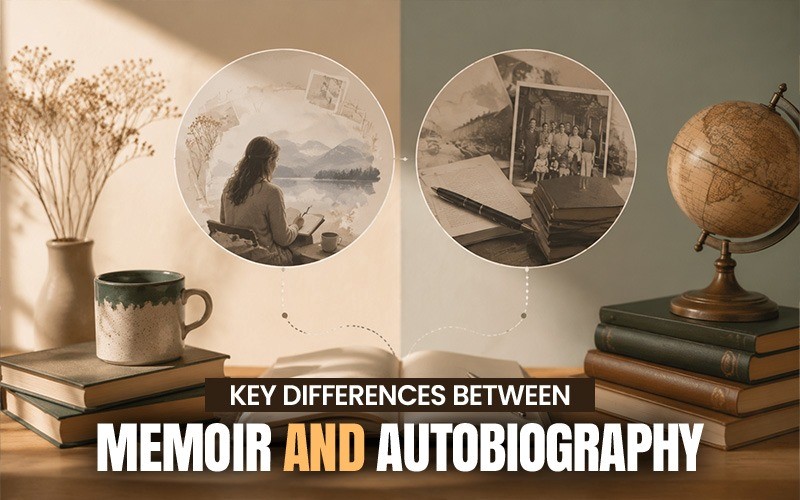
One major difference is focus. A memoir is theme-driven, meaning it revolves around a specific emotion, relationship, or life phase. An autobiography, however, is time-driven and follows the writer’s life from beginning to present in a structured way. This is where the autobiography definition becomes important again, because it highlights the idea of a complete life record.
Another key difference is tone. Memoirs often feel more personal, emotional, and reflective. They allow the writer to explore thoughts and feelings in depth, which is why readers often connect with them on a deeper emotional level. Autobiographies, on the other hand, tend to stay closer to facts and real events without focusing too heavily on interpretation.
The purpose also differs. In memoir vs autobiography, a memoir is usually written to share insight, meaning, or personal truth from a specific experience. An autobiography is written to document a life story as completely and accurately as possible.
Even within broader life writing types, these two stand out because they represent two very different approaches to telling real stories, one selective and emotional, the other complete and chronological.
Which One Should You Write (With Simple Examples)
Choosing between memoir vs autobiography really depends on what kind of story you want to tell and how you want your readers to experience it.
If you are someone who wants to focus on a specific phase of life, like a struggle, achievement, relationship, or transformation, then a memoir is usually the better choice. The idea behind is that not every story needs to cover everything; sometimes one meaningful chapter of life carries more emotional weight than the entire timeline. A memoir lets you slow down and explore those moments in depth.
On the other hand, if your goal is to document your entire journey from beginning to present, then an autobiography fits better. According to the autobiography definition, it is meant to give a complete and structured account of your life. This works well for public figures, professionals, or anyone who wants to preserve their full life story in a chronological form.
To put it simply in the context of memoir vs autobiography, think of a memoir like zooming into one powerful scene of your life, while an autobiography is like watching the full movie from start to finish.
For example, a traveler might write a memoir about a life-changing trip, while still writing an autobiography later that covers their entire journey through different countries, careers, and experiences.
Both forms are valid, and neither is better than the other, it just depends on what part of your story you want to highlight. This guide is brought together with insights inspired by discussions around storytelling and life writing, including resources like America Publishers Author Spotlight, which focuses on helping readers explore books and author-related topics in a simple and engaging way.
Frequently Asked Question
-
What is the difference between memoir and autobiography?
The main difference in memoir vs autobiography is that a memoir focuses on specific life experiences, while an autobiography covers the entire life story in chronological order.
-
What is memoir meaning?
Memoir meaning refers to a personal form of writing where the author reflects on selected memories or experiences that shaped their life emotionally or mentally.
-
What is autobiography definition?
The autobiography definition is a written account of a person’s entire life, usually told in sequence from early life to the present.
-
Are memoirs based on real life?
Yes, memoirs are based on real experiences, but they focus more on emotional truth and personal reflection rather than a full timeline.
-
Which is more detailed: memoir or autobiography?
In memoir vs autobiography, an autobiography is generally more detailed in terms of life coverage, while a memoir is deeper in emotional focus but limited in scope.
Conclusion
Understanding memoir vs autobiography becomes much easier once you realize they are not competing forms of writing but different ways of telling real-life stories. One focuses on emotional depth and selected experiences, while the other captures a full and structured life journey.
When you explore life writing types, you start to see how flexible storytelling can be. Whether you choose a memoir or an autobiography depends entirely on your purpose, your memories, and the message you want to leave behind.
At the end of the day, both styles help preserve real human experiences in meaningful ways, just from different angles.
