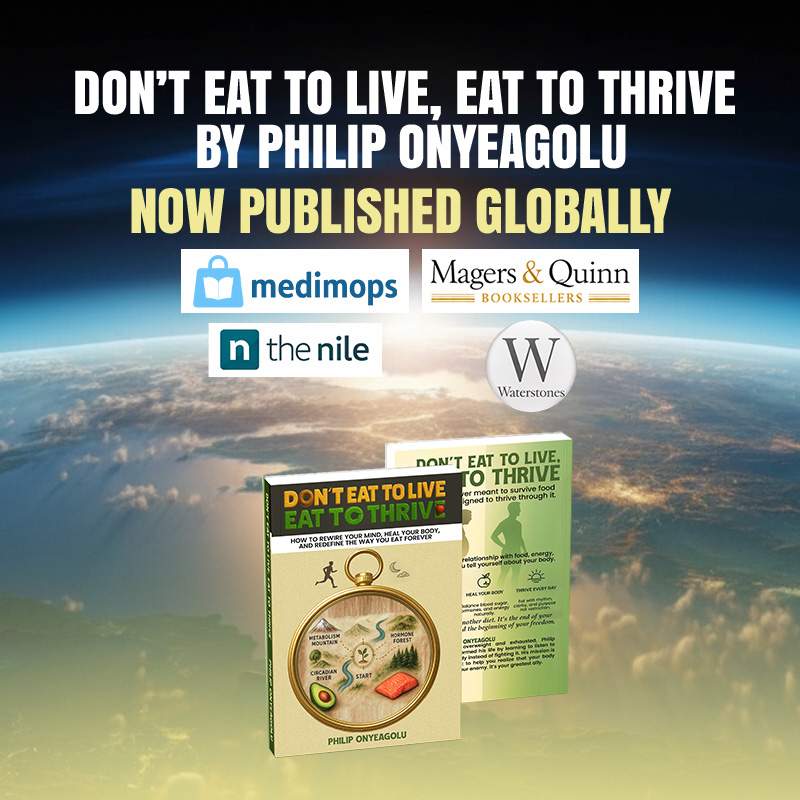
By addressing health as a lived experience rather than a fixed outcome, the book establishes itself as a grounded and globally relevant contribution to modern wellness literature.
Central to the book’s message is the understanding that food choices rarely exist in isolation. Don’t Eat to Live, Eat to Thrive explores how habits are shaped by stress, routine, emotional responses, and learned behaviors that often operate unconsciously. In this way, the book functions as a food mindset transformation book, inviting readers to observe their patterns without guilt or self-judgment.
Rather than prescribing rigid rules, the narrative focuses on awareness and internal recalibration. This allows the book to stand clearly as a nutrition and mental rewiring book, where change begins with understanding how thought patterns influence physical behavior. By reframing eating as a response to internal cues rather than external pressure, the book also aligns with the principles of a healthy eating mindset book.
This section reinforces the idea that sustainable health begins not with restriction, but with insight and intentional change.
Rather than isolating food from the broader context of daily living, Don’t Eat to Live, Eat to Thrive approaches wellbeing as an interconnected system shaped by physiology, routine, and mental awareness. This framing places the work clearly within the category of a holistic health nonfiction book, where health is understood as a balance between nourishment, recovery, movement, and internal regulation.
The narrative encourages readers to move away from fragmented thinking that treats symptoms without examining underlying causes. Food is discussed as one component within a larger framework, aligning the book with the principles of a holistic nutrition book that considers how lifestyle patterns influence long-term outcomes.
By addressing health through integration rather than intervention, the book supports a wellness lifestyle change book model that values sustainability, adaptability, and informed self-awareness over rigid plans or extremes.
A defining element of the book is its refusal to promise rapid results without lasting impact. Instead of reinforcing cycles of reset and relapse, Don’t Eat to Live, Eat to Thrive positions health as a gradual process shaped by consistency and understanding. This approach allows it to function as a health transformation book grounded in realism rather than urgency.
The emphasis is placed on creating foundations that can be maintained across changing seasons of life. Small, intentional adjustments are presented as more effective than drastic overhauls, aligning the book with a nutrition and lifestyle reset book focused on long-term alignment rather than temporary correction.
As a work of wellness transformation nonfiction, the book acknowledges that meaningful change unfolds over time, encouraging readers to prioritize patience, awareness, and sustainable habits.
Don’t Eat to Live, Eat to Thrive is written for readers who sense that health challenges often reflect deeper patterns rather than isolated behaviors. It speaks to individuals searching for a book about healing the body and mind, where physical wellbeing is addressed alongside emotional awareness and daily habits that influence long-term health.
Rather than offering prescriptive solutions, the book supports reflection and self-observation, making it especially relevant as a health habits and mindset book. Readers are encouraged to recognize how routine, stress, and internal narratives shape their relationship with food and energy.
In this way, the book functions as a personal health transformation guide, supporting readers who are ready to move beyond surface-level fixes and engage with health as a gradual, informed, and deeply personal process.
The publication of Don’t Eat to Live, Eat to Thrive reflects a growing demand for health literature that speaks across cultures and lifestyles. Positioned as a health book available worldwide, the title addresses challenges that are increasingly shared by readers navigating modern food environments, stress, and lifestyle imbalance.
Its reach as a globally published wellness book ensures accessibility for readers seeking sustainable approaches to health beyond trend-driven advice. Rather than relying on region-specific frameworks, the book focuses on foundational principles that translate across daily realities and cultural contexts.
By engaging wellness book international readers, the book contributes to a broader global conversation around long-term wellbeing. It reinforces the idea that sustainable health is not confined by geography, but shaped by shared biological patterns and conscious, informed choices.
For readers in the United Kingdom, the book is available through established national retailers, including Don’t Eat to Live Eat to Thrive Waterstones, where it appears among curated health books UK Waterstones readers turn to for informed, long-term wellbeing perspectives. Its placement aligns naturally with the interests of wellness books UK readers seeking substance over trends.
European readers can access the title via Don’t Eat to Live Eat to Thrive Medimops, supporting visibility among those exploring health books Germany English while engaging with a reflective nutrition mindset book Germany audiences can connect with.
In the United States, the book is available through Don’t Eat to Live Eat to Thrive Magers and Quinn, reinforcing its presence in health books USA independent bookstores known for thoughtful curation. This positioning resonates with readers of wellness nonfiction USA seeking depth and credibility.
Internationally, access is supported through Don’t Eat to Live Eat to Thrive The Nile, placing the book alongside global health books The Nile distributes for readers seeking an international wellness book.
Don’t Eat to Live, Eat to Thrive reflects a growing shift toward health narratives grounded in understanding rather than urgency. As a Philip Onyeagolu book, it contributes meaningfully to conversations around sustainable wellbeing by addressing how mindset, routine, and awareness shape long-term outcomes.
Its release as part of the Philip Onyeagolu global book release positions the work within the wider international book release health genre, ensuring accessibility through health book global distribution channels. Available as a nutrition mindset book global readers can engage with at their own pace, it also functions as a wellness book order online for those seeking balance over extremes.
For readers pursuing a wellness book for long term change, the book stands as a health transformation book global readers can return to with clarity and purpose.
Don’t Eat to Live, Eat to Thrive by Philip Onyeagolu
Now published globally.
🔗 For Medimops (Germany & Europe): Click here
🔗 For The Nile (New Zealand & International): Click here
🔗 For Magers & Quinn (United States): Click here
🔗 For Waterstones (United Kingdom): Click here
For future updates and upcoming releases follow Philip Onyeagolu on his official’s pages.
🔗 For Facebook (Author Updates): Click here
🔗 For Facebook (Community & Announcements): Click here