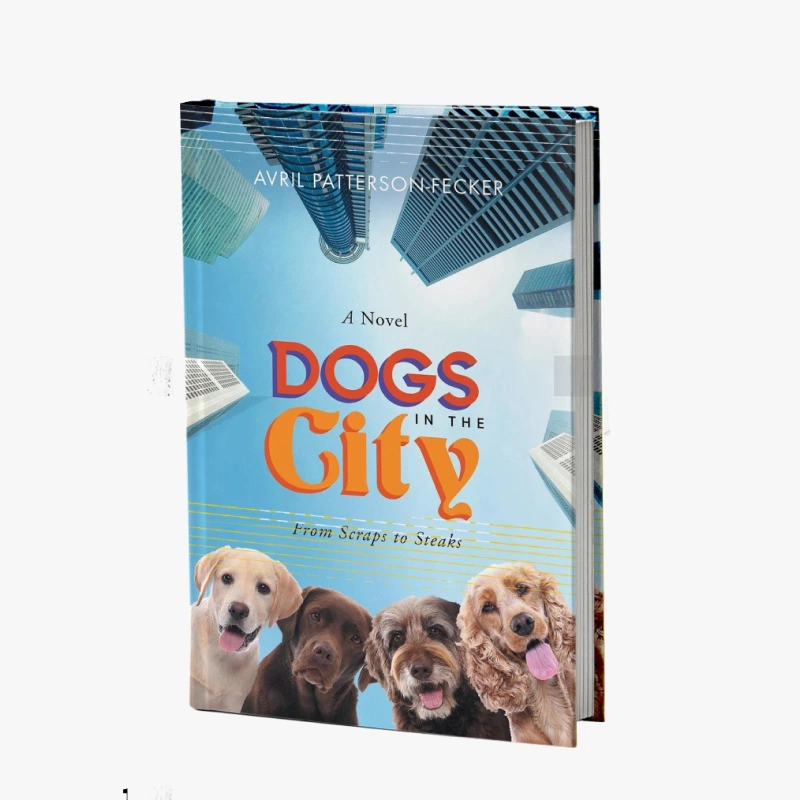
McMurray’s journey begins with that question of belonging. At the center of Dogs in the City: From Scraps to Steaks is a dog whose experiences move him through very different versions of what people might call home. Born in a Manhattan brownstone, separated from his mother at an early stage, and later placed in a shelter, McMurray experiences dependence and uncertainty before he ever understands the stability of a family. His circumstances eventually change when he becomes part of the Farber family in Brooklyn, but even that new beginning brings questions about identity, trust and control. The Dogs in the City: From Scraps to Steaks novel therefore goes beyond the idea of a simple adventure about a dog. It becomes a story about what happens when a vulnerable animal must navigate decisions made by humans while trying to understand where he fits. For readers drawn to books about dogs finding home, McMurray offers a particularly compelling central figure because his search is emotional as much as physical. His journey through New York is ultimately a search for security, recognition and belonging.
McMurray’s Earliest Loss
McMurray’s story begins in a Manhattan brownstone, a setting that might initially suggest warmth, shelter and the security of a home. Yet his earliest experience is marked by separation. Being born and then separated from his mother establishes a pattern that becomes important to understanding the McMurray character: stability is never something he can simply assume will remain. His first loss occurs before he has any ability to make choices for himself, placing him in a world where human circumstances determine where he goes and who cares for him. That early experience gives the story an emotional foundation without requiring McMurray to be treated like a human child. His perspective remains distinctly canine, while readers are invited to understand the vulnerability of an animal whose environment can change without his consent. As a dog survival story, Dogs in the City: From Scraps to Steaks begins not with an extraordinary quest but with a basic need for safety. McMurray’s earliest experiences establish why the idea of home carries such weight later in the story and why separation continues to influence the choices he makes.
The shelter introduces another layer to that uncertainty. For McMurray, it becomes a place where his future depends heavily on decisions made by people around him. That makes the shelter more than a temporary setting in the Dogs in the City plot. It represents a condition of dependence, where an animal’s sense of security can be interrupted by circumstances beyond his understanding or control. The experience also deepens the book’s exploration of abandonment and belonging themes. What does an animal learn when the people responsible for him can disappear from his life? What does security mean after that security has already been lost once? These questions give the shelter scenes significance beyond the mechanics of where McMurray happens to be. In Dogs in the City: From Scraps to Steaks, the shelter becomes an important part of McMurray’s early experience with uncertainty, dependence and the search for belonging. Here, McMurray’s experiences contribute to a larger emotional journey. He is not simply waiting for someone to choose him. He is gradually developing an understanding of the difference between being somewhere and actually feeling that he belongs there.
A New Home and a New Name
McMurray eventually enters the Farber family’s life in Brooklyn, giving him a new environment and the possibility of a more permanent home. Yet the transition introduces an important change that goes beyond location: McMurray becomes Barkley. The renaming of an animal can appear ordinary, particularly within an adoption story, but in this novel it offers an interesting way to consider identity. A name is one of the simplest ways humans identify one another, and changing it can suggest a new beginning while also creating a distance from what came before. For McMurray, becoming Barkley connects him to his new family and his new life, but the earlier parts of his existence do not simply disappear. This is where the dog adoption novel becomes more layered than a straightforward rescue narrative. The question is not only whether McMurray has found a home, but what happens to the identity he carried into it. Through the Barkley dog character, the story can explore how affection, adoption and renaming can all be part of a complicated transition between one life and another.
His relationship with Tommy adds another dimension to that transition. A new home can offer affection and companionship, but living within a family also brings expectations. Animals and humans may share attachment while understanding obedience, freedom and responsibility very differently. McMurray’s relationship with Tommy therefore helps reveal one of the tensions beneath his new life: being cared for does not necessarily mean experiencing every situation in the same way as the people providing that care. Their relationship allows Dogs in the City: From Scraps to Steaks to explore the human-animal bond in literature without turning the story into a simple lesson about whether one side is right or wrong. Affection matters, but so do trust and understanding. For McMurray, the challenge is learning how to exist within a human household while carrying experiences that began long before the Farber family entered his life. That tension prepares the ground for the decision that eventually pushes him beyond the boundaries of his new home.
The Decision That Changes Everything
The turning point arrives when McMurray learns about the planned operation. His response is not simply an impulsive escape from an uncomfortable situation. From his perspective, the discovery touches something much deeper: fear over what will happen to his body, uncertainty about decisions being made on his behalf, and the possibility that the identity he has begun building as Barkley can once again be disrupted by circumstances outside his control. This is where the Dogs in the City: From Scraps to Steaks analysis becomes especially interesting. The conflict can be understood through McMurray’s perception rather than through human assumptions about what should happen next. He does not possess the language or authority to negotiate the situation on equal terms with the people around him. His response is therefore shaped by the limited choices available to him. Running away becomes an act connected to fear, autonomy and self-preservation. The story does not require readers to approach the situation as a medical debate. Instead, it asks them to remain close to McMurray’s perspective and consider what it means for an animal to experience a major decision as something being done to him rather than something he can control.
That decision sends McMurray into a very different chapter of his life and transforms the meaning of the city around him. Until this point, New York has been connected to the different homes and institutions that have shaped his life: the Manhattan brownstone where he was born, the shelter where he experienced uncertainty, and the Brooklyn home where he became Barkley. Now the city itself begins to take on another role. It becomes the space between what McMurray has known and what he might discover next. His escape is therefore more than a change of scenery. It forces him into a world where freedom comes without the protections of a household, and where every unfamiliar street can represent both possibility and danger. The dog journey through New York is beginning to widen, but the central question remains the same one that has followed McMurray from the beginning: what does it take to find a place that truly feels like home?
New York as a Character
Once McMurray leaves the security of the Farber home, New York takes on a different meaning. The city is no longer simply the backdrop surrounding his life; it becomes an active force in his experience. The cellar, shelter, family home, streets and penthouse represent dramatically different environments, each carrying its own version of safety and uncertainty. That contrast is central to the way the novel uses place. A home can offer protection while also coming with expectations, while a shelter can provide temporary care without guaranteeing permanence. The streets offer movement and independence, but they also expose an animal to dangers that do not exist inside a household. Even the penthouse, with its very different level of comfort, raises questions about what security looks like from another perspective. Through these spaces, Dogs in the City: From Scraps to Steaks turns New York into more than a setting. It becomes a landscape through which McMurray encounters different forms of dependence, privilege, vulnerability and freedom. The result is a work of urban animal fiction in which McMurray’s physical journey is closely tied to his emotional search for belonging.
New York also complicates McMurray’s idea of freedom. Away from the boundaries of his former home, he has more control over where he goes, but that independence comes at a cost. The streets do not offer the predictable protection of a family environment, and survival requires McMurray to respond to circumstances as they arise. This tension gives the dog journey through New York its emotional weight. Freedom can mean escaping a situation that feels frightening or restrictive, but it can also mean entering a world where there is no guarantee of safety. In that sense, the city embodies the novel’s recurring conflict between freedom versus protection. McMurray is forced to experience both sides rather than receiving an easy answer about which is better. His circumstances also place him within the familiar territory of a homeless dog story, where the absence of a permanent home makes every encounter potentially significant. Yet Dogs in the City: From Scraps to Steaks does not reduce his journey to a simple search for shelter. The deeper question is whether independence without belonging can ever provide the security he has been seeking since his earliest separation.
The People and Animals He Encounters
Among the people McMurray encounters is Eddie, a street musician whose presence expands the novel’s exploration of life outside conventional structures. Eddie is important not simply because he becomes another person in McMurray’s path, but because his circumstances offer another perspective on survival and human behavior. A street musician occupies a very different position from the family that once cared for McMurray, and that difference matters. Through the Eddie street musician character, the story can place McMurray alongside someone whose own life is shaped by uncertainty, movement and the need to navigate the city. Their connection also reinforces one of the book’s broader ideas: survival does not always follow a single path. People and animals can find ways of adapting to circumstances that others might never choose for themselves. Eddie’s presence therefore contributes to the emotional dog adventure without turning the story into a conventional adventure tale. McMurray is learning from the people he encounters, even when those lessons are not delivered as formal explanations. His experiences with Eddie help widen his understanding of the human world and show him another version of life beyond the boundaries of a traditional home.
Fifi offers a very different contrast. A penthouse poodle occupies almost the opposite end of the city’s social and physical landscape from a dog navigating the streets. That difference makes the Fifi penthouse poodle character particularly useful to the novel’s exploration of how animals can experience the same city in radically different ways. McMurray’s circumstances expose him to uncertainty, while Fifi’s environment represents comfort and a very different relationship with human protection. The contrast does not require invented romantic scenes or developments between the two dogs. Instead, Fifi helps broaden the story’s perspective by reminding readers that an animal’s life can be shaped profoundly by the environment and social circumstances into which it is placed. This creates an opening for examining social class in animal fiction without losing sight of the individual characters. The city can contain abundance and deprivation within the same geographic space, and animals can experience those divisions through the humans who care for them. By placing McMurray’s journey alongside Fifi’s very different circumstances, Dogs in the City: From Scraps to Steaks encourages readers to look beyond the simple categories of owned and homeless, protected and vulnerable, fortunate and unfortunate.
Follow Avril Patterson-Fecker for Further Updates
🔗 Facebook: Click here
Dogs in The City: From Scraps to Steaks | Available Now
🔗 For Amazon: Click here
🔗 For Walmart: Click here