
What Does It Mean to Make the World a Better Place?

What Does It Mean to Make the World a Better Place?

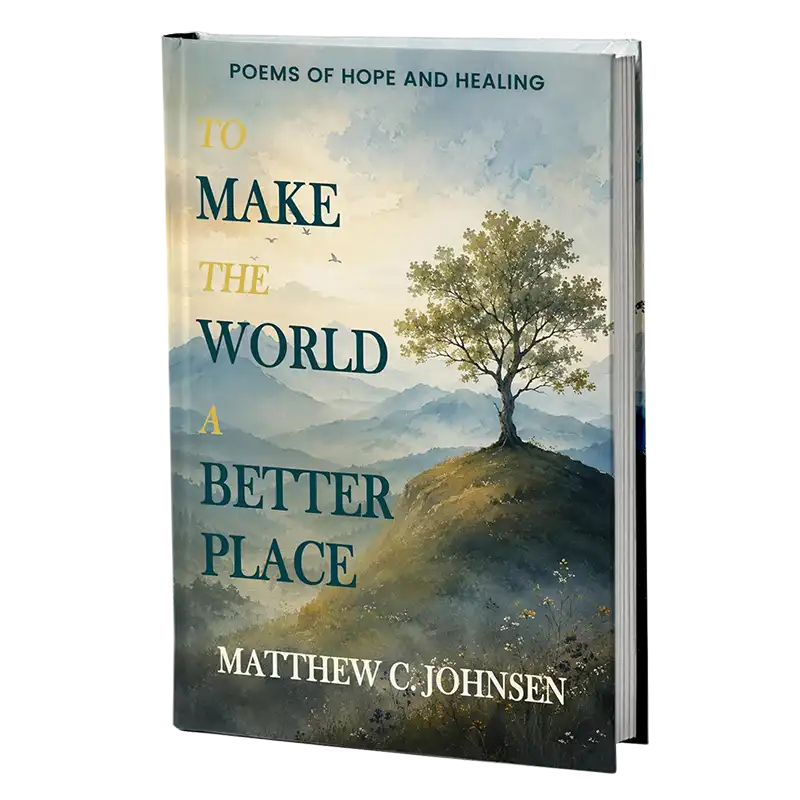
What does it mean to make the world a better place when the challenges around us can feel too large for one person to solve? To Make the World a Better Place: Poems of Hope and Healing by Matthew C. Johnsen approaches that question through poetry, bringing together reflections on ordinary experiences, human connection, peace, purpose, and the responsibilities people share. Rather than presenting one straightforward answer, the collection creates space to pause and consider how attention, awareness, and meaningful choices can shape the way people relate to themselves, one another, and the wider world.

The book begins from a simple but expansive idea: everyday life can contain questions worth noticing. A moment of observation can lead toward reflection on relationships, community, nature, faith, creativity, aging, recovery, or the passage of time. From there, the collection moves toward broader concerns involving equality, justice, peace, and responsibility. This movement gives the poetry room to remain personal while also considering experiences that extend beyond the individual.

That makes To Make the World a Better Place: Poems of Hope and Healing more than a collection organized around a single theme. Its focus shifts between the intimate and the social, asking readers to look closely at ordinary life while remaining aware of their connections with other people and the world they share. The collection ultimately invites reflection rather than prescribing one fixed response.

For readers approaching the book, this provides a useful lens: how does poetry move from noticing what is immediately around us toward questions about meaning, connection, and responsibility? The answer unfolds through the collection’s structure, its recurring themes, and the perspective Matthew C. Johnsen brings to his writing.

To Make the World a Better Place: Poems of Hope and Healing is a contemporary poetry collection that places everyday observations alongside larger questions about how people live and connect. Its poems consider subjects including love, creativity, nature, community, faith, aging, recovery, and time, while also opening toward questions of purpose, justice, equality, peace, and human responsibility.

This range gives the collection a broad scope without turning it into an academic discussion or a step-by-step guide. The book is a reflective literary work, using poetry to explore ideas that can be difficult to approach through direct explanation alone. Instead of separating personal experience from social concerns, it allows the two to exist alongside each other.

The collection is also shaped by an interest in awareness. Readers encounter reflections on moments that might otherwise pass quickly: aspects of daily life, relationships, seasons, music, friendship, and the natural world. These observations become points of entry into larger considerations of how people understand themselves and their surroundings.

The title itself points toward the collection’s central concern with contribution and responsibility, while its subtitle, “Poems of Hope and Healing,” adds another dimension. Hope appears alongside uncertainty and reflection rather than as a promise of simple resolution. The poetry considers how people might remain attentive, compassionate, and connected even when circumstances are not straightforward.

The structure of the book supports this movement. It is organized into seven sections, Prelude; Creativity and Awareness; Love, Community and Peace; Day’s Journey; Seasons; Purpose; and Epilogue. Together, these sections create a progression that moves between inner reflection, relationships, community, and wider questions about what individuals can contribute.

This feature follows that progression while also considering the perspective of the author behind it. It looks at what kind of poetry collection To Make the World a Better Place is, how its seven sections shape the reading experience, and how its recurring ideas of awareness, connection, hope, peace, and responsibility come together.

Matthew C. Johnsen brings a background in sociology and community-focused work to his writing. He is Professor Emeritus of Sociology at Worcester State University and a Rotary Peace Fellow alumnus. Those experiences provide relevant context for understanding why people, communities, relationships, and social responsibility occupy an important place in his poetry.

Johnsen earned his PhD in Sociology from North Carolina State University in 1993 and later built an academic career centered on understanding people, social systems, and communities. His work included teaching and research involving areas such as community structures, mental-health systems, disability, homelessness, social enterprise, program evaluation, and social innovation.

That background matters here not because To Make the World a Better Place: Poems of Hope and Healing is an academic sociology book, it is not but because sociology offers one context for the collection’s attention to how individuals exist within wider communities. Sociological observation often asks people to look beyond an isolated experience and consider the relationships and circumstances surrounding it. Poetry can approach a similar act of observation through a different form.

In Johnsen’s collection, personal reflection can sit beside questions about community, equality, peace, responsibility, and human connection. The connection between his academic background and poetry is therefore best understood as a continuity of interest rather than a conversion from one discipline into another. His earlier work examined people and communities through scholarship; his poetry provides another way to reflect on those concerns through language, imagery, and feeling.

His path also extends beyond the university. Johnsen’s work in social innovation placed him at the intersection of academic knowledge and practical community action, while his musical leadership developed another perspective on listening, participation, and shared expression. His later creative work brings these different experiences into a form that can consider both individual awareness and the wider relationships in which people live.

Seen in that context, Matthew C. Johnsen’s poetry journey is not presented as a separate chapter disconnected from his earlier life. It is another expression of questions that have appeared throughout his work: how people understand one another, what connects individuals and communities, and how awareness can contribute to a more thoughtful and compassionate way of living.

Matthew C. Johnsen’s connection to peacebuilding adds another important context to To Make the World a Better Place: Poems of Hope and Healing. In 2018, he was selected for a Rotary Peace Fellowship and studied peacebuilding and conflict resolution at the Rotary Peace Center at Chulalongkorn University in Bangkok.

That experience provides a relevant perspective on a collection that repeatedly considers peace, community, responsibility, and human connection. The connection does not require assuming that a particular poem came directly from a particular experience. Instead, peacebuilding offers another lens through which Johnsen’s broader interest in how people live together can be understood.

Peacebuilding itself asks questions about relationships, conflict, cooperation, and the conditions that allow people and communities to move toward greater understanding. Poetry approaches those questions differently. It does not need to establish an argument or provide a formal framework for resolving conflict. It can instead create a moment of attention, allowing readers to consider the human dimensions behind ideas such as peace, compassion, responsibility, and connection.

That distinction is important when reading Johnsen’s work. To Make the World a Better Place is not presented as a manual for peacebuilding or a collection of policy recommendations. Its interest is reflective. The poetry makes room for questions about how people relate to one another and what it might mean to participate thoughtfully in the communities and world around them.

This perspective also connects with the book’s wider movement from individual awareness toward shared responsibility. A person first notices something within or around their own life, then considers relationships and community, and eventually encounters broader questions about how people contribute to the world they share. The collection explores that movement through poetry rather than through formal instruction.

Sociology and peacebuilding are not the only parts of Matthew C. Johnsen’s background that provide context for his poetry. Music has also been a long-standing part of his life. He began working as a church musician at age 18 and later studied at Dartmouth, the Peabody Conservatory, and the Hochschule für Musik in Vienna. He has also served as Music Director of the Unitarian Universalist Church of Worcester and directed its choir.

His musical work offers another dimension to the author’s creative background. His musical work adds another dimension to his creative background, particularly through its emphasis on listening, participation, and shared expression. Those ideas provide useful context when considering a poet whose collection is similarly concerned with awareness, connection, community, and shared experience.

Johnsen has also been involved in community-oriented creative work, including the Peace Choir Worcester, which he co-founded. These activities help establish the breadth of his interests without turning the poetry collection into an extension of his choir work. To Make the World a Better Place: Poems of Hope and Healing remains its own literary project.

What connects these areas is less a single subject than an ongoing attention to people and participation. Academic work, peacebuilding, music, community engagement, and poetry use different forms, but each can involve listening carefully to human experience. In the collection, that attention becomes a poetic practice: noticing ordinary moments, reflecting on relationships, and considering questions of purpose and responsibility.

This broader creative background also helps explain why the collection can move comfortably between personal and shared concerns. Its poems are not limited to one category of experience. Instead, they create space for reflections on love, nature, creativity, community, faith, aging, recovery, and the passage of time, while also opening toward questions about peace, justice, equality, and responsibility.

One of the clearest ways to understand To Make the World a Better Place: Poems of Hope and Healing is through its structure. The collection is organized into seven sections: Prelude; Creativity and Awareness; Love, Community and Peace; Day’s Journey; Seasons; Purpose; and Epilogue.

These sections are not simply a list of separate subjects. Together, they give the collection a sense of movement. The sequence begins with an opening Prelude, moves into creativity and awareness, widens toward love, community, and peace, then turns to the experiences of daily life and the changing seasons before arriving at questions of purpose and an Epilogue.

That progression matters because the collection repeatedly moves between different scales of experience. Some reflections begin with what is close and immediate, while others consider relationships, communities, and broader responsibilities. The structure allows those perspectives to sit alongside one another rather than forcing the book into one narrow subject.

The seven sections also reinforce the collection’s central interest in paying attention. Awareness is not treated as an isolated idea; it becomes part of a larger movement toward connection and participation. The book can therefore be read not only poem by poem, but also as a gradual movement through different ways of noticing and considering life.

Prelude and Creativity and Awareness

The opening sections establish the importance of attention and reflection. Prelude introduces the collection, while Creativity and Awareness places those ideas more directly at the center of the reading experience. Rather than beginning with a formal argument, the collection establishes a reflective space in which ordinary experiences can become occasions for thought.

Creativity and awareness are particularly important together. Creativity can change how familiar experiences are seen, while awareness requires slowing down enough to notice what might otherwise be overlooked. In the context of the collection, these ideas provide a foundation for the reflections that follow.

This is also where the book’s movement between the personal and the wider world begins to take shape. Paying attention to an individual experience does not necessarily keep the reader focused only on the self. It can also lead toward questions about relationships, surroundings, and the ways people participate in shared life.

The third section, Love, Community and Peace, expands that focus from individual awareness toward connection with others. The grouping of these ideas places relationships and community alongside peace, suggesting a wider field of human experience in which personal connection and shared responsibility can be considered together.

The collection’s treatment of love is not limited to a single definition. Within the broader themes presented for the book, love sits alongside community, compassion, connection, and responsibility. This allows the idea to function as part of the book’s wider reflection on how people relate to one another.

The section also gives the collection’s social dimension greater visibility. Peace is considered alongside community rather than presented as an abstract concept detached from everyday relationships. The result is consistent with the book’s broader movement: awareness begins close to the individual, but reflection can gradually widen toward other people and the communities they form.

At this point in the collection, the journey is no longer only inward. It begins to ask what attention to oneself might reveal about relationships with others and about the shared spaces in which people live. The later sections continue that movement through time, nature, purpose, and the larger question of what it means to participate meaningfully in the world.

After Love, Community and Peace, the collection continues its movement through Day’s Journey and Seasons, two sections that bring attention back to the rhythms of everyday life and the passage of time. These sections broaden the idea of awareness by placing human reflection within the changing circumstances of daily existence. Rather than treating time simply as something that passes, the structure creates room to consider what people notice, experience, and carry with them as life moves forward.

Day’s Journey suggests a focus on the ordinary progression of life, where meaning can emerge through attention to moments that might otherwise seem routine. This fits naturally with the collection’s wider interest in observation. A day does not need to contain an extraordinary event to become worthy of reflection. The simple act of noticing can make space for questions about experience, relationships, priorities, and the ways people move through the world.

Seasons widens that perspective further by placing change within a natural rhythm. Seasons offer an accessible way of thinking about transition, repetition, growth, and time without requiring a single fixed interpretation. Within the overall structure of the collection, this attention to changing circumstances complements its interest in aging, nature, recovery, and the passage of time.

The movement then turns toward Purpose. After attention has moved through personal experience, relationships, community, daily life, and changing seasons, the question of purpose gives the collection another direction. What does it mean to live intentionally? How might awareness influence the choices people make? And how does an individual’s sense of meaning relate to the wider world?

The final section, Epilogue, completes the seven-part structure without reducing the collection to one definitive answer. Its place at the end allows the questions raised throughout the book to remain open to reflection. The progression from Prelude through Purpose and Epilogue therefore gives To Make the World a Better Place: Poems of Hope and Healing a sense of continuity: noticing leads to reflection, reflection can lead toward connection, and connection can raise questions about meaningful participation in the world.

The subtitle, Poems of Hope and Healing, adds an important layer to the book’s overall perspective. The subtitle places hope and healing alongside the collection’s broader reflections on change, difficulty, renewal, and the process of moving forward. Neither needs to suggest a simple resolution to the challenges that appear in human life.

That distinction matters because the collection does not need to promise that poetry can solve personal or social problems. Instead, its subtitle establishes a reflective atmosphere in which uncertainty and possibility can exist together. The idea of healing can be considered alongside the book’s attention to recovery, aging, relationships, nature, faith, and the passage of time, without turning the poetry into medical or therapeutic advice.

Hope also connects naturally with the book’s larger social concerns. A collection asking readers to think about peace, equality, human connection, and responsibility is necessarily engaging with questions that extend beyond private experience. Yet the poetry approaches those subjects through reflection rather than through a formal political program or a set of prescribed solutions.

This is one of the more interesting tensions within the collection. The title asks about making the world better, while the subtitle introduces hope and healing. Together, they place personal reflection and wider responsibility in the same frame. The possibility of positive change is not presented as something achieved through one dramatic act. Instead, the collection leaves room to consider the significance of awareness, compassion, relationships, and purposeful choices.

The social dimension is particularly relevant to the book’s recurring concerns with peace, equality, and responsibility. These are large concepts, but poetry can bring them closer to lived experience by considering how people relate to one another. In that sense, the collection’s social questions remain connected to its interest in ordinary life rather than existing separately from it.

One of the central ideas that emerges from the collection’s structure is the movement from private attention toward shared responsibility. The journey begins with awareness of experience and gradually widens toward relationships, community, peace, time, purpose, and the world beyond the individual.

This does not mean that every reader has to follow the same interpretation. Poetry allows different readers to notice different details, questions, and emotional associations. What matters is that the collection creates a framework in which personal reflection can become connected to larger questions about how people live alongside one another.

That makes To Make the World a Better Place: Poems of Hope and Healing relevant to readers who enjoy contemporary poetry that considers more than one dimension of experience. Someone drawn to reflective writing may find its attention to everyday life meaningful, while readers interested in community and social questions may be drawn to its consideration of peace, equality, connection, and responsibility.

Readers interested in sociology may also recognize some familiar concerns, although the book should not be approached as a sociology text. Its questions are expressed through poetry rather than academic analysis. The distinction is useful because it allows the collection to be appreciated on its own terms while acknowledging the perspective Matthew C. Johnsen brings from his professional background.

The book may also appeal to readers who prefer poetry that leaves space for contemplation rather than directing them toward one predetermined conclusion. Its seven-section progression offers a way to move through different dimensions of life while allowing individual poems and themes to invite personal responses.

The title’s central question can therefore remain with the reader. Making the world a better place can sound like an enormous responsibility when considered at the scale of society. The collection instead creates an opportunity to consider that question through smaller points of attention: how people see, listen, connect, reflect, and participate.

The seven sections provide a natural way for readers to approach the collection as a developing conversation rather than simply moving through unrelated poems. The sequence offers several points of attention: the relationship between creativity and awareness, the expansion from individual experience toward community, the presence of nature and time, and the eventual turn toward purpose.

Readers might notice how the scale of the collection changes. An idea can begin with an individual observation and then open toward relationships or broader social concerns. Elsewhere, attention to time, nature, or everyday experience can provide another way into questions of meaning. Looking for those shifts can help reveal connections across the seven sections without requiring every poem to be interpreted in exactly the same way.

The progression can also be approached slowly. A reflective poetry collection does not necessarily need to be consumed as quickly as a narrative. Moving section by section can give readers an opportunity to notice recurring questions and consider how the ideas introduced earlier appear differently later in the book.

There is no single required response to the collection. Some readers may focus on its social questions, others on its reflections about ordinary life, and others on its attention to hope, connection, nature, or purpose. The seven-section structure simply provides a framework through which those different possibilities can be explored.

To Make the World a Better Place: Poems of Hope and Healing represents a new literary form for Matthew C. Johnsen, but it does not exist separately from the experiences that preceded it. His work in sociology, social innovation, music, community engagement, and peacebuilding provides context for the concerns that appear throughout the collection.

As Professor Emeritus of Sociology at Worcester State University and a Rotary Peace Fellow alumnus, Johnsen has spent much of his professional life examining people, communities, and the ways individuals participate in larger social systems. His musical leadership adds another dimension, particularly through its emphasis on listening, shared expression, and participation.

These experiences do not need to be treated as explanations for individual poems. Rather, they help establish the perspective from which Johnsen approaches contemporary poetry. His academic work provided one way of examining society, music offered another language for expression and connection, and peacebuilding created opportunities to consider cooperation and conflict from broader perspectives.

Poetry now gives those longstanding interests a different form. To Make the World a Better Place: Poems of Hope and Healing brings together reflections on personal experience and wider social questions without requiring the reader to separate the two. The result is a continuation of an established interest in people and communities, expressed through a literary rather than academic form.

America Publishers Author Spotlight features Matthew C. Johnsen and his work, giving readers an additional place to explore his background and the collection. To Make the World a Better Place: Poems of Hope and Healing is available now, with the verified book listing providing readers with the current purchasing information.

Conclusion

What does it mean to make the world a better place? To Make the World a Better Place: Poems of Hope and Healing does not attempt to settle that question with one answer. Instead, Matthew C. Johnsen’s collection approaches it through a gradual movement between attention, connection, reflection, and responsibility.

Across its seven sections, the book considers experiences that can feel deeply personal while remaining connected to wider questions about community, peace, purpose, equality, and human responsibility. Its movement from Prelude through Epilogue gives those ideas a broader shape, allowing ordinary moments and larger concerns to exist within the same literary space.

Johnsen’s background in sociology, music, community work, and peacebuilding provides useful context for understanding this perspective, but the collection ultimately stands on its own as poetry. It invites readers to consider what they notice, how they connect with others, and what meaning they attach to the lives and communities they share.

Perhaps that is where the title’s question becomes most interesting. Making the world better can seem like an impossible task when viewed only at the largest scale. Poetry can bring the question closer, asking readers to consider attention, compassion, connection, and purposeful participation as part of the larger conversation.

For readers interested in reflective contemporary poetry and questions of hope, human connection, community, and responsibility, To Make the World a Better Place: Poems of Hope and Healing offers an opportunity to pause with those questions and discover their own way of responding to them.

  1. What is To Make the World a Better Place: Poems of Hope and Healing about?

To Make the World a Better Place: Poems of Hope and Healing is a contemporary poetry collection by Matthew C. Johnsen. It reflects on everyday life, relationships, community, peace, nature, purpose, responsibility, and the possibility of meaningful connection.

  1. Is it a poetry collection or an academic sociology book?

It is a poetry collection, not an academic sociology book. Matthew C. Johnsen’s background in sociology provides context for some of the collection’s social concerns, but the book explores its ideas through poetry and reflection rather than academic analysis.

  1. How many sections are in the collection?

The collection contains seven sections: Prelude; Creativity and Awareness; Love, Community and Peace; Day’s Journey; Seasons; Purpose; and Epilogue. Together, they create a progression through personal reflection, connection, community, time, and purpose.

  1. Who is Matthew C. Johnsen?

Matthew C. Johnsen is Professor Emeritus of Sociology at Worcester State University and a Rotary Peace Fellow alumnus. His professional background also includes social innovation, music, community engagement, and peacebuilding, alongside his work as a poet.

  1. Do readers need a background in sociology to approach the book?

No academic background in sociology is required to approach the collection. The book is poetry, and readers can engage with its reflections on everyday experience, relationships, community, peace, and purpose according to their own interests and interpretations.

  1. Where can readers find the book?

To Make the World a Better Place: Poems of Hope and Healing is available now. Readers can check the current book listing for availability and purchasing information.

To Make the World a Better Place: Poems of Hope and Healing | Available Now

🔗 Author Website: Explore the Book

🔗 Amazon: Click here

Follow Matthew Johnsen for Updates

🔗 Facebook: Matthew Johnsen