
Published November 27, 2026
Imagine trying to tell someone where you grew up when the places that would explain it no longer exist. You can give them the name of the village. You can describe the route to a neighbor’s door or where your family used to gather. But the person listening has to imagine a world you once knew without thinking about it. When an entire community is forced to leave, who gets to tell the story of what was lost? And how much of that story can anyone recover?
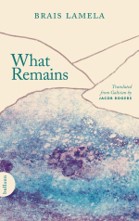
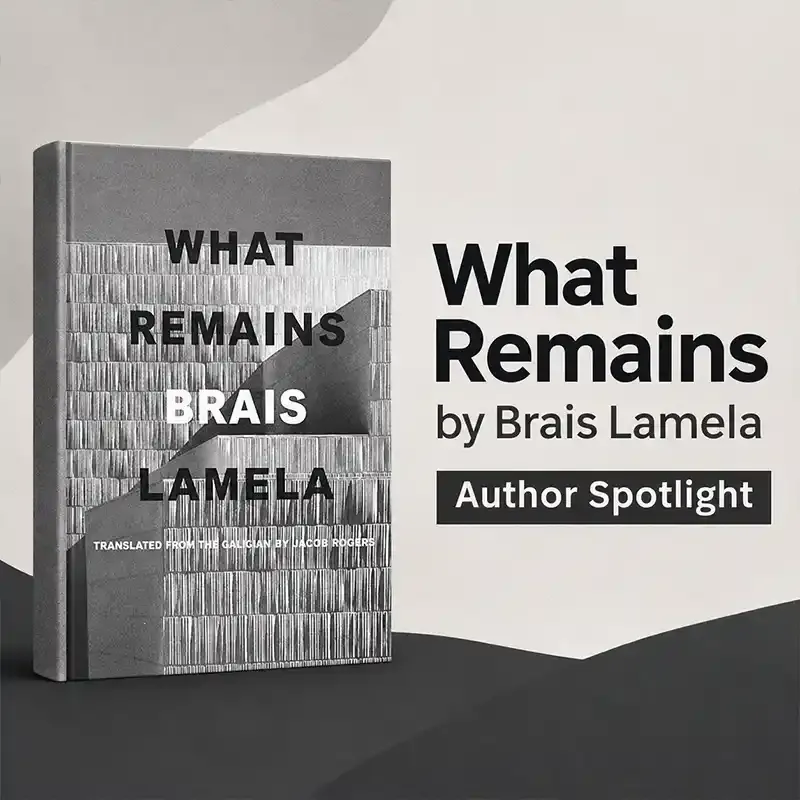
What Remains by Brais Lamela follows a young scholar in New York as he investigates the forced resettlement of rural communities in Galicia under Francisco Franco. Translated from Galician by Jacob Rogers, the novel moves between the narrator’s unsettled present and a past he can reach only through records, interviews and the traces people leave behind. The Bullaun Press edition appeared on October 2, 2025. A separate Dorothy edition followed on October 6, 2026.
What a New House Can’t Replace
The historical story in What Remains by Brais Lamela concerns people displaced after a hydroelectric project flooded a valley in northwestern Spain. Residents from Negueira de Muñiz were moved to agricultural settlements in the area known as Terra Ché. The narrator, who grew up in the area where the settlements were built, has a personal connection to the places he studies. What he knows as home is also a place other people were sent to after losing theirs.
That overlap gives the novel’s question about home a practical edge. A resettlement plan can specify where families will live and what their new houses will look like. It has no equivalent measure for the ease of walking into a neighbor’s kitchen or knowing which door to knock on when someone needs help. Those ordinary forms of familiarity can take years to build. In conversations about development, they can disappear from view in the time it takes to mark a boundary on a map.
Mandy Wight’s review for the European Literature Network draws attention to the kitchens in the new houses. Their layout limited the space available for people to sit and talk together. The detail gives readers a way to think about how decisions made on paper can change the rhythm of a household. It also sharpens a question that runs through the novel. Who gets to decide what counts as a better way to live?
The Lives That Official Records Leave Out
The narrator’s work gives What Remains by Brais Lamela a tension familiar to anyone interested in historical memory in literature. An official record might tell a researcher where people were relocated. An interview can reveal which consequences stayed with them long after the move. Each kind of evidence has limits, and the differences between them shape the story the narrator is able to tell. His research draws him towards individual lives that could easily disappear inside a broad account of agricultural policy.
The relationship between fiction and archival research matters here because the narrator has to decide how to write about people whose experiences he can only partially reconstruct. A missing detail can make a story harder to tell. The temptation to fill that gap can also make the story easier to tell than it has any right to be. This is one of the novel’s most absorbing questions. How much can you say about another person’s life when the surviving evidence tells you so little about how they understood it?
For readers drawn to books about forced displacement, that uncertainty is part of the novel’s moral force. A policy can affect hundreds of people at once, but its consequences play out in individual homes, on different timelines and under different circumstances. Following a single life gives the reader room to see what a larger account can miss. It also gives that person dignity beyond their role in illustrating what happened to a community.
A Temporary Life in New York
New York gives What Remains by Brais Lamela another way to examine belonging. The narrator is in the city on a fellowship. He lives in a cramped apartment, and the people he spends time with are often there for a limited period themselves. They share practical advice about getting by, and their friendships take shape in a city where rising rents make it difficult to feel settled. The novel gives the narrator’s uncertainty a physical scale through the rooms he can afford and the thin walls around him.
The fellowship and the forced resettlement carry different stakes. The narrator has come to New York to pursue his research for a set period. The Galician residents he studies had to rebuild their lives after decisions that were made for them. Reading these strands together brings a specific part of belonging into focus: how much control a person has over staying, leaving or returning. Even the prospect of a return has a different meaning when the place you would have gone back to is gone.
That makes the novel a distinctive piece of literary fiction about belonging. The narrator can find companionship in New York while still wondering how long he can make a life there. Galicia can feel familiar to him while his research unsettles what he thought he knew about it. In both places, belonging depends partly on other people and partly on circumstances that can change before anyone has had time to prepare.
What Survives When a Place Changes?
One of the pleasures of this work of Galician literary fiction is how much Lamela leaves readers to notice for themselves. There is room to sit with an interview, a house or an ordinary conversation before deciding what it means. Rogers’s English translation also gives readers a way into a story whose particular places matter. Negueira de Muñiz and Terra Ché carry different associations depending on whether someone remembers a home they had to leave, a settlement they had to learn to live in or the place where they grew up.
Among stories about losing home, What Remains by Brais Lamela is especially attentive to what memory asks of the people who inherit it. The narrator can study the settlement where he grew up and find that its history reaches into another community’s loss. He can listen to people who remember the displacement, yet their accounts can take him only so far. The gaps matter because the people who lived through those decisions had full lives beyond what could be recorded about them.
Return to the village you were trying to describe at the beginning. Someone listening might remember where the road turned or tell you about a family you never knew. Between you, a little more of the place becomes visible. You still have to decide what to pass on, and how to speak about the parts neither of you can recover. That is the question Lamela leaves with the reader. When a home survives in fragments, what do we owe to the people whose lives those fragments can only partly reveal?
Discover What Remains by Brais Lamela through Author Spotlight by America Publishers and explore how one community’s displacement opens a larger question about what it means to belong.
Source: “What Remains by Brais Lamela,” November 5, 2026. Read more at PublishersWeekly.com.