
Published on October 13, 2026
Wordle can feel much easier when a few letters begin to fall into place. Sometimes, the clues point toward a less obvious pattern: the word begins and ends with the same letter. Once you notice that structure, the search becomes less about trying random combinations and more about narrowing down what can actually fit.
Knowing 5 letter words starting and ending with the same letter can be especially useful when you have already confirmed letters at the beginning or end of the grid. Instead of treating each empty square as a complete mystery, you can use the known positions to create a framework and work through the possibilities from there.
This guide brings together examples of 5 letter words with same first and last letter, along with practical ways to recognize and use the pattern during a game. The goal isn’t simply to memorize a list. It’s to understand how a small structural clue can turn an uncertain Wordle board into a much more manageable puzzle.
Note: A five-letter English word may be accepted as a Wordle guess without necessarily belonging to the game’s current answer pool. The examples below are therefore intended primarily as pattern-recognition and solving references.
Why Words With Matching First and Last Letters Can Help in Wordle
One of the most useful things about Wordle is that every clue gives you information about both a letter and its position. A green letter tells you exactly where that letter belongs, while a yellow letter confirms that it belongs somewhere in the word but not in that particular position. Gray letters, meanwhile, help eliminate possibilities. When several of these clues come together, even a simple word structure can become valuable.
Imagine that your board eventually gives you a pattern like C _ _ _ C. You now know that the answer is five letters long, begins with C, and ends with C. That is a much smaller search space than starting with five completely unknown positions.
This is where Wordle word patterns become useful. Rather than looking at individual letters in isolation, you can start thinking about the shape of the entire answer. The three middle spaces become the main puzzle, while the matching letters at the edges provide a fixed frame.
There is another advantage to recognizing these patterns: they can help you avoid wasting guesses. If you already know that the first and final letters match, randomly testing words that break that structure may give you less useful information than exploring words that fit the clues you have already uncovered.
At the same time, pattern recognition works best alongside the rest of the board. A word that technically matches a pattern isn’t automatically the answer. You still need to consider which letters Wordle has ruled out, which yellow letters need to be repositioned, and which combinations form plausible English words.
Some unusual five-letter words also become easier to notice when you start looking for repeated edge letters. However, unusual does not necessarily mean useful. In an actual game, prioritize candidates that satisfy all confirmed positional and letter clues rather than words that match only the first-and-last-letter pattern.
The key is to treat the matching first and last letters as another piece of evidence. They can narrow the field, but they work best when combined with everything else you have learned from previous guesses.
5 Letter Words Starting and Ending With the Same Letter: Useful Examples
Once you know that the first and last letters match, the pattern becomes much easier to visualize. Instead of searching through every possible five-letter combination, you can focus on words that follow a structure such as A _ _ _ A, C _ _ _ C, or S _ _ _ S.
Below are some examples worth keeping in mind. For practical solving, recognizable five-letter candidates are easier to work with, but remember that Wordle’s accepted guesses and potential answers are not necessarily the same set of words.
Words Beginning and Ending With A
arena — A five-letter noun referring to a place designed for sports, entertainment, or public events. Its A-at-both-ends structure makes it an easy example of the pattern.
aroma — A five-letter noun that begins and ends with A, giving players another straightforward A _ _ _ A example.
Words Beginning and Ending With B
Five-letter words beginning and ending with B are uncommon, but recognizable examples do exist. One useful example is BLURB, which follows the B _ _ _ B pattern. If your clues create a pattern such as B _ _ _ B, it may be worth checking whether another interpretation of the clues is possible rather than forcing an unlikely answer.
Words Beginning and Ending With C
civic — A particularly recognizable example, meaning relating to a city or community. It begins and ends with C and also has a symmetrical feel that makes it memorable.
cynic — A person who is distrustful of people’s motives or sincerity. It starts with C and finishes with C, making it another useful candidate to remember.
These are good examples of why matching-letter patterns can sometimes produce more than one possibility. If your board gives you C _ _ _ C, the pattern alone does not identify the answer. The middle letters and your previous guesses still matter.
Words Beginning and Ending With D
dread — A recognizable five-letter example that follows the D _ _ _ D pattern. Even when a word fits the outer-letter structure, Wordle clues should still be combined rather than interpreted in isolation. If the outer letters seem to match but the resulting word choices look extremely unlikely, revisit the yellow and gray information on the board.
Words Beginning and Ending With E
Several recognizable five-letter words begin and end with E, including ELIDE, ELUDE, ERODE, ETUDE, and EVADE. This is another situation where recognizing the structure is more valuable than immediately assuming that a matching pattern must lead to an answer.
When several candidates fit the same pattern, pay particular attention to the letters Wordle has already eliminated. A single gray letter can sometimes remove several apparently possible candidates at once.
Words Beginning and Ending With F
fluff — A familiar five-letter example that begins and ends with F. If a particular outer-letter pattern leaves very few plausible candidates, use that limitation as part of your solving process. It may indicate that another clue has been misunderstood or that a confirmed letter has been placed incorrectly in your mental model.
Words Beginning and Ending With G
Five-letter words beginning and ending with G are less obvious in everyday vocabulary, so players may have fewer familiar candidates immediately available. This is one reason not every matching-letter pattern deserves the same amount of attention. Some outer-letter combinations produce more familiar candidates than others, while certain patterns may leave only a small number of recognizable possibilities.
Words Beginning and Ending With H
hatch — A familiar example of a five-letter word beginning and ending with H. If this pattern appears, avoid filling the board with increasingly obscure possibilities simply because they technically fit. Wordle solving is about combining evidence, not finding the strangest word that satisfies one condition.
Words Beginning and Ending With L
level — A common five-letter example following the L _ _ _ L structure. If your board produces L _ _ _ L, look carefully at any yellow letters you have already discovered. Those letters can help determine whether a candidate actually fits the puzzle rather than merely resembling the pattern.
Words Beginning and Ending With M
maxim — A recognizable five-letter word following the M _ _ _ M structure. Matching letters can give you a useful framework, but the three middle positions still contain most of the information needed to identify the answer.
Words Beginning and Ending With N
nylon — A familiar five-letter example beginning and ending with N. If you see this pattern, don’t immediately assume that the answer has to fit it unless both N positions are genuinely confirmed by the game.
Words Beginning and Ending With P
plump — A recognizable five-letter word that follows the P _ _ _ P structure. These unusual combinations demonstrate an important Wordle lesson: a pattern can narrow your search without necessarily producing a large list of possible answers.
Words Beginning and Ending With R
radar — A familiar five-letter example that begins and ends with R.
refer — Another recognizable example following the R _ _ _ R structure. If the board appears to create this structure, focus on the middle letters and use your previous guesses to eliminate combinations that cannot work.
Words Beginning and Ending With S
The S pattern produces several recognizable examples. SOCKS, for instance, follows the S _ _ _ S structure and shows that matching edge letters do not require the entire word to be symmetrical. However, you still need to check the exact word length and letter positions before committing to a guess.
This is where words with the same first and last letter become most useful as a solving pattern rather than simply a vocabulary list. The matching letters provide the frame; the remaining clues determine what belongs inside it.
Words Beginning and Ending With T
Five-letter words following T _ _ _ T include recognizable examples such as TENET. Although the pattern is not especially common, confirmed middle letters can make these candidates much easier to identify. If this pattern appears, don’t let the novelty of the structure distract you from the basic Wordle clues. A confirmed green letter elsewhere may be much more informative than the fact that the outer letters happen to match.
Words Beginning and Ending With W
widow — A familiar five-letter example that begins and ends with W. If your board seems to produce this structure, double-check the evidence before spending a valuable guess on an obscure possibility.
Words Beginning and Ending With Y
yummy — A familiar five-letter example that begins and ends with Y. In cases like this, the best approach is to combine the pattern with every available clue rather than searching for a word simply because it satisfies the outer letters.
The biggest takeaway from this list is that matching first and last letters do not always produce dozens of candidates. Some letters create recognizable possibilities, while others leave the player with very little vocabulary to work with. That difference is useful information in itself.
When you encounter one of the more unusual patterns, remember that unusual five-letter words can be interesting to study without necessarily being practical Wordle guesses. Your goal during a game is not to prove that a word exists; it is to find the word that best matches all the evidence on your board.
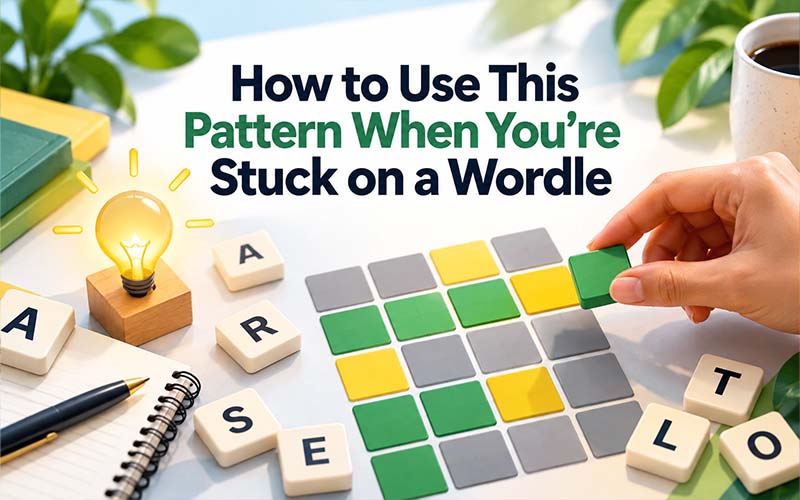
How to Use This Pattern When You’re Stuck on a Wordle
Finding a matching first and last letter is only the beginning. The real advantage comes from knowing what to do with that information.
Start With the Confirmed Positions
Suppose your board gives you C _ _ _ C. Write that structure mentally before considering possible answers. You now have three unknown positions rather than five.
That small change can make the puzzle feel much less open-ended. You can concentrate on the middle of the word instead of repeatedly testing letters that have already been confirmed.
Use Your Yellow Letters
Yellow letters are especially valuable once the outside positions are known. If you’ve already discovered that a particular vowel or consonant belongs somewhere in the word, try placing it in each of the remaining positions.
For example, if your pattern is C _ _ _ C and you know that I appears somewhere in the answer, you can test structures such as C I _ _ C or C _ I _ C against the remaining clues.
That is a much more manageable problem.
Remove the Letters You Already Know Are Wrong
One of the simplest Wordle solving tips is to use gray-letter feedback carefully. A gray letter usually means that letter is absent from the answer, but repeated-letter guesses require extra attention because one occurrence can be gray while another occurrence of the same letter is green or yellow.
If letters have been fully eliminated, remove them from consideration before searching for a candidate. When a guess contains repeated letters, however, check the complete color feedback before ruling that letter out entirely. This prevents you from repeatedly returning to words that cannot possibly be the answer.
Think About the Middle Three Letters
Once the outside letters match, the middle positions become the heart of the puzzle.
Try building possible structures rather than guessing complete words immediately:
C _ I _ C
C I _ _ C
C _ _ I C
Each version creates a different search path. Testing a confirmed vowel across the available middle positions can shrink the possibilities considerably.
Don’t Force the Pattern
This may be the most important point. If the clues do not genuinely confirm that the first and last letters are the same, don’t make the pattern fit simply because you’re looking for it.
A strong Wordle strategy uses every available clue together. Matching letters are helpful when confirmed, but they should never override a green or yellow clue that tells you something different.
This is particularly important with difficult Wordle guesses, where several candidates can appear plausible. When the board becomes uncertain, return to the evidence instead of guessing based on what merely looks familiar.
When These Word Patterns Become Difficult
A matching-letter pattern sounds straightforward until several possible words remain. That’s when the limits of pattern recognition become obvious.
The biggest challenge is that a structure such as C _ _ _ C does not tell you what belongs in the middle. You may still have several vowels and consonants to consider, and previous guesses may have eliminated only a portion of them.
Uncommon vocabulary can make things even harder. Some unusual five-letter words may technically match the structure but be unfamiliar to an everyday player. That creates a temptation to choose an obscure word simply because it fits.
It is usually more useful to work from the strongest clues first. A confirmed green letter in the middle, for example, may narrow the field far more effectively than the fact that the outside letters match.
This is also where difficult Wordle guesses can become frustrating. You may know the first letter, the final letter, and several letters that appear somewhere in between, yet still have multiple possible arrangements.
When that happens, slow the process down. Recheck your gray letters, reposition your yellow letters, and look for familiar combinations. Don’t assume that the most unusual candidate is automatically the solution.
The same principle applies to five-letter words with the same first and last letter in general. The pattern is a useful shortcut, but it is not a complete solving method. Think of it as the frame around the puzzle, then use the rest of the clues to fill it in.
Ultimately, the strongest approach combines pattern recognition with careful elimination. That gives you more information from every guess and reduces the chance of chasing a word simply because it happens to match an interesting structure.
Conclusion
Recognizing 5 letter words starting and ending with the same letter can make a difficult Wordle puzzle easier to narrow down once both outside positions are confirmed. Instead of considering every possible five-letter combination, players can focus on the three middle letters and use the rest of the board to test which candidates actually fit.
The key is to treat the matching first and last letters as one part of the solving process rather than a complete strategy. Green letters should remain fixed, yellow letters should be tested in new positions, and fully eliminated letters should be removed from consideration. Repeated-letter feedback also deserves careful attention, since the same letter can sometimes produce different tile colors within a single guess.
Learning to recognize these patterns can also help players become more familiar with unusual five-letter words and common letter structures. The more effectively you combine pattern recognition with elimination, the easier it becomes to move from a broad set of possibilities to a smaller group of realistic guesses.
Readers interested in additional publishing, books, authors, and related editorial content can also explore the America Publishers Author Spotlight for more resources and features.
Ultimately, a matching first and last letter is not a shortcut to the answer, but it can be a valuable structural clue. Used alongside the rest of Wordle’s feedback, it can turn an uncertain board into a much more focused and manageable search.
Frequently Asked Question
-
What are 5 letter words starting and ending with the same letter?
5 letter words starting and ending with the same letter have identical letters in their first and fifth positions. For example, CYNIC begins and ends with C, while ARENA begins and ends with A. The middle letters do not need to mirror one another, so matching first and last letters do not necessarily make the entire word symmetrical.
-
How can 5 letter words with the same first and last letter help in Wordle?
Five-letter words with the same first and last letter can help narrow the search when both outside positions have been confirmed. Instead of considering five unknown positions, players can concentrate on the three middle spaces and use their previous guesses to determine which letters belong there.
-
Are matching-letter patterns useful for difficult Wordle guesses?
They can be, particularly when a player has already confirmed the beginning and ending of the answer. However, difficult Wordle guesses may still have several possible candidates. The matching letters should therefore be combined with yellow, green, and eliminated-letter clues rather than used on their own.
-
What should a player do after finding a Wordle word pattern?
Start by identifying every confirmed position and then review the letters that have already been ruled out. Wordle word patterns can provide a useful framework, but the remaining clues determine which candidate is most plausible. Looking at the middle positions is often the next logical step.
-
Should players memorize unusual five-letter words for Wordle?
Memorizing unusual five-letter words can expand your vocabulary, but it is not necessary for solving most puzzles. It is generally more useful to understand common letter combinations and recognize how clues interact. A rare word that fits one pattern may still be wrong if it conflicts with another confirmed clue.
-
What are some useful Wordle solving tips for matching-letter words?
A few practical Wordle solving tips include keeping green letters fixed, testing yellow letters in new positions, ruling out fully eliminated letters, and checking repeated-letter feedback carefully.