
Published on October 13, 2026
Have you ever been one guess away from solving Wordle, only to realize that the word you have been looking for contains two of the same letter? You have the right vowel, a couple of green tiles, and perhaps even the correct ending, yet every guess seems to lead nowhere. Sometimes, the missing piece is simply a repeated letter hiding in plain sight.
Finding 5 letter words with double letters can make a surprising difference when a puzzle gets difficult. Words such as APPLE, SHEEP, and STILL demonstrate how a single letter can occupy more than one position, creating possibilities that are easy to overlook. Even experienced players can get caught up searching for new letters instead of considering whether a familiar one appears twice.
Repeated letters become easier to spot when you track how many copies of each letter the clues allow. Once you understand how Wordle handles duplicate letters and learn to recognize common spelling patterns, you can use each row of feedback more effectively. This guide brings together useful word examples, explanations, and practical strategies to help you approach your next puzzle with greater confidence. In this guide, ‘double letters’ mainly refers to words containing repeated letters, whether the matching letters appear side by side or in separate positions. Some examples also contain a letter three times.
Why Double Letters Make Wordle More Challenging
Wordle looks simple on the surface: find a hidden five-letter word in six guesses. Each attempt provides feedback through colored tiles, helping players narrow down the possibilities. Yet the challenge becomes more complicated when a word contains a repeated letter. A player might correctly identify a letter but still overlook that it appears twice, leaving an otherwise promising guess incomplete.
Understanding how repeated letters work
In Wordle, a green tile indicates that a letter is in the correct position, while yellow means the letter belongs in the answer but is in a different position. Gray generally indicates that a letter is absent, although repeated letters introduce an important exception. The game accounts for how many times each letter actually occurs in the answer.
Consider the word APPLE. It contains two Ps, one A, one L, and one E. If the answer is APPLE and your guess contains three Ps, only two of those Ps can receive green or yellow feedback. The extra P turns gray. Wordle awards green matches first, then uses any remaining matching letters for yellow tiles. Extra copies turn gray.
This is why a gray tile does not always mean that a letter is completely absent. When another copy of that letter is green or yellow in the same guess, the gray tile may simply indicate that the answer contains fewer copies than your guess.
Understanding this distinction can prevent a common mistake: eliminating a letter entirely when the clues actually suggest that another copy might be present. Wordle allows letters to appear more than once, so a green or yellow letter may also occur elsewhere in the answer.
Why the second copy is easy to miss
When players receive a green E or a yellow S, they often focus on finding the remaining letters. That instinct makes sense, especially with only six attempts available. However, it can also lead to overlooking familiar patterns such as double L, double S, or double E.
For example, a player who has identified the letters S, T, and I might consider several arrangements but forget that STILL contains two Ls. Similarly, SHEEP can be difficult to recognize when the clues suggest E but the player assumes it appears only once.
The challenge is not just remembering more vocabulary. It is learning to consider letter frequency alongside letter position. Keeping a mental note of confirmed letters, possible duplicates, and eliminated options can make the search much more manageable.
5 Letter Words With Double Letters for Wordle
If your confirmed letters are not forming an answer, scan the lists below for a repeated-letter pattern that fits your green and yellow tiles. The following list groups five-letter words by their repeated letters, making it easier to compare your clues with possible answers. These examples are useful as a reference for both everyday vocabulary and less familiar combinations.
Remember that a word being valid English does not automatically mean it is included in the official Wordle answer list. Some words may be accepted as guesses without being selected as daily solutions. Use the list to explore possibilities, then check each word against the feedback on your board.
Words with double L
Double L appears in many familiar English words, particularly those ending in -LL or containing the combination in the middle. If your clues confirm an L but leave an uncertain position, consider whether the answer might contain two.
| Word | Meaning or clue |
| ALLEY | A narrow passage between buildings. |
| BELLE | A beautiful or admired woman. |
| DROLL | Odd or amusing in an unusual way. |
| FULLY | Completely or entirely. |
| HILLY | Having many hills. |
| JELLY | A soft, sweet food made from fruit juice. |
| SKILL | An ability developed through practice. |
| STILL | Not moving, or continuing up to the present. |
| TROLL | A mythical creature or someone who provokes others online. |
| SULLY | To damage someone’s reputation or purity. |
A useful clue is the position of the Ls. In STILL, the repeated letters appear at the end, while ALLEY places them in the middle. If one L has already turned green, try testing a second L in a position consistent with the remaining clues.
Words with double E
Repeated Es are particularly easy to overlook because E is one of the most common letters in English. When a puzzle reveals an E, avoid assuming that you have found the only vowel in the answer.
| Word | Meaning or clue |
| EERIE | Strange, mysterious, or unsettling. |
| GEEKY | Unusually enthusiastic about a particular interest. |
| GEESE | Plural of goose. |
| NEEDY | Lacking necessities or requiring attention. |
| QUEEN | A female monarch. |
| SHEEP | Woolly farm animals; both singular and plural. |
| SLEEP | A state of rest. |
| STEEL | A strong metal alloy. |
| TEENS | People between thirteen and nineteen years old. |
| WEEKS | Periods of seven days. |
Notice how the double E can appear in different parts of a word. SHEEP and SLEEP have the repeated vowels in the middle, while EERIE begins with a double E and contains a third E later in the word. If your clues confirm E but the usual vowel combinations are not working, these patterns may offer another direction.
Words with double O
Double O can represent different sounds, as in BLOOD and GOOFY. Because the same double-O spelling appears in words with different sound patterns, focus primarily on letter position and the feedback already on your board.
| Word | Meaning or clue |
| BLOOD | The red fluid circulating through the body. |
| BLOOM | To produce flowers or flourish. |
| GOOFY | Silly or playfully ridiculous. |
| GROOM | A person who cares for horses, or a bridegroom. |
| SCOOP | A rounded utensil or an exclusive news story. |
| STOOD | Past tense of stand. |
| STOOL | A seat without a back, or a type of bodily waste. |
| SWOON | To faint or become overwhelmed with emotion. |
| WOODS | Areas covered with trees. |
| WOODY | Resembling or containing wood. |
BLOOM and GROOM both end in OOM, but their first two letters differ. Compare those positions with your existing clues before choosing a guess. STOOD and STOOL share the same opening pattern but differ in their final letters, making them a reminder to use green and yellow feedback carefully rather than guessing based on appearance alone.
Words with double S
Double S occurs frequently in short English words, including many with familiar endings. If you have confirmed an S, consider whether the letter could appear twice rather than searching only for a different consonant.
| Word | Meaning or clue |
| ASSES | Plural of ass, a donkey or a foolish person. |
| CLASS | A group of students or a category of things. |
| GLASS | A transparent material or a drinking vessel. |
| PRESS | To push or apply pressure. |
| CROSS | To move from one side to another, or a mark shaped like a plus sign. |
| DRESS | Clothing worn as a single garment. |
| GUESS | To give an answer without complete information. |
| MESSY | Untidy or disorganized. |
| BOSSY | Inclined to tell others what to do. |
| CHESS | A strategy board game played between two opponents. |
Some words contain a letter more than twice. For example, ASSES contains three Ss, while words such as ARRAY repeat two different letters. In CLASS, the repeated Ss appear at the end. These combinations can be helpful when the first few tiles have already established a likely structure.
Words with double T and other repeated letters
Double T is another pattern worth checking, particularly in the middle of words such as ATTIC and OTTER.
| Word | Meaning or clue |
| ATTIC | A space beneath a roof. |
| OTTER | A semiaquatic mammal. |
| KITTY | A young cat, or an informal name for a cat. |
| BITTY | Very small; often used in the phrase “itty-bitty.” |
| TATTY | Shabby or worn-out. |
| ABBEY | A religious building or community. |
| ARRAY | An ordered arrangement or display. |
| MAMMA | An informal word for mother. |
| PUPPY | A young dog. |
| CARRY | To take something from one place to another. |
The final group shows that repeated letters are not limited to vowels or common consonants. ABBEY contains double B, PUPPY contains three Ps, MAMMA contains three Ms and two As, and ARRAY repeats both A and R. These less obvious combinations are worth keeping in mind when more familiar patterns fail.
For players building a personal reference list, the most useful approach is to separate words by their repeated letters and note which positions are confirmed. That makes it easier to revisit possibilities without repeatedly scanning the entire vocabulary.
How to Spot Repeated Letters Using Wordle Clues
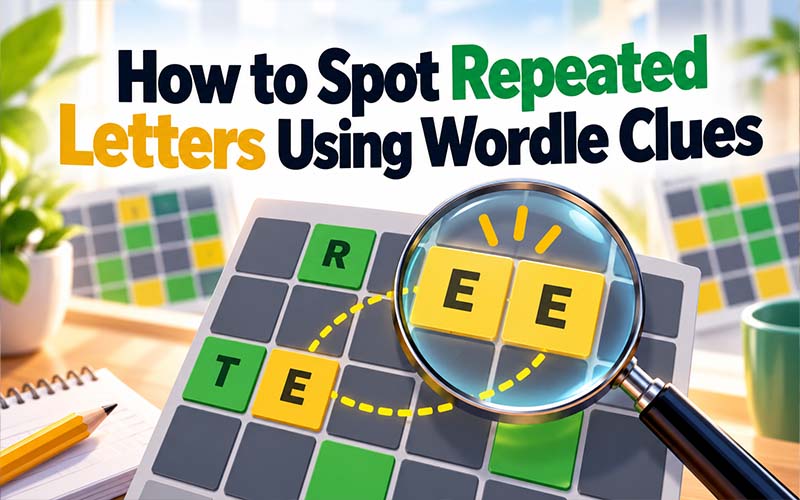
Finding a repeated letter is often less about guessing the right word and more about reading the clues you already have. Every green, yellow, and gray tile provides information that can help narrow the possibilities. When you suspect a letter appears twice, the goal is to test that possibility without sacrificing valuable guesses.
Pay attention to yellow and green tiles
A green tile confirms both the letter and its position. A yellow tile confirms the letter is present but misplaced. If you receive either color for a letter, consider whether another occurrence might fit elsewhere in the answer.
For example, suppose your guesses reveal an L in the answer, but the available positions are still uncertain. Instead of immediately trying a completely different consonant, consider words such as ALLEY or STILL if their other letters fit your clues.
This is particularly useful with Wordle words with double letters because the first confirmed occurrence may not reveal the full spelling pattern. A second copy could be adjacent to the first, as in SHEEP, or separated by other letters, as in ARRAY.
Use gray tiles carefully
Gray tiles are useful for eliminating possibilities, but repeated letters require a little extra attention. If a guess contains two copies of a letter and one is green while the other is gray, the answer contains only one copy of that letter.
Consider a hypothetical puzzle in which you guess a word containing two Es. One E turns green, while the other turns gray. That feedback indicates that the answer contains one E.
On the other hand, if both copies receive positive feedback, you know the answer contains at least two occurrences. This distinction helps you decide whether to keep testing a duplicate or move on to other letters.
Keep a simple letter checklist
A small written checklist can be surprisingly useful, particularly when several guesses have produced mixed feedback.
| Clue | What to record |
| Green letters | Confirmed positions |
| Yellow letters | Letters that must move |
| Gray letters | Eliminated letters or excess copies |
| Possible duplicates | Letters that may appear more than once |
| Remaining positions | Spaces still available for testing |
The idea is to avoid treating each guess as an entirely new puzzle. Your previous feedback should guide the next attempt.
When looking for 5 letter words with repeated letters, compare possible words against every confirmed position instead of choosing one simply because it contains a familiar double-letter pattern. A word can look promising but still contradict a yellow tile or a previously eliminated letter.
Tricky Wordle Words That Can Catch You Off Guard
Some words are difficult because they contain uncommon letters, while others are challenging simply because their spelling is easy to overlook. Repeated letters create both situations. A familiar word may suddenly become hard to identify when one letter occupies two positions, particularly if the puzzle has already eliminated several common alternatives.
Watch out for repeated vowels
Vowels are often the first letters players test, but repeated vowels can make the process less straightforward. EERIE contains three Es: two at the beginning and one in the fifth position. A player who assumes every vowel appears only once might overlook it.
Similarly, GOOFY and BLOOM use double O, while QUEEN and SHEEP contain double E. These patterns demonstrate why it is worth considering repeated vowels even after finding one confirmed vowel.
A useful habit is to ask yourself whether a remaining position could contain another copy of a vowel already identified. This does not mean guessing every possible duplicate; it means keeping that option open when the feedback supports it.
Look beyond familiar word endings
Many players become comfortable with common endings such as -ER, -ED, and -LY. However, repeated-letter words can follow different patterns.
Consider these examples:
- ARRAY repeats both A and R, with the double R appearing in the middle.
- PUPPY contains three Ps, including an adjacent pair in the middle.
- ABBEY contains double B near the beginning.
- TATTY contains three Ts, including an adjacent pair in the middle.
These examples illustrate how repeated letters can appear in different positions rather than always forming a pair at the end. If your current clues do not fit a familiar ending, reconsider the middle of the word.
Smart Strategies for Solving Double-Letter Wordle Puzzles
A good Wordle strategy balances finding the answer with learning as much as possible from each guess. When repeated letters are involved, that balance becomes even more important. You do not need to guess a double-letter word immediately, but you should know when testing one could provide useful information.
Start with words that reveal useful letters
A starting word containing several common letters can help identify which parts of the alphabet are worth exploring. Once the first feedback appears, use it to narrow down the possibilities.
If you have confirmed one E and the remaining clues fit SHEEP or SLEEP, a guess containing two Es can test whether the answer has a second copy. However, the best choice depends on the actual clues on your board.
The point is not to memorize one perfect starting word. It is to choose guesses that test plausible letters and positions.
Avoid repeating information you already know
Once a letter is confirmed in a particular position, use later guesses to test unresolved letters and positions rather than repeatedly revisiting information you already know. Likewise, avoid using several attempts on words that differ only in a letter you have already eliminated.
For double letter words for Wordle, think about what each guess will teach you. If you suspect a second S, for example, choose a candidate that also tests other unresolved letters rather than one that simply repeats the same information.
Keep a shortlist instead of guessing blindly
After a few attempts, write down two or three possible words that match your clues. Compare their repeated letters, vowel positions, and endings.
If two candidates share the same pattern, look for a guess that helps distinguish them. If only one candidate fits every confirmed tile, you may have enough information to try solving the puzzle.
Repeated-letter puzzles become easier when you compare each candidate with the positions and letter counts your guesses have already established. Keep track of what the board has established, remain open to a second occurrence, and make each guess count.
For readers interested in exploring more word puzzles and English vocabulary, America Publishers Author Spotlight also features language-focused articles and writing resources. These can offer additional ways to explore spelling patterns, word meanings, and the quirks of the English language beyond a single Wordle puzzle.
Conclusion
Repeated letters can turn an apparently straightforward Wordle puzzle into a real challenge, but recognizing common patterns makes the process easier. From repeated vowels in SHEEP and EERIE to repeated consonants in STILL and PUPPY, the right possibilities become clearer when you pay attention to both letter positions and frequency.
Keep a record of your clues, consider whether a confirmed letter appears twice, and use each guess to eliminate possibilities. With practice, spotting 5 letter words with double letters becomes less of a guessing game and more of a process of careful deduction. The next time a puzzle leaves you stuck, a familiar letter might be exactly what you need.
Frequently Asked Question
-
Can Wordle answers contain double letters?
Yes. Wordle answers can contain repeated letters, including two identical letters next to each other or in separate positions. Words such as APPLE, SHEEP, and STILL illustrate this pattern. Players should consider repeated letters whenever the available clues support them.
-
What are some five-letter words with double letters?
Examples include APPLE, ALLEY, BLOOM, CLASS, GOOFY, SHEEP, SLEEP, STILL, ABBEY, and OTTER. These Wordle words with double letters cover several common patterns, including repeated vowels and consonants.
-
How do you know if a Wordle word has a repeated letter?
Look at the colored feedback from previous guesses. If a letter is confirmed but the remaining positions are difficult to solve, consider whether another copy could fit. Pay particular attention to gray tiles when the same letter appears more than once in a guess, because gray may indicate an extra copy rather than complete absence.
-
Can a repeated letter turn gray even when it is in the answer?
Yes. Wordle accounts for the number of times a letter appears in the answer. If your guess contains more copies of a letter than the answer does, the extra occurrence may turn gray after matching copies have been accounted for. A gray duplicate does not necessarily mean that the letter is absent altogether.
-
What are some tricky Wordle words with repeated letters?
EERIE, ARRAY, ABBEY, GOOFY, and TATTY are examples that can be challenging because their repeated letters appear in different positions. Some tricky Wordle words also combine unusual spelling patterns with less common vocabulary, making it important to consider both meaning and letter placement.
-
Should you guess a double-letter word early in Wordle?
Not necessarily. The decision depends on the clues already available. If a repeated letter is a plausible possibility, testing it can provide useful information. However, guessing a duplicate without supporting evidence may waste an attempt. Compare the remaining possibilities and choose a word that tests the most useful unresolved letters.