
Published November 25, 2026
What makes a city unforgettable? In Paris, part of the answer begins on a bridge. On the Pont Neuf, pedestrians could stop and look out over the Seine. There were no houses along the crossing to block the view, and raised sidewalks gave people on foot room of their own. A trip across the river could become a chance to take in the city.
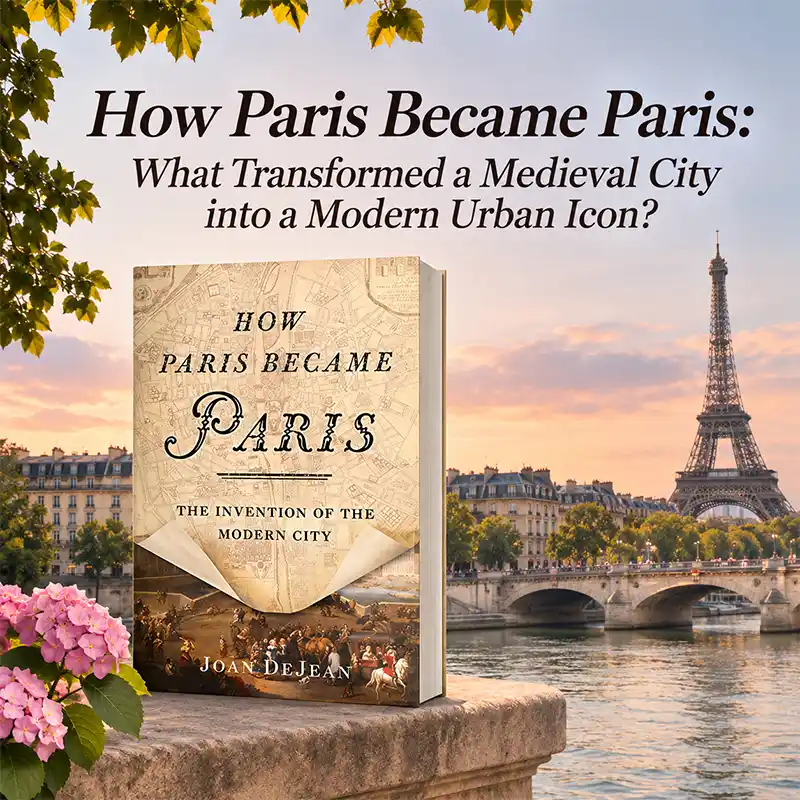
That change in what an ordinary walk could offer is at the heart of Joan E. DeJean’s How Paris Became Paris: The Invention of the Modern City. First published in the United States by Bloomsbury on March 4, 2014, the nonfiction book follows the transformation of Paris during the 17th century. DeJean asks how a city emerging from its medieval past developed streets, squares, and public spaces that people sought out for pleasure as well as convenience.
What How Paris Became Paris Is About
DeJean starts with a city whose landmarks were already recognizable. The challenge was what lay between them. At the beginning of the 17th century, Paris still had a street pattern inherited from its medieval past. Over the course of the century, new crossings, wider routes, and planned squares changed how people moved through the city and what they found along the way.
Henri IV and Louis XIV enter the history of Paris at different moments in this transformation. Under Henri IV, the completion of Pont Neuf and the creation of the Place Royale, now Place des Vosges, gave Parisians new kinds of public space. Under Louis XIV, the removal of old ramparts made room for tree-lined boulevards. Taken together, these projects help explain how 17th-century Paris became a city people could experience through a walk, a gathering, or an afternoon spent browsing.
Pont Neuf and Place des Vosges Changed What Public Space Could Do
The history of Pont Neuf spans two reigns. Construction began under Henri III and finished under Henri IV. Its design made a difference at street level. With sidewalks and open views of the river, the bridge gave pedestrians a reason to linger along a route they might otherwise have used simply to get across. Its historical significance lies partly in that choice: a piece of infrastructure designed to connect two banks also gave people a place to pause.
Place des Vosges shows how a planned square could change the experience of a neighborhood. Henri IV announced the project in 1605, when it was known as the Place Royale. Its coordinated buildings give the square a distinct shape and make the space they enclose feel like a destination. Where Pont Neuf opens the view toward the river, the square draws attention inward. Both projects show how architecture can influence where people choose to walk, stop, or meet.
How Paris’s Boulevards Made Walking Part of City Life
Under Louis XIV, the demolition of old fortifications opened up routes that gradually became the Grands Boulevards. It was a striking change in how Paris used its land. Ground that once helped defend the city could now carry traffic and accommodate broad, tree-lined avenues. This chapter of Paris urban history belongs to the 17th century, well before the 19th-century rebuilding associated with Baron Haussmann.
Boulevards were one part of a wider change. Public parks gave people places to walk and spend time outdoors. Sidewalks made room for pedestrians on busy routes, and street lighting helped extend public activity beyond daylight. Think of the difference between walking somewhere because you have an errand and going out because the walk itself appeals to you. DeJean follows the changes that made the second kind of outing a more visible part of Parisian life.
When Shopping and Entertainment Became Reasons to Go Out
One of the most familiar moments in How Paris Became Paris is the decision to go shopping without anything specific to buy. DeJean treats recreational shopping as a development worth examining in its own right. Browsing gave people another reason to head into the city. Fashion could be encountered in shops and on the people passing by, while opera and ballet offered other ways to spend time out. Those activities help explain how Paris acquired a cultural identity through the things people did there, day after day.
The connection between commerce and public life gives the book much of its appeal. A wider route helps people get somewhere. A concentration of shops or places to meet gives them reasons to make the trip again. DeJean’s account keeps those two parts of the story together, showing how the layout of Paris and the habits of its residents helped shape each other. Readers interested in French architectural history will find the buildings and plans here, alongside the everyday decisions that gave those places their character.
Joan E. DeJean and the History Behind Everyday Habits
Joan E. DeJean (1948–2023) was an American literary scholar and the Trustee Professor Emerita of Romance Languages at the University of Pennsylvania. Her research included 17th- and 18th-century French literature, women’s writing, and material culture. She wrote twelve books, including The Essence of Style and The Age of Comfort, and was elected an International Fellow of the British Academy in 2020.
That interest in material culture helps explain why the book pays such close attention to a sidewalk or a shopping trip. These details make it possible to picture what urban development meant to the people living through it. DeJean’s use of maps, paintings, and guidebooks also invites a question that still feels familiar. When people describe a city to someone who has never been there, what do they choose to show them? The answer tells us something about what the city values and what visitors have learned to look for.
The Legacy of 17th-Century Paris
Paris acquired its modern identity over generations, as ambitious public projects made room for ordinary pleasures. Someone could stop on a bridge to watch the river, take a longer route home for the sake of a walk, or go out to see what was in the shops. Each decision seems small on its own. Together, they help explain how Paris became a modern city and why the streets between its famous landmarks deserve a closer look.
Discover How Paris Became Paris: The Invention of the Modern City by Joan E. DeJean through Author Spotlight by America Publishers and explore the fascinating history behind one of the world’s most recognizable cities.
🔗 For Amazon (Joan E. DeJean’s author page): Click here
🔗 For Bloomsbury (official book description and audiobook): Click here
🔗 For Rizzoli Bookstore (book listing): Click here
🔗 For the University of Pennsylvania Almanac (author biography): Click here
Source: “How Paris Became Paris: The Invention of the Modern City, December 2, 2013.” Read more at PublishersWeekly.com.