

Published October 5, 2026 · The Digital Desk, America Publishers
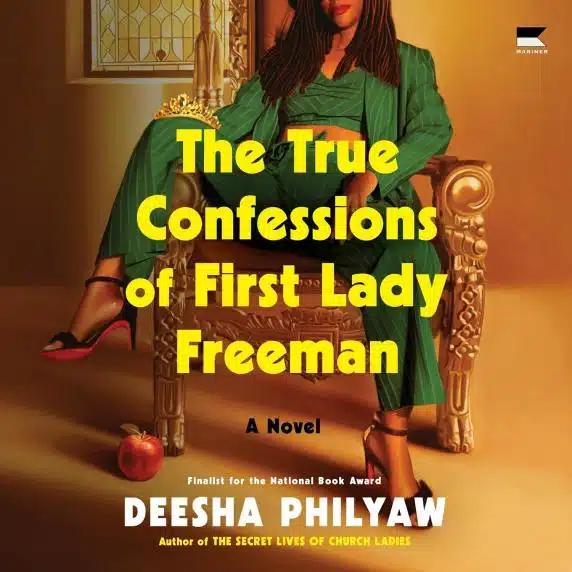
Public admiration does not necessarily bring private acceptance. That tension sits at the center of The True Confessions of First Lady Freeman, the debut novel from Deesha Philyaw, whose award-winning collection The Secret Lives of Church Ladies established her reputation for writing about women navigating faith, desire, and community expectations. Published by Mariner Books on September 29, 2026, the novel introduces Scharisse Freeman, a megachurch pastor’s wife whose comfortable public life becomes vulnerable when her past attracts unwelcome attention.
The publication marks a significant step in Philyaw’s literary career. Her move into the novel brings a sustained focus to questions that readers of her short fiction will recognize: who gets to belong, who sets the conditions of acceptance, and what a woman must conceal to remain welcome. Early critical coverage offers an introduction to a story where religious prestige, personal ambition, and the desire for approval become closely entangled.
From Award-Winning Stories to a Debut Novel
Philyaw arrives at this publication with substantial recognition behind her. The Secret Lives of Church Ladies won the 2021 PEN/Faulkner Award for Fiction, The Story Prize, and the Los Angeles Times’ Art Seidenbaum Award for First Fiction. It was also a finalist for the 2020 National Book Award for Fiction.
In announcing the PEN/Faulkner win, the award’s judges emphasized the collection’s combination of distinct individual voices and emotional coherence. That recognition provides context for the interest surrounding Philyaw’s next work: readers are encountering a novelist who has already demonstrated her ability to bring complicated lives into focus through short fiction.
The change in form also creates a different reading experience. A novel allows a central character’s choices and relationships to accumulate across a longer narrative. For readers familiar with Philyaw’s earlier work, the interest lies partly in how that expanded space accommodates another woman negotiating the distance between community approval and personal freedom.
A First Lady Still Seeking Acceptance
Scharisse’s position appears enviable. Publishers Weekly identifies her as the wife of Pastor David Freeman of Hope in Christ, a 25,000-member megachurch in the fictional Georgia town of Belleton. Alongside their religious prominence, the couple has commercial interests spanning branded products, clothing, and books. Yet Scharisse remains outside the circle of acceptance she wants to enter.
The official synopsis describes a woman judged as insufficiently suitable by church insiders while also facing distance from an old friend. Her material success has therefore failed to settle the question of where she belongs. The invitation to participate in the First Lady USA pageant seems to offer the recognition she has been seeking from other pastors’ wives.
That premise gives the novel an accessible emotional conflict. Scharisse can possess influence and still feel excluded. Her circumstances invite readers to consider the difference between being visible within a community and being accepted by it, particularly when acceptance depends on standards established by other people.
The pageant places Scharisse’s aspirations within a setting built around public judgment. Publishers Weekly explains that participating pastors’ wives compete for a monetary prize benefiting their chosen charities. For Scharisse, the opportunity carries a more personal significance because it could change her standing among her peers.
As a narrative device, the competition makes approval tangible. There are participants, expectations, and an outcome. It gives a recognizable shape to something less easily measured: the wish to have one’s place in a group acknowledged.
The premise also raises a difficult question about the price of that recognition. If belonging requires someone to keep presenting an acceptable version of herself, acceptance can become an ongoing performance. Scharisse’s situation suggests a useful distinction between receiving an invitation and feeling secure enough to stop proving that she deserves it.
The threat to Scharisse’s position comes through revelations connected to her past. Publishers Weekly describes information concerning her family history that forces her to confront a choice between disclosure and the protection of her public persona. The specific revelations are best left for readers to discover.
At the level of its premise, the conflict concerns control over a personal story. A person may work hard to establish a present-day identity while remaining vulnerable to how others interpret an earlier chapter of her life. When reputation is involved, the meaning attached to a disclosure can become as consequential as the information itself.
This creates room for discussion without reducing the novel to a lesson about honesty. Readers can ask who has the authority to judge Scharisse, whether her community’s expectations are fair, and how much of a person’s history others are entitled to demand. Those questions follow from the setup without requiring advance knowledge of her decisions.
Critical coverage identifies comedy as an important part of the novel’s approach. Publishers Weekly praises its pacing and irreverence. Kirkus Reviews describes it as a satire of Black megachurch culture and highlights its engagement with misogyny, classism, colorism, and hypocrisy.
That framing helps clarify the book’s potential readership. A church setting does not automatically make a novel devotional fiction. Here, the critical descriptions point toward social satire concerned with hierarchy, exclusion, and the contradictions surrounding a prominent woman.
Humor can make such contradictions easier to recognize while leaving their consequences intact. For readers drawn to stories about status-conscious communities, the appeal may lie in watching apparently respectable behavior come under scrutiny. The emotional stakes remain rooted in Scharisse’s wish to belong and the uncertainty surrounding what that belonging requires.
For publishing readers, the clearest significance is Philyaw’s progression from an acclaimed story collection to her first novel with Mariner Books, an imprint of HarperCollins. The publication extends a literary career already recognized by major fiction awards while giving readers a new central character and a different narrative form.
For readers considering the book, its premise offers a specific reason to look closer: a
woman’s public success has not freed her from the need for approval, and the return of her past threatens the identity through which she has pursued it. The question accompanying Scharisse Freeman’s story is what becomes possible when maintaining that identity costs more than confronting the truth.
Source: “The True Confessions of First Lady Freeman, June 23, 2026.” Read more at PublishersWeekly.com.