

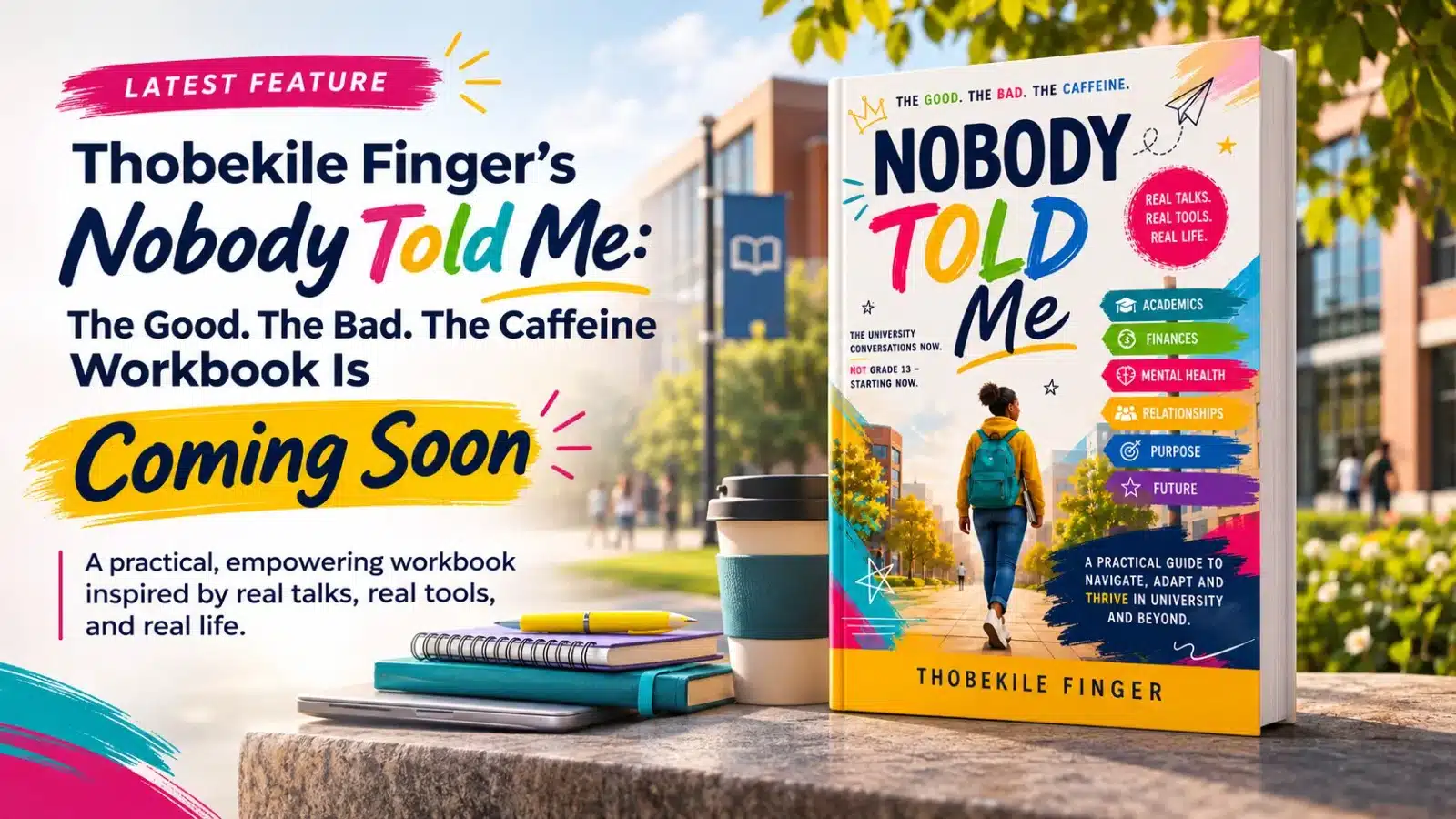
Thobekile Finger’s, Nobody Told Me: The Good. The Bad. The Caffeine. is coming soon. The companion workbook builds on her published book, A Mother’s Prayer: The Stuff They Don’t Tell You, the Good, the Bad and the Caffein, and focuses on a question that becomes real in the first weeks after high school. What does it take to make your own decisions when so much around you is new?
A college or university acceptance letter can tell you when classes start. The first week brings questions of its own. You might be getting used to a new city, deciding who to spend time with, or wondering how to ask for help when everyone else seems to have settled in. Finger’s upcoming college transition workbook gives students a way to think through that change and consider what support they might need along the way.
Introducing Thobekile Finger and A Mother’s Prayer
In A Mother’s Prayer, Thobekile Finger writes about the transition to higher education as something a young person experiences alongside parents, caregivers, and the community that helped raise them. The book draws on faith and the African proverb “It takes a village to raise a child.” Its voice is conversational, with the candor and humor of someone who remembers how unfamiliar the next step can feel.
Finger considers what can happen when a student leaves the routines of home and school for a larger, less familiar world. Academic pressure is part of that experience, alongside cultural adjustment, the freedom to make more decisions, and the question of how to stay connected to where you come from.
The book also speaks directly to mothers watching their children enter this new stage. For families accustomed to sharing the details of daily life, even a change in how often they talk can take some getting used to. Finger gives parents and students a way into that conversation, grounded in the values and relationships they already share.
What Readers Can Expect from the Nobody Told Me Workbook
The Nobody Told Me workbook continues the conversation with students at the center. Preparing for university life can mean figuring out which decisions are yours to make, whose advice you trust, and when it makes sense to reach out. Those questions can feel abstract before classes start. They become easier to talk about when you picture an ordinary week.
Consider a student who has always relied on a familiar school routine. At college or university, they might have a long gap between classes and several assignments due around the same time. The challenge may be deciding how to use that open time and recognizing when their approach needs to change. A conversation about academic pressure becomes more concrete when it starts with a schedule the student will actually have to manage.
Cultural adjustment can be just as personal. A student who moves to a city may be learning how to get around and meeting people whose experiences differ from their own. At the same time, they may want to keep up a practice that mattered at home, whether that means making time for prayer or keeping a regular call with family. Staying connected to your roots can involve small choices about what you carry into a new routine.
These situations illustrate the kind of transition the companion workbook addresses. A student can start by considering what already feels manageable, what remains unfamiliar, and who they would feel comfortable turning to if they needed help.
Preparing for Life After High School
The transition from high school to college can feel uneven. A student might feel ready for the coursework and still be unsure how to meet people. Another might make friends quickly and then find that managing deadlines takes more effort than expected. Even students who stay close to home may find that a new academic schedule changes how they spend their time and how often they see the people they rely on.
Growing independence also changes what asking for support looks like. At school, a teacher may have noticed when a student fell behind. In a large class, the student may be the one who has to start that conversation. Deciding when to speak up is one of the smaller, more ordinary parts of independence, and it can make a real difference to how a student handles a difficult week.
Parents and caregivers have their own adjustment to make. A student who calls home about a setback might want help thinking it through or might simply want someone to listen. Asking which kind of support would help can give the student room to decide what to do next. That balance between staying available and giving a young adult space is one of the threads connecting the published book and the upcoming workbook.
From A Mother’s Prayer to a Companion Workbook
In A Mother’s Prayer, Finger opens up a conversation about what families and communities can pass on before a young person heads to college or university. Nobody Told Me: The Good. The Bad. The Caffeine picks up that conversation as students begin making more of those decisions themselves. The connection between the two books is especially clear when a student encounters a choice that puts familiar advice into practice.
For families, the two books offer a shared subject to talk about before the first semester gets busy. For students, the workbook offers a chance to consider what they want to carry forward and where they may need to build new habits. America Publishers looks forward to sharing Thobekile Finger’s companion workbook with readers preparing for that next stage.
Where to Find A Mother’s Prayer and Follow the Workbook Release
Thobekile Finger’s A Mother’s Prayer: The Stuff They Don’t Tell You, the Good, the Bad and the Caffeine is available in different platforms. Her companion workbook, Nobody Told Me, is coming soon.
🔗 For Barnes & Noble: Click here
🔗 For Amazon: Click here