

Published October 22, 2026 · The Digital Desk, America Publishers
An awkward greeting. A disagreement over manners. A conversation that continues long after everyone should have walked away. Ordinary encounters offer endless material for comedy, especially when someone notices the small contradictions other people would rather ignore.
Larry David has spent much of his career turning those contradictions into television. As co-creator of Seinfeld and creator and star of Curb Your Enthusiasm, he helped build stories around social expectations, wounded pride, and the consequences of refusing to let something go.
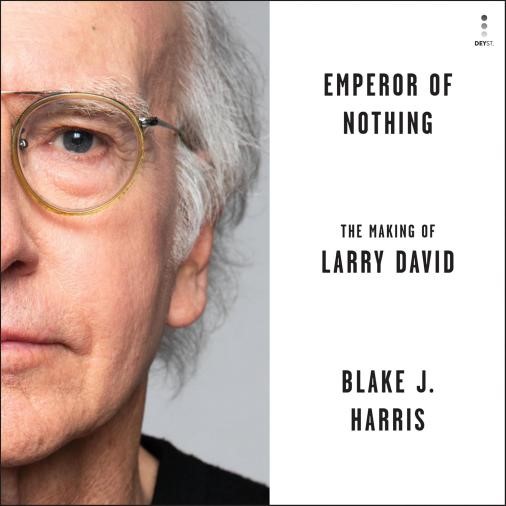
But familiarity with his comedy does not necessarily mean familiarity with the person who makes it. That distinction sits at the center of Emperor of Nothing: The Making of Larry David, Blake J. Harris’s new biography, published by Dey Street Books on October 20, 2026. The book follows a creative career whose public image has become unusually intertwined with a fictional character bearing the same name.
A Larry David Biography Beyond the Television Persona
The first authorized biography of Larry David, Emperor of Nothing draws on more than five years of research and interviews with David, his family, friends, and collaborators. Its scope stretches from his Brooklyn upbringing and early stand-up career to his partnership with Jerry Seinfeld and his work on Curb Your Enthusiasm.
That access gives the biography a clear focus: the relationship between a working comedian’s experiences and the public figure audiences believe they know.
Harris has previously explored entertainment and technology through Console Wars and The History of the Future. His documentary work also includes Console Wars and GameStop: Rise of the Players. His earlier projects also examine the people and professional relationships behind developments in entertainment and technology.
For readers, the appeal extends beyond learning what happened behind a familiar television scene. The larger question is how a particular way of seeing the world becomes a sustained creative practice.
Brooklyn Beginnings and an Uneven Professional Path
David grew up in Sheepshead Bay, Brooklyn, and entered comedy through stand-up before establishing himself in television. His early television work included writing and performing on ABC’s Fridays, followed by a writing position on Saturday Night Live.
Those beginnings deserve attention because later success can make a career appear more straightforward than it was. Looking backward from Seinfeld, each earlier job can seem like an obvious step toward an inevitable destination. At the time, however, a performer or writer has no such certainty.
David’s early stand-up years provide a counterweight to his later television success. They bring the focus back to the professional uncertainty that can accompany the development of a distinctive comic voice.
The practical lesson is measured. Persistence does not guarantee success, but repeated experience gives creative people opportunities to refine their judgment, recognize weaknesses, and discover which ideas they want to pursue.
Larry David and Jerry Seinfeld: Finding a Shared Comic Language
The creative partnership between Larry David and Jerry Seinfeld provides one of the clearest examples of an individual perspective finding strength through collaboration.
The Television Academy recounts how the two comedians discussed Seinfeld’s television opportunity during a visit to a New York deli in 1988. Their conversation helped shape the idea of a series built around the everyday details they already found funny.
The significance lies in the material they considered worth developing. A minor irritation, an uncomfortable exchange, or an apparently pointless conversation could support a story when the characters’ reactions supplied enough tension.
This is central to understanding the story behind Seinfeld. Ordinary life was not simply background scenery. It provided the disagreements, competing interpretations, and social complications that moved the comedy forward.
Their partnership also challenges the idea that originality requires isolation. Two writers can share an interest without having identical instincts. Working together creates room to question a premise, test a response, and discover possibilities that neither person would necessarily reach alone.
How Everyday Observations Become Comedy
An observation becomes a comic premise when it opens a problem. Who decides whether someone has been rude? Does an explanation resolve an offense or make it worse? What happens when two people apply different rules to the same encounter?
These questions help explain the appeal of David’s approach to comedy. The situations may be small, but the characters’ investment makes them consequential.
Viewed as a storytelling technique, the humor often depends on escalation. Someone identifies an inconsistency, insists on discussing it, and creates a larger difficulty through the effort to prove a point. The audience can recognize the original grievance while also seeing the damage caused by pursuing it.
For readers interested in Larry David’s creative process, this offers an accessible way to think about originality. Inspiration need not begin with an extraordinary event. It can begin with close attention to an ordinary experience, followed by the work of finding its dramatic possibilities.
From Writing to Performing in Curb Your Enthusiasm
With Curb Your Enthusiasm, David placed a fictionalized version of himself at the center of the action. The series developed from a 1999 HBO special and premiered as a continuing show in October 2000. Its episodes use story outlines, while much of the dialogue is improvised by the performers.
That format gives collaboration a different function. Writers establish the situations and narrative direction; actors help determine how the encounters unfold through timing, phrasing, and reaction.
The format also highlights David’s adaptability. His interest in everyday behavior carried into a different production method, with performance taking a more prominent role.
HBO describes the screen character as an exaggerated version of David living a fictionalized life. That distinction matters whenever viewers try to use a scene as evidence of his private personality. A familiar name and recognizable circumstances can make fiction feel intimate, but they do not turn it into a complete personal record.
Why Creative Partners Matter
A recognizable creator gives audiences an easy way to identify a show. The work itself depends on a wider group.
Seinfeld brought David and Seinfeld’s writing into contact with an ensemble whose performances shaped how audiences experienced the characters. Curb Your Enthusiasm makes the contribution of fellow performers especially visible through its use of improvisation.
Comedy writing and collaboration involve more than encouragement. Colleagues can challenge an unclear idea, expose a weak scene, or supply an unexpected reaction that improves the material.
Creative independence can survive that process. Maintaining a perspective does not require rejecting every suggestion. It requires judgment about which changes strengthen the work and which pull it away from its purpose.
What Readers Can Take from Larry David’s Creative Journey
The most useful reflections extend beyond television comedy. What do we notice that others pass over? Which skills need more practice? When does defending an idea help it, and when would another person’s response make it better?
David’s movement through stand-up, sketch television, sitcom writing, and performance gives those questions a concrete professional context. It also encourages a more careful understanding of setbacks: one difficult experience cannot explain an entire career.
Emperor of Nothing: The Making of Larry David arrives with a subject whose screen presence is widely recognizable, yet whose public familiarity leaves room for closer examination. Its focus on upbringing, work, and relationships invites readers to consider the experiences behind the comic perspective.
The next ordinary conversation may never become a television scene. Paying attention to it, however, is a place to begin.
🔗 For Amazon: Click here
🔗 For Apple Books: Click here
Source: “Emperor of Nothing: The Making of Larry David,” by Blake J. Harris. Read more at HarperCollins.com.