

Published November 4, 2026 · The Digital Desk, America Publishers
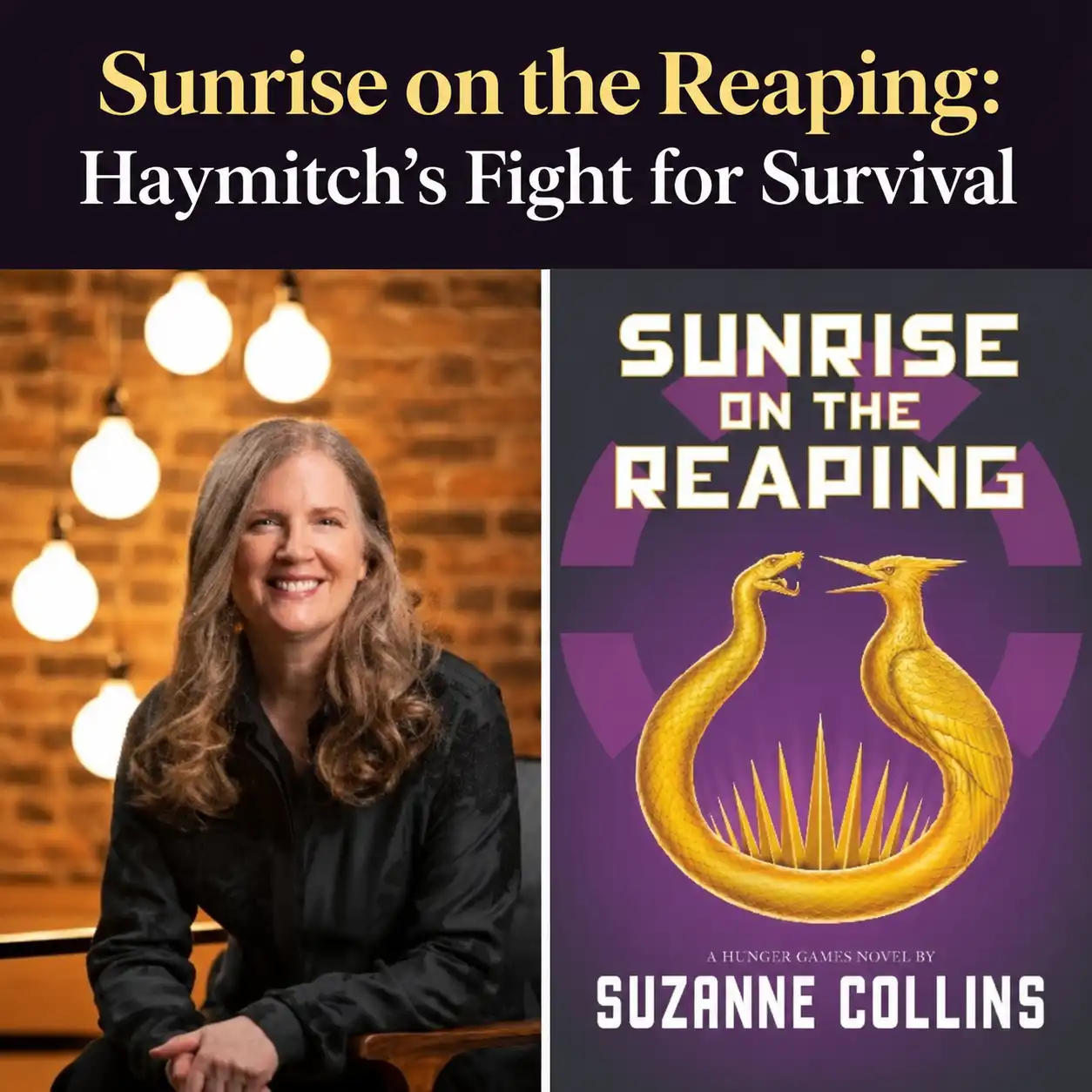
Sunrise on the Reaping: Haymitch’s Fight for Survival in a Capitol Built on Fear
What can a sixteen-year-old plan for when his future depends on a ceremony he cannot control? For Haymitch Abernathy, getting through reaping day should mean returning to his family and spending time with the girl he loves. Instead, it becomes the beginning of a struggle in which even his own story may belong to someone else.
In Sunrise on the Reaping, Suzanne Collins returns to Panem twenty-four years before the events of The Hunger Games. The fiftieth annual Games are approaching, and the Second Quarter Quell carries a devastating rule: each district must surrender twice the usual number of tributes. Forty-eight young people will enter the arena.
At the center of this Hunger Games prequel is a younger Haymitch, whose relationships and hopes give the familiar machinery of the Capitol an intensely personal meaning. Before he becomes the mentor readers recognize, he is a teenager with a life he wants to keep.
What Is Sunrise on the Reaping About?
A spoiler-light Sunrise on the Reaping summary begins with an ordinary wish: Haymitch wants reaping day to pass without taking anyone he loves. That wish becomes impossible when he is forced to leave District 12 alongside Louella McCoy, Wyatt Callow, and Maysilee Donner.
Their departure brings together four people who share a home district but arrive with different relationships, assumptions, and ways of facing danger. Meanwhile, the Capitol turns their separation from home into a public spectacle.
Published originally on March 18, 2025, the novel is The Hunger Games Book 5 in publication order. The linked UK paperback edition was published on August 4, 2026. Its place earlier in Panem’s history allows Collins to examine the world that existed before Katniss Everdeen’s story.
The central tension reaches beyond whether Haymitch can survive. What room does he have to make a meaningful choice when the people controlling the competition also control how everyone else sees it?
Haymitch Abernathy Before the Hunger Games Trilogy
Readers familiar with Haymitch may approach this novel carrying a fixed impression of him. An origin story asks them to set that impression aside long enough to meet the young person who came first.
His family and his relationship with Lenore Dove matter because they establish a future outside the Games. He has people to return to, private concerns, and reasons to look beyond the next few hours. Being taken from District 12 threatens that entire life.
This is where Haymitch’s journey in Sunrise on the Reaping gains its emotional force. Survival cannot remain an abstract contest when readers understand what being forced into it interrupts.
The publisher’s description establishes his growing recognition that the competition has been arranged against him, alongside his determination to push back. That creates a difficult distinction: trying to endure the Capitol’s rules and questioning its authority are different kinds of struggle.
Seen this way, the Haymitch Abernathy origin story invites readers to consider how resistance begins. It may start before anyone has a strategy, in the refusal to accept that those in power have the right to decide everything.
Louella McCoy: A Connection to Home
Among the Sunrise on the Reaping characters, Louella McCoy brings an especially painful familiarity to Haymitch’s situation. She is a younger friend he has known since her birth, someone whose place in his life approaches that of a little sister.
Her presence makes the Capitol’s cruelty harder to keep at a distance. One of the people caught in the same machinery is someone Haymitch already cares about.
That connection also exposes a contradiction at the heart of the Games. The Capitol gathers young people into a competition that demands division, yet those young people arrive with attachments that cannot simply disappear.
Louella’s significance lies partly in that collision. A familiar face can offer a connection to home while making the danger feel even more immediate. Through her relationship with Haymitch, readers can consider what happens when the instinct to protect someone meets a system built to endanger them both.
Her later experiences are best discovered in the novel. Knowing the bond is enough to understand why her presence matters.
Wyatt Callow: Calculating Chances Under Capitol Rules
Wyatt Callow brings a different perspective to the District 12 tributes. Identified in the publisher’s description through his habit of calculating odds, he introduces the language of probability into a situation dominated by fear.
There is something unsettling about that combination. Numbers can seem to offer clarity, particularly when events feel uncontrollable. Yet a calculation is only as reliable as the information available to the person making it.
As a literary interpretation, Wyatt’s association with odds raises a useful question: how much can anyone predict in a competition whose organizers hold such unequal power?
His presence broadens the group beyond a single response to danger. Haymitch must navigate the experience alongside people who approach it differently, including someone inclined to assess chances.
A spoiler-light introduction should leave Wyatt’s specific decisions and later role unexplained. The tension is already present in the premise: understanding the odds does not give a tribute control over the conditions.
The Second Quarter Quell: Twice the Tributes, Greater Control
The significance of the Second Quarter Quell begins with its scale. Instead of twenty-four tributes, the 50th Hunger Games require forty-eight, taking four young people from each district.
For families in Panem, that means more children facing removal from home. For the Capitol, the anniversary becomes another occasion to demonstrate its authority over the districts.
The Games can be read as a political ritual as well as a survival contest. Their repetition teaches people to expect the ceremony, fear its arrival, and organize their lives around a decision they cannot refuse.
Doubling the tributes intensifies that message. The government can expand the suffering and present the change as part of an established tradition.
President Snow belongs to this wider structure of power. The threat surrounding Haymitch extends beyond individual opponents to the institutions that arrange the spectacle and determine its public meaning.
Propaganda and the Power to Tell the Story
One of the most important directions for Sunrise on the Reaping analysis concerns information: who produces it, who controls its circulation, and whose experience survives in the public account.
Collins has explicitly connected the novel to propaganda and the power of controlling a narrative. She has also identified philosopher David Hume’s discussion of how a small number govern a much larger population as an inspiration.
That context gives the Capitol’s spectacle another dimension. Physical force can compel people to participate. A managed public narrative can influence how their participation is understood.
For readers, this introduces a reason to question appearances. A public account may be selective even when it seems complete. The people being watched may understand their circumstances very differently from the audience watching them.
Without revealing how the novel develops this conflict, its premise encourages a disturbing question: what happens when the authority responsible for suffering also gets to explain it?
Survival, Sacrifice, and Human Connection
The novel’s major themes meet in Haymitch’s relationships. Survival matters because he has a life beyond the arena. Love gives that life meaning while making separation more painful.
Courage, in this context, need not mean an absence of fear. It can mean attempting a choice while recognizing how little protection that choice offers.
Sacrifice raises harder questions still. An oppressive system can force people into situations where every available action carries a cost. Discussing those pressures does not require revealing the decisions characters eventually make.
Power and inequality connect these personal struggles to Panem’s political order. The Capitol sets the conditions; district families bear the consequences. Resistance begins to matter because those consequences are human, specific, and unequally imposed.
For readers exploring Suzanne Collins’s dystopian fiction through America Publishers Author Spotlight, these tensions offer a way into the book beyond its survival premise.
Suzanne Collins and the Questions Behind Panem
Suzanne Collins is the American author of The Hunger Games series and the middle-grade fantasy series The Underland Chronicles. Across her work, she has explored war, violence, and their effects on young people.
Returning to Haymitch allows those concerns to take shape through someone readers may believe they already understand. The interest lies in encountering his earlier life on its own terms, before later knowledge defines every part of him.
What Can Resistance Preserve?
Haymitch’s story begins with attachments that the Capitol has no reason to respect: family, friendship, love, and the expectation of another ordinary day. Those attachments give readers a measure of what is at stake.
What does it take to keep making choices when powerful people have arranged the conditions against you? And what can resistance preserve when even the public version of your life may be beyond your control?
🔗 For Amazon: Click here
🔗 For Suzanne Collins’s Amazon Author Page: Click here
🔗 For Scholastic’s Paperback Announcement:Click here
🔗 For Suzanne Collins’s Author Biography: Click here
Source: “Suzanne Collins Has Another Hit in ‘Sunrise on the Reaping,’ March 27, 2025.” Read more at PublishersWeekly.com.