
Published on August 26, 2026
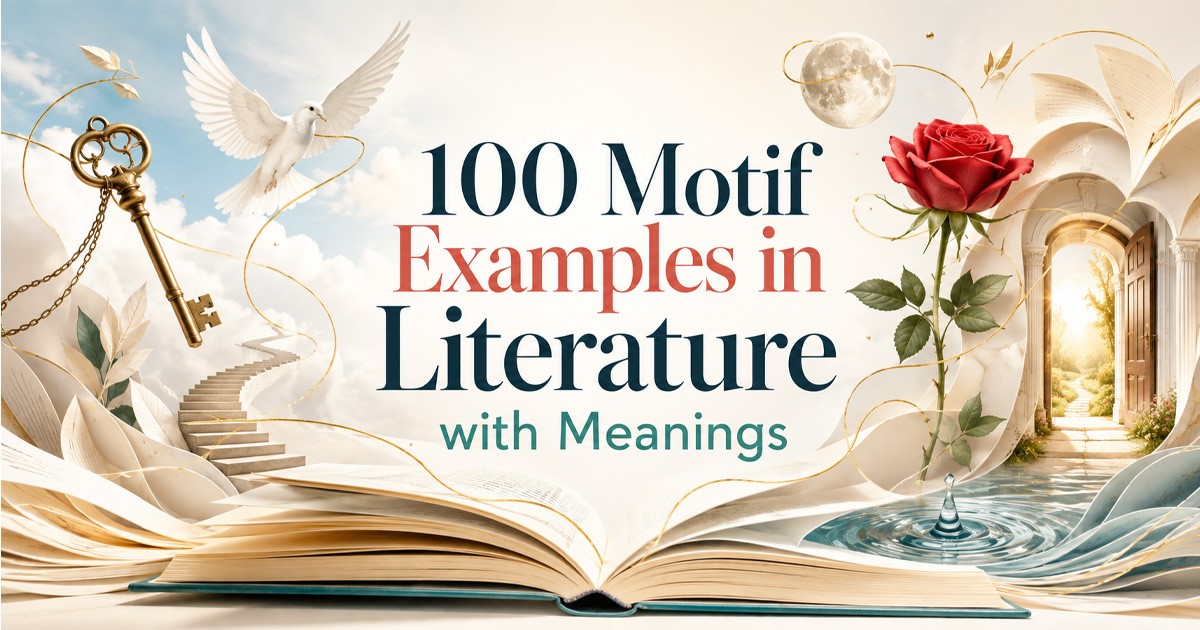
Have you ever noticed a color, object, sound, or action appearing repeatedly throughout a story? It may seem insignificant at first, but each repetition can add another layer of meaning. These recurring details are called motifs, and writers use them to connect characters, emotions, conflicts, and themes without explaining everything directly.
Some of the most memorable motif examples are surprisingly simple: a locked door representing secrecy, changing seasons reflecting personal growth, or a persistent storm suggesting approaching conflict. Once readers recognize these patterns, familiar stories can begin to reveal ideas that were hiding in plain sight.
This guide explores 100 motif examples in literature and explains what each one can mean. Because motifs can carry different meanings in different stories, the interpretations included here are not definitive. Instead, they offer a starting point for readers analyzing literature and writers looking for thoughtful ways to add depth, atmosphere, and emotional continuity to their own work.
Affiliate Disclosure: As an Amazon Associate I earn from qualifying purchases. at no additional cost to you.
What Is a Motif in Literature?
A motif is an element that appears repeatedly in a literary work and helps develop its central ideas. It might be an object, color, phrase, sound, place, image, action, or situation. What makes it meaningful is not simply that it returns, but that each appearance strengthens, changes, or adds to its meaning within the story.
Imagine a novel in which the main character repeatedly encounters locked doors. One may belong to a childhood home, another may prevent access to a hidden room, and a third may appear in a dream. Individually, these doors are part of the setting. Together, they may form a motif connected to secrecy, emotional repression, lost memories, or truths the character is not ready to confront.
A motif is closely related to a symbol and a theme, but the three are not identical. A symbol is a specific element that represents something beyond its literal meaning. A theme is the broader idea the story explores, such as freedom, ambition, grief, or the loss of innocence. A motif is the repeated detail that helps the reader see and understand that theme.
For instance, a bird may symbolize freedom in one scene. If birds, cages, feathers, and images of flight continue appearing at important moments, the pattern becomes a motif that supports the larger theme of freedom. This relationship is visible in many literary motif examples, where repetition gradually turns an ordinary detail into something emotionally or intellectually significant.
The clearest examples of motifs, therefore, have two essential qualities: repetition and purpose. When examining motif examples, readers should ask not only, “What keeps appearing?” but also, “What new meaning does it carry each time?”
Recommended Reading
Explore how recurring archetypes and motifs operate across literature, traditional stories, and folklore.
Why Do Writers Use Motifs?
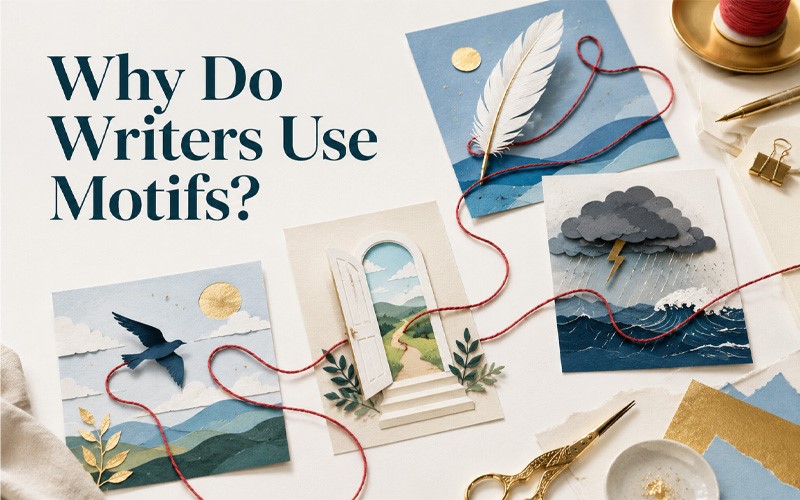
Writers use motifs because they allow a story to communicate on more than one level. A character may never openly discuss feeling trapped, for example, but repeated images of cages, narrow rooms, blocked roads, and closed windows can make that emotion unmistakable. Instead of directly telling readers what to think, the writer creates a pattern and allows them to discover the connection.
Motifs can reinforce a theme, establish atmosphere, reveal a character’s development, connect separate scenes, and foreshadow an approaching event. They can also change meaning as the story progresses. Fire might initially represent destruction but later suggest warmth, survival, or renewal. This evolving meaning gives readers a reason to reconsider earlier details.
Many common motifs in literature remain popular because they can carry different meanings in different contexts. Water may suggest cleansing in one novel and danger in another. A journey can represent freedom, exile, discovery, or an attempt to escape the past. The story surrounding the repeated element determines its significance.
Strong motif examples never feel as though they have been inserted only to appear meaningful. They grow naturally from the characters, setting, and conflict. Their repetition creates familiarity, while each new appearance deepens the reader’s understanding. This balance helps a story feel unified without making its message overly obvious.
Recommended Reference
Study how recurring literary elements reinforce themes and connect ideas across Western literature.
100 Motif Examples in Literature with Meanings
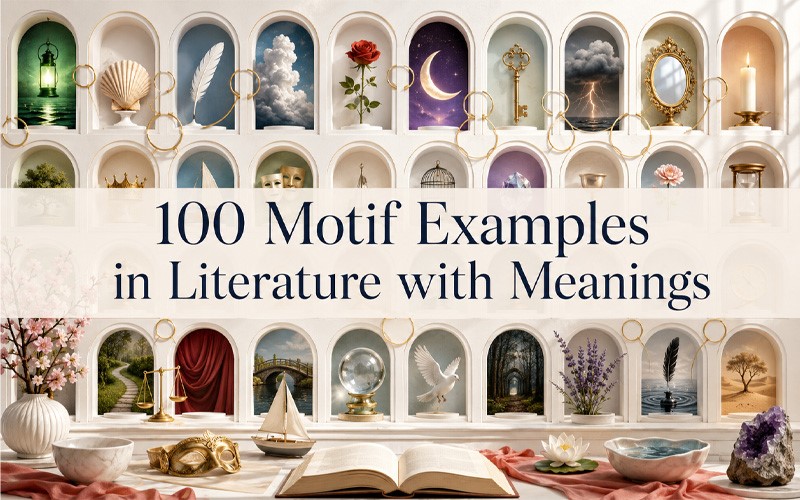
The following motif examples in literature are tied to identifiable novels, plays, poems, and epics. Each entry examines an element that recurs or develops as a sustained pattern, rather than treating every important object as a motif. The interpretations are grounded in the work’s characters, conflicts, and themes, although readers may arrive at additional meanings. Together, these examples demonstrate how repetition can transform landscapes, colors, objects, animals, and journeys into meaningful parts of a literary work.
Recommended Reading
Examine how mythology and recurring literary patterns influence characters, themes, and storytelling.
View on Amazon (ad)Nature and Weather Motifs in Literature
Nature is rarely a passive background in literature. Writers repeatedly use oceans, rivers, forests, flowers, seasons, and weather to reflect characters’ emotions, signal approaching conflict, and connect human experiences with larger natural cycles.
- The Sea in Moby-Dick by Herman Melville
The sea remains a powerful and unpredictable presence throughout Melville’s novel. It represents freedom and opportunity for some sailors but also danger, isolation, and forces beyond human understanding. Its constant movement mirrors Ahab’s increasingly unstable pursuit of the white whale and humanity’s struggle to control nature.
- The River in Adventures of Huckleberry Finn by Mark Twain
The Mississippi River repeatedly offers Huck and Jim temporary freedom from the restrictive society surrounding them. However, it also exposes them to uncertainty and danger. Its changing conditions reflect the instability of their journey, while each return to the shore brings renewed contact with prejudice, deception, and social corruption.
- The Moors and Changing Weather in Wuthering Heights by Emily Brontë
The exposed moors recur as a setting associated with freedom, emotional intensity, isolation, and the relationship between Catherine and Heathcliff. Violent weather often accompanies conflict or psychological disturbance. Together, the landscape and storms make the characters’ turbulent emotions feel inseparable from the natural world surrounding them.
- Fog in Bleak House by Charles Dickens
Fog repeatedly spreads through London in Bleak House, obscuring streets, buildings, and people. It reflects the confusion and delay created by the Court of Chancery, where cases become almost impossible to understand or resolve. The fog connects physical pollution with institutional disorder and the moral blindness of society.
- The Forest in The Scarlet Letter by Nathaniel Hawthorne
The forest repeatedly provides an alternative to the severe rules of Puritan society. Away from the settlement, Hester and Dimmesdale can speak more openly about their relationship and imagine a different future. The forest therefore represents privacy and possibility, although its darkness also carries uncertainty and potential danger.
- Flowers in Mrs Dalloway by Virginia Woolf
Flowers appear throughout Mrs Dalloway, beginning with Clarissa’s decision to buy them herself. They connect beauty, social ritual, memory, affection, and the fragility of life. Their vivid presence contrasts with the psychological pain experienced by several characters, especially as the novel moves toward news of Septimus’s death.
- The Garden in The Secret Garden by Frances Hodgson Burnett
The neglected garden changes as Mary, Colin, and Dickon care for it, making its restoration parallel their physical and emotional recovery. Its seasonal growth reinforces ideas about friendship, renewal, and the healing influence of nature. The garden is therefore more than a setting: it becomes a sustained pattern of transformation.
- Seasonal Change in The Great Gatsby by F. Scott Fitzgerald
The novel begins during the brightness and possibility of summer, while Gatsby’s dream still appears achievable. As the story moves toward autumn, relationships collapse and the atmosphere becomes increasingly bleak. The changing seasons reinforce the movement from hope and illusion toward exposure, loss, and the end of Gatsby’s imagined future.
- Barren Land and Water in The Waste Land by T. S. Eliot
Eliot repeatedly contrasts dry, lifeless landscapes with images of water. The barren land suggests spiritual exhaustion, cultural fragmentation, and the inability to renew, while water carries the possibility of cleansing and rebirth as well as the threat of drowning. The contrast gives the poem’s fragmented world a recurring pattern of death and desired renewal.
- Lilacs in “When Lilacs Last in the Dooryard Bloom’d” by Walt Whitman
Lilacs return throughout Whitman’s elegy for Abraham Lincoln. Their recurring fragrance and seasonal blooming connect personal mourning with remembrance and natural renewal. Because the flowers bloom again each spring, they allow grief and continuing life to coexist rather than presenting death as a simple or final separation.
Colors, Light, and Darkness as Motifs
Colors and changing light can create patterns that operate beneath a story’s visible action. The following literary motif examples show how writers use visual repetition to develop longing, identity, morality, concealment, and psychological conflict.
- The Green Light in The Great Gatsby by F. Scott Fitzgerald
Gatsby repeatedly looks toward the green light at the end of Daisy’s dock. Initially, it represents his desire to reunite with her, but its meaning expands to include ambition, the future, and the unreachable promises people continue pursuing. Its distance reflects the gap between Gatsby’s dream and reality.
- The Color Red in The Scarlet Letter by Nathaniel Hawthorne
Red repeatedly appears through the scarlet letter, its decorative embroidery, and imagery associated with passion and social judgment. Although the community intends the letter to identify Hester’s sin, its meaning changes as she builds an independent life. Red consequently carries shame, vitality, defiance, suffering, and emotional strength.
- Whiteness in Moby-Dick by Herman Melville
The whale’s whiteness is repeatedly examined rather than given one stable interpretation. Whiteness can suggest purity, holiness, emptiness, terror, or the absence of understandable meaning. Its ambiguity intensifies the mystery surrounding Moby Dick and demonstrates how the same visual quality can inspire wonder and profound fear.
- Light and Darkness in Romeo and Juliet by William Shakespeare
Romeo and Juliet repeatedly describe one another through images of stars, torches, sunlight, and night. Darkness offers privacy from the feud separating them, while light expresses the intensity of their love. However, brightness can also expose them to danger, giving the pattern a tension between revelation, beauty, secrecy, and death.
- Darkness in Heart of Darkness by Joseph Conrad
Darkness recurs in descriptions of places, institutions, memories, and human behavior. Rather than belonging exclusively to the African landscape, it increasingly points toward European exploitation, moral corruption, and the capacity for brutality within supposedly civilized people. Its repetition challenges the belief that civilization and moral goodness are naturally connected.
- Blue Eyes in The Bluest Eye by Toni Morrison
Pecola’s repeated desire for blue eyes reflects her belief that dominant white standards of beauty could make her lovable and safe. References to eyes, looking, and appearance reveal how racism reshapes self-perception. Blue eyes become a painful motif of internalized prejudice, invisibility, and the destructive desire to become someone else.
- Purple in The Color Purple by Alice Walker
Purple becomes associated with beauty, dignity, spirituality, and the ability to notice joy despite suffering. As Celie develops greater independence, color enters her surroundings and clothing more confidently. Purple helps trace her movement away from silence and oppression toward self-expression, emotional freedom, and appreciation of her own life.
- Black-and-White Imagery in Othello by William Shakespeare
The play repeatedly uses contrasts between blackness and whiteness in discussions of race, beauty, morality, and reputation. Characters manipulate these associations to portray Othello as threatening or inferior. As the tragedy develops, the imagery exposes how racial prejudice and simplistic moral categories can distort judgment and enable manipulation.
- Gold and Treasure in Beowulf
Gold, weapons, rings, and treasure repeatedly circulate between rulers and warriors. These objects represent generosity, loyalty, reputation, and the responsibilities binding a community together. Later, the dragon’s hoard presents treasure that has been removed from social exchange, turning wealth into a sign of isolation, greed, and approaching destruction.
- Light in A Streetcar Named Desire by Tennessee Williams
Blanche repeatedly avoids strong light because she fears that it will reveal her age, history, and carefully constructed appearance. The paper lantern she places over the bulb softens reality and supports her preferred illusions. Light therefore develops into a motif connecting exposure, truth, vulnerability, desire, and fear of judgment.
Recurring Objects and Possessions
Objects become motifs when they return at important moments and accumulate new associations. A letter, portrait, shell, or piece of jewelry can carry personal memories while also revealing larger conflicts involving identity, authority, class, love, and loss.
- The Portrait in The Picture of Dorian Gray by Oscar Wilde
Dorian repeatedly returns to the portrait as it records the physical consequences of his choices while his own appearance remains unchanged. Its deterioration turns it into an external representation of his hidden conscience. The portrait connects beauty with deception and exposes the moral corruption concealed beneath an attractive surface.
- The Handkerchief in Othello by William Shakespeare
The handkerchief passes repeatedly among Desdemona, Emilia, Iago, Cassio, and Bianca. For Othello, it represents love, loyalty, and marital fidelity; in Iago’s hands, it becomes manufactured evidence of betrayal. Its changing ownership demonstrates how an ordinary possession can be transformed through jealousy, manipulation, and false interpretation.
- The Conch Shell in Lord of the Flies by William Golding
The boys repeatedly use the conch to call assemblies and determine who may speak. It initially represents shared rules, communication, and democratic order. As the boys become increasingly violent, respect for the conch disappears. Its eventual destruction marks the collapse of organized society and the triumph of force over reason.
- The Glass Paperweight in 1984 by George Orwell
Winston repeatedly studies and values the glass paperweight because it appears to preserve a beautiful fragment of the past. It also reflects his desire for a private world with Julia, protected from the Party. When the Thought Police shatter it, the destruction exposes the fragility of memory, privacy, and personal resistance.
- The Mockingjay in The Hunger Games by Suzanne Collins
The mockingjay recurs as a pin, a living bird, a musical signal, and eventually a symbol associated with Katniss and the rebellion. Because mockingjays resulted from an unintended failure of the Capitol’s genetically engineered jabberjays, they represent survival, communication, and resistance. The motif demonstrates how authoritarian attempts at control can produce unexpected forms of defiance.
- Letters in Pride and Prejudice by Jane Austen
Letters repeatedly reveal information that spoken conversations conceal or distort. Darcy’s letter forces Elizabeth to reconsider her judgment of both Darcy and Wickham, while other letters announce Lydia’s crisis and its consequences. Written communication becomes a motif through which misunderstanding is challenged, reputations change, and private truths enter public relationships.
- The Past and Recurring Time Imagery in The Great Gatsby by F. Scott Fitzgerald
Gatsby repeatedly attempts to recover his earlier relationship with Daisy and believes that the past can be recreated exactly. The green light, his insistence on repeating the past, the changing seasons, and the clock he nearly knocks over during their reunion reinforce his struggle against time. Together, these recurring details reveal that no amount of determination or wealth can perfectly restore what has already been lost.
- The Red-Room in Jane Eyre by Charlotte Brontë
Jane’s childhood confinement in the red-room returns through memory during later experiences of fear, isolation, and powerlessness. The room represents punishment and the authority adults exercise over a dependent child. Its psychological recurrence shows how early trauma continues shaping Jane even after she physically leaves Gateshead behind.
- The Briefcase in Invisible Man by Ralph Ellison
The narrator receives a briefcase after the humiliating battle royal and carries it through much of the novel. It accumulates documents and objects connected to identities that institutions have imposed upon him. The briefcase becomes a motif of social expectation, manipulation, memory, and the burden of carrying definitions created by others.
- The Pearl in The Pearl by John Steinbeck
Kino repeatedly imagines the future he hopes the pearl will purchase, including education, security, and dignity for his family. As greed and violence gather around it, the pearl’s imagined beauty becomes increasingly disturbing. Its changing appearance reflects the transformation of hope into obsession, danger, and devastating loss.
Animals and Birds as Literary Motifs
Animal imagery allows writers to explore human behavior indirectly. Birds may suggest freedom or confinement, while insects, predators, and domesticated animals can expose vulnerability, power, instinct, social hierarchy, and dehumanization.
- Mockingbirds in To Kill a Mockingbird by Harper Lee
The warning against killing mockingbirds recurs as a moral idea associated with innocent beings that cause no harm. It becomes connected particularly with Tom Robinson and Boo Radley, both of whom suffer because of prejudice, cruelty, or misunderstanding. The mockingbird motif reinforces the novel’s concern with protecting innocence.
- Birds and Cages in The Awakening by Kate Chopin
Caged and injured birds appear at important points in Edna Pontellier’s story. They reflect restricted communication, confinement, and the difficulty of escaping prescribed social roles. The bird imagery changes alongside Edna’s pursuit of independence, but it also warns that the ability to imagine freedom does not guarantee a safe escape.
- The Raven in “The Raven” by Edgar Allan Poe
The raven repeatedly answers the speaker with the same word, transforming its presence into a pattern of hopelessness. The speaker attaches increasingly painful meanings to the bird’s response as he asks about Lenore and the possibility of reunion. The raven becomes connected with grief, obsessive questioning, and the permanence of loss.
- Mice in Of Mice and Men by John Steinbeck
Mice recur in connection with Lennie’s desire to touch soft things and his inability to control his physical strength. Their deaths anticipate later violence and reveal the dangerous contrast between his affectionate intentions and their consequences. The motif joins tenderness, vulnerability, accidental harm, and the destruction of fragile dreams.
- Horses in All the Pretty Horses by Cormac McCarthy
Horses repeatedly shape John Grady Cole’s understanding of freedom, work, instinct, and communication. His ability to connect with them contrasts with the violence and dishonesty he encounters among people. The horse motif also supports the novel’s examination of a disappearing way of life and an idealized vision of the American West.
- Rabbits in Of Mice and Men by John Steinbeck
Lennie repeatedly asks George to describe the rabbits they will raise on their future farm. The imagined animals give him comfort and make their shared dream feel tangible. As the story darkens, the rabbits come to represent hope, innocence, dependence, and a future that remains emotionally powerful even though it cannot be reached.
- Pigs in Animal Farm by George Orwell
The pigs gradually separate themselves from the other animals, take control of knowledge, and adopt the privileges of the humans they replaced. Their recurring rule changes and increasingly human behavior expose the corruption of revolutionary principles. They become part of the novel’s sustained pattern of power reproducing the inequality it promised to destroy.
- The Albatross in “The Rime of the Ancient Mariner” by Samuel Taylor Coleridge
After the mariner kills the albatross, the bird remains central to the poem’s pattern of crime, punishment, guilt, and spiritual change. Its body is placed around his neck, making his wrongdoing physically visible. Later references preserve the albatross as a reminder that careless violence against nature carries lasting consequences.
- Insect Imagery in The Metamorphosis by Franz Kafka
Gregor’s transformation into an insect establishes a pattern of dehumanization that continues through his family’s treatment of him. As his body becomes harder to recognize as human, his emotional needs remain painfully familiar. The insect imagery exposes alienation, shame, economic usefulness, and the conditional nature of familial care.
- Flies in Lord of the Flies by William Golding
Flies gather around the pig’s severed head, intensifying the novel’s imagery of decay and corruption. The “Lord of the Flies” becomes associated with the fear and violence developing within the boys themselves. Rather than presenting evil solely as an outside threat, the motif locates brutality within ordinary human beings.
Journeys, Roads, and Significant Places
Literary journeys frequently operate on physical and psychological levels at the same time. Roads, rivers, houses, islands, and hidden spaces can track changes in identity while raising questions about freedom, belonging, exile, and the meaning of home.
- Homecoming in The Odyssey by Homer
Odysseus’s repeated attempts to return to Ithaca give the epic its central structure. Each delay tests his judgment, loyalty, endurance, and self-control. Homecoming represents more than reaching a location: it requires Odysseus to recover his identity, restore order to his household, and prove that he still belongs there.
- The Road in The Road by Cormac McCarthy
The father and son continually follow the road through a devastated landscape. It offers the possibility of survival but repeatedly exposes them to danger, hunger, and moral uncertainty. Their movement along it reflects persistence without any guarantee of safety, making the road a motif of endurance, hope, and human vulnerability.
- The Spiritual Journey in The Pilgrim’s Progress by John Bunyan
Christian’s physical journey repeatedly places him before locations, obstacles, and characters representing moral or spiritual choices. Places such as the Slough of Despond and Vanity Fair turn internal struggles into visible experiences. The journey motif presents faith as an ongoing process of testing, failure, learning, and perseverance.
- The Mississippi Journey in Adventures of Huckleberry Finn by Mark Twain
Huck and Jim’s repeated movement down the Mississippi allows them to imagine life beyond society’s restrictions. Yet every interruption on shore introduces new forms of deception, greed, or prejudice. Their journey therefore contrasts the relative freedom of the raft with the moral failures of the communities they encounter.
- The Westward Journey in The Grapes of Wrath by John Steinbeck
The Joad family’s journey to California begins with promises of employment and security. Repeated hardship gradually exposes the exploitation hidden beneath that promise. Their movement west becomes a motif of displacement, economic injustice, endurance, and the distance between the American Dream of opportunity and the reality experienced by migrant families.
- Circular Waiting in Waiting for Godot by Samuel Beckett
Vladimir and Estragon repeatedly consider leaving, yet they remain beside the same road and tree while waiting for Godot. The next day reproduces many of the same actions and uncertainties. This circular pattern turns waiting itself into a journey without progress, reflecting habit, dependence, hope, and existential uncertainty.
- Labyrinths in “The Garden of Forking Paths” by Jorge Luis Borges
The story repeatedly connects gardens, books, mysteries, and branching possibilities with the idea of a labyrinth. The maze is ultimately revealed not simply as a physical structure but as a model of time containing multiple possible futures. It represents interpretation, choice, uncertainty, and realities that may exist simultaneously.
- The House in Beloved by Toni Morrison
The house at 124 repeatedly holds the emotional and supernatural consequences of a history its inhabitants cannot escape. Its haunting makes suppressed trauma physically present and affects each family member differently. The house becomes a motif of memory, grief, isolation, and the continuing presence of slavery within domestic life.
- The Beast in Lord of the Flies by William Golding
The boys repeatedly imagine the beast as an external creature hiding on the island, and their fear of it grows as social order collapses. Simon eventually realizes that the beast is not a separate monster but a representation of the violence within the boys themselves. The recurring motif connects fear, superstition, manipulation, and the human capacity for savagery.
- Walls, Doors, and Paths in The Secret Garden by Frances Hodgson Burnett
The garden’s walls, concealed door, and hidden paths repeatedly separate neglect from renewal. Mary’s search for a way inside parallels her gradual movement beyond loneliness and emotional withdrawal. Once the entrance is discovered, crossing the boundary allows the garden, and the children caring for it, to return to life.
The Body, Blood, Sleep, and Human Senses
Repeated references to blood, sleep, sight, scars, hunger, silence, and physical sensation can make internal conflicts visible. These bodily motifs help writers communicate guilt, trauma, deprivation, identity, and psychological suffering through experiences readers can physically imagine.
- Blood in Macbeth by William Shakespeare
Blood appears repeatedly before and after acts of violence. At first, it is the physical evidence of murder; later, it becomes an imagined stain that neither Macbeth nor Lady Macbeth can remove. Its changing meaning connects political violence with guilt, psychological torment, and the permanent consequences of immoral ambition.
- Sleep in Macbeth by William Shakespeare
Sleep initially represents innocence, peace, and the natural order Macbeth destroys by murdering Duncan. After the murder, both Macbeth and Lady Macbeth lose the ability to rest normally. Repeated references to sleeplessness and disturbed sleep reveal how guilt invades the mind even when the characters attempt to conceal their crimes.
- Sight and Blindness in Oedipus Rex by Sophocles
References to seeing and blindness recur throughout the play. The physically blind Tiresias understands the truth, while the sighted Oedipus remains unable to recognize his identity and crimes. When Oedipus finally gains knowledge, he blinds himself, completing the play’s connection between physical vision, self-knowledge, ignorance, and unbearable truth.
- Eyes and Watching in 1984 by George Orwell
Images of eyes, posters, telescreens, and observation repeatedly remind Winston that the Party may always be watching him. Surveillance becomes both an external system and an internal fear shaping his behavior. The motif demonstrates how authoritarian power controls people not only through punishment but also through the expectation of constant observation.
- Hands in Macbeth by William Shakespeare
Hands repeatedly represent action, responsibility, and guilt. Macbeth uses his hands to commit murder, while Lady Macbeth initially believes that washing them will remove the evidence. Their later fixation on stained hands reveals that physical cleansing cannot erase moral responsibility or silence the psychological consequences of their actions.
- Hunger in The Hunger Games by Suzanne Collins
Hunger appears repeatedly in Katniss’s memories of District 12, her hunting, the tesserae system, and the Capitol’s extravagant food. It exposes the inequality allowing one group to waste resources while another struggles to survive. Hunger also explains many of Katniss’s decisions and connects physical deprivation with political control.
- Harry’s Scar in the Harry Potter Series by J. K. Rowling
Harry’s lightning-shaped scar repeatedly hurts when Voldemort is nearby or experiencing intense emotions. It connects Harry to the violence that killed his parents and to an enemy whose mind he can sometimes perceive. The scar represents survival, inherited trauma, unwanted connection, and the lasting mark left by an earlier act of violence.
- Hunger and Refusal in “A Hunger Artist” by Franz Kafka
Fasting is repeated as both the hunger artist’s performance and the basis of his identity. Although audiences initially admire him, their interest gradually disappears. His refusal to eat reflects artistic isolation, dissatisfaction, and an extreme desire for recognition, while also questioning whether suffering can ever be fully understood by spectators.
- Silence and Failed Communication in The Heart Is a Lonely Hunter by Carson McCullers
Silence, sign language, monologues, and failed listening recur around John Singer and the people who confide in him. Each person imagines that Singer understands them completely, although genuine mutual understanding remains limited. The pattern makes silence a motif of loneliness, projection, emotional need, and the difficulty of human connection.
- Suffocation and Confinement in The Bell Jar by Sylvia Plath
Esther repeatedly describes exhaustion, suffocation, bodily discomfort, and separation from her surroundings. These physical sensations make her psychological distress tangible. The recurring image of the bell jar gives those experiences a unifying form, representing confinement, distorted perception, and the fear that depression may descend over her again.
Time, Memory, Dreams, and the Past
Motifs connected to memory and time reveal that the past does not remain safely behind a character. It can return through sensations, stories, dreams, family patterns, and fragmented recollections, shaping how individuals interpret their present lives.
- Rememory in Beloved by Toni Morrison
Sethe’s past repeatedly returns through memories, stories, physical scars, and the presence of Beloved. The novel presents memory as something that can be avoided temporarily but not erased. Its recurrence demonstrates how individual trauma is connected to the wider historical violence of slavery and must eventually be confronted.
- Dreams in A Midsummer Night’s Dream by William Shakespeare
Characters repeatedly explain strange experiences as dreams, particularly after the magical confusion in the forest. Dream language blurs the boundary between reality and imagination, allowing identities and relationships to shift temporarily. The motif supports the play’s exploration of love as irrational, unstable, transformative, and sometimes impossible to explain logically.
- Clocks and Measured Time in The Sound and the Fury by William Faulkner
Clocks, watches, dates, and disrupted chronology recur throughout the novel. Quentin is especially preoccupied with time and attempts to damage his watch while remaining unable to escape what it represents. The motif connects family decline with memory, mortality, obsession, and the impossibility of controlling the past.
- The Mockingbird in To Kill a Mockingbird by Harper Lee
The mockingbird repeatedly represents innocence that causes no harm and therefore should not be destroyed. Atticus explains that killing a mockingbird is wrong, and the image later becomes associated with Tom Robinson and Boo Radley, both of whom suffer despite their essential innocence. The motif reinforces the novel’s exploration of prejudice, moral responsibility, compassion, and the destruction of vulnerable people.
- Involuntary Memory in In Search of Lost Time by Marcel Proust
Sensory experiences repeatedly awaken memories that conscious effort cannot recover. The taste of the madeleine is the most famous example, but music, places, textures, and other sensations perform similar functions. The motif presents memory as unpredictable and embodied, allowing lost moments to return through experience rather than deliberate recollection.
- Storytelling in The Things They Carried by Tim O’Brien
Stories are repeatedly told, revised, questioned, and retold throughout the book. O’Brien distinguishes factual accuracy from the emotional truth a story may communicate. Storytelling becomes a motif through which soldiers process fear, guilt, grief, and memory while preserving people and experiences that might otherwise disappear.
- Repeated Names and History in One Hundred Years of Solitude by Gabriel García Márquez
Members of the Buendía family repeatedly inherit the names Aureliano and José Arcadio, along with recognizable temperaments and mistakes. The repetition makes generations difficult to separate and reinforces the novel’s circular understanding of history. Characters remain trapped in patterns of solitude because they fail to understand or escape their past.
- Prophetic Dreams in Julius Caesar by William Shakespeare
Dreams, omens, and supernatural warnings repeatedly anticipate Caesar’s assassination and the disorder that follows. Calpurnia’s dream gives especially direct form to the danger surrounding him, but Caesar allows pride and persuasion to overcome caution. The motif explores fate, interpretation, political ambition, and humanity’s tendency to ignore unwelcome warnings.
- Recollected Time in The Remains of the Day by Kazuo Ishiguro
Stevens repeatedly revisits memories of his service to Lord Darlington and his relationship with Miss Kenton. As his journey continues, seemingly professional recollections reveal personal regret and self-deception. Memory becomes a motif through which the novel examines dignity, emotional repression, unreliable narration, and opportunities recognized only after they have passed.
- Time in “The Love Song of J. Alfred Prufrock” by T. S. Eliot
Prufrock repeatedly assures himself that there will be time, yet his thoughts circle around hesitation, aging, and missed opportunities. References to measured life, repeated decisions, and physical decline expose the contradiction between imagined possibility and continued inaction. Time becomes associated with anxiety, self-consciousness, delay, and mortality.
Identity, Clothing, Names, and Social Performance
Identity in literature is often something characters perform, conceal, inherit, or struggle to define. Clothing, names, disguises, mirrors, and social rituals reveal the pressure to become what families, institutions, and communities expect.
- Clothing in The Handmaid’s Tale by Margaret Atwood
The Handmaids’ red clothing, the Wives’ blue garments, and the uniforms assigned to other women repeatedly identify their social functions. Clothing removes individuality by making a woman’s status immediately visible. Its color-coded repetition demonstrates how Gilead controls identity, behavior, sexuality, and social interaction through enforced categories.
- False Identities in The Importance of Being Earnest by Oscar Wilde
Jack and Algernon repeatedly invent alternative identities to escape social obligations and pursue their desires. Their performances create confusion while exposing the artificiality of respectable Victorian behavior. False identity becomes a motif of hypocrisy, freedom, courtship, and the gap between a socially acceptable appearance and a person’s private actions.
- Names and Renaming in The Namesake by Jhumpa Lahiri
Gogol’s changing relationship with his name follows him from childhood into adulthood. His decision to become Nikhil appears to offer reinvention, yet it cannot completely separate him from his family or cultural history. Naming becomes a motif of inheritance, embarrassment, assimilation, belonging, and the gradual acceptance of a complex identity.
- Doubling in Strange Case of Dr Jekyll and Mr Hyde by Robert Louis Stevenson
Jekyll and Hyde create a sustained pattern of divided identity, concealed behavior, and opposing appearances. Hyde allows Jekyll to act upon desires he refuses to acknowledge publicly. The motif of doubling challenges the idea that good and evil exist in completely separate people, placing both impulses within one personality.
- Disguise in Twelfth Night by William Shakespeare
Viola’s disguise as Cesario repeatedly complicates how other characters understand her and their own desires. It gives her access to freedoms unavailable to her as a woman but also prevents her from expressing her love openly. Disguise becomes connected with gender, identity, attraction, misunderstanding, and social performance.
- Invisibility in Invisible Man by Ralph Ellison
The narrator repeatedly describes himself as invisible because other people refuse to see him as an individual. Instead, they project racial, political, and institutional expectations onto him. Invisibility becomes a motif of social erasure, misrecognition, identity, and the struggle to define oneself beyond identities imposed by others.
- Mirrors in Jane Eyre by Charlotte Brontë
Mirrors appear at important moments when Jane confronts altered, divided, or unfamiliar versions of identity. Her childhood reflection in the red-room and her later encounter with Bertha’s reflected image create unease about selfhood and confinement. Mirror imagery connects perception, female identity, doubling, fear, and self-recognition.
- Dancing and Balls in Pride and Prejudice by Jane Austen
Balls repeatedly bring characters together under strict rules of manners, rank, and courtship. Who dances, refuses, observes, or speaks during these gatherings reveals attraction and social judgment. Dancing becomes a motif of compatibility and performance, allowing private feelings to emerge within carefully controlled public behavior.
- Passing in Passing by Nella Larsen
Irene and Clare repeatedly negotiate how racial identity is seen, concealed, and performed. Clare’s ability to pass as white gives her access to privilege while creating constant danger. Passing becomes a motif of instability, desire, social surveillance, belonging, and the psychological cost of living through an identity that must remain hidden.
- Veils and Clothing in Persepolis by Marjane Satrapi
Clothing repeatedly becomes a site of conflict between personal identity and political authority. The compulsory veil, Western-style garments, and public dress codes determine how Marji is judged by competing cultures. These visual patterns explore religious control, rebellion, cultural belonging, gender expectations, and the pressure to make identity externally legible.
Power, Violence, Society, and Conflict
Writers frequently develop motifs around systems rather than individual objects. Surveillance, language, machinery, food, ceremonies, and public punishments can reveal how power is created, maintained, resisted, and disguised as normal social order.
- Surveillance in 1984 by George Orwell
Telescreens, microphones, patrols, spies, and Big Brother’s face repeatedly remind citizens that privacy has almost disappeared. The Party’s surveillance encourages people to monitor not only others but also their own expressions and thoughts. Its recurrence reveals how fear can turn external political control into internal psychological obedience.
- Altered Language in Animal Farm by George Orwell
The animals’ commandments are repeatedly revised as the pigs accumulate power. Slogans simplify complicated ideas, while official explanations reinterpret events the animals remember differently. Language becomes a motif of propaganda and manipulation, demonstrating how control over words can weaken memory, restrict thought, and make political betrayal appear legitimate.
- Fire in Fahrenheit 451 by Ray Bradbury
Fire first appears as an instrument used to destroy books and suppress independent thought. As Montag’s understanding changes, he encounters fire as warmth, community, and potential renewal. The motif’s development demonstrates that an element associated with destruction can acquire a different meaning when used to sustain rather than control human life.
- Games and Performance in The Hunger Games by Suzanne Collins
The arena turns violence into a televised competition controlled by the Capitol. Katniss must repeatedly perform emotions for cameras while determining which relationships remain genuine. Games become a motif of political spectacle, manipulation, survival, and resistance, revealing how entertainment can conceal institutional cruelty.
- Parties in The Great Gatsby by F. Scott Fitzgerald
Gatsby’s parties repeatedly display music, alcohol, fashion, gossip, and enormous wealth. Although crowds fill his house, Gatsby remains emotionally isolated and most guests know little about him. The parties develop into a motif of excess, performance, loneliness, and the emptiness beneath the glamorous surface of the American Dream.
- The Wallpaper in “The Yellow Wallpaper” by Charlotte Perkins Gilman
The narrator repeatedly studies the wallpaper’s color, smell, movement, and confusing pattern. As her confinement continues, she begins to imagine a woman trapped behind it. The wallpaper becomes a motif of psychological imprisonment, enforced domesticity, suppressed identity, and her desperate attempt to escape patriarchal control.
- Machinery in Hard Times by Charles Dickens
Machines, factories, smoke, and repetitive industrial movement shape Dickens’s description of Coketown and its inhabitants. Workers are treated as interchangeable units rather than complex human beings. Machinery becomes a motif of dehumanization, rigid education, industrial exploitation, and a society that values measurable productivity above imagination and compassion.
- Silence in The Color Purple by Alice Walker
Celie’s early inability to speak openly about abuse reflects the power others exercise over her. Her letters provide a private language when direct speech feels impossible. As she develops independence, silence gradually gives way to expression, making the motif central to trauma, survival, voice, and personal liberation.
- The Guillotine in A Tale of Two Cities by Charles Dickens
The guillotine repeatedly appears as the Revolution moves from demands for justice toward organized vengeance. Crowds treat executions as public spectacle, allowing violence to become routine. The guillotine represents political terror, dehumanization, historical retaliation, and the danger that victims of oppression may reproduce the cruelty they once suffered.
- Hospitality in The Odyssey by Homer
Odysseus repeatedly encounters hosts who either observe or violate the customs of hospitality. Generous hosts provide food, shelter, and assistance, while figures such as the Cyclops and Penelope’s suitors abuse those expectations. Hospitality becomes a moral test distinguishing civilized community from selfishness, disorder, and violence.
Death, Fate, Guilt, and the Supernatural
The final literary motif examples examine ghosts, monsters, prophecies, burial rituals, dreams, bells, and images of rebirth. These patterns allow the dead and the unresolved past to influence the living while raising questions about responsibility, destiny, justice, and redemption.
Further Reading
Discover additional context on recurring characters, situations, and supernatural patterns found across traditional narratives.
View on Amazon (ad)- The Ghost in Hamlet by William Shakespeare
The Ghost’s appearance begins Hamlet’s pursuit of revenge, but uncertainty about its nature and honesty continues to trouble him. References to haunting and the dead returning reinforce the corruption hidden within Denmark. The Ghost becomes a motif of unresolved crime, memory, suspicion, filial duty, and the demands the past places upon the living.
- Haunting in Beloved by Toni Morrison
Haunting begins with disturbances inside 124 and later takes human form through Beloved. The supernatural presence forces Sethe, Denver, and Paul D to confront memories they have tried to suppress. It becomes a motif of historical trauma, grief, guilt, and the painful persistence of experiences that have never been fully acknowledged.
- Supernatural Prophecy in Macbeth by William Shakespeare
The witches’ predictions repeatedly influence Macbeth’s interpretation of events and encourage his ambition. Later apparitions offer promises that appear reassuring but contain dangerous ambiguities. Prophecy becomes a motif of temptation, equivocation, fate, and self-fulfillment because Macbeth’s attempts to secure the predicted future help bring about his destruction.
Related Resource
Explore the relationship between mythology, prophecy, and recurring patterns in literary works.
View on Amazon (ad)- Fate and Crossroads in Oedipus Rex by Sophocles
The crossroads returns through accounts of Laius’s death and Oedipus’s forgotten past. It marks the place where his attempt to escape a prophecy unknowingly helps fulfill it. Combined with repeated prophecies, the crossroads becomes associated with choice, identity, fate, and the limits of human control.
- Burial Rites in Antigone by Sophocles
Polyneices’s burial recurs through Creon’s prohibition, Antigone’s defiance, repeated debates, religious warnings, and the burial act itself. These repeated references to burial rites represent divine law, family loyalty, political authority, and respect for the dead. The motif exposes the destructive consequences of placing absolute state power above religious and moral responsibility.
- Monstrous Language and Imagery in Frankenstein by Mary Shelley
References to monsters, deformity, horror, and unnatural creation repeatedly shape how Victor and others perceive the creature. Although his appearance inspires fear, the rejection and cruelty he experiences contribute to his later violence. This recurring monstrous imagery questions whether evil comes from physical difference, irresponsible creation, social rejection, or deliberate action.
- Dreams in Wuthering Heights by Emily Brontë
Dreams and supernatural experiences repeatedly blur the boundary between memory, desire, and reality. Lockwood’s nightmare of Catherine at the window and Heathcliff’s longing for her return connect dreaming with grief and haunting. The motif reinforces the idea that powerful attachments continue beyond separation and even death.
- Death and Decay in “A Rose for Emily” by William Faulkner
Images of dust, aging, unpleasant smells, deteriorating spaces, and physical decline recur around Emily and her house. The town changes while she attempts to preserve an earlier social world. Decay becomes a motif of death, denial, isolation, historical decline, and the destructive attempt to prevent change.
- Bells in “The Bells” by Edgar Allan Poe
The poem repeatedly returns to different kinds of bells, moving from the brightness of sleigh bells to wedding bells, alarm bells, and funeral bells. Their changing sounds trace a movement through celebration, fear, and death. Bells become a motif of life’s stages, passing time, emotional transformation, and mortality.
- Resurrection in A Tale of Two Cities by Charles Dickens
The idea of being “recalled to life” recurs through Dr Manette’s release, Jerry Cruncher’s occupation, apparent deaths, and Sydney Carton’s final sacrifice. Resurrection can be physical, emotional, social, or spiritual. The motif connects recovery and redemption with the possibility that sacrifice may allow another person to begin again.
How to Identify and Use Motifs Effectively
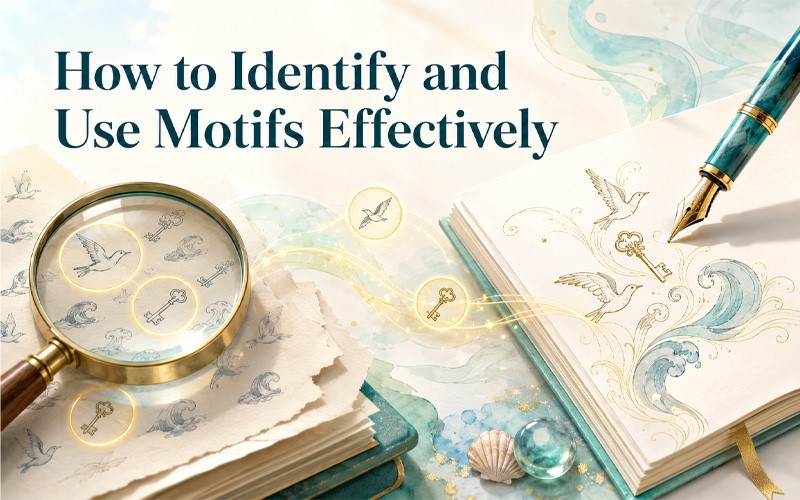
To identify motifs while reading, begin by noticing details that return at significant moments. These may include objects, colors, phrases, sounds, weather conditions, dreams, settings, or repeated actions. Record where each one appears and consider whether its meaning changes. The strongest motif examples usually develop alongside the character or conflict rather than remaining identical throughout the story.
Next, connect the pattern to a larger question. Does it reinforce a theme? Does it predict danger, reveal an emotion, or connect the present with the past? When examining motif examples in literature, context matters more than frequency alone. A repeated red dress is not automatically meaningful, but it may become significant if it appears whenever a character seeks power or loses control.
For Further Study
Use this handbook as a supporting reference when connecting recurring motifs with the larger themes they develop.
View on Amazon (ad)Writers can use a similar process in reverse. Start with the theme or emotion you want to explore, then select an image or action that can arise naturally from the setting and characters. Examples of motifs should inspire possibilities, not become a checklist copied into a story.
Avoid repeating the chosen element so often that readers feel directed toward a predetermined answer. Many common motifs in literature are effective because their meanings remain flexible. A well-developed pattern should invite interpretation while still supporting the narrative. Introduce it quietly, vary the circumstances in which it appears, and allow its significance to grow as the story moves forward. America Publishers Author Spotlight also explores literary concepts, storytelling techniques, and the creative elements that help readers understand books more deeply.
Frequently Asked Question
-
What is a simple example of a motif?
A recurring storm is a simple motif. If storms appear whenever a family conflict intensifies, the weather may reflect anger, emotional disorder, or approaching change. Similar examples of motifs include fading photographs suggesting distorted memory and recurring songs representing grief or nostalgia.
-
What is the difference between a motif and a theme?
A theme is the larger idea a story explores, while a motif is a recurring element that helps communicate that idea. For example, freedom may be the theme, while birds, open skies, and broken cages form a repeated pattern. Literary motif examples are therefore the visible or repeated details through which an abstract theme becomes easier to recognize.
-
Can a character be a motif in literature?
A recurring character type or figure can function as a motif, especially across myths, poems, or interconnected stories. Figures such as the trickster, lost child, double, or mysterious stranger may repeatedly represent temptation, innocence, divided identity, or disruption. Within a single novel, however, a major character is not automatically a motif simply because they appear frequently.
-
Does a motif have to appear a certain number of times?
There is no required number. Most literary motifs appear more than once, but frequency alone is not enough. The repeated element must contribute to a theme, mood, conflict, or character arc. Three meaningful appearances can be more effective than ten repetitions that add nothing new.
-
Can one motif have several meanings?
Yes. Common motifs in literature often carry multiple or even opposing meanings. Water may represent cleansing, freedom, danger, or uncertainty. Its meaning depends on the surrounding events, the character experiencing it, and how its role changes throughout the work.
-
How do writers choose motifs for a story?
Writers can begin with the story’s main theme, conflict, or emotional question. They can then choose an object, color, action, setting, or sensory detail that connects naturally with it. The chosen element should appear at meaningful moments, develop with the narrative, and remain subtle enough to let readers form their own interpretations.
Conclusion
Motifs reward attentive readers by revealing connections that may not be obvious at first. A recurring bird, locked door, storm, song, or color can unite separate scenes and give a story greater emotional depth. The most effective motif examples do not announce what they mean. Their significance develops gradually through repetition, context, and the experiences of the characters.
Although many common motifs in literature carry familiar associations, their meanings are never completely fixed. Fire can destroy or renew, while a journey can represent freedom or exile. Readers should therefore look beyond the repeated element and consider how its role changes throughout the story. For writers, motifs offer a subtle way to reinforce themes, shape atmosphere, and create narratives that remain in the reader’s mind long after the final page.