

Published on August 31, 2026
Consonance examples are everywhere, including in sentences you remember without knowing why. A phrase may not rhyme, yet it can still feel rhythmic, powerful, or unusually satisfying. Often, the secret lies in a consonant sound quietly echoing through nearby words.
Say this aloud: “The black truck shook beside the creek.” Hear the repeated /k/ sound? It gives the sentence a crisp, clipped beat and makes every word feel more deliberate. That subtle sound pattern is consonance.
Writers use it to create tension, softness, speed, atmosphere, and emphasis without making their language sound forced. Once you recognize it, you will hear it in poetry, novels, speeches, advertisements, and everyday conversation.
This guide brings together 100 consonance examples organized by sound and effect. You will discover clear examples of consonance, carefully explained consonance examples in poetry, and practical consonance examples in sentences. By the end, you will not simply recognize consonance; you will understand how to use it to make your own writing more memorable.
Affiliate Disclosure: As an Amazon Associate I earn from qualifying purchases at no additional cost to you.
What Is Consonance and How Does It Work?
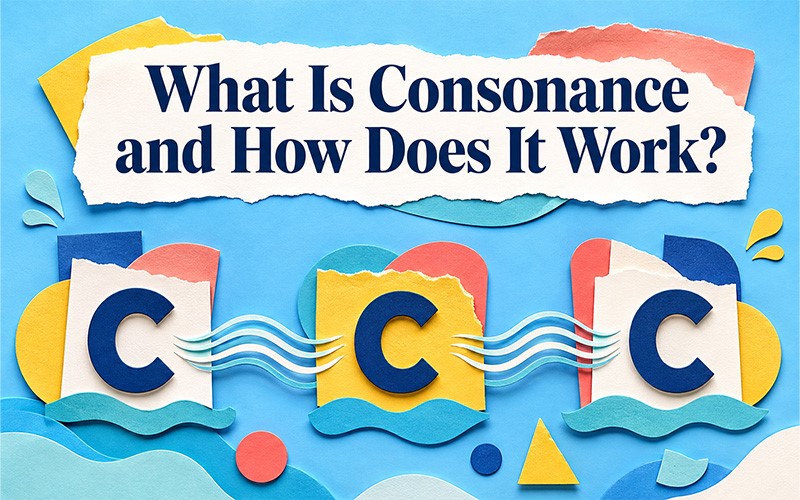
Consonance is a literary device in which identical or similar consonant sounds are repeated in nearby words. The repetition may occur at the beginning, middle, or end of those words.
Take this sentence:
Mike struck the rock with a quick flick.
The /k/ sound appears in Mike, struck, rock, quick, and flick. The words do not all rhyme, and the letter producing the sound is not always placed in the same position. What connects them is the sound we hear.
This distinction matters because consonance is based on pronunciation, not simply on matching letters. The words city and snake, for instance, both begin with the /s/ sound even though one starts with c and the other with s. Meanwhile, chair and chorus begin with the same letter but produce different consonant sounds.
Good consonance examples usually place the repeated sound close enough for the ear to recognize it. If matching sounds appear several paragraphs apart, readers are unlikely to experience them as one deliberate pattern.
Writers use consonance to make language more memorable and expressive. Soft sounds such as /m/, /l/, and /s/ can make a passage feel calm, intimate, or secretive. Harder sounds such as /k/, /t/, and /g/ may suggest impact, urgency, conflict, or abrupt movement. However, these effects are not fixed rules. Meaning, pacing, and surrounding words also shape what the reader feels.
Here are two quick examples of consonance:
- The dull bell fell silent.
- The black rock cracked.
Read them aloud. The repeated /l/ in the first line creates a smoother movement, while the /k/ in the second feels sharper. Comparing consonance examples in this way helps you hear how sound can support meaning.
When examining consonance examples in sentences, ask one question: which consonant sound keeps returning? Listening is often more reliable than looking at the spelling. The strongest consonance examples become clear when spoken rather than silently scanned.
Literary Reference
The Poetry Dictionary
Look up consonance and other essential poetry terms in a practical reference designed for readers, students, and writers.
Consonance vs. Alliteration, Assonance, and Rhyme
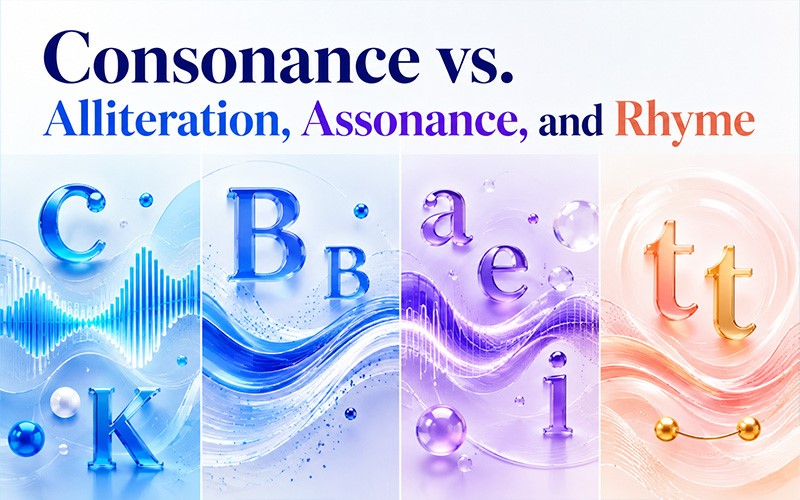
Consonance is often confused with alliteration, assonance, and rhyme because all four devices create noticeable sound patterns. The easiest way to separate them is to identify what repeats and where that repetition occurs.
| Literary device | What repeats? | Example |
| Consonance | A consonant sound within nearby words | blank and think |
| Alliteration | The opening sound of nearby words | bright blue balloons |
| Assonance | A vowel sound within nearby words | mellow wedding bells |
| Rhyme | The final stressed vowel and following sounds | light and night |
Alliteration is the closest relative of consonance. It repeats sounds specifically at the beginnings of nearby words, as in “wild winds whipped.” Consonance is more flexible because its repeated sound can occur anywhere. In “The stroke of luck struck Jack,” the /k/ sound recurs in several positions, demonstrating that consonance is not restricted to the beginnings of words.
Under the broad definition used in this guide, alliteration can be considered a specialized form of consonance because it repeats initial consonant sounds. However, some textbooks treat the two devices as separate categories. Among the clearest examples of consonance are phrases such as “blank and think,” where the repeated /nk/ sound appears at the end rather than the beginning.
Assonance works similarly but focuses on vowels. “Go slow over the road” repeats the long /o/ sound, while “The black truck struck the rock” relies mainly on /k/. Some lines contain both devices, so readers may hear more than one pattern at once.
Rhyme involves a fuller match at the ends of words. Light and night share both their vowel and final consonant sounds. Words such as blank and think share consonants but use different vowels, making them consonant echoes rather than perfect rhymes. This kind of partial sound agreement can also contribute to slant or half rhyme.
When reviewing consonance examples, do not ask whether the words look alike. Say them aloud and follow the repeated sound. That simple habit makes distinguishing these devices much easier.
Try these consonance examples in sentences:
- The wind bends around the hill.
- Silent bells filled the hall.
Both repeat consonant sounds, but they do not depend on identical beginnings or complete rhymes. Recognizing that difference is the key to identifying consonance examples accurately.
Recommended Reference
The Oxford Dictionary of Literary Terms
Explore clear explanations of consonance and hundreds of other literary terms used in poetry, fiction, criticism, and academic study.
100 Consonance Examples Organized by Sound
The following consonance examples are arranged by their dominant sound rather than by topic. This makes it easier to compare sharp, soft, flowing, and breathy patterns.
Some lines resemble poetry, while others sound like ordinary conversation or descriptive prose. Together, these examples of consonance show how repeated sounds can shape pace, emphasis, and atmosphere. You can also use the collection to study consonance examples in poetry, consonance examples in literature, and consonance examples in sentences without treating every sound pattern as identical.
/k/ Sound: Crisp, Sharp, and Forceful
The /k/ sound can create impact, tension, or an abrupt rhythm. Notice that the sound may be written with c, k, or ck.
- The black truck shook beside the creek.
The repeated /k/ gives the line a hard, clipped finish. - Jack quickly locked the back
The repeated /k/ sound supports the character’s hurried movement. - The crack in the rock grew thick.
Repeated endings emphasize damage and pressure. - Luke took a dark walk.
The /k/ sound gives the sentence a steady beat. - The clock clicked beside the lock.
The repeated /k/ sound imitates small mechanical movements. - A thick cloak covered his back.
The pattern makes the description feel heavy and enclosed. - She struck the deck with a stick.
Strong endings emphasize each physical action. - The quick hiker escaped through the crack.
The sharp /k/ sounds add speed and urgency. - Mark broke the chalk against the brick.
The repeated /k/ makes the objects feel solid and rough. - The dark lake reflected the peak.
Here, the same sound creates a quieter form of unity.
/t/ and /d/ Sounds: Tapping, Movement, and Tension
These sounds can imitate footsteps, ticking, knocking, or a sequence of quick actions.
- The cat sat beside the gate.
The repeated /t/ creates a neat, controlled rhythm. - A cold wind moved through the field.
The /d/ sound gives the line a low, lingering quality. - The light fluttered late at night.
The repeated /t/ sound gives the sentence a light but tense rhythm. - He waited and counted every beat.
The pattern suggests patience and nervous attention. - The dust settled over the empty
Repeated /t/ sounds make the description feel dry and still. - She folded the old letter and nodded.
The softer /d/ pattern supports a reflective mood. - The boat drifted beyond the port.
The recurring sound creates measured movement. - A distant drum beat started at dusk.
The /t/ pattern gives the sentence a percussive pulse. - He lifted the gate and ent
The repeated /t/ sounds divide the action into distinct steps.
- The child held the wild
Repeated /d/ gently connects the child with the object.
/p/ and /b/ Sounds: Bursts, Beats, and Playfulness
The lips briefly close to form /p/ and /b/, giving these patterns a popping or beating quality.
- The lamp bumped against the ramp.
The repeated cluster creates a heavy, awkward rhythm.
- A deep sleep fell over the camp.
The closing /p/ sound makes the line feel complete.
- The cup slipped from his grip.
The pattern highlights the sudden accident. - She kept the folded note in her p
The repeated /p/ sound gives the action a restrained, secretive quality. - The ship crept through the sleeping
The /p/ sound creates restrained, careful movement.
- The club became quiet when Rob
Repeated /b/ gives the line a firm beat.
- A dim bulb hung above the tab
The recurring /b/ subtly connects the details of the room. - He gripped the rope before it dropp
The repeated /p/ sound strengthens the urgency.
- The pup leaped onto the step.
The quick /p/ pattern gives the action a playful bounce.
- Bob beat the drum beside the club.
The recurring /b/ creates a firm, percussive beat.
/m/ Sound: Warm, Gentle, and Intimate
The humming /m/ sound often makes language feel calm, dreamy, personal, or comforting.
- The room grew warm in the storm.
The repeated /m/ creates a quiet sense of shelter. - Sam came home at the same
The pattern produces a smooth, familiar rhythm. - Her calm smile comforted him.
The humming sound supports the tenderness of the moment. - The moon seemed dim above the farm.
The /m/ pattern makes the image subdued and reflective. - A soft hum came from the machine.
The language echoes the sound being described. - Memories swim through the summer rain.
The repetition gives the line a dreamy movement. - Tom carried the empty frame home.
The /m/ sound connects separate details naturally. - The team claimed the game at noon.
The repeated ending creates a confident rhythm. - Her poem seemed to glim
The soft /m/ pattern adds a lyrical quality.
- The thunder became a distant murm
The repeated sound helps the storm fade gently.
These first forty consonance examples show how dramatically a passage can change when a writer moves from hard /k/ sounds to softer /m/ sounds.
Recommended for Poetry Writers
A Poetry Handbook
Develop a stronger ear for sound, rhythm, word choice, and the poetic techniques that make language memorable.
View on Amazon (ad)
/n/ and /ŋ/ Sounds: Continuity and Reflection
These nasal sounds can produce a sustained, humming effect that works well in thoughtful or atmospheric writing.
- The sun shone on the brown
The repeated /n/ creates warmth and continuity.
- Rain fell again across the plain.
The sound stretches through the line like steady rainfall.
- The train moved on into dawn.
Repetition reinforces the feeling of onward movement.
- A thin moon hung above the town.
The /n/ pattern gives the image a quiet finish.
- She turned down the unknown
The sound connects uncertainty with movement.
- The king sang of a disappearing
The /ŋ/ endings create a resonant, songlike pattern.
- Winter began with a lonely wind.
The repeated sound supports the bleak atmosphere. - The young climber clung to the ledge.
The /ŋ/ sound strengthens the sense of strain.
- No one had seen the green
The pattern gives the sentence a smooth progression.
- The evening bell rang beyond the garden.
The recurring /n/ creates a distant, meditative tone.
/l/ Sound: Flowing, Light, and Lyrical
The /l/ sound allows the voice to move smoothly, making it useful for graceful descriptions and emotional passages.
- The bell fell silent beside the well.
The repeated ending produces a slow musical echo. - A pale sail crossed the still
The /l/ sound supports the calm visual movement. - She held the old letter close.
The pattern adds tenderness to the action. - Moonlight spilled across the hill.
Repetition makes the image feel fluid and luminous. - The small child followed the trail.
The gentle sound softens the movement. - A cool breeze filled the empty hall.
The /l/ pattern creates an airy, spacious effect. - The wild flowers bowed in the field.
Similar endings tie the natural images together. - Her tale traveled from village to vall
The repeated sound makes the sentence feel expansive. - The candle flickered beside the wall.
The /l/ sound creates a delicate rhythm.
- He felt alone beneath the silver sky.
The flowing sound reinforces the reflective mood.
/r/ Sound: Energy, Roughness, and Motion
The /r/ sound can make language feel restless, powerful, rolling, or emotionally charged.
- The car roared past the bar
The repetition amplifies speed and engine noise. - A fierce storm tore along the shor
The repeated /r/ sound gives the line turbulence. - The river curved under the bridge.
The repeated sound mirrors continuous movement.
- He heard the birds stir before sunrise.
The pattern connects the small morning sounds.
- Her words burned in his memor
The /r/ sound adds emotional intensity.
- The horse charged through the bar
Repetition strengthens the sense of forward motion.
- A farmer repaired the broken door.
The sound gives the action a steady rhythm. - The thunder rolled over the har
The recurring /r/ imitates a low rumble.
- She carried the story for year
The pattern gives weight to the passage of time.
- The fire grew brighter near the for
The repeated sound builds urgency.
At this point, the consonance examples begin to reveal an important principle: repeated sounds are most effective when they reinforce the meaning instead of merely decorating the sentence.
/s/ and /z/ Sounds: Whispers, Secrecy, and Unease
Repeated /s/ and /z/ sounds are often described as sibilance. They can suggest whispering, wind, silence, smoothness, or danger.
- The mist passed across the silent coast.
The soft hiss creates an eerie atmosphere. - A loose chain slid across the stone.
The repeated /s/ makes the movement sound quiet and tense. - She closed the curtain as the city doz
The repeated /z/ contributes to a sleepy mood. - The grass rustled beneath his steps.
The line quietly imitates movement through grass. - A voice whispered from the house.
The pattern reinforces secrecy and uncertainty. - The waves rose through the evening haz
The repeated /z/ gives the movement a soft, continuous quality. - His glass slid across the desk.
The sound makes the action feel controlled and tense. - The forest kept its oldest secrets.
Sibilance gives the setting a mysterious quality. - A frosty wind passed through the forest.
The repeated /s/ suggests cold air moving nearby. - She paused as the music ros
The recurring /z/ connects the two gradual actions.
/f/ and /v/ Sounds: Breath, Friction, and Movement
These sounds are formed by pushing air between the lip and teeth. They can make a passage feel breathy, flowing, restless, or fragile.
- The leaf drifted off the cliff.
The repeated /f/ creates light, airy movement. - A soft wind left the roof
The breathy sound reinforces the presence of wind. - Her scarf fluttered in the soft evening air.
The repeated /f/ gives the image softness and motion. - The thief hid the safe beneath the loaf.
Repetition adds a playful, suspicious rhythm. - Life felt brief after their relief.
The /f/ endings create a reflective cadence. - The wave moved over the cov
The /v/ sound supports the water’s flowing movement. - She gave five lovely violets away.
The voiced sound produces a gentle vibration. - The driver curved around the grov
Repetition mirrors the smooth change of direction. - His brave voice never wav
The pattern reinforces steadiness and confidence. - A silver river divided the v
The recurring /v/ gives the description a fluid quality.
/sh/, /ch/, and /j/ Sounds: Hush and Dramatic Texture
These sounds can slow a sentence, create a hush, or add bursts of expressive energy.
- The fish splashed beneath the bush.
The /sh/ sound helps recreate movement through water. - She wished for silence on the sh
The repeated /sh/ gives the line a hushed quality. - A fresh breeze brushed her face.
The repeated /sh/ sound makes the sensation more immediate.
- The dish crashed beside the wash
The soft sound contrasts with the sudden accident.
- His rush through the marsh ended at dusk.
The repetition creates swift but muffled movement.
- The coach reached the church.
The repeated /ch/ endings produce a tight, punchy rhythm.
- A rich merchant approached the coach.
Repetition gives the line a formal, measured beat. - The branch scratched the cottage window.
The /ch/ sound adds tension to the physical action. - The judge stood at the edge of the bridge.
The repeated /j/ sound connects the person with the precarious setting. - A strange orange glow filled the lodge.
The repeated /j/ gives the description an unusual musical finish.
These 100 consonance examples demonstrate that consonance is not tied to one mood. Depending on the sound and context, it can soothe, disturb, energize, or slow the reader.
Further Reading
A Poetry Handbook
Learn how poets use sound, rhythm, line, and language to strengthen the emotional and musical effects of their writing.
Consonance Examples in Poetry and Literature
Consonance examples in poetry are rarely included merely to make a line sound attractive. Poets use repeated consonants to control pace, connect important words, reinforce imagery, and create emotional undertones.
Consider the opening of William Blake’s The Tyger:
“Tyger Tyger, burning bright”
The recurring /r/ sound in Tyger, burning, and bright contributes energy and can suggest a subtle growling quality. The repeated initial /b/ in burning bright also adds a forceful beat. These overlapping patterns show why a poetic line may contain more than one sound device.
Edgar Allan Poe creates a different effect in “The Raven”:
“And the silken, sad, uncertain rustling of each purple curtain”
The repeated /s/ sound in silken, sad, uncertain, and rustling creates sibilance that resembles a whisper or rustle. It makes the movement feel secretive and unsettling before the reader has fully processed the scene. Among well-known consonance examples, this one demonstrates how sound can intensify atmosphere.
Consonance examples in poetry may also appear at the ends of lines. When words share final consonants but use different vowel sounds, the result can contribute to slant rhyme. Words such as shape and keep, or load and laid, feel connected without producing the neat closure of a perfect rhyme.
Writers use the same technique in prose. Effective consonance examples in literature often appear in descriptions, dialogue, character names, and emotionally important sentences. A novelist might repeat hard /k/ sounds during a violent confrontation or use /m/ and /l/ sounds in a peaceful memory.
When analyzing consonance examples in literature, consider three questions:
- Which consonant sound repeats?
- Which words does that sound connect?
- Does the pattern support the mood, action, or meaning?
Do not assume that every repeated letter is deliberate. Strong examples of consonance occur close enough to be heard and contribute something noticeable to the passage.
The most meaningful consonance examples in literature unite sound and purpose. If removing or replacing the repeated sound weakens the rhythm, mood, or emphasis, the pattern is probably doing real work. The same test can be applied to consonance examples in poetry when examining how a poet builds tension or musicality.
Poetry Study Resource
The Poetry Dictionary
Strengthen your understanding of consonance, rhythm, rhyme, sound patterns, and other techniques used when reading or analysing poetry.
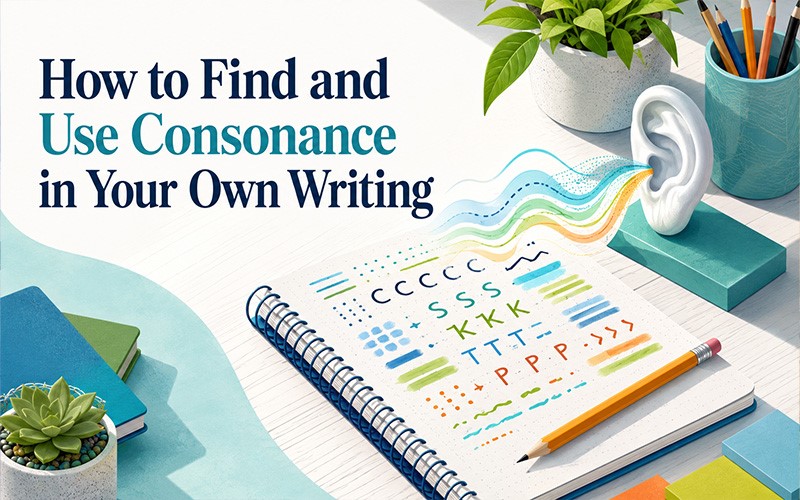
How to Find and Use Consonance in Your Own Writing
The easiest way to find consonance is to read a passage aloud. Your eyes naturally focus on spelling, but your ears are better at detecting repeated sounds.
Start with one sentence and underline words that seem to echo. Then identify the actual sound they share. Remember that matching letters do not always produce matching sounds. Circle and cat begin with the same letter, for example, but their opening sounds are different.
When examining consonance examples in sentences, pay particular attention to stressed words. Repetition is more noticeable when it appears in important nouns, verbs, or adjectives rather than being scattered among less prominent words.
You can also create consonance intentionally:
- Decide what mood the passage needs.
- Select a sound that supports that mood.
- Build the pattern around meaningful words.
- Read the result aloud.
- Remove repetitions that feel forced or distracting.
Compare these versions:
- The vehicle moved rapidly along the rocky road.
- The truck quickly struck the rocky track.
The second version uses /k/ to make the movement feel rougher and more forceful. It is memorable, but adding several more /k/ words would probably make it sound like a tongue twister. Effective consonance should guide the ear without drawing attention away from the message.
When studying consonance examples, notice how often the best patterns are subtle. Two or three strategically placed echoes may achieve more than a sentence overloaded with matching sounds.
This technique is useful beyond poems. Authors can study consonance examples in literature to strengthen prose, while speechwriters, advertisers, and storytellers can use repeated sounds to make key phrases easier to remember. Practicing with short consonance examples will help you develop an ear for sound without sacrificing clarity or natural expression.
Essential Literary Guide
The Oxford Dictionary of Literary Terms
Build your knowledge of consonance and related literary techniques with an authoritative reference for writers and literature students.
View on Amazon (ad)Resources such as America Publishers Author Spotlight explore literary techniques, language patterns, and storytelling concepts to help readers develop a clearer understanding of how writing works. Learning about devices like consonance can also help writers make more thoughtful choices about rhythm, mood, and expression.
Frequently Asked Question
-
What is a simple example of consonance?
“The black rock cracked” is a simple example. The repeated /k/ sound connects black, rock, and cracked. Clear consonance examples like this are easy to recognize when spoken aloud.
-
What are five common examples of consonance?
Five short examples of consonance are “blank and think,” “stroke of luck,” “pitter-patter,” “the black rock cracked,” and “the lumpy, bumpy road.” Each phrase repeats one or more consonant sounds across nearby words.
-
How can you identify consonance in a sentence?
Read the sentence aloud and listen for consonant sounds that return in nearby words. When reviewing consonance examples in sentences, focus on pronunciation rather than spelling because different letters can sometimes produce the same sound.
-
Is consonance the same as alliteration?
No. Alliteration repeats a sound specifically at the beginnings of nearby words. Consonance is broader because the repeated sound may appear at the beginning, middle, or end of a word.
-
Why do poets and authors use consonance?
Writers use it to shape rhythm, connect ideas, emphasize important words, and strengthen a particular mood. Consonance examples in poetry often create musicality, while consonance examples in literature can add tension, softness, speed, or atmosphere to prose.
-
Can consonance occur at the beginning of words?
Yes. A consonant sound may repeat anywhere in nearby words. If it appears mainly at the beginning, the pattern may also qualify as alliteration. The most useful consonance examples demonstrate that sound position can vary without weakening the effect.
Conclusion
Consonance proves that memorable writing is not shaped by meaning alone. Repeated consonant sounds can make a line flow gently, strike sharply, build suspense, or remain in the reader’s memory long after it ends. The effect may be subtle, but it adds rhythm and emotional texture to poems, stories, speeches, and everyday language.
The best way to understand the technique is to read different consonance examples aloud. Listen for the returning sound and consider how it changes the mood. Recognizing details like these can help readers appreciate literature more deeply and help writers become more intentional with every word they choose.