

Published on August 31, 2026
The most memorable mood examples often begin with an ordinary place described in an unexpected way. Picture an empty house. Sunlight warming its floorboards could make it feel peaceful, while music drifting from another room might evoke nostalgia. But let a door creak open in the middle of the night, and that same house suddenly feels threatening.
This transformation reveals the power of mood in writing. A setting does not determine how readers will feel; the writer’s choices do. Light, sound, imagery, pacing, and even sentence length can turn a familiar place into one that feels safe, romantic, lonely, or deeply unsettling.
The strongest examples of mood do more than attach an emotional label to a scene. They allow readers to experience the feeling for themselves. In this guide, you will discover 100 atmospheric words organized by emotional effect, along with miniature scenes showing how each one works.
Whether you need mood words and examples for a novel, poem, short story, or classroom assignment, this guide will help you create an atmosphere readers can enter, recognize, and remember.
Affiliate Disclosure: As an Amazon Associate I earn from qualifying purchases at no additional cost to you.
What Is Mood in Writing?
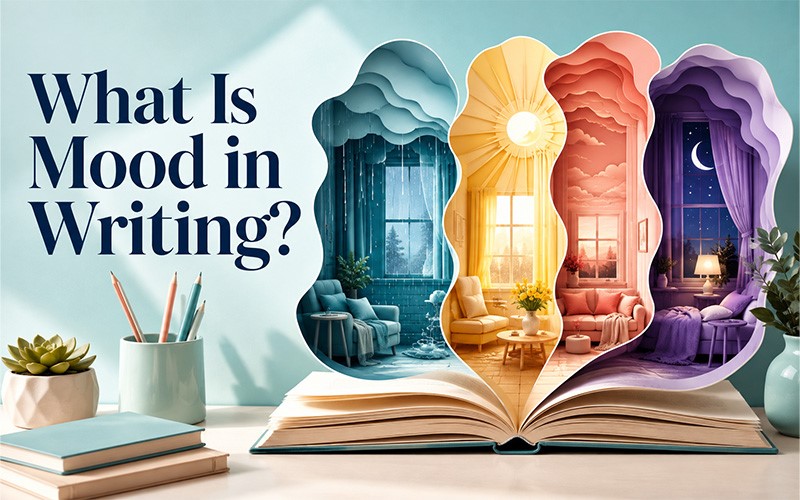
Mood is the emotional feeling or atmosphere a piece of writing creates for its audience. It is not necessarily what a character feels. A character might be perfectly calm while the reader senses that something terrible is about to happen. In that case, the character’s emotion is calm, but the mood of the scene is ominous or suspenseful.
Understanding mood in writing becomes easier when you think about how a scene affects you. Does it make you feel relaxed, uneasy, curious, joyful, or lonely? Your emotional response provides an important clue to the mood the writer has established.
Good mood examples often combine several creative choices. A deserted road, failing streetlights, and footsteps approaching from behind can produce anxiety. A glowing fireplace, the smell of cinnamon, and rain tapping gently against a window can create comfort. These mood examples demonstrate that atmosphere grows from specific details rather than from simply telling readers how they should feel.
Mood, tone, atmosphere, and character emotion are closely connected, but they are not identical:
| Element | What It Describes |
| Mood | The emotional response created in the reader |
| Tone | The writer’s or narrator’s attitude toward the subject |
| Atmosphere | The surrounding conditions used to develop the mood |
| Character emotion | What an individual character feels within the scene |
Consider these two examples of mood: a wedding scene could feel joyful and affectionate, or it could feel tense and uncertain if one person keeps looking at the door. The event alone does not decide the mood. Its presentation does.
When studying mood words and examples, therefore, look beyond the adjective. Ask which details produced that emotional effect and why they influenced you.
Further Reading
Atmosphere, Mood, Stimmung: On a Hidden Potential of Literature
Explore how atmosphere and mood influence the way readers experience literary works beyond their plots and stated meanings.
How Writers Create Mood and Atmosphere
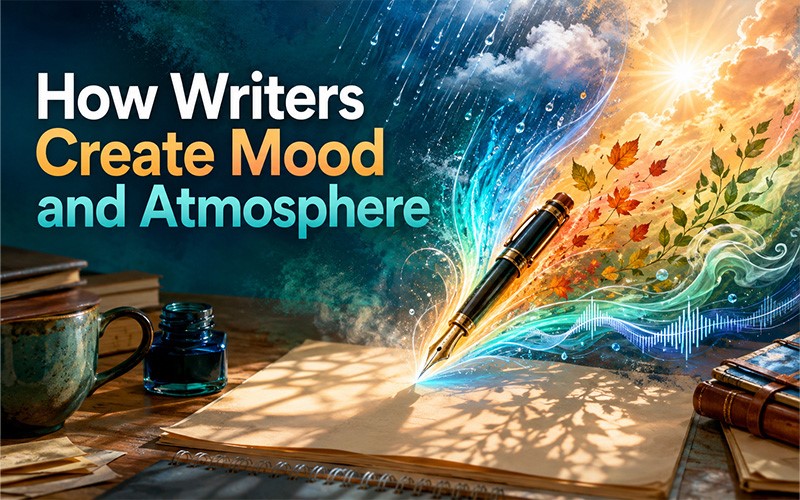
Writers rarely create atmosphere with one descriptive word. They build it through several elements working quietly together. The following techniques can turn a neutral passage into one that carries a clear emotional charge.
- Setting: Location, time, season, and weather establish the emotional possibilities of a scene. A crowded railway platform can feel exciting, overwhelming, or painfully lonely depending on how it is presented.
- Sensory imagery: Sight is only the beginning. Sound, smell, texture, temperature, and taste can pull readers deeper into a setting. The sour smell of damp walls may be more unsettling than simply describing a room as old.
- Word choice: Words with similar definitions can produce different reactions. A character may “walk,” “wander,” “stumble,” or “creep” down a hallway, but each verb changes what readers imagine.
- Sentence rhythm: Short, abrupt sentences can create urgency or panic. Longer, flowing sentences can slow the experience and make it feel peaceful, reflective, or dreamlike.
- Dialogue: What characters say, and what they avoid saying, can affect mood in writing. A polite conversation filled with unfinished sentences may feel more hostile than an open argument.
- Light, color, and weather: Pale morning light can suggest hope, while harsh fluorescent light can make the same place feel cold or sterile. Weather is effective when it adds meaning rather than repeating a familiar cliché.
- Symbolism and foreshadowing: A stopped clock, an untouched meal, or birds suddenly falling silent can suggest that something is wrong before the story explains why.
Compare these mood examples:
Neutral: Elena entered the kitchen and placed her keys on the counter.
Unsettling: Elena entered the kitchen. Her keys struck the counter, and something beneath the table shifted.
The second version never tells the reader to feel afraid. Its sound, pacing, and unexplained movement create that reaction naturally. Other examples of mood may use warmth, humor, beauty, or silence in the same way.
When reviewing mood words and examples, treat each word as a destination. Setting, sensory detail, diction, and rhythm are the routes that lead your reader there. The strongest mood examples allow readers to experience an emotion before they consciously name it.
Recommended for Writers
Make That Scene: A Writer’s Guide to Setting, Mood, and Atmosphere
Learn practical ways to build convincing settings and use description to create the intended mood and atmosphere in every scene.
100 Mood Examples and Words for Every Kind of Scene
Knowing the name of an emotion is useful, but knowing how to create it is even better. These mood examples are grouped by the effect they have on readers, making it easier to find the right atmosphere for a particular scene.
Unlike bare adjective lists, the following mood words and examples show how each feeling might appear on the page. Notice how ordinary details, a chair, a window, a distant sound, can become emotionally meaningful. These examples of mood can also be adapted for fiction, poetry, memoir, and descriptive essays.
Happy and Uplifting Moods
- Joyful: Laughter spilled from the kitchen as everyone gathered around the birthday cake.
- Cheerful: Bright curtains danced in the breeze while the radio played an old favorite.
- Hopeful: For the first time in weeks, a green shoot appeared above the soil.
- Celebratory: Music shook the windows as confetti floated over the cheering crowd.
- Playful: The puppy stole her slipper and waited proudly for the chase to begin.
- Lighthearted: They missed the train but spent the next hour inventing stories about strangers.
- Optimistic: Daniel opened the rejection letter, smiled, and began another application.
- Inspired: As the speaker finished, notebooks opened across the room almost simultaneously.
- Triumphant: She crossed the finish line with trembling legs and both hands raised.
- Carefree: Their shoes lay forgotten on the riverbank while they raced through the water.
Happy scenes do not need constant laughter or exaggerated excitement. Small victories, playful behavior, bright movement, and a sense of possibility can create a convincing positive atmosphere.
Calm and Comforting Moods
- Peaceful: The lake held the evening sky without a single ripple.
- Serene: Incense drifted toward the open window as distant bells marked the hour.
- Cozy: Rain tapped the roof while they shared soup beneath a faded quilt.
- Soothing: Her grandmother hummed softly, smoothing the child’s hair with each note.
- Contented: The work was finished, the dishes were drying, and no one needed anything.
- Intimate: They spoke quietly across the candlelit table as the restaurant emptied around them.
- Warm: Every arrival was met with a hug and another plate placed on the table.
- Safe: The lock clicked behind him, and his shoulders finally relaxed.
- Restful: Curtains moved gently above the bed while afternoon light softened the room.
- Idyllic: Sheep grazed beyond the cottage, and wildflowers crowded the narrow path.
Comfort often comes from familiar sounds, gentle movement, soft textures, and the absence of immediate demands. Slower sentences can support this effect by giving readers time to settle into the scene.
Sad and Reflective Moods
- Melancholy: The playground swings moved in the wind long after the children had gone.
- Sorrowful: She folded his coat carefully, although no one would wear it again.
- Mournful: A lone violin carried through the church after the final prayer.
- Lonely: His voice echoed through the apartment and returned without an answer.
- Regretful: The apology remained in her drafts until his number stopped working.
- Nostalgic: The old perfume brought back summer evenings and voices she could almost remember.
- Bittersweet: He applauded at her graduation, proud of the future taking her away.
- Somber: Even the youngest family members lowered their voices as they entered the room.
- Heartbroken: Two cups still stood beside the kettle out of habit.
- Reflective: Watching the sunset, she wondered when ambition had become exhaustion.
The mood examples in this category show that sadness is rarely one simple feeling. It may contain love, memory, guilt, pride, or acceptance. A specific object or unfinished routine often communicates loss more effectively than directly announcing it.
Character-Emotion Resource
The Emotion Thesaurus: A Writer’s Guide to Character Expression
Find physical signals, behaviours, thoughts, and reactions that can help characters express complex emotions without relying on obvious emotional labels.
View on Amazon (ad)Frightening and Unsettling Moods
- Eerie: Every clock in the abandoned house had stopped at exactly 3:17.
- Frightening: A handprint slowly appeared on the outside of the upstairs window.
- Sinister: The stranger smiled as though he already knew how the evening would end.
- Ominous: Birds lifted from the trees at once, leaving the forest unnaturally silent.
- Creepy: The doll faced the wall when Mia entered and the doorway when she returned.
- Haunting: A child’s song drifted through the station years after it had closed.
- Disturbing: Everyone in the family photograph had the same carefully scratched-out face.
- Nightmarish: The corridor stretched farther with every door he passed.
- Claustrophobic: The elevator stopped, the lights failed, and the emergency button remained silent.
- Threatening: Heavy footsteps crossed the floor above her, although the house was supposed to be empty.
Fear becomes stronger when a writer withholds part of the explanation. Readers instinctively try to understand strange sounds, unnatural silence, altered objects, and impossible events.
Tense and Suspenseful Moods
- Tense: Nobody reached for the envelope lying unopened between them.
- Anxious: She refreshed the results page again, though only three seconds had passed.
- Suspenseful: The doorknob turned slowly while Marcus searched for somewhere to hide.
- Nervous: His prepared speech disappeared from memory when his name was announced.
- Apprehensive: Each step toward the office made the conversation ahead feel more real.
- Urgent: Smoke filled the stairwell as the alarm continued to scream.
- Uncertain: The map ended at the river, but the path continued into the trees.
- Restless: She checked the window, paced the room, and checked it again.
- Expectant: The theater fell silent seconds before the curtain began to rise.
- Breathless: He reached the platform just as the train doors started closing.
Effective tension often depends on timing. Delays, approaching danger, unanswered questions, and limited choices keep readers waiting for a result they cannot yet predict.
Angry and Hostile Moods
- Angry: Every cupboard door slammed harder than the one before it.
- Hostile: Conversation stopped the moment the new manager entered the break room.
- Bitter: He toasted their success with a smile that never reached his eyes.
- Resentful: She congratulated her brother while remembering who had done most of the work.
- Furious: The letter shook in his hand before he tore it down the middle.
- Confrontational: Chairs scraped backward as both men stood at the same time.
- Rebellious: By sunrise, every forbidden poster had been pasted across the city.
- Unforgiving: Her apology was received with the careful silence reserved for strangers.
- Volatile: One careless comment was enough to make the entire table fall quiet.
- Oppressive: Armed guards watched from every corner while citizens kept their eyes lowered.
Other examples of mood in hostile scenes might use clipped dialogue, intrusive noise, harsh physical movement, or uncomfortable silence. Anger can be loud, but restrained resentment can produce equal pressure.
Romantic and Passionate Moods
- Romantic: He remembered how she took her coffee before he remembered her surname.
- Affectionate: She straightened his collar and brushed away a thread that was not there.
- Tender: Their hands met between the hospital chairs and remained there.
- Passionate: Neither noticed the rain until they were already soaked.
- Flirtatious: She returned his pen with a smile and kept the cap.
- Sensual: Warm candlelight moved across the room as music softened the silence.
- Devoted: Every morning, he placed fresh flowers beside the photograph.
- Yearning: She searched every arriving face for the one she had promised to forget.
- Enchanted: The crowded ballroom seemed to disappear when their eyes met.
- Loving: He took the burnt piece of toast and placed the better one on her plate.
Romance becomes believable through attention. Small gestures, remembered preferences, hesitation, and emotional vulnerability often create more intimacy than dramatic declarations.
Mysterious and Curious Moods
- Mysterious: A sealed letter arrived each year in handwriting she did not recognize.
- Secretive: Whenever the attic was mentioned, her father changed the subject.
- Puzzling: The footprints crossed the snow but began and ended in the middle of the field.
- Curious: One book on the shelf had no title, author, or final page.
- Surreal: Fish swam above the rooftops while pedestrians continued their morning routines.
- Otherworldly: Blue trees glowed beneath two moons as the travelers entered the valley.
- Magical: Each word the child whispered became a tiny golden bird.
- Dreamlike: The train passed through clouds, childhood bedrooms, and fields without horizons.
- Hypnotic: The pendulum moved steadily as every voice in the room grew distant.
- Uncanny: The portrait looked exactly like him, although it had been painted a century earlier.
These mood examples rely on unanswered questions and unusual details. Curiosity grows when something almost makes sense but refuses to fit ordinary logic.
Energetic and Adventurous Moods
- Exciting: The gates opened, engines roared, and the crowd surged forward.
- Adventurous: With one backpack and an unfinished map, she boarded the midnight ferry.
- Lively: Vendors called across the market while drums echoed between the crowded stalls.
- Exhilarating: Cold air struck his face as the bicycle flew down the mountain road.
- Spirited: Each team answered the other’s chant with one even louder.
- Daring: He stepped onto the narrow ledge before anyone could stop him.
- Chaotic: Phones rang, papers scattered, and three people shouted different instructions.
- Wild: Wind tore through the campsite as lightning divided the sky.
- Frenetic: She grabbed the file, cleared the barrier, and disappeared into the crowd.
- Determined: Blisters covered his feet, but the summit was finally visible.
Energy comes from active verbs, physical movement, compressed time, and quick changes. Shorter sentences can accelerate the scene and make readers feel as though events are unfolding around them.
Cold, Empty, and Detached Moods
- Bleak: Beyond the factory, gray fields stretched toward a sunless horizon.
- Desolate: Sand had buried the road, the gardens, and half the abandoned houses.
- Isolated: The nearest light appeared across a valley the storm had made impossible to cross.
- Hollow: Applause filled the auditorium, but the award meant nothing to her now.
- Detached: He read the verdict without blinking and folded the paper into perfect quarters.
- Indifferent: Commuters stepped around the fallen flowers without slowing down.
- Sterile: White walls, metal chairs, and fluorescent lights made the waiting room feel lifeless.
- Grim: The final loaf was divided among twelve people without discussion.
- Hopeless: Each wave erased another section of the message he had written in the sand.
- Alienating: Everyone at the table spoke about him as though he were not sitting there.
A cold atmosphere can represent physical emptiness, emotional distance, social rejection, or the loss of hope. Silence and absence are particularly effective because they make readers notice what should be present but is not.
Use these mood examples as starting points rather than fixed formulas. You can combine two feelings, such as hopeful and anxious or romantic and bittersweet, to give a scene greater emotional complexity. The strongest mood words and examples become meaningful when they support the characters, conflict, and purpose of the story.
Understanding mood in writing also means recognizing that the same detail can produce different effects. Candlelight may feel romantic in one scene, comforting in another, and deeply unsettling in an abandoned house. Context determines the emotional result. Before looking at literary uses of atmosphere, try rewriting one of the miniature scenes above with the opposite emotional effect.
Recommended Writing Resource
The Emotion Thesaurus: A Writer’s Guide to Character Expression
Create more believable emotional scenes by replacing vague labels with meaningful actions, physical responses, thoughts, and behavioural cues.
Mood Examples in Literature and Famous Stories
The most memorable stories do not simply describe events; they shape how readers feel while those events unfold. Examining mood examples in literature reveals how setting, imagery, pacing, and recurring details can create an emotional experience that lasts beyond the final page.
The Tell-Tale Heart by Edgar Allan Poe
Poe creates a paranoid, claustrophobic atmosphere through the narrator’s obsessive attention to sound, secrecy, and time. The confined setting and increasingly frantic rhythm trap readers inside an unstable mind. These mood examples in literature demonstrate how sentence structure can mirror psychological pressure: as the narrator loses control, the storytelling itself feels more urgent.
The Raven by Edgar Allan Poe
The poem begins in isolation and grief before becoming increasingly uncanny and despairing. Its nighttime setting, repetitive sounds, shadowed room, and mysterious visitor create a mournful, haunting atmosphere. Repetition matters because each return of the raven’s answer makes the speaker’s grief feel more inescapable.
Jane Eyre by Charlotte Brontë
Thornfield Hall frequently feels mysterious, isolated, and Gothic. Strange laughter, locked spaces, fire, darkness, and unexplained behavior suggest that the house contains secrets. These mood examples in literature show how a setting can become emotionally active rather than serving as a passive background.
The novel’s atmosphere also changes with Jane’s circumstances. Moments of connection feel warmer, while separation and uncertainty produce loneliness. The shifts allow readers to experience her changing sense of security.
A Christmas Carol by Charles Dickens
Dickens moves through several distinct emotional environments. Scrooge’s cold rooms and lonely routines initially establish bleakness and emotional isolation. The spirits then lead him through scenes of warmth, regret, fear, and possibility.
These contrasting mood examples in literature demonstrate the power of emotional progression. The hopeful ending feels earned because readers have first experienced Scrooge’s loneliness and confronted the consequences of his behavior.
The Great Gatsby by F. Scott Fitzgerald
The parties at Gatsby’s mansion appear glamorous, energetic, and almost magical. Beneath that brilliance, however, lies a growing sense of emptiness. Crowds gather, music plays, and wealth is displayed, yet meaningful connection remains difficult to find.
As the story progresses, the glittering atmosphere becomes melancholic and disillusioned. Among well-known mood examples in literature, this novel is especially useful for showing how surface beauty can conceal emotional hollowness.
These works also demonstrate that a story does not need one permanent mood. Atmosphere can evolve with new information, changing relationships, or approaching danger. A thoughtful shift can reveal that a place or event was never quite what it first appeared to be.
Literary Mood Study
Atmosphere, Mood, Stimmung: On a Hidden Potential of Literature
Examine the role of atmosphere in literature and how a text’s emotional presence can shape the reader’s experience.
How to Choose and Change the Mood of a Scene
Before describing a setting, ask one practical question: What should the reader feel here? “Interested” is usually too broad. Choose something more precise, such as reassured, suspicious, nostalgic, trapped, or cautiously hopeful.
These steps can help you turn that intention into an effective scene:
Choose one dominant mood. Give the scene a clear emotional direction before adding details.
Add a complementary feeling. Combining moods can prevent the scene from feeling predictable. A reunion might be joyful but awkward, while a victory could feel triumphant yet bittersweet.
Select details that support the effect. If the scene should feel lonely, notice empty chairs, unanswered messages, distant voices, or unused belongings.
Control the rhythm. Short sentences can increase urgency. Longer sentences can encourage reflection or create a dreamlike flow.
Remove conflicting signals. A frightening scene can include beauty, but each contrast should have a deliberate purpose.
Allow the atmosphere to change. A comforting room can become threatening when a character discovers that an object has been moved. A bleak morning can become hopeful when help finally arrives.
When reviewing mood examples, do not copy every detail associated with a particular feeling. Rain does not automatically create sadness, and darkness does not always create fear. Original mood in writing comes from details that belong specifically to the characters and their situation.
Consider this simple exercise:
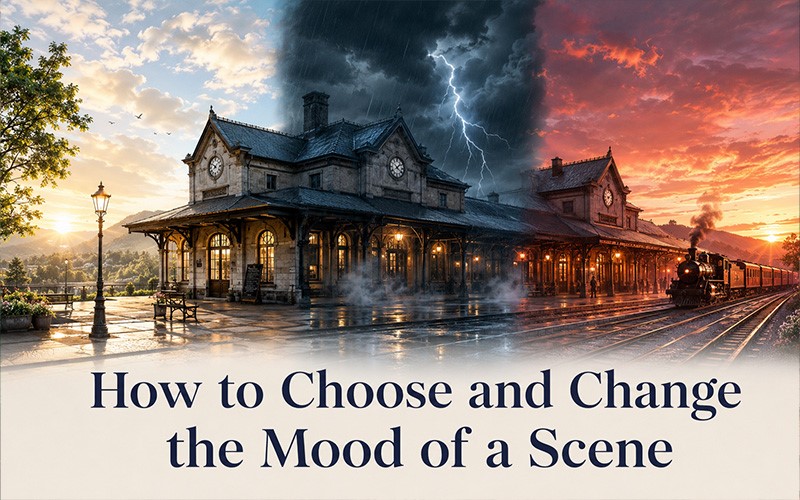
Describe an empty railway station in three sentences. First, make it feel peaceful. Next, rewrite it as threatening. Finally, make it feel nostalgic.
The location remains unchanged, but the selected sounds, objects, lighting, and sentence rhythm should transform the reader’s experience. This is one of the clearest examples of mood being shaped through presentation rather than plot.
Use mood words and examples during revision as a diagnostic tool. Write two words describing the intended atmosphere at the top of the scene. Then examine each paragraph and ask whether it strengthens, complicates, or weakens that effect.
The best mood examples never order readers to be frightened, comforted, or moved. They arrange the details so carefully that the emotion arrives on its own.
Practical Scene-Writing Guide
Make That Scene: A Writer’s Guide to Setting, Mood, and Atmosphere
Improve scene construction by coordinating setting, description, mood, and atmosphere to create a stronger experience for readers.
View on Amazon (ad)America Publishers Author Spotlight regularly examines literature, storytelling, and the techniques authors use to shape a reader’s experience. Their articles offer additional context for readers interested in how stories are written and understood.
Frequently Asked Question
-
What is an example of mood in a story?
A deserted playground could create a lonely feeling through empty swings, fading daylight, and the distant sound of children elsewhere. The writer does not need to call the place lonely because the selected details communicate that emotion.
-
What are the most common moods in writing?
Common choices include joyful, hopeful, peaceful, romantic, nostalgic, melancholic, mysterious, anxious, suspenseful, frightening, and gloomy. Writers may establish one dominant feeling or combine several to create emotional complexity.
-
What is the difference between tone and mood?
Tone reflects the attitude of the writer or narrator toward the subject. Mood describes the emotional response created in the reader. A narrator can speak humorously about a situation that readers still find uncomfortable or sad.
-
How does setting create mood?
Setting influences emotion through location, weather, time, lighting, sound, temperature, and surrounding objects. A forest can feel magical in golden sunlight or threatening when darkness conceals the path ahead.
-
Can the mood change within a scene?
Yes. A scene may begin peacefully and become tense when an unexpected sound is heard. Such shifts can reveal new information, signal danger, reflect a character’s realization, or prepare readers for a turning point.
-
How can you identify the mood of a passage?
Notice your emotional reaction, then examine what produced it. Look at the writer’s word choice, imagery, setting, sentence rhythm, dialogue, and sensory details. Repeated patterns usually reveal the dominant emotional atmosphere.
Conclusion
Mood determines how readers emotionally experience a story. A peaceful setting can offer relief, a tense silence can signal danger, and one familiar object can awaken years of longing. The effect comes not from naming an emotion but from choosing details that allow readers to discover it for themselves.
Use these mood examples as creative starting points, not rigid formulas. Decide what you want readers to feel, select details that support that response, and pay attention to imagery, sound, pacing, dialogue, and sentence rhythm. When appropriate, combine contrasting emotions to create an atmosphere that feels more complex and human.
Most importantly, experiment. Rewrite the same location with several emotional effects and notice how dramatically it changes. The setting may stay the same, but the reader’s experience, and the meaning of the scene, can become entirely different.