

Published November 6, 2026 · The Digital Desk, America Publishers
You send a message saying you can’t take on one more assignment. Ten minutes later, you’re still looking at the screen, wondering whether to soften it with another apology. You had a good reason to say no. What unsettles you is the possibility that someone will think less of you for saying it.
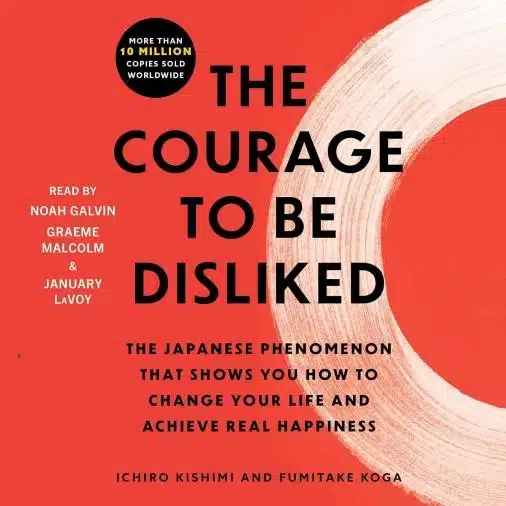
That ordinary moment gets at the question behind The Courage to Be Disliked by Ichiro Kishimi and Fumitake Koga. How much of what we call a personal choice is really an attempt to manage another person’s opinion? The book’s audiobook ranks No. 8 in the November 2026 New York Times Audio Advice, How-To & Miscellaneous category, according to Simon & Schuster’s bestseller roundup. Atria Books published the U.S. hardcover on May 8, 2018. Simon & Schuster’s audiobook listing reports that the book has sold more than 13 million copies worldwide.
What Is The Courage to Be Disliked About?
The Courage to Be Disliked introduces Alfred Adler’s Individual Psychology through five conversations between a philosopher and a young man. The young man arrives skeptical of the philosopher’s views and pushes back on his claims about happiness, relationships, and the influence of the past. His objections give readers room to consider where the ideas hold up and where they would ask a harder question.
The format grew out of the authors’ collaboration. Ichiro Kishimi is a Kyoto-born philosopher who writes and lectures on Adlerian psychology. Fumitake Koga, an award-winning nonfiction writer, became interested in Adler’s ideas in his late twenties. He visited Kishimi in Kyoto and took notes that helped shape the book’s dialogue. The result reads like a discussion you can join. When the young man asks how an idea could work in real life, you have a chance to form your own answer before the philosopher gives his.
What Does It Mean to Have the Courage to Be Disliked?
The title refers to accepting that other people may disapprove of a decision you have good reasons to make. Say your family expects you to follow a particular career path. You can listen to their concerns, research your options, and explain your decision honestly. You still have to decide whether you’re willing to choose a different path if they remain disappointed. In the book’s terms, that willingness is part of personal freedom.
The authors explore this distinction through the separation of tasks. The idea is to ask who is responsible for which part of a situation. You’re responsible for what you say, how you say it, and how you respond if someone raises a fair objection. The other person has their own judgment to make. At work, for instance, you can raise a concern about a project deadline and explain what you think would make it realistic. Your manager may disagree, but trying to predict whether they’ll approve of you can keep you from raising a problem they need to hear about.
The same distinction makes self-acceptance easier to understand. Suppose you work hard on a project and receive little recognition. It’s reasonable to want credit and to ask for feedback. You can also evaluate the work on its own terms. Did it solve the problem? What did you learn? What would you change next time? Those questions give you more information about your progress than guessing what silence means.
What Adlerian Psychology Says About the Past and Personal Change
One of the book’s sharper disagreements concerns how much authority we give the past. The philosopher asks the young man to examine whether earlier experiences have become the only explanation he considers for what he does today. That argument shifts the conversation toward present choices and the possibility of change, a central theme in the authors’ treatment of personal development and happiness.
Consider someone who was mocked after speaking up in class and now stays quiet in meetings. The earlier experience helps explain the hesitation. The book’s approach also invites a question about what staying quiet accomplishes today. It may spare the person an awkward exchange, while also keeping a useful idea out of the discussion. Seeing both effects opens up a more specific choice. The person could share one point in a small meeting and see what happens, with room to reconsider how and when to speak up again.
Building Relationships Without Constant Competition
Social comparison can change what we hear when a friend shares good news. A promotion becomes a reminder that we’re still waiting for one. A classmate’s success starts to feel like evidence that we’re falling behind. Once every achievement becomes a ranking, even people we care about can start to feel like rivals.
Adler’s concept of community feeling, also translated as social interest, puts belonging and cooperation at the center of how we relate to others. In the book, that idea complicates the pursuit of personal freedom in a useful way. You can care about what happens to someone without needing their approval. In a friendship, that might mean congratulating someone on a promotion and later talking honestly about your own frustration. Both experiences have room in the relationship.
Why the Five Conversations Are Worth Reading
A short explanation can make the separation of tasks sound simple. The dialogue gives the young man time to ask the questions that make it difficult. What happens when the person you might disappoint is someone you love? How do you take criticism seriously without letting it decide what you do? Those tensions are part of the reading experience. The book gives you two voices to think alongside, and your sympathies may shift depending on which problem they’re discussing.
The audiobook preserves that conversational structure, with Noah Galvin, Graeme Malcolm, and January LaVoy credited as narrators. Whether you read or listen, try bringing one recent decision to the discussion. Think of a time you changed your mind after hearing someone else’s opinion. What did you learn from their reaction, and how much of the change came from wanting to keep their approval? The two can be hard to separate, which is precisely why the young man has more questions for the philosopher.
Explore the Book and Its Authors
🔗 For Amazon (Audible Audiobook): Click here
🔗 For the Official Book Page: Click here
🔗 For the Official Audiobook Page: Click here
🔗 For Ichiro Kishimi’s Author Profile: Click here
🔗 For Fumitake Koga’s Author Profile: Click here
Source: Simon & Schuster’s New York Times bestseller roundup, November 2026 Audio Advice, How-To & Misc. chart. Read more at SimonandSchuster.biz.